Manipur- The Valley That Split In Two
How a court order, two armed communities, a broken government, and a multi-million-dollar shadow economy combined to push an Indian state to the edge — and why nobody in power moved to stop it.

The Order
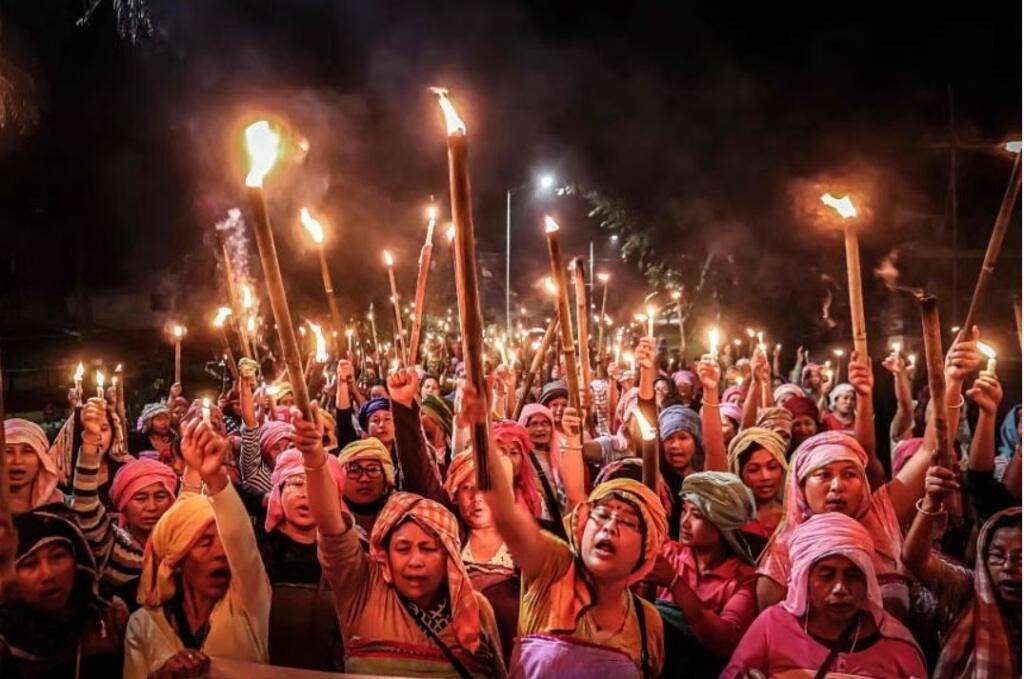
On March 27, 2023, a single-bench order of the Manipur High Court directed the state government to respond within four weeks to the Meitei community’s long-standing petition for Scheduled Tribe status, and to consider forwarding their claim to the Union government for deliberation. The order did not grant ST status. It did not even formally recommend it. What it did was validate the petition’s standing, give the demand institutional momentum, and, in the hills of Manipur land with the force of a judgment already delivered.
To understand why, you need to understand what Scheduled Tribe designation actually confers. It is not symbolic recognition. It is a legal architecture of protection: reserved seats in government employment, reserved places in higher education, and most consequentially access to land ownership rights in constitutionally protected hill areas. Manipur’s hill districts are governed under the Manipur (Hill Areas) District Councils Act, 1971, and parallel state land laws that explicitly restrict the sale and transfer of hill land to non-tribal peoples. These provisions were constructed for communities living in precisely the kind of precarious geography that the hills of Manipur represent: remote, resource-rich, chronically underserved, and surrounded by more powerful groups with more capital and more political weight.
For the Kuki-Zo peoples of the surrounding hills, those land protections were not bureaucratic abstractions. They were the last legal wall between their territory and encroachment. The Meitei community, predominantly Hindu, valley-dwelling, numerically dominant constitute roughly 60 percent of Manipur’s population but occupy approximately 10 percent of the state’s land area: the Imphal valley and its basin. The hills, covering 90 percent of the territory, are home to the Naga and Kuki-Zo tribal communities, who comprise roughly 40 percent of the population. This is the foundational asymmetry of Manipur’s political geography. It has never been resolved, only managed, and poorly.
The Geography That Drives Everything: Forty of Manipur’s 60 state assembly constituencies lie in the valley, giving the Meitei community structural legislative dominance regardless of coalition politics. The hills hold 90 percent of the land but return only 20 seats. Any policy that extends valley-based community rights into the hills therefore bypasses normal democratic correction — the valley simply outvotes the hills, always, on every issue where their interests diverge. This is not a new problem. It is the architectural problem of Manipur, and every crisis the state has experienced traces back to it in some form.
The Meitei’s ST campaign was not new. Their advocates argued, with some historical basis, that pre-colonial administrative records showed them classified as a tribal community before British land surveys reclassified them. But context matters more than genealogy in these disputes. The Meitei dominate Manipur’s valley civil services, its business economy, and its political institutions. They have legislative dominance by arithmetic. To the Kuki-Zo, extending ST protections to this already-dominant group was not corrective justice. It was the judicial endorsement of a land grab conducted in slow motion. The constitutional barrier that kept Meitei capital out of the protected hills would dissolve. Their territory, always coveted, never fully secure, would become legally accessible.
The court order was experienced as existential. That word is overused in political coverage. Here, it is the only accurate one.
The Pressure Vessel
Between March 27 and May 3, 2023, a period of approximately five weeks, Manipur did not erupt. It pressurised.
The All Tribal Student Union Manipur called for protests within days of the order. Rallies spread across hill districts. The sense of threat was real, collective, and communicated with the velocity of a society already primed for conflict. Manipur had not been at peace in any meaningful sense for decades. Its insurgency ecosystem — multiple armed organisations operating across ethnic lines, some in ceasefire negotiations with New Delhi, others not — meant that weapons, organisational capacity, and the grammar of collective violence were already embedded in the social landscape. The state was not a blank slate onto which a court order wrote its provocation. It was a pressure vessel that had been filling for years.
What the March order did was provide a single legible grievance capable of unifying fragmented Kuki-Zo anxieties into a common cause. Five weeks is long enough for a serious mobilisation to organise. It is also long enough for a competent state government to intervene — to convene stakeholders, issue clarifications, seek a stay, or at minimum signal that it understood the alarm. There is no documented evidence that Chief Minister N. Biren Singh’s government did any of these things with genuine urgency.
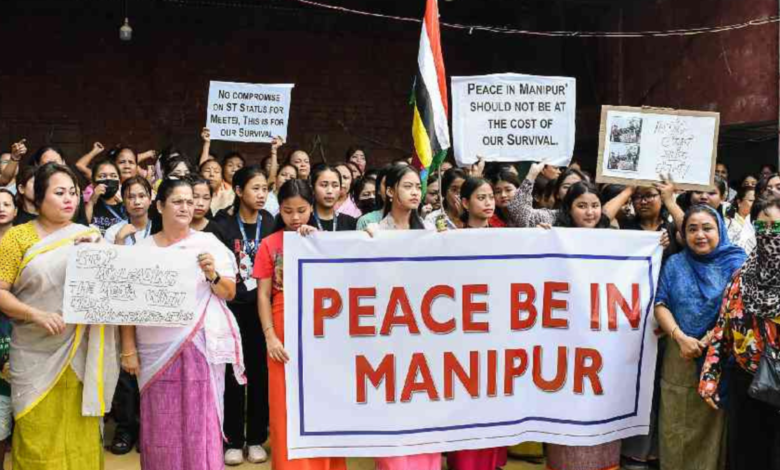
On May 3, 2023, tribal solidarity rallies took place across the hill districts, most prominently in Churachandpur. As marchers moved through a landscape already taut with rumour and counter-rumour, violence broke out. It spread to the valley within hours. Churches were burned. Houses were torched. People were killed. Two Kuki-Zo women were paraded naked through a village in the valley — a video that would surface publicly two months later, producing a moment of national outrage whose intensity was itself an indictment: so little attention had this crisis received that it took a single viral video to make the country look.
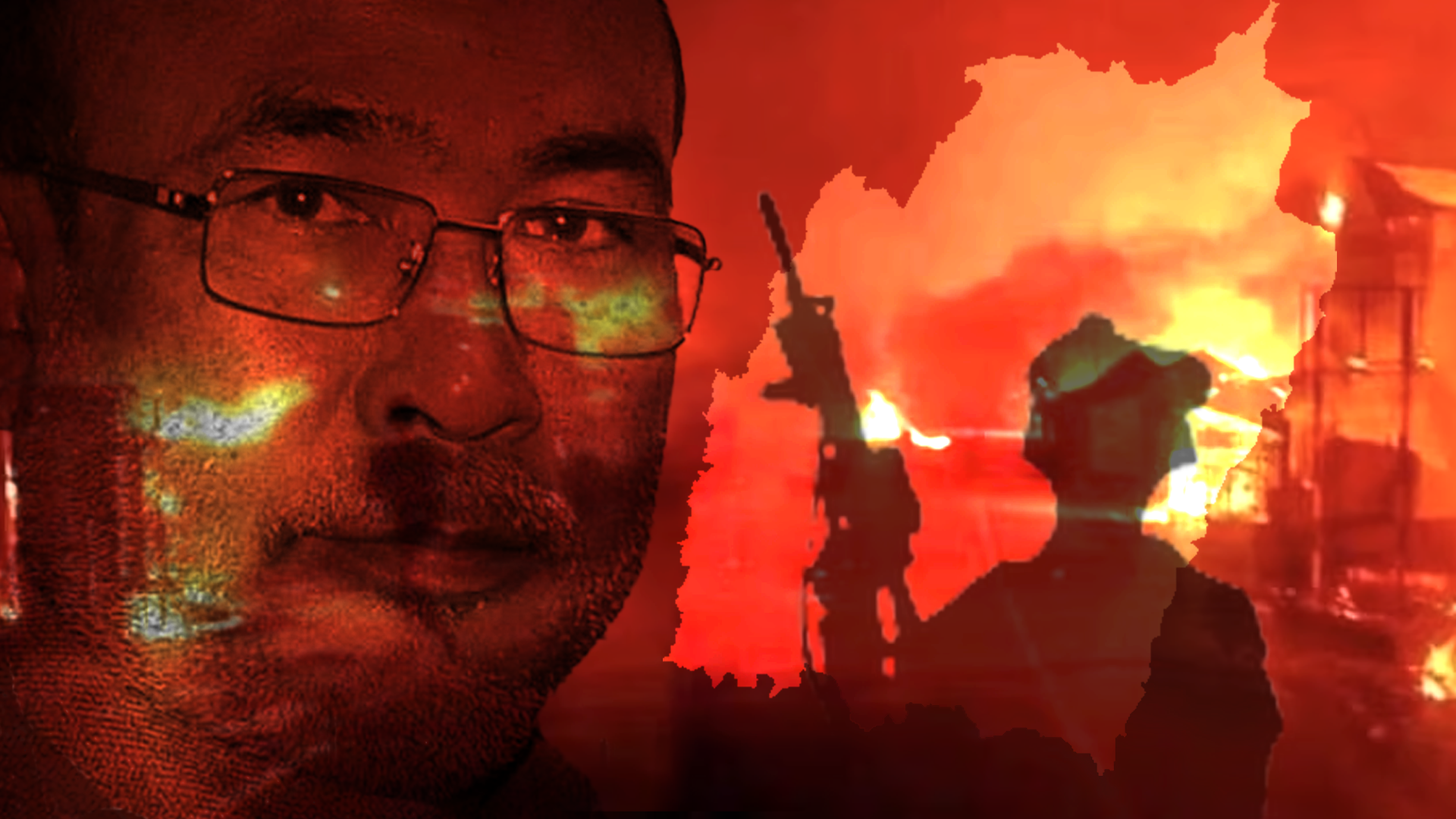
By the end of the first week of May, the shape of the catastrophe was clear. This was not a riot with a beginning and an end. It was a partition, not of territory on a map but of a society along ethnic lines, enforced by violence and cemented by fear. Neighbourhoods emptied. People fled toward the safety of their own community’s geography. The valley and the hills, always distinct worlds, became separated by something closer to a front line. The Indian state had, in the space of a week, allowed one of its northeastern territories to fracture in a manner it has spent decades insisting is impossible in Kashmir.
The Political Machine
You cannot understand May 3 without understanding the political machine running in Manipur before it.
Chief Minister N. Biren Singh’s BJP government had, in the years preceding the crisis, developed a relationship with Meitei nationalist organisations that crossed a line most democratic governments are careful to avoid. Two organisations in particular: Arambai Tenggol, whose cadre strength has been estimated by journalists and security analysts at somewhere between 30,000 and 60,000 members — a figure the organisation itself has claimed at the higher end, though no independent verification exists — and Meitei Leepun, reported by multiple outlets to number in the low tens of thousands.
Both organisations occupied a deliberately ambiguous space: nominally civil society bodies rooted in cultural revivalism, operationally paramilitary. Politicians appeared on their platforms. Weapons appeared in their hands. Their stated vision of Manipur — Meitei territorial primacy, extending into the protected hills — aligned precisely with the political direction the state government was moving.
When the violence came, these organisations were not bystanders. In late 2023, audio recordings emerged in which a voice identified by multiple forensic analyses as that of N. Biren Singh appeared to describe facilitating or coordinating attacks on Kuki villages. Singh denied the recordings’ authenticity and their characterisation. The National Forensic Science Laboratory (NFSL/NFSU), tasked by the Supreme Court, has reported that the tapes were “modified, edited, and tampered with” and therefore not scientifically fit for conclusive voice comparison.
They were not dismissed, not by the media organisations that published them, not by the Supreme Court of India that received briefings on their content, and not by the human rights investigators who cited them in formal reports. What was not forthcoming was a prosecution. No First Information Report was lodged against the Chief Minister. The investigation proceeded at the pace of an institution that had already decided not to be in a hurry about where it was going.
Singh survived. He survived the initial crisis, survived months of Supreme Court scrutiny, survived the rage of a state that had been de facto partitioned under his administration. He survived because his survival served the interests of a political machine larger than Manipur. The BJP’s central leadership, which possesses the constitutional instrument of President’s Rule and has deployed it in far less dramatic circumstances in other states, chose not to use it here. For months through the summer of 2023, while the Supreme Court expressed increasingly pointed alarm, the central government’s response was to deploy the Army as a buffer and wait.
The Human Cost (figures sourced from government affidavits and official commissions): 258 people officially confirmed dead. Approximately 60,000 estimated displaced. 4,786 homes burned or destroyed. 386 religious structures vandalised.
Singh resigned on February 9, 2025, not because accountability caught up with him but because arithmetic did. The BJP had lost both of Manipur’s parliamentary constituencies to Congress in the 2024 general election. A no-confidence motion was imminent in the state assembly. He left as a political calculation. Not a single senior official or militia leader was successfully prosecuted for the events of May 2023 or any subsequent violence. As Amnesty International formally stated, his departure was not justice for the victims. It was an exit. The distinction must be held in the mind carefully and not permitted to blur.
The Bunker Economy
We think wars are fought by governments. In the hills of Manipur, they are being fought by crowdfunding.
In early 2025, the Indian Army identified and demolished a network of concrete military-grade bunkers in the hill districts — fortifications with no legitimate civilian purpose, engineered to withstand sustained armed assault. Within hours of the demolition, local communities began rebuilding. Not symbolically. Structurally. Concrete was sourced, labour was mobilised, contributions were pooled from within the community. The bunkers went back up.
This is what state failure looks like from the inside: not chaos, but a rival order. When a government cannot protect you, protection becomes a private enterprise. Communities do not dissolve into helplessness — they construct parallel institutions, parallel economies, parallel armies. The bunkers are not anomalies in Manipur’s current landscape. They are its most honest expression of what has been lost.
To understand what the conflict is actually being fought over, you have to be willing to look past the ethnic framing — not to dismiss it, because the Kuki-Zo and Meitei grievances are real and historically grounded, but to recognise that they coexist with a material war over extraordinary economic stakes.
The hills of Manipur and the adjoining regions of Myanmar sit atop one of the most lucrative unregulated economies in Asia: the opium and synthetic drug trade running through the Golden Triangle’s northwestern corridor. Poppy cultivation in the Manipur-Myanmar border belt has expanded substantially over the past decade, accelerated by the collapse of agricultural alternatives and, since the 2021 Myanmar coup, by the effective disappearance of state law enforcement on the Myanmar side of the border.
The Poppy Economy: The Manipur hills and the Sagaing region of Myanmar together form a significant node in the methamphetamine supply chain moving toward South and Southeast Asian markets. Narcotics Control Bureau and state police seizures in Manipur have increased year-on-year since 2020. The trade does not merely fund armed groups — it structures their incentives. A ceasefire that ends the conflict also ends the permissive security environment that makes large-scale drug transit possible. For those who profit from both, instability is not a problem to be solved. It is the operating condition.
Control of the hill territories means influence over transit routes, cultivation zones, and the conversion networks that turn agricultural product into pharmaceutical profit at industrial scale. Militia groups operating in this conflict do not draw clean distinctions between ethnic protection and economic protection. In a shadow economy, they are the same claim, defended by the same people with the same weapons, financed by the same supply chain. Any peace settlement that does not address this underlying economy will not hold — because too many actors on both sides have a material interest in the conflict’s continuation. When war becomes a business model, peace is a competitive threat.
The Fractured State
The fracturing of the state’s monopoly on violence was not metaphorical. It was documented, itemised, and placed before the Supreme Court of India.
In the first days of the May 2023 violence, police armouries were raided across the valley. Thousands of weapons — service rifles, carbines, pistols, and substantial quantities of ammunition — disappeared into the crisis. The official characterisation was looting. The evidence assembled by journalists, human rights monitors, and the Supreme Court’s fact-finding pointed toward something more deliberate: in multiple documented instances, state police personnel appear to have facilitated the transfer of government weapons to civilian militias aligned with their own ethnic community. The doors, as multiple sources put it, were opened from the inside.
Manipur’s police force split — not in any policy document, but functionally and with brutal clarity. Officers from the hill districts stopped reporting to valley-based command structures. Officers from the valley stopped operating in hill areas. The institutional apparatus of the state, in the single domain where state authority is most foundational — the legitimate use of force — dissolved along the same fault lines that the violence had carved through the rest of civil society. When state police are distributing government weapons to ethnic militias, the government has not merely lost control of the situation. It has lost its claim to be the government in any meaningful functional sense.
What replaced it was not anarchy but a tiered system of private security. Community defence volunteers. Militia checkpoints on roads that were once administered public infrastructure. Arambai Tenggol operating openly as a territorial force. Against them, Kuki-Zo village defence units with their own organisational chains, some connected to insurgent groups simultaneously in ceasefire negotiation with the central government — negotiations that continued, with a kind of administrative surrealism, even as those groups’ affiliated communities were being killed and their homes were being burned.
The central government’s response was to deploy the Army and the Assam Rifles, creating buffer zones along the ethnic fault lines. These zones — military-controlled corridors separating the valley from the hills — function in practice as a ceasefire line inside a sovereign Indian state. New Delhi has maintained a muscular posture on territorial integrity in Kashmir for decades, deploying enormous military and political resources against the very concept of internal partition. In Manipur, partition was quietly administered from above and dressed in the language of peacekeeping. The contradiction has never been publicly addressed.
The Border and What Crosses It
New Delhi rarely says this plainly in formal diplomatic communications, but the weapons fuelling the Manipur conflict are not, in significant measure, made in India.
Manipur shares approximately 390 kilometres of border with Myanmar, one of the most difficult frontiers to monitor in Asia, running through forest and hill terrain that no reasonable number of border personnel could effectively cover. It is crossed daily by people, goods, and weapons in proportions that no official trade data captures and no border agency has the capacity to intercept comprehensively.
The Myanmar military’s 2021 coup and the subsequent civil war that it ignited fundamentally destabilised the border’s informal management systems. Armed groups on the Myanmar side — both pro-junta forces and the diverse coalition of resistance militias — developed interests in the Manipur situation that ranged from opportunistic arms sales to more deliberate strategic positioning, using the Indian border zone as sanctuary and staging ground.
Weapons of Chinese manufacture — assault rifles, thermal imaging optics, and in documented cases commercially available drones repurposed for military reconnaissance — have been recovered in Manipur in sufficient quantities and with sufficient pattern consistency that Indian security analysts no longer treat it as coincidental. The specific models correspond to weapons documented circulating in Myanmar’s active civil war theatre. The supply chain is not mysterious to those with professional visibility into it. It is an open operational secret that becomes classified the moment it requires New Delhi to make a formal diplomatic accusation it is not prepared to sustain against Beijing.
Whether this constitutes deliberate Chinese strategic interference — using the border conflict to keep India’s northeast destabilised and distracted — or whether it is primarily market dynamics (weapons flow toward active conflicts with money behind them, regardless of the ideological preferences of their manufacturers) is a question the evidence does not definitively settle. What is documentable is the effect: an Indian state with a fractured police force, divided civil society, and collapsed civilian governance is being armed from outside its borders. The central government’s studied silence on this point is not a neutral position. It is a policy choice, and it has costs.
The Architecture That Failed
What failed in Manipur was not one government or one man. It was a layered system of accountability that was supposed to prevent exactly this, and did not.
The Manipur High Court issued an order without adequate assessment of its political and territorial consequences — or, which is worse, with adequate assessment and indifferent regard for them. The state government allowed five weeks to pass between the order and the violence without meaningful intervention, while organisations with documented paramilitary capacity and political proximity to the ruling party prepared for confrontation. The central government — with both the constitutional authority and the intelligence apparatus to have seen this trajectory — chose inaction for months, then chose military deployment not to restore civilian governance but to freeze the conflict in its existing shape.
The Supreme Court became the most active institutional respondent — taking suo motu cognisance, issuing directions on victim compensation, special investigation teams, and armoury recovery. But courts are not executives. They cannot by judicial direction restore displaced persons to their homes, disarm militias, or compel a chief minister to govern. They can observe, direct, and express the kind of measured alarm that eventually appears in judgments that the executive branch accepts and does not implement on any timeline that matters to the people waiting in relief camps.
The Supreme Court’s Role: The court’s suo motu proceedings (Writ Petition Criminal No. 44 of 2023) became the primary forum for accountability in the absence of effective executive action. The court appointed a committee of retired women IPS officers to assess relief and rehabilitation; issued directions on FIRs related to the assault video; and repeatedly sought compliance reports from a state government that submitted them with consistent delays. The court’s intervention was extraordinary. It was also a symptom of the failure of every institution that should have acted before the matter reached the judiciary.
What Manipur reveals, with the specific clarity that only a genuine catastrophe provides, is the gap between India’s constitutional architecture and its political reality. The constitution provides for President’s Rule when a state government has demonstrably failed — a provision exercised in considerably less dramatic circumstances in other states by the same central government that declined to exercise it here. The constitution guarantees equal protection under law regardless of community. That guarantee was suspended by the arithmetic of political loyalty, and the suspension has not been seriously addressed by any branch of government.
What Peace Would Actually Require
Stop counting in days. Start counting in years — and understand why even years may not be enough if the underlying conditions are not addressed.
The displaced persons in Manipur’s relief camps — tens of thousands, as of early 2025, some of whom have been in temporary shelters for nearly two years — cannot go home because home no longer means what it meant before May 3, 2023. The villages that Kuki-Zo families fled in the valley have been occupied or destroyed. The areas where Meitei residents lived near the hill borders have been emptied and reorganised by the logic of ethnic geography. Return requires not just physical safety but the restoration of a social contract that was not merely broken but deliberately, methodically, and in some cases officially incinerated.
Peace in Manipur would require, at minimum, four things that are each politically costly, institutionally demanding, and structurally connected. First, the credible prosecution of those responsible for the violence, across communities and regardless of political proximity — something that has not occurred, and without which any future peace settlement will be understood by its victims as an arrangement made over their heads.
Second, the disarmament of all civilian militias, including those with powerful political patrons — something that has been discussed repeatedly and not done, because doing it requires confronting the same political networks that allowed the militias to form in the first place.
Third, a negotiated constitutional framework for Kuki-Zo political aspirations — whether a separate district, a territorial council, or a new administrative arrangement — that does not indefinitely defer the question while the displacement hardens into permanent demographic change.
Fourth, a regional economic policy capable of offering the hill communities a legitimate alternative to the narcotics shadow economy, which requires a commitment of resources, political imagination, and sustained engagement that neither Imphal nor New Delhi has so far demonstrated the will to provide.
None of these is beyond the capacity of the Indian state. All of them require a sustained political commitment that has, at every critical juncture of this crisis, been systematically absent.
What has been provided instead is managed partition: ethnically separated territories held apart by military buffer zones, the slow rotation of relief camp populations through a bureaucracy with no clear plan for their return, and the resignation of a chief minister whose departure resolved nothing for the people whose lives were destroyed under his administration. The bunkers will be rebuilt. They always are, in the places where the state has made clear beyond reasonable doubt that it will not protect you. That is not paranoia speaking. In Manipur, after May 2023, it is engineering — the rational application of available resources to a problem that the state has declined to solve.
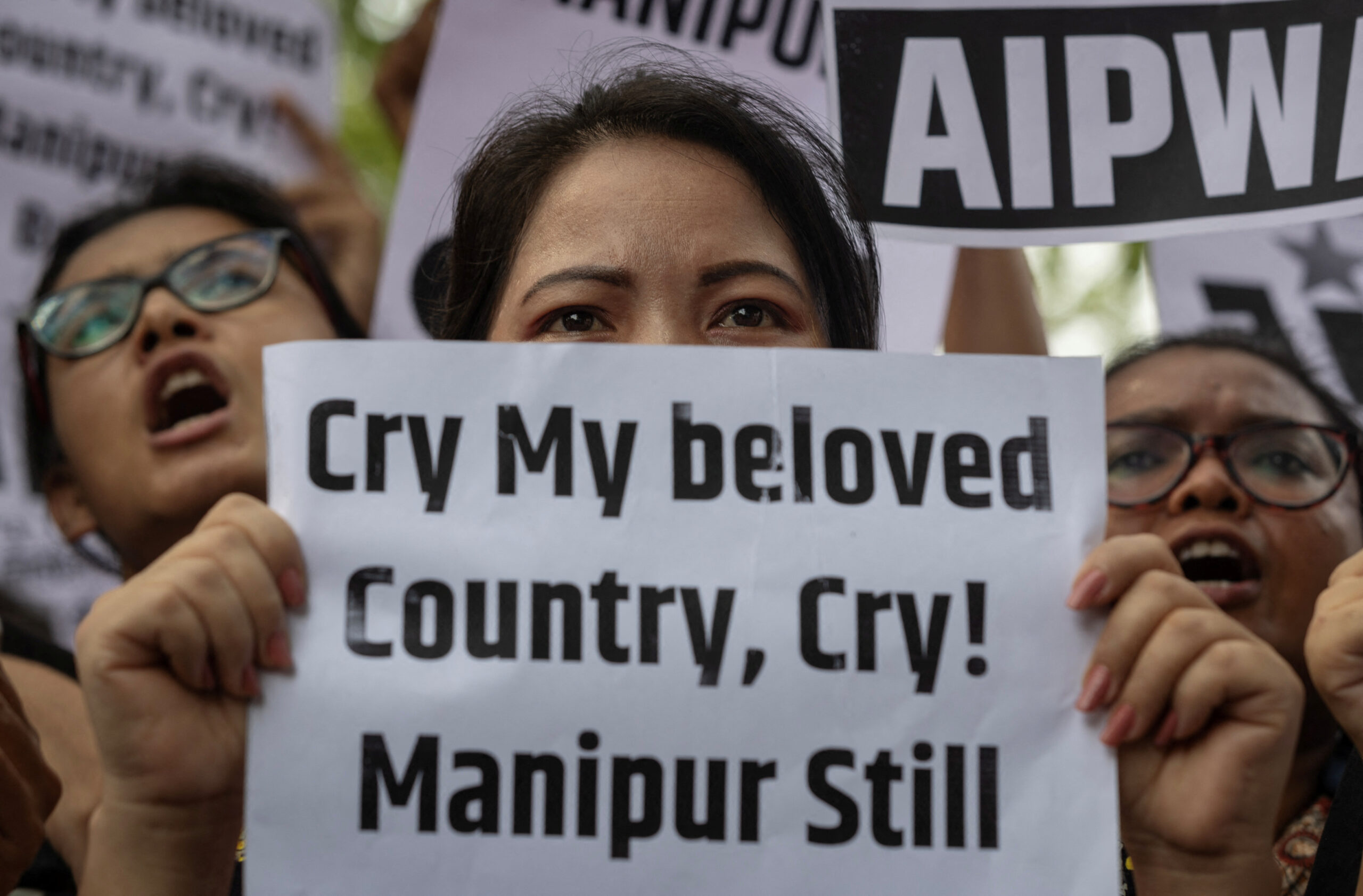
The valley and the hills remain, in every practical sense that matters to the people living in them, two countries administered under a single flag, held together not by governance or law or trust but by the presence of an army that has not restored peace so much as frozen a war in place and called it order. The monopoly on violence is broken. The bazaar of impunity is open for business. And the reckoning that the political system has declined to deliver is not going anywhere. It is simply accumulating interest.