How Blinkit’s Checkout Design Is Flouting MRP And Dark Pattern Rules?
Is Quick Commerce's Second-Biggest Player Running the Same Playbook as Zepto- A report into Blinkit’s handling fees, late-night charges, and whether India's dark pattern game is still on

The Rs 480 cigarette that cost more than Rs 480
Order a pack of cigarettes on a quick-commerce app, Blinkit, and the maximum retail price, the number printed on the pack, the number the Law says you cannot legally be charged more than, reads Rs 480. By the time the cart is confirmed, though, a small stack of line items has appeared beneath it: a handling fee, a late-night fee, a convenience fee, sometimes a “small cart” fee. None of them were visible when you added the product. All of them show up only once you’re a tap away from paying.
This is not a glitch. It is a pricing design, and as of December 2025, India’s consumer protection regulator has a name for it, a legal theory for why it’s illegal, and a penalty order to prove it, against Zepto. The question this piece asks is whether Blinkit, the country’s largest quick-commerce platform by order volume, is running a close cousin of the same design, and why, unlike Zepto, it hasn’t yet faced a formal finding.
What the CCPA actually found on Zepto?
On August 2026, the Central Consumer Protection Authority (CCPA) issued its final order against Zepto Marketplace Pvt. Ltd., fining it Rs 7 lakh, the largest single penalty among nine platforms punished in a coordinated crackdown that also caught IndiGo, BookMyShow, FirstCry, PharmEasy, SpiceJet, McAfee, Physics Wallah, and the coaching platform run by Anuj Jindal. Zepto’s fine was for two specific dark patterns: “drip pricing,” where handling charges were disclosed only late in the checkout flow, and “basket sneaking,” where a membership pass fee was pre-ticked and added to the cart without explicit consent.
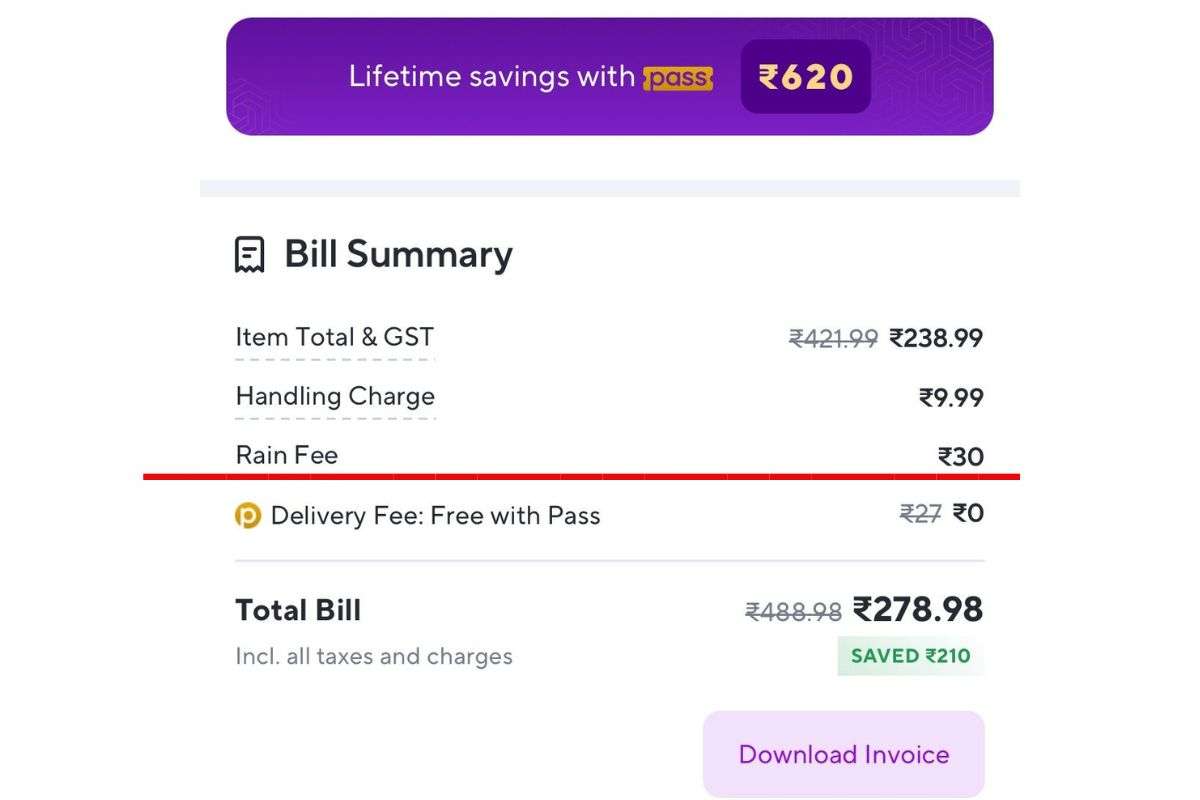
What makes the Zepto order significant isn’t just the fine, but it’s the legal reasoning behind it. Zepto argued that all its charges were shown before payment was finalised, and that the membership add-on could be removed with a single click. The CCPA rejected that defence outright. It held that showing a low headline price and then layering on mandatory charges at checkout amounts to indirectly bypassing the statutory ban on selling above MRP. In other words, the CCPA collapsed the distinction between a “deceptive interface” and an actual pricing-law violation, a checkout design that nudges the final payable amount above MRP is now, in the regulator’s view, the same offence as printing a fake MRP sticker.
Where Blinkit actually sits in this story
First, the LocalCircles disclosure gap. In November 2025, the consumer research platform LocalCircles reviewed the self-audit declarations that 26 major e-commerce and quick-commerce companies were required to file with the CCPA after the regulator’s June 2025 advisory. It identified drip pricing, gradually adding mandatory fees through the checkout process, on 11 of those 26 platforms, and named Blinkit explicitly alongside Flipkart, Myntra, Zomato, BigBasket, MakeMyTrip and Cleartrip. Separately, LocalCircles flagged that Blinkit was among a handful of companies — alongside BigBasket, Zomato and Swiggy — that filed “especially minimal disclosures” in their self-audits.
LocalCircles founder Sachin Taparia’s underlying point was structural: the CCPA has no mechanism to cross-check these self-declarations against actual user experience, so a platform can declare itself dark-pattern-free without anyone verifying the claim. That is precisely the loophole Zepto exploited before its penalty — the government noted Zepto’s own self-audit had asserted it did not use dark patterns, right up until the CCPA found otherwise.
Second, the government’s own cash-on-delivery probe. In October 2025, the Department of Consumer Affairs, under Minister Pralhad Joshi, launched a formal investigation into e-commerce platforms after complaints surfaced about a checkout screen showing an “Offer Handling Fee,” a “Payment Handling Fee” and a “Protect Promise Fee” stacked on top of an advertised price. Joshi’s statement described this explicitly as a dark pattern that “misleads and exploits consumers,” and promised strict action against violators. That investigation was framed sector-wide, not against a single named platform, which means quick-commerce players generally, Blinkit included, are within its scope by definition of the practice it targets: multiple micro-fees revealed only at the point of payment.
Third, and this cuts the other way — an independent benchmarking report released in June 2026 that scored platforms on a “dark pattern” harm index estimated that there are hidden fees of Rs 25–100 per transaction, individually too small to trigger formal complaints, and these are quietly costing Indian e-commerce users an estimated Rs 28,000 crore a year in aggregate, and that a majority of quick-commerce users have lost money to subscription traps and basket sneaking somewhere in the sector.
Why the MRP question matters more than it sounds
It’s worth being precise about why “handling fee” and “convenience fee” charges are legally interesting rather than just annoying. The Law prohibits selling a packaged commodity above the MRP printed on it. Platforms have historically defended service charges like payment processing, delivery, night-time staffing, as separate from the price of the product itself, and therefore outside MRP rules altogether. That defence is exactly what Zepto ran, and exactly what the CCPA rejected.
The regulator’s position is that if these charges are mandatory, non-negotiable, and disclosed only after a consumer has already committed to the purchase psychologically, then the effect on the consumer’s wallet is indistinguishable from an MRP violation — regardless of what the fee is labelled internally. A “late night fee” on a Rs 480 pack of cigarettes that pushes the payable total to Rs 510 is functionally an MRP breach under this reasoning, whether or not the receipt calls it that.
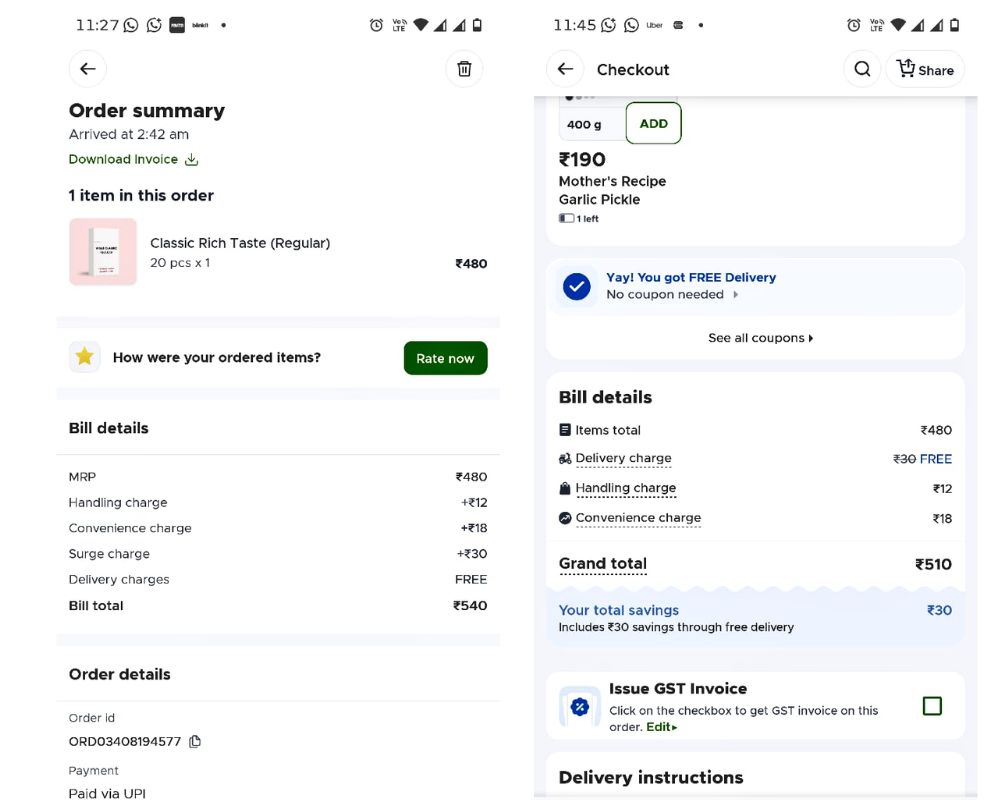
This is precisely why the government’s Dark Pattern Guidelines, 2023, and the June 2025 advisory matter beyond Zepto’s specific case. They give the CCPA a template it can now apply to any platform where the same checkout mechanics recur, and the mechanics here described (MRP shown at cart, extra fees appearing only at final payment) map closely onto what was penalized.
The self-regulation problem no one has fixed
The deeper story here isn’t really about any single company, but it’s about how thin India’s enforcement infrastructure still is. The CCPA’s own approach relies on platforms self-auditing and self-declaring compliance, with no independent verification process. The Internet Freedom Foundation has formally asked the CCPA for a public registry of self-audit statements precisely because there’s currently no way for an outside party to check a platform’s claims against reality. Zepto’s own “clean” self-declaration, filed months before its penalty, is the clearest illustration of why that gap is dangerous: a company can certify itself dark-pattern-free and be wrong, and nothing in the current system catches that until a regulator investigates independently or complaints pile up.
Blinkit’s “minimal disclosure” self-audit, flagged by LocalCircles, sits in exactly that same unverified space. It may genuinely reflect a cleaner checkout design than Zepto’s did. Or it may reflect the same self-grading problem that let Zepto declare itself compliant right up until the CCPA found otherwise. There is currently no independent way to know which is true — and that, more than any single fee, is the actual scandal.
What should happen next
The CCPA should extend the same MRP-violation framework it applied to Zepto to a formal review of Blinkit’s checkout flow, rather than waiting for a complaint volume threshold that individually small fees are designed to stay under.
Until Blinkit is investigated with the same rigor Zepto was, the honest answer to “is Blinkit doing the same thing” is: plausibly, on the available evidence, but not yet established, which in a market this size, moving this much money through fees this small, is precisely the kind of uncertainty regulators exist to resolve.