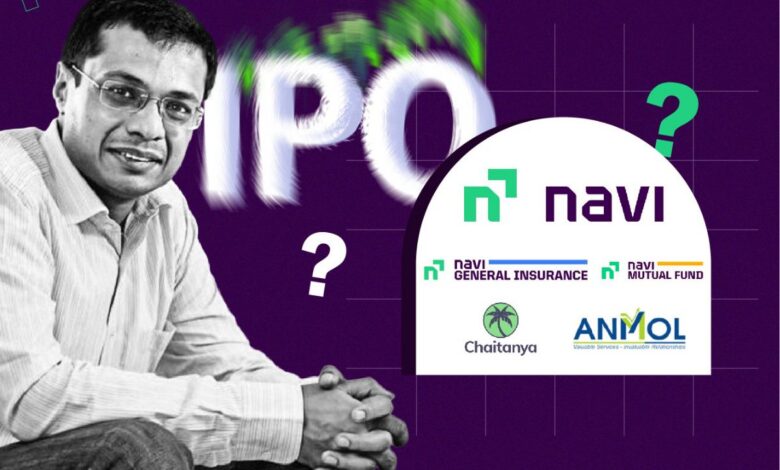
If you are looking at Indian fintech or digital lending names that might list in the next year or two, Navi (now Navi Limited) is one of the more interesting stories to understand. It is not a pure tech unicorn in the classic sense, nor is it a traditional bank. It sits in the middle as a digital-first financial services platform that offers personal loans, home loans, insurance, mutual funds and UPI payments.
What makes it stand out for investors is the unusual ownership and funding history: Flipkart co-founder Sachin Bansal has largely funded the company himself, keeping a very large majority stake. That changes the usual dynamics you see in venture-backed fintechs. The company has also faced a high-profile RBI lending ban, swung from profit to loss and back, and is now preparing for a second attempt at an IPO after the first one in 2022 never launched.
Company Basics: What Navi Actually Does
Navi was founded in 2018 in Bengaluru by Sachin Bansal and Ankit Agarwal (who previously worked at Bank of America). Bansal is best known as one of the co-founders of Flipkart. After selling his stake in Flipkart, he put a large amount of his own capital into Navi. Reports indicate he has funded the company with roughly ₹4,000 crore of personal money over the years. At the time of the 2022 IPO filing, he held around 97% of the company. That level of founder ownership is rare in the Indian startup world and means external investors have had limited say so far.
The business model is digital-first financial services. The core products are:
- Unsecured personal loans (the biggest growth engine for many years)
- Home loans (a more recent and more secured push)
- General and health insurance
- Mutual fund distribution
- UPI payments
In August 2025 the company changed its name from Navi Technologies Limited to Navi Limited. The rename was intended to signal that it wants to be seen as a broader financial-services platform rather than just a tech or lending app.
From an general investor point of view, the important points are: heavy dependence on the founder’s capital so far, a mix of high-yielding unsecured loans and lower-yielding but stickier secured products, and a push into payments and insurance that could improve customer stickiness and reduce pure credit risk over time.
The First IPO Attempt in 2022 — Why It Never Happened
In March 2022 Navi filed its Draft Red Herring Prospectus (DRHP) with SEBI. The proposed IPO was for ₹4,020 crore. Of that, ₹3,350 crore was a fresh issue (new shares issued by the company to raise capital) and about ₹670 crore was a pre-IPO placement. Importantly, Bansal was not selling any of his own shares. The entire issue was meant to bring in growth capital.
SEBI gave its approval on 12 September 2022. Under normal circumstances the company would have gone ahead and opened the issue within a year. That did not happen.
The reason was straightforward market timing. Late 2022 was a difficult period for technology and fintech listings in India and globally. Interest rates were rising, global tech valuations were falling, and several high-profile Indian new-age IPOs (Paytm and Zomato being the most discussed examples) were trading well below their issue prices. Investor appetite for pure consumer-lending or high-growth fintech stories had cooled. Navi chose not to force the issue into a weak market.
SEBI approvals have a one-year shelf life. By around September 2023 the approval simply lapsed. The company raised money through non-convertible debentures (NCDs) instead and continued operations.
Around the same period, in mid-2023, Navi laid off nearly 200 employees across product and management teams. The company described it as a normal performance-related exercise rather than a direct result of the stalled IPO. From an investor lens, the timing is still worth noting: when equity markets close, companies often tighten costs and shift to debt funding.
The RBI Lending Ban of October–December 2024 — The Biggest Stress Test
This is the event that most clearly tested the company’s resilience. Between 17 and 21 October 2024 the Reserve Bank of India barred four NBFCs, including Navi Finserv, from sanctioning and disbursing new loans. The ban took effect on 21 October, with a short window allowed for already-pipeline transactions.
The official reason was “material supervisory concerns” around pricing policies. Specifically, the RBI looked at the Weighted Average Lending Rate (WALR) and the interest spread these companies were charging over their cost of funds. The spreads were judged excessive and not in line with regulations. There were also issues with how household income and existing repayment obligations were assessed for microfinance-style loans, and non-compliance with the Fair Practices Code.
RBI Governor Shaktikanta Das had publicly warned NBFCs and microfinance institutions about chasing high equity returns through very high interest rates, processing fees and penalties. Detailed inspections of several NBFC-MFIs had taken place in the preceding quarter. Navi was one of the names that faced action.
Immediate impact: Navi Finserv cancelled a planned ₹100 crore bond issue. The RBI later allowed the company to complete already-sanctioned home-loan disbursals until the end of December 2024.
The ban was lifted on 2 December 2024 after Navi showed that it had improved its pricing, underwriting and compliance systems. One concrete change reported was a reduction in the maximum interest rate on unsecured personal loans from around 35% to about 26%.
After the ban was lifted, Navi Finserv raised more than ₹1,200 crore, including a large AAA-rated securitisation deal of ₹295 crore. That ability to return to the capital markets relatively quickly is a positive signal of restored confidence among lenders and investors.
From an investor’s perspective, the RBI action highlights the regulatory risk that sits over every Indian NBFC that grows fast on unsecured credit. High yields look attractive in good times but can attract supervisory attention when the central bank decides that consumer protection or systemic risk needs tighter control. The speed of the lift and the subsequent fundraising suggest Navi treated the episode seriously and made the required changes.

Beyond the ban there have been smaller but still relevant issues:
- In February 2026 the RBI imposed a monetary penalty of ₹3.80 lakh on Navi Finserv for recovery-agent call timing violations (contacting borrowers outside the permitted 8 AM–7 PM window). The amount is small, but it shows ongoing scrutiny of recovery practices.
- Around January 2025 there were reports of scammers defrauding Navi Technologies of ₹14.26 crore. Fraud risk is real in digital lending and payments.
- Financial results have been volatile. In FY24 the company reported a profit of ₹358.5 crore, helped by a one-time ₹189.5 crore gain from selling its microfinance subsidiary Chaitanya India Fin Credit. In FY25 it swung to a net loss of ₹126 crore even though revenue grew about 18% to roughly ₹2,565–2,690 crore. Finance costs rose sharply (around 21%) as the loan book was funded more with debt.
- The NBFC arm, Navi Finserv, saw consolidated net profit fall 46% year-on-year to ₹93.3 crore in FY26 while operating revenue rose 17%.
These points matter because they show that growth in the loan book does not automatically translate into steady profits. Higher leverage and funding costs can squeeze margins quickly, especially when interest rates or regulatory caps change.
Positive Developments and the Path Back to Growth
After the RBI ban, Navi moved to rebuild momentum. By mid-2026 monthly loan disbursals were reported in the ₹3,000–4,000 crore range. The loan book scaled back up. One July 2026 report indicated the company returned to profit with a net profit of around ₹292 crore for FY26, alongside continued double-digit revenue growth.
Other constructive steps include:
- Naming as one of India’s new unicorns in 2025.
- Launch of a “Credit Line on UPI” in partnership with Karnataka Bank.
- Integration of Navi UPI with the ONDC Network for metro ticketing in Delhi, Mumbai and Bengaluru (November 2025).
- Large securitisation deals involving Goldman Sachs and Aye Finance.
- Raising close to ₹16,000 crore since April 2025 across debt and equity instruments, including a ₹170 crore debt round in July 2025.
- A strategic shift toward a more balanced loan book (targeting roughly 50-50 secured and unsecured over three to five years). The home-loan segment has reportedly reached break-even.
/entrackr/media/post_attachments/wp-content/uploads/2022/09/navi.jpg)
Most notable from an ownership and valuation angle: in 2026 Navi is in advanced talks for its first meaningful external equity round, potentially led by Dutch investor Prosus (possibly with Accel Growth Fund). Valuation discussions have been in the $1.7–2 billion range (enterprise value around ₹13,000 crore). Until now Bansal had funded almost everything himself. Bringing in a large external investor at this stage is a clear signal that the company is preparing for public markets and wants institutional validation of its valuation.
The Second IPO Attempt — Status as of August 2026
Sachin Bansal had indicated as early as April 2025 that the company was looking at a listing in FY26. Guidance later shifted to filing draft papers in the January–March quarter of FY27.
The most recent development came on 13 August 2026: Navi is preparing to formally start the IPO process and is targeting a raise of up to ₹30 billion (approximately $314–315 million). It has appointed JM Financial, Kotak Mahindra Capital, Goldman Sachs and JPMorgan Chase as advisers. The target valuation is up to $2 billion.
Unlike the 2022 attempt, this offering may include both a fresh issue and an offer-for-sale component (final structure not yet locked). It is also expected to come after, or in close proximity to, the Prosus-led pre-IPO equity round.
The company has survived a stalled IPO, a lending ban, a swing into loss and public scrutiny of its interest rates. It has also shown the ability to cut rates when required, raise large amounts of debt after the ban, expand product offerings and attract serious external equity interest for the first time.
Whether that trajectory is enough for a successful listing at the targeted valuation will depend on the financials it presents in the forthcoming DRHP, the interest-rate environment at the time of the issue, and how cleanly it navigates ongoing RBI oversight.
For now, Navi remains a private company with a clear intention to go public. The next six to twelve months of disclosures, the outcome of the Prosus discussions, and the actual IPO structure will give investors the clearest data points yet. Keep an eye on those rather than on speculative claims that the company is already listed. The story is still being written, and the numbers that matter most are still ahead.