Why Roop Kishore Madan & Bela Madan Incorporated Dubious Web Of Shell Companies In The Name Of Secretary Chhavi Sharma Das
Each And Every Company Owned & Operated By Roop Kishore Madan & Bela Madan Must Be Investigated Deeply & Throughly

The Shadow Network: How Roop Kishore Madan and Bela Madan Built a Web of Companies Around Their Long-Serving Secretary
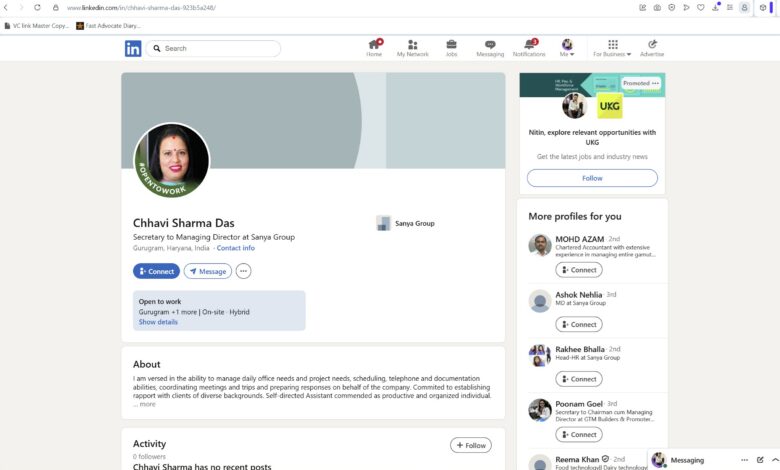
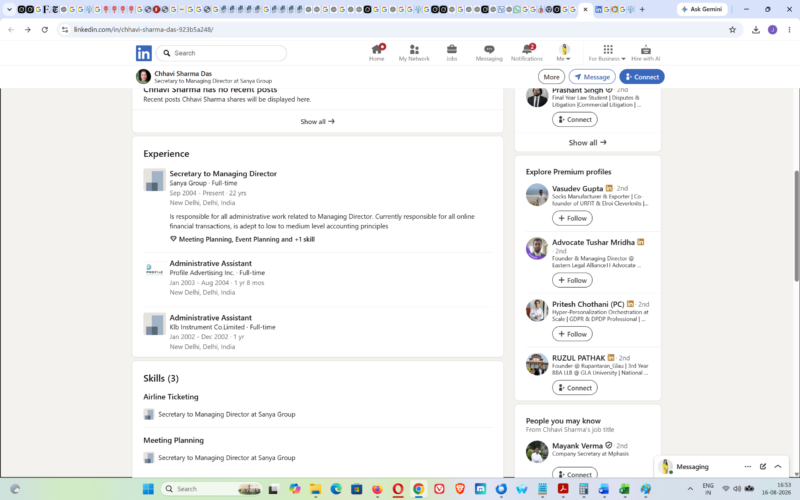
In the opaque corridors of Delhi’s private limited company ecosystem, names appear and disappear on board lists with the fluidity of paperwork rather than the weight of real ownership. One name that surfaces with striking consistency across a cluster of Sanya-linked entities is Chhavi Sharma Das, DIN 03558730. Public records show her as a director—current or historical—in twelve companies. LinkedIn, however, presents a very different picture: a career administrative professional who has served as Secretary to the Managing Director of Sanya Group since September 2004—more than twenty-two years of continuous service handling scheduling, documentation, meeting coordination, and “all online financial transactions” with only “low to medium level accounting” competence.
This is not a coincidence of names. It is a pattern. And the pattern centres on two recurring figures: Roop Kishore Madan (DIN 00656697) and Bela Madan (DIN 00656730). Kindly check the profile of Chhavi Sharma Das At https://www.linkedin.com/in/chhavi-sharma-das-923b5a248/
The Core Contradiction
Chhavi Sharma Das’s professional identity, as she herself presents it, is that of a trusted executive assistant. She manages the Managing Director’s administrative universe. She is proficient in office systems, Microsoft Office, and routine financial processing. She is not described as a promoter, investor, strategic decision-maker, or capital contributor. Yet from August 2015 onwards, her name was inserted into the boards of multiple companies that form part of, or sit adjacent to, the Sanya Group orbit.
The appointments were not gradual. A significant cluster occurred on or around 1 August 2015:
- Spirit Promoters Pvt. Ltd.
- Sanya Trading Pvt. Ltd.
- Sanya Telecommunications Pvt. Ltd.
- Sanya Mobile Pvt. Ltd.
- Sanya Holding Pvt. Ltd.
- Horizon Info Solutions Pvt. Ltd.
- Roop Travels Pvt. Ltd.
- Blossom Info Solutions Pvt. Ltd.
Additional, extremely short-lived appointments followed in 2017 (Hermes Clean Energy Solutions and Hermes Global Holdings—both lasting roughly one day) and a same-day entry-and-exit in AIMS Sanya Developers on 12 August 2015.
In several of these companies, the transition was almost surgical. Roop Kishore Madan ceased or reduced his visible board presence on the same date Chhavi joined. Bela Madan remained a constant co-director in the core Sanya entities. Sanjay Thukral appears repeatedly as another overlapping director. The result is a dense, interlocking network in which a long-serving secretary sits on boards alongside the Madans and their associates.
The Scale of the Structure
These are not shell companies of negligible size. Bullion Infra Structure Pvt. Ltd., for example, carries authorised capital of approximately ₹12 crore and paid-up capital approaching ₹10 crore. Horizon Info Solutions has maintained a multi-director board over many years. Several entities remain active; others have been struck off. The common thread is not business activity visible to the public; it is the repeated appearance of the same small group of names—Bela Madan, Roop Kishore Madan, Sanjay Thukral, and the secretary.
Public director databases (Zauba, Tofler, and others) consistently show Bela Madan and Chhavi Sharma Das as the two-person board in Spirit Promoters, Sanya Trading, and Sanya Holding. In Bullion Infra Structure the board has included both Roop Kishore Madan and Chhavi. In the Hermes pair, Roop Kishore Madan and Annat Jain appear as the continuing directors after Chhavi’s one-day tenure ended.
This is not organic growth of independent businesses. It is a constructed lattice.
Why Place Companies in the Name of the Secretary?
The most charitable explanation is administrative convenience or trust. A secretary who has handled the Managing Director’s affairs for more than a decade, including online financial transactions, is a known quantity. Appointing her as director may simplify paperwork, ensure someone reliable is available to sign routine filings, or provide continuity when principal directors travel or face other constraints.
But that explanation collapses under scrutiny when examined against the broader pattern.
First, the concentration of appointments on a single date in August 2015 suggests deliberate restructuring rather than organic need. Second, the extremely short tenures—same-day cessation in AIMS Sanya Developers and one-day stints in the Hermes companies—serve no plausible operational purpose for a genuine working director. They are consistent with the temporary use of a name to meet formal requirements or to facilitate a transition. Third, the continued presence of Bela Madan as the enduring co-director in the core active companies indicates that real continuity of control remained with the Madan side of the network. Fourth, the LinkedIn profile itself never discloses any directorships. The public professional identity remains that of an administrative assistant, while the legal identity on MCA records is that of a multi-company director.
In Indian corporate practice, the use of trusted employees, relatives, or associates as nominee directors is a well-documented method of creating distance between beneficial owners and the formal face of companies. It can serve legitimate purposes (privacy, operational flexibility). It can also serve less transparent ones: layering ownership, complicating beneficial-owner identification, facilitating related-party arrangements, or maintaining control while diluting visible concentration of power. The data available here does not prove illicit intent. It does, however, reveal a structure that is difficult to justify on purely commercial or governance grounds.
Roop Kishore Madan appears as both a historical and, in some cases, current director across the network. Bela Madan is the most persistent co-director with Chhavi in the active Sanya entities. Together they form the recurring poles around which the companies revolve. The secretary’s name functions as a connecting node—present enough to satisfy formal requirements, yet never presented as a principal.
Opacity as a Feature, Not a Bug
The public record itself is imperfect. Aggregator databases are not always synchronised with the latest MCA filings. Some show Chhavi’s DIN as active; others indicate deactivation. Board compositions in third-party sites sometimes reflect older snapshots. These inconsistencies do not erase the pattern; they amplify the opacity. Anyone seeking to understand who truly controls these companies must move beyond director lists to annual returns (MGT-7), shareholding patterns, PAS-3 allotments, DIR-12 filings, charge documents, and Significant Beneficial Owner declarations. Until that deeper layer is examined, the visible structure remains a web of overlapping directorships centred on the Madans and their long-serving secretary.
What is already clear is the asymmetry of power and presentation. One side of the relationship has decades of continuity as the administrative backbone of Sanya Group and simultaneous legal presence on multiple boards. The other side—Roop Kishore Madan and Bela Madan—appears as the enduring, recurring directors whose names define the network. The companies exist. The appointments happened. The timing clusters. The short tenures occurred. The professional identity of the secretary never publicly claimed the directorships.
This is the anatomy of a carefully constructed corporate lattice. Whether it is merely efficient internal management or something designed to keep beneficial ownership one step removed from public view is a question the formal records alone cannot fully answer. The pattern, however, is no longer hidden. It is documented across twelve companies, two decades of employment, and a handful of recurring names that refuse to leave the board lists.
The secretary’s name is on the papers. The architecture belongs to the Madans.