From Dark Patterns To Cash Burn: How Zepto’s Growth Machine First Hit Regulatory Check And Then Market Reality
Zepto Sold Speed, Lost Its 10-Minute Promise, Raised Delivery Fees, and Watched Its IPO Collapse


Zepto did not merely sell groceries. It sold a single, intoxicating idea: that nothing in India could arrive faster.
The very name was chosen to advertise that claim. A zeptosecond is a unit of time so absurdly small it borders on marketing fiction, and the company leaned into it with relentless messaging about ten-minute delivery. In a market crowded with competitors, speed was not a feature. It was the entire brand.
That brand proposition was dismantled by a government order in January 2026. Quick-commerce platforms were barred from advertising guaranteed ten-minute delivery on grounds of rider safety. The core promise that had differentiated Zepto was no longer allowed to be made. A few weeks later the company shelved the IPO it had spent two years preparing. Official statements insist the two events are unrelated. The timing, the growth data and the valuation collapse suggest otherwise.
After the ban, the competitive picture shifted with unusual clarity. In early January, Blinkit’s lead over its closest rival stood at 1.79 million weekly users. By May, that lead had widened to 7.7 million. Zepto’s own store expansion slowed sharply. Only about 6 percent of its new stores opened during the restricted period, while rivals continued opening stores at a rate of 15 to 17 percent. The platform that had built its customer-acquisition machine around an explicit speed claim suddenly found itself without the claim. Growth decelerated. The narrative that had justified premium private valuations began to fray.
Public-market investors noticed. What they saw was a still deeply loss-making, standalone quick-commerce business whose single most powerful marketing lever had been removed by regulation. They were not prepared to pay the valuations Zepto had grown accustomed to in private rounds. The company had been valued at $7 billion as recently as the October 2025 investment by CalPERS. It is now raising roughly ₹1,000 crore from existing backers at a valuation of $4–4.5 billion — a reduction of more than a third.
Rather than accept the lower public-market price, Zepto chose to defer the listing. Founder Aadit Palicha told employees the pause would last one or two quarters. The updated listing papers remain valid with SEBI until 21 August, a technical detail that does little to disguise the reality: the IPO that was supposed to crystallise years of hyper-growth has been postponed because the market no longer believed the story at the old price.
The company maintains that the regulatory change and the IPO delay are coincidental. That insistence is difficult to sustain. Zepto’s entire early identity was constructed around a promise the government has now prohibited it from making. When that promise disappeared, the growth differential that had set it apart narrowed, store expansion lagged, and public investors demanded a steep discount. The decision to raise private capital at a sharply lower valuation rather than list is the rational response of a company that knows the old narrative no longer commands the same premium.
Yet the loss of the ten-minute advertising claim is only one part of a larger story of a company that has spent five years burning cash at an extraordinary rate while simultaneously testing the boundaries of consumer protection rules and delivery pricing.
Bleeding Money Since Inception
Zepto has never made a profit. From its launch in July 2021 through the financial year ended March 2026, the company has reported continuous and widening losses even as revenue exploded. In FY24, revenue from operations stood at roughly ₹4,455 crore while the restated loss was ₹1,215 crore. In FY25, revenue more than doubled to ₹11,110 crore, but the loss ballooned to ₹4,700 crore. In FY26, revenue doubled again to ₹22,624 crore — an impressive headline number — yet the net loss widened further to ₹5,905 crore.
The absolute cash burn has been relentless. Net cash used in operating activities ran into thousands of crores each year. Free cash flow remained deeply negative. Even as unit economics showed some improvement — adjusted EBITDA loss per order narrowed from ₹136 in FY25 to roughly ₹79 in FY26 — the overall losses continued to climb because the company kept expanding its dark-store network, hiring more delivery partners, and spending heavily on customer acquisition. By the end of FY26, Zepto operated 1,139 dark stores and had more than 220,000 active delivery partners on average. Scale brought higher absolute costs faster than it brought profitability.
This is the financial reality public-market investors were asked to underwrite: a business that had grown revenue five-fold in two years while still losing nearly ₹6,000 crore in a single year and remaining years away from consistent positive free cash flow. The decision to delay the IPO rather than accept a sharply lower valuation was not merely about the loss of the ten-minute slogan. It was also about the market’s refusal to ignore the persistent cash burn.
Raising Delivery Charges After Selling Convenience
Having built a customer base on the promise of near-instant, low-friction delivery, Zepto has steadily made that delivery more expensive. The company once offered free delivery on orders above ₹99. That threshold was later raised to ₹149. In August 2026 it was raised again to ₹199 during normal hours and as high as ₹299 during periods of peak demand. Orders below the threshold now attract a delivery fee of ₹30.
The progression is clear. What began as an aggressive fee-waiver strategy to seize market share has been reversed as the company tries to improve contribution margins. Customers who used Zepto for small, urgent purchases — the very use case that made ten-minute delivery attractive — now face higher costs or are forced to inflate their baskets. The platform that once differentiated itself on speed and convenience is now aligning its fee structure with rivals while simultaneously losing the ability to advertise the speed that justified the inconvenience of higher thresholds.
Dark Patterns and Regulatory Pushback
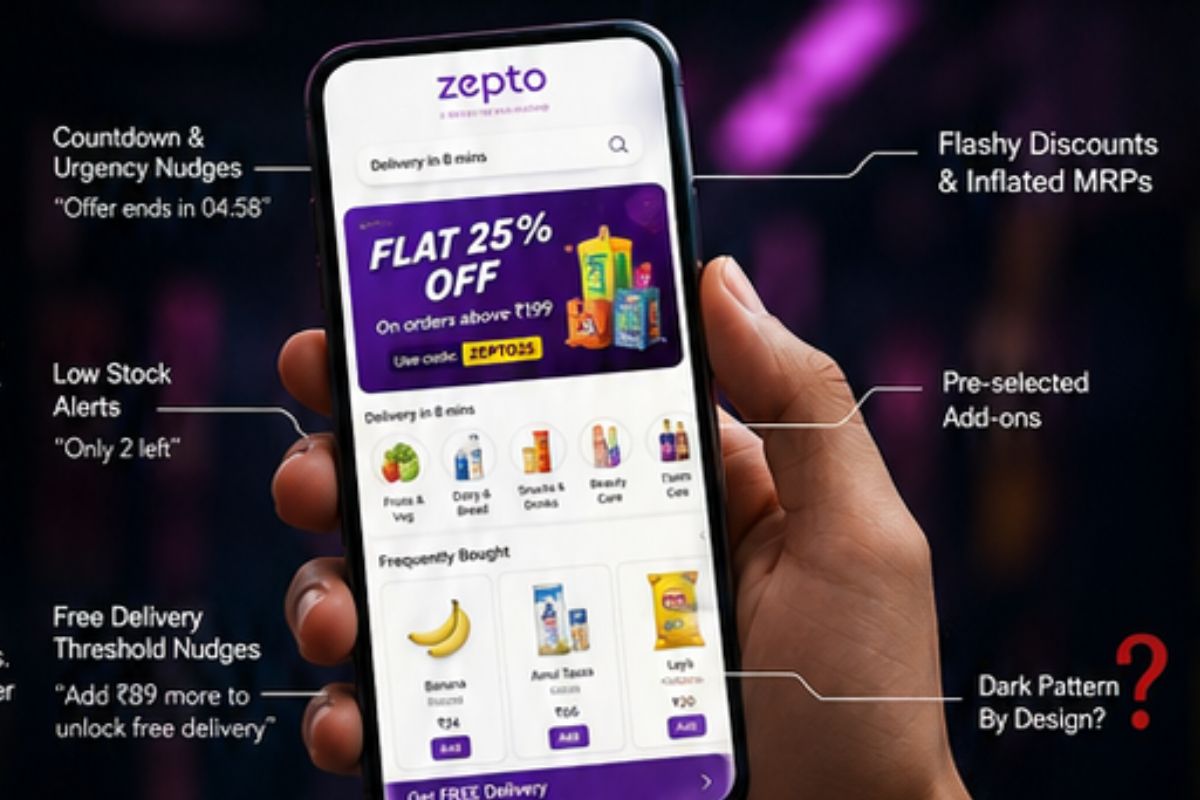
The same growth-at-all-costs mindset appeared in the design of the checkout experience. The Central Consumer Protection Authority found that Zepto engaged in practices classified as dark patterns. Specifically, the platform was found to have used drip pricing, displaying a lower price initially and then adding handling charges and membership fees at later stages of checkout, and basket sneaking, in which additional charges or membership were added without clear, affirmative consent.
Zepto Marketplace was fined ₹7 lakh, the highest among a group of platforms penalised in the same action. The company has since stated that it discontinued the practices and overhauled its app to display all charges more clearly and to auto-apply free delivery where applicable. The founder later described the earlier approach as a mistake. The regulatory finding, however, remains on record: for a period, the platform’s interface was designed in ways that the consumer protection authority judged to mislead users about the final price they would pay.
The Competition Commission of India has also been drawn into the sector. Distributors’ bodies have filed information alleging anti-competitive conduct, predatory pricing and deep discounting by quick-commerce platforms including Zepto. The CCI has sought details from the company. While no formal full-scale investigation order against Zepto alone has been the defining public event, the existence of active complaints and information requests adds another layer of regulatory scrutiny to a business already facing consumer-protection penalties and a ban on its core marketing claim.
A Business Model Under Multiple Pressures
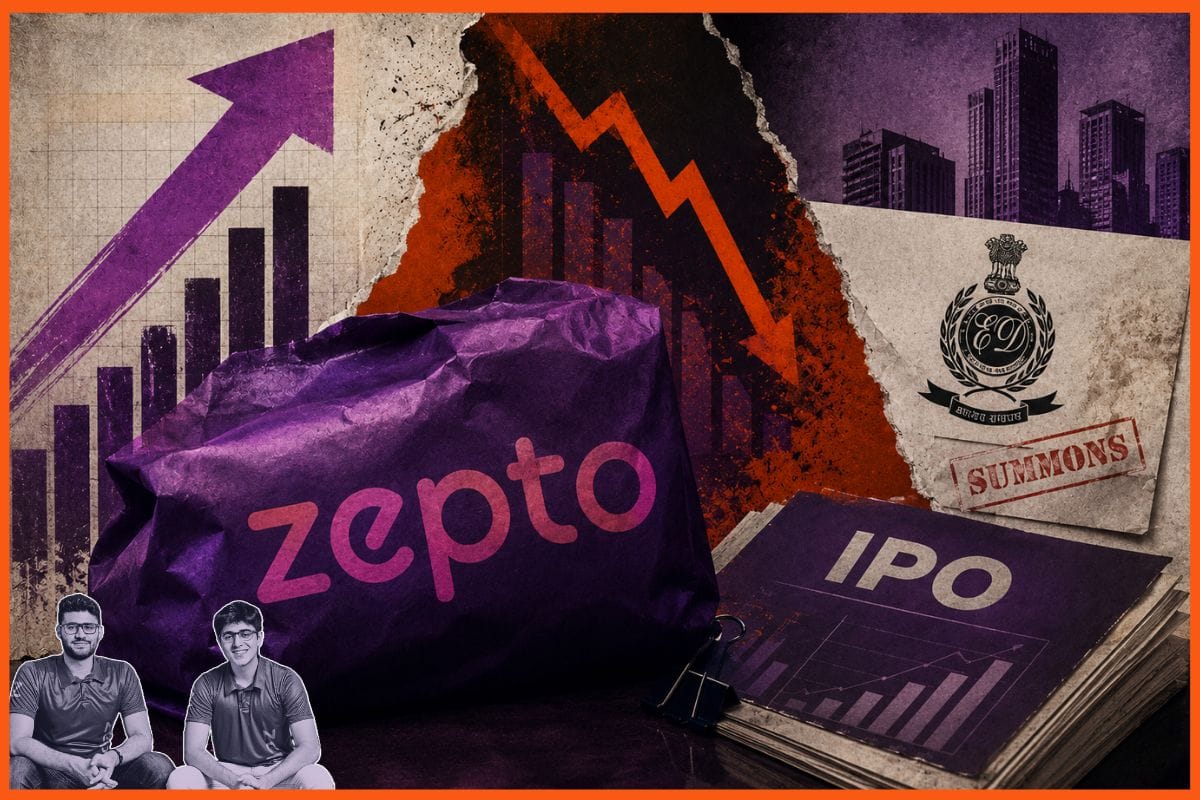
Put the pieces together and the picture is consistent. Zepto grew by promising extreme speed, subsidising delivery, expanding dark stores at high cost, and, for a time, using interface designs that regulators later ruled crossed into dark patterns. It has never been profitable. Losses have widened in absolute terms even as revenue scaled. When the government prohibited the advertising of guaranteed ten-minute delivery, the marketing foundation of the brand was removed. Growth relative to rivals slowed. Store expansion lagged. Public investors, already wary of the cash burn, refused to pay the previous private-market valuation. The IPO was deferred. Delivery fees were raised. The company is now raising private capital at a significantly lower valuation.
The insistence that the IPO delay has nothing to do with the loss of the ten-minute claim requires investors and the public to ignore the sequence of events and the simultaneous deterioration in relative growth metrics. It also requires them to overlook the deeper structural problem: a business that has spent five years demonstrating that extreme speed at scale is extraordinarily expensive, that the costs of that speed have not yet been brought under control, and that regulatory and competitive pressures are now constraining the very tools — aggressive fee waivers, bold speed claims, and conversion-optimised interfaces — that previously drove rapid customer acquisition.
Zepto sold speed. When it could no longer advertise that speed, when its delivery became more expensive for small orders, when its checkout practices drew regulatory penalties, and when its cumulative losses reached nearly ₹6,000 crore in a single year, the public markets declined to underwrite the previous story at the previous price. The company chose to wait.

Whether a more compelling and sustainable narrative can be built in the coming quarters remains an open question. What is no longer open to serious debate is that the original pitch — unlimited speed, minimal friction, and rapid dominance — has been constrained on multiple fronts at once. The IPO delay is not an isolated scheduling decision. It is the market’s verdict on a model that has burned cash continuously since inception while relying on a promise it is no longer allowed to make.