BJP’s Silent Loot Of The Diaspora: How Modi’s Government Turned NRI Patriotism Into A Wealth-Destroying Trap

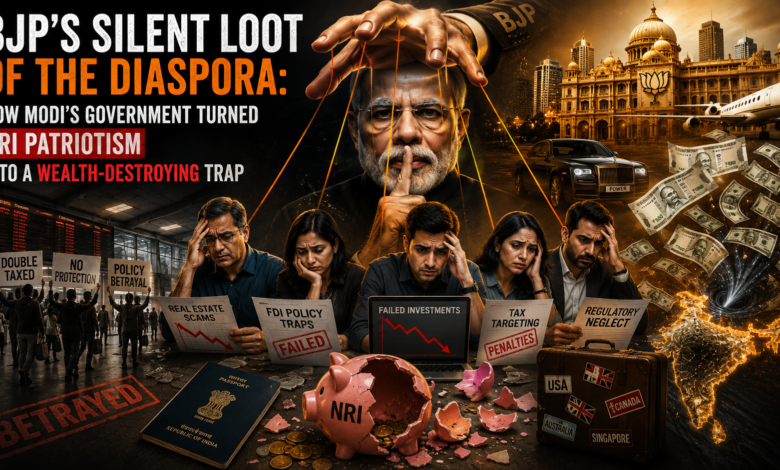
An investigative exposé on the calculated policy architecture by BJP that has systematically eroded the hard-earned dollars of Non-Resident Indians while the ruling party wraps itself in the tricolour and counts the remittance billions that keep its forex reserves afloat.
For more than a decade the Bharatiya Janata Party government has sold a glittering story of a rising India to the global Indian diaspora. “Come home with your capital,” the slogans screamed. “Invest in the motherland.” What the fine print never disclosed is that the same government has engineered, tolerated and taxed a currency regime that quietly converts those dollars into a steadily depreciating unit of account. The arithmetic is merciless. The policy is deliberate. And the biggest losers are the very NRIs whose remittances have become one of the few reliable props holding up India’s external accounts.
The Numbers Do Not Lie — They Accuse
In 1991 the rupee stood at roughly ₹17–22 to the dollar. By August 2026 it trades near ₹95–96. That is not market noise. That is a structural depreciation averaging roughly 4–4.5 percent every single year for more than three decades. Under the BJP’s uninterrupted rule since 2014 the slide has continued without interruption: from the mid-60s to the mid-90s. The government that never tires of claiming credit for every growth statistic has never once offered an inflation-adjusted or currency-adjusted capital-gains regime that would protect the real purchasing power of the capital it so eagerly solicits from abroad.
Consider the cold mathematics that NRIs are forced to live with. An NRI who parked $100,000 in Indian markets in 2015 and earned a respectable 10 percent annual rupee return would have seen the investment swell by roughly 158 percent in rupee terms by 2025. Converted back into dollars after the rupee’s relentless fall, that same portfolio sits at approximately 81 percent of the original principal — before taxes, before compliance costs, before the frictional costs of repatriation. The Nifty 50’s much-advertised 10-year and 20-year rupee CAGRs of 11–13 percent compress to the high single digits once the currency drag is subtracted. Meanwhile the S&P 500 delivered higher nominal returns in a hard currency that does not melt by design.
Fixed deposits fare even worse. A 7 percent FD return looks comforting on a bank statement until 4 percent annual depreciation and real inflation are subtracted. What remains is a slow bleed dressed up as safety. The BJP government has never once adjusted the tax treatment of these instruments for the currency loss it has allowed — and in many respects encouraged — through its macroeconomic choices.

Taxation Without Mercy, Without Adjustment
The tax architecture erected and maintained by this government adds insult to the currency injury. Short-term capital gains on equity are taxed at 20 percent. Long-term gains above the ₹1.25 lakh threshold are taxed at 12.5 percent. Both rates were raised under this very regime in 2024. Crucially, the tax is levied on the rupee gain before any adjustment for the depreciation that has already reduced the real dollar value of that gain. An NRI is therefore taxed on phantom profits — money that does not exist in hard-currency terms.
Repatriation is treated with open suspicion. Under the Liberalised Remittance Scheme the Tax Collected at Source continues to stand at 20 percent on general outward remittances above the threshold (with only partial relief for education and medical purposes introduced in Budget 2026). The government that celebrates every record remittance inflow simultaneously erects a tax barrier on the way out. Remittances themselves have become a quiet addiction: $135.4 billion in FY25, rising further toward $155 billion in FY26. These flows help finance the current-account deficit and pad forex reserves. Yet the same NRIs who supply this oxygen are offered no currency-loss deduction, no inflation-indexed capital-gains relief, and no meaningful protection against the very depreciation their dollars help delay.
The contrast is grotesque. When foreign portfolio investors threaten to flee, the government suddenly discovers the virtue of tax exemptions on government securities. When the rupee approaches ₹97, capital-gains tax on certain debt instruments is waived and investment limits for non-residents are hastily expanded. The message is unambiguous: foreign capital that can leave is courted; NRI capital that is expected to stay out of sentiment is squeezed.
A Policy of Silent Extraction
This is not accidental incompetence. It is a coherent policy of keeping capital onshore while allowing the unit of account to erode. No serious attempt has been made to introduce inflation-adjusted or currency-adjusted taxation for capital gains. No credible long-term strategy has been articulated to arrest the structural depreciation. Instead the government has relied on the emotional pull of “patriotism” and the practical difficulty of moving money out under LRS and TCS rules.
The result is a one-way transfer of real wealth. NRIs convert hard-earned dollars into a soft currency, pay tax on nominal rupee gains that have already been devalued, and then face further friction if they attempt to take the diminished proceeds back out. The ruling party collects the political credit for record remittances and swelling reserves while the diaspora absorbs the silent loss.
The Hypocrisy of the Growth Narrative
Every Independence Day and every budget speech the same government proclaims India’s arrival as a global power. Yet the currency that is supposed to reflect that strength has been allowed to lose more than four-fifths of its value against the dollar since the early 1990s, with the bulk of the recent damage occurring on this government’s watch. Growth figures are trumpeted in rupees. Wealth destruction is measured in dollars. The party that never misses an opportunity to lecture the diaspora on national duty has constructed a tax and currency regime that systematically penalises those who answer the call.
The data is public. The exchange-rate history is public. The tax statutes are public. The remittance numbers are public. What remains hidden is only the political will to admit that the system is extracting real value from the very citizens it claims to celebrate. Until that will materialises, every NRI who continues to park hard currency in pure-rupee assets under the current policy framework is participating in a slow, state-enabled transfer of wealth — from their balance sheets to the government’s ability to postpone the day of reckoning.

The rupee will keep falling. The taxes will keep applying to the wrong numbers. And the party that has governed this arrangement for more than a decade will keep asking for applause.