Rajesh Exports Has A Problem. The Real Question Is How Deep It Goes
The question is no longer whether Rajesh Exports is facing scrutiny. The record makes that undeniable. The question is what the scrutiny will ultimately establish.


For Rajesh Exports, the problem is no longer confined to one investigation, one regulator or one disputed transaction, because in 2026 the company has found itself facing questions from several authorities at almost the same time, while also dealing with substantial lender claims, pending litigation and a corporate history that already contains significant regulatory and enforcement proceedings.
SEBI has raised prima-facie concerns about the company’s financial reporting, transactions involving related and promoter-linked entities, the documentation supporting overseas revenue and a reported ₹1,035 crore investment in African gold mines, following which it ordered a forensic examination of the relevant records and restrained chairman Rajesh Mehta from dealing in Rajesh Exports securities until further orders.
Within weeks, the Enforcement Directorate searched nine premises connected with Rajesh Exports and related persons in Bengaluru and Mumbai under FEMA, examining foreign transactions, alleged opaque set-offs, overseas investments, stock records and suspected offshore connections, while the company’s own financial disclosures subsequently confirmed that the Serious Fraud Investigation Office had initiated an investigation and that the National Financial Reporting Authority had begun examining auditor-related concerns following SEBI’s referral.
The financial pressure is coming from another direction as well. In March 2026, the Debt Recovery Tribunal in Chennai partly allowed Canara Bank’s recovery application, dismissed a counterclaim of approximately ₹20,456 crore filed by Rajesh Exports and its promoters and held Rajesh Exports, Rajesh Mehta and Prashant Mehta jointly and severally liable for the recomputed dues, while a separate Section 7 insolvency petition filed by Canara Bank remained before the NCLT Bengaluru in August under the status “for admission”, with no verified order showing that CIRP had commenced.
That distinction matters because the Rajesh Exports story now sits at an uncomfortable intersection between what regulators are alleging, what courts and tribunals have actually decided and what remains to be established through further evidence.
The present scrutiny, however, did not emerge from nowhere. The company’s paper trail stretches back to its 1995 public issue and a final SEBI restraint in 2002, through the 2013 DRI investigation involving alleged diversion of gold, the Income-tax search conducted that same year, the private criminal complaint arising from an approximately ₹110 crore foreign investment, years of banking and commercial litigation and, finally, the unusually concentrated regulatory attention that has descended on the group in 2026.
The question is therefore no longer whether Rajesh Exports is facing scrutiny. The record makes that undeniable. The real question is what that scrutiny will ultimately establish.

SEBI’s ₹15.15 Lakh Crore Question
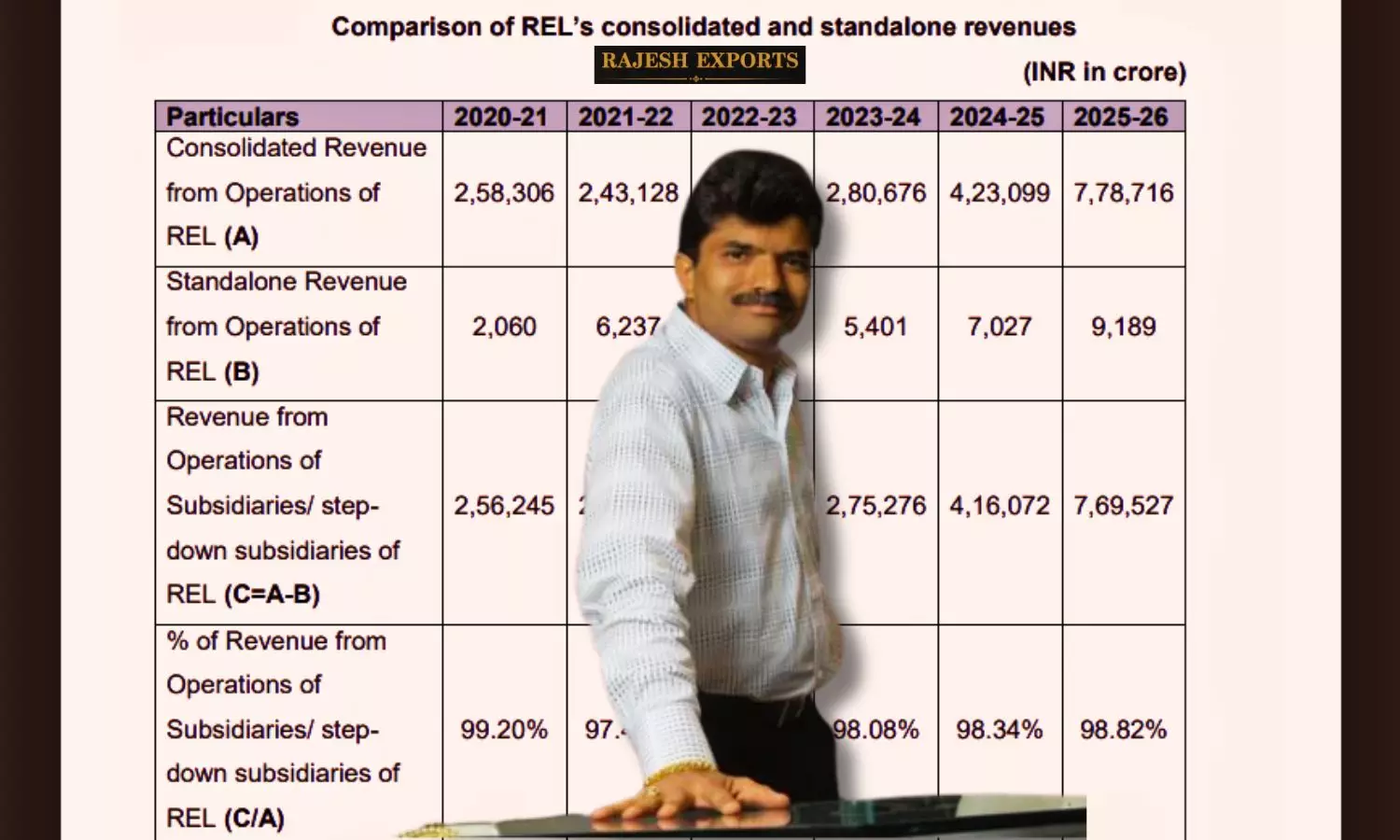
The numbers in SEBI’s June 2026 interim order are difficult to ignore, but the significance of the ₹15.15 lakh crore figure lies less in its sheer size than in the regulator’s question about whether the reported revenue can be reconciled with the underlying records.
Over five financial years, Rajesh Exports reported approximately ₹15.15 lakh crore in consolidated subsidiary revenue, with approximately 99.8% of subsidiary revenue and roughly 97% to 99% of consolidated group revenue attributed to overseas operations, principally through Global Gold Refineries and its Swiss subsidiary, Valcambi.
SEBI’s concern was not simply that these numbers were unusually large, because gold refining can naturally generate enormous reported turnover owing to the value of bullion passing through a refinery; the regulator’s concern was whether the figures could be adequately substantiated and reconciled with the underlying documentation.
One of the sharpest examples involved Affluence Shares and Stocks, which SEBI’s preliminary analysis identified as the counterparty to approximately ₹11,486.60 crore of sales and approximately ₹11,488.42 crore of purchases recorded in Rajesh Exports’ standalone books between FY2021-22 and FY2023-24, transactions that SEBI said represented roughly two-thirds of the company’s standalone purchase and sales activity during the relevant periods.
The concern deepened because, according to SEBI’s interim record, Affluence told the regulator that it had not conducted such business with Rajesh Exports and that its dealings were instead with Rajesh Mehta personally, creating a fundamental discrepancy between the way the transactions were reflected in the company’s books and the counterparty’s account of the relationship.
That discrepancy is now part of the forensic examination, but it would be wrong to convert it into a conclusion that the transactions were fictitious, because SEBI’s June order remains an interim, ex parte order based on prima-facie concerns and does not finally adjudicate that the reported purchases and sales were fabricated.
The same order raised questions about payments involving Rajesh Mehta, Siddharth Mehta and Elest, transactions involving ACC Energy Storage and the documentation supporting the reported African gold-mine investment, which together explain why the regulator moved beyond seeking explanations and ordered a forensic examination of the relevant financial records and transactions.
The deeper question behind the headline number is therefore not whether ₹15.15 lakh crore is inherently implausible, but whether the financial story presented by Rajesh Exports can ultimately be reconciled, transaction by transaction, with the counterparties, assets, contracts, bank movements and supporting records that are supposed to sit behind those numbers.
3. The ₹11,488 Crore Counterparty That Says It Wasn’t Doing Business With Rajesh Exports
The Affluence transactions deserve separate attention because they present one of the clearest examples of the kind of inconsistency SEBI is now asking the forensic examination to resolve.
According to SEBI’s preliminary analysis, Rajesh Exports’ standalone books recorded approximately ₹11,486.60 crore in sales to Affluence and approximately ₹11,488.42 crore in purchases from the same entity between FY2021-22 and FY2023-24, amounts that were significant not merely because of their size but because they represented roughly two-thirds of the company’s purchase and sales activity during the relevant periods.
The problem is that SEBI’s interim order records Affluence as denying that it conducted this business with Rajesh Exports and instead stating that its dealings were with Rajesh Mehta personally.
That creates a question that cannot be resolved through the accounts alone: if Rajesh Exports recorded Affluence as a major buyer and seller while Affluence described the relationship differently, what precisely were the transactions recorded in Rajesh Exports’ books, who were the actual principals behind them and why were they reflected in the company’s accounts in that manner?
SEBI also referred to an alleged payment of approximately ₹7.45 crore by Rajesh Mehta from a personal account to Affluence, together with an alleged loss of approximately ₹3.5 crore, although that transaction by itself does not establish that the promoter’s personal dealings were connected to the company’s transactions.
The important point is that Affluence is not established in the public record as a Rajesh Exports subsidiary, associate or group company, and should therefore be described as a counterparty identified in the regulator’s investigation rather than as part of the corporate group.
SEBI has not finally ruled that Affluence was a fictitious counterparty, has not established that the reported purchases and sales were sham transactions and has not finally concluded that funds were siphoned through the relationship. What it has established at the interim stage is that there is a significant discrepancy requiring the underlying records to be examined.
The scale nevertheless makes the issue difficult to dismiss as a minor accounting disagreement, because the amounts involved run into thousands of crores and the transactions occupied such a large proportion of the company’s standalone activity.
The forensic examination will therefore have to determine what actually sits behind those numbers.

The Money Moving Between The Promoter, Elest And ACC
The Affluence transactions are not the only financial movements that SEBI has questioned, because the regulator’s interim order also examines money moving between Rajesh Exports, its promoter, promoter-linked entities and companies connected to the group’s newer businesses.
Between April 2020 and September 2025, SEBI’s preliminary analysis identified approximately ₹338.90 crore in gross payments from Rajesh Exports to Rajesh Mehta, of which approximately ₹232.44 crore was reportedly received back, while approximately ₹21.25 crore was paid to Siddharth Mehta. SEBI also identified approximately ₹565.88 crore in gross payments from Rajesh Exports to Elest Private Limited, of which approximately ₹350.03 crore was reportedly returned, leaving a net movement of approximately ₹215.85 crore.
The regulator’s concern was not simply that money moved between connected parties, because transactions between a listed company and related or promoter-linked entities are not inherently improper; the question is whether those transactions had a genuine commercial purpose, were properly authorised, supported by adequate documentation and appropriately disclosed.
The inquiry becomes more complicated when ACC Energy Storage enters the picture. Elest acquired approximately 49% of ACC Energy Storage in January 2025, after which SEBI examined a series of transactions involving the two entities, including an alleged transfer of approximately ₹147 crore from Elest to ACC, an approximately ₹112 crore same-day return movement and an approximately ₹262 crore investment by ACC into Elest.
SEBI questioned whether these transactions were supported by adequate valuation documents, commercial justification and corporate approvals, and the regulator also referred to statements attributed to senior management indicating that some individuals did not have detailed knowledge of certain transactions. Rajesh Mehta has disputed any suggestion of diversion and has maintained that the transactions and their accounting were misunderstood.
The forensic examination will therefore have to determine whether the underlying agreements, approvals, valuations, accounting entries and movement of funds provide a coherent commercial explanation for the transactions, because the issue is ultimately not merely where money moved but whether the corporate documentation supports why it moved, who authorised it and how it was reflected in the company’s accounts.
The ₹1,035 Crore African Gold-Mine Question
One of the most consequential questions raised by SEBI reaches beyond Rajesh Exports’ domestic books and into the group’s overseas assets.
The company had represented that approximately ₹1,035 crore had been invested in African gold mines, which would represent a substantial deployment of capital for a group whose principal business is built around gold, yet SEBI said that adequate documentation had not been provided to substantiate the investment, including records establishing ownership interests, title to underlying assets, valuations and the transactions through which the investment was made.
The same investment subsequently appeared in the Enforcement Directorate’s FEMA investigation, creating an overlap between two separate regulatory processes that should nevertheless not be treated as though either agency has already established that the investment did not exist.
At this stage, the public record establishes a regulatory question rather than a final conclusion: Rajesh Exports reported a very large overseas gold-mine investment, while investigators are seeking documentation capable of demonstrating where the money went, what assets were acquired, what ownership rights resulted from the investment and whether the value attributed to those assets can be supported.
That distinction is especially important because an accounting entry showing that money was spent does not, by itself, establish what was acquired overseas; the underlying foreign corporate records, ownership documents, valuation reports, bank trails and transaction agreements are what ultimately have to establish the complete chain from investment to asset.
Rajesh Exports has disputed the broader allegations of financial wrongdoing and has said that it is cooperating with the authorities, leaving the forensic examination to determine whether the company’s reported investment can be reconciled with the underlying evidence.

Then Came The ED: Nine Premises, Foreign Transactions And A ₹3,000 Crore Question
The SEBI investigation was followed within weeks by another major intervention when the Enforcement Directorate began searching premises connected with Rajesh Exports and related persons in Bengaluru and Mumbai on 23 June 2026, with the company stating that the searches concluded on 25 June.
The legal character of that action is important because the searches were conducted in connection with an investigation under FEMA, and the public record reviewed does not establish a PMLA prosecution, a money-laundering case, an ED attachment of Rajesh Exports’ assets or an ED arrest of Rajesh Mehta or Prashant Mehta. A FEMA investigation and a PMLA money-laundering investigation are separate legal processes and should not be treated as interchangeable.
The allegations emerging from the ED investigation are nevertheless substantial. The agency examined foreign transactions for which it said records were inadequate or unavailable, raised questions concerning approximately ₹3,000 crore of alleged opaque set-offs involving foreign or UAE counterparties, examined the approximately ₹1,035 crore African gold-mine investment and raised concerns concerning inventory records and transactions involving Rajesh Exports shares.
One account of the investigation also attributed to the ED an allegation that more than ₹600 crore may have been siphoned through share-related transactions involving NRI benamidars, although that remains an investigative allegation and the public record reviewed does not establish a judicial finding of hawala, money laundering or benami transactions against Rajesh Exports or its promoters.
Rajesh Exports has strongly disputed the allegations emerging from the searches and stated that investigators found no discrepancy in physical inventory or cash, that no valuable property was seized and that the material taken consisted principally of documents and electronic information, while also maintaining that the company cooperated with the investigation.
The competing accounts therefore remain part of an unresolved FEMA investigation, and the ED search establishes scrutiny without establishing the wrongdoing being investigated.
The Regulators Are Now Looking Beyond The Company
The regulatory scrutiny has expanded beyond SEBI and the Enforcement Directorate, with Rajesh Exports’ own August 2026 financial-results disclosure confirming that the Serious Fraud Investigation Office had initiated an investigation and that management had furnished, or was in the process of furnishing, information and documents requested by the agency.
The disclosure does not identify a final SFIO investigation report, prosecution complaint, arrest or concluded finding of corporate fraud, which means that any assertion that SFIO has already established fraud would go beyond the public record.
The National Financial Reporting Authority has also begun examining auditor-related issues after SEBI referred concerns arising from its June interim order, with NFRA chair Nitin Gupta confirming that the authority had commenced its process; as of the research cut-off, no final NFRA disciplinary order, debarment or monetary penalty against a named Rajesh Exports auditor had been located.
The significance of these developments lies in the fact that several institutions are now examining different dimensions of the same corporate ecosystem, with SEBI looking at financial reporting, related-party transactions and fund movements, the ED examining foreign-exchange matters and overseas transactions, SFIO examining the company’s affairs under the Companies Act and NFRA examining the audit-related questions arising from the financial reporting concerns.
A separate administrative issue has emerged around ACC Energy Storage and the government’s ₹18,100 crore Production Linked Incentive scheme for Advanced Chemistry Cell battery storage, under which ACC Energy Storage was awarded 5 GWh of capacity. Government material recorded approximately ₹262 crore of cumulative investment and 184 direct jobs in the project as of 31 December 2025, while July 2026 reporting indicated that the Ministry of Heavy Industries was considering or preparing a show-cause notice over implementation delays; the available record does not establish that the government had finally cancelled the award or removed Rajesh Exports or ACC Energy Storage from the programme.
The breadth of this scrutiny is difficult to ignore, but the legal and evidentiary status of each proceeding remains different, which means that the current record is best understood as an expanding field of questions rather than as one completed finding against the company.

The 2013 Gold Case: 900 Grams, Two Arrests And An NBW
The current regulatory scrutiny also has to be viewed against the company’s earlier enforcement history, particularly the 2013 DRI investigation that began after an employee of Rajesh Exports was intercepted at Ernakulam Railway Station carrying approximately 900 grams of gold.
DRI registered O.R. No. 3/2013 under Sections 104 and 135 of the Customs Act and investigated allegations that gold imported duty-free for use in a Special Economic Zone had been diverted into the domestic market. According to the material placed before the Kerala High Court, Harish Babu allegedly told investigators that the gold had been handed to him by Biju Abraham, a Rajesh Exports manager, for delivery to Prashant J. Mehta. Harish Babu and Biju Abraham were subsequently arrested.
Prashant J. Mehta, then associated with the management of Rajesh Exports and the brother of founder Rajesh Mehta, was named as the first accused. His anticipatory-bail application was rejected by the Kerala High Court on 25 July 2013, an Additional Chief Judicial Magistrate subsequently issued a non-bailable warrant and contemporaneous reports attributed to the DRI an allegation that customs-duty evasion over the preceding years could have been approximately ₹90 crore.
That ₹90 crore figure was an allegation made during the investigation and should not be presented as a sum finally established by a court.
The matter subsequently reached the Supreme Court, which on 31 July 2014 made its earlier interim protection of Prashant Mehta absolute and directed that, if he were arrested in connection with O.R. No. 3/2013, he should be released on bail subject to conditions and cooperate with the investigation.
The public record therefore establishes the refusal of anticipatory bail and the subsequent non-bailable warrant, but it does not establish that Prashant Mehta was actually arrested.
The customs proceedings continued on other fronts, including a December 2013 CESTAT proceeding concerning the extension of time for issuing a show-cause notice, in which the tribunal recorded that the investigation remained incomplete, including because Prashant Mehta’s statement had not yet been recorded. Connected VAT proceedings were also set aside by the Kerala High Court in August 2014 on natural-justice grounds, while the authorities were permitted to undertake the proceedings again.
The 2013 DRI case is therefore an important part of the Rajesh Exports record, but its legal status has to remain precisely described: the investigation produced two arrests, named Prashant Mehta as an accused and resulted in a non-bailable warrant after anticipatory bail was refused, while the Supreme Court subsequently protected him against arrest subject to bail conditions; the material reviewed does not establish an actual arrest or criminal conviction of Prashant Mehta in that case.
The ₹110 Crore Pramerica Complaint That Survived A Quashing Attempt
The next major criminal proceeding arose from a completely different dispute involving an approximately ₹110 crore foreign investment in a residential-development project at Devanahalli, which eventually produced a private criminal complaint against Rajesh Exports and members of the promoter family.
Pramerica ASPF II Cyprus Holding Ltd initiated the proceedings through PCR No. 6154/2013, which subsequently became C.C. No. 15955/2013, with Rajesh Exports identified as accused no. 6, Rajesh J. Mehta as accused no. 8 and Prashant J. Mehta as accused no. 9. The allegations included unauthorised mortgages over project property, improper dealings with development rights, diversion or misappropriation of investment funds, use of disputed board resolutions and a conspiracy to deceive the foreign investor.
The Magistrate took cognizance of alleged offences including criminal breach of trust, cheating and conspiracy under the Indian Penal Code, after which Rajesh Exports and the individual accused approached the Karnataka High Court seeking to have the proceedings quashed.
The High Court did not decide whether the allegations were true; rather, on 14 December 2023 it held that the central questions concerning the genuineness and authority of corporate resolutions, the creation of mortgages, the handling of development rights, the movement of investment funds and the alleged involvement of the accused involved disputed questions of fact that required evidence and therefore could not appropriately be resolved at the quashing stage.
The court also rejected the argument that connected civil proceedings or a commercial settlement automatically eliminated the possibility of criminal liability where the allegations disclosed matters requiring evidence.
The proceedings were therefore allowed to continue, but the order should not be converted into a finding that Rajesh Exports, Rajesh Mehta or Prashant Mehta committed cheating or misappropriation.
The connected civil litigation also remained unresolved in the indexed public record reviewed for this dossier, with a Supreme Court order dated 19 July 2024 continuing an interim arrangement and relisting the civil appeals.
The Pramerica matter therefore occupies a significant but carefully defined place in the company’s history: it became a live criminal prosecution and survived a High Court challenge to quash it, but the public record reviewed does not establish that the alleged cheating, diversion or conspiracy was ultimately proved at trial.
The Tax Search That Produced A ₹3,871 Crore Assessment
The 2013 DRI investigation was accompanied by another major enforcement action when the Income-tax Department conducted a Section 132 search at Rajesh Exports’ Brunton Road premises in Bengaluru on 17 December 2013, seizing document bundles and a hard disk containing electronic records that subsequently became the basis for years of tax litigation.
The search assessments examined inter-corporate deposits and loans, interest income, sales reflected in seized material, Section 68 additions, Section 10AA exemption claims and alleged gold shortages or losses. For one assessment year, the Assessing Officer made a Section 68 addition of approximately ₹3,871.30 crore concerning sales to Excel Goldsmith and disallowed approximately ₹670.23 crore claimed as a Section 10AA exemption.
Those figures, however, were assessment-stage amounts rather than final findings of tax fraud, because the subsequent appellate record shows that individual issues were contested, remanded or decided differently depending on the evidence available.
The ITAT, for example, remanded certain questions concerning interest accrual so that it could be determined whether the income had genuinely accrued and whether it was realistically recoverable, while on another issue it accepted Rajesh Exports’ explanation concerning approximately 99.055 kilograms of process-related gold loss, noting that the claimed loss represented approximately 0.047% and that the search had not produced evidence of corresponding excess physical stock or unaccounted sales.
The seized electronic records were also used in assessments involving third-party bullion dealers, where authorities alleged cash-and-cheque bullion transactions involving Rajesh Exports, including approximately ₹4.37 crore of cash sales across multiple assessment years. Those proceedings were principally directed against outside taxpayers, however, and connected cases saw additions deleted or restricted where corroborating evidence was insufficient.
The company’s broader tax record includes disputed service-tax, VAT and income-tax demands, while the FY2024-25 annual report also disclosed favourable appellate orders for certain assessment years and stated that there were no undisputed statutory dues outstanding for more than six months as of 31 March 2025.
The 2013 tax search is therefore firmly established, as are the substantial assessment figures that followed it, but the appellate history makes clear that those figures cannot simply be presented as equivalent to proven tax fraud. The same distinction will be critical when assessing the company’s present financial-reporting controversy, because an assessment number, an investigative allegation and a final adjudicated finding carry very different evidentiary weight.
The Banking Crisis: ₹451 Crore Claimed, ₹20,456 Crore Counterclaimed
Alongside the regulatory and criminal proceedings, Rajesh Exports has been engaged in a prolonged dispute with Canara Bank that has moved through debt-recovery, SARFAESI and insolvency proceedings, with the March 2026 DRT order providing one of the clearest substantive adjudications in the company’s recent financial history.
Canara Bank approached DRT-I Chennai seeking approximately ₹451.68 crore together with interest at 16.35% per annum with monthly rests and penal interest, while Rajesh Exports, Rajesh Mehta and Prashant J. Mehta responded with a counterclaim of approximately ₹20,456 crore, alleging incorrect debits, problems involving foreign-exchange hedging, unauthorised payments and consequential business losses.
On 18 March 2026, the tribunal partly allowed Canara Bank’s recovery application and dismissed the defendants’ counterclaim, although it did not simply accept the bank’s entire claim on the terms originally pleaded. The tribunal accepted a base debit or closing balance of approximately ₹749.39 crore as of 6 August 2020, directed the bank to account for subsequent credits, prescribed 6.75% interest for the period from 6 August 2020 to 21 May 2021 and subsequently permitted 9% annual interest compounded annually on the recomputed dues, while disallowing penal interest up to 5 September 2020.
The tribunal also held Rajesh Exports, Rajesh Mehta and Prashant Mehta jointly and severally liable for the recomputed amount and permitted the bank to proceed against secured assets in accordance with law in the event of default.
The order is therefore materially adverse to Rajesh Exports and its two principal promoters, but it would be inaccurate to report that the tribunal simply awarded Canara Bank the entire ₹451.68 crore at the bank’s demanded rate, because the tribunal rejected aspects of the bank’s interest calculation and required the outstanding amount to be recomputed.
Canara Bank subsequently put an exposure of approximately ₹509.37 crore relating to Rajesh Exports up for sale as a stressed loan, although the auction was cancelled on 7 May 2026 without a publicly stated reason, and the cancellation did not extinguish the underlying debt or recovery proceedings. The bank’s chief executive later stated that more than half of an approximately ₹500 crore exposure had been recovered by June 2026.
Rajesh Exports also challenged Canara Bank’s SARFAESI measures before the Karnataka High Court, but on 16 June 2026 the court disposed of the writ challenge after noting that statutory remedies were available and discharged the interim protection.
There is, however, an important counterpoint in the group’s earlier banking litigation, because the Karnataka High Court had held in July 2020 that Canara Bank was required to honour compliant letters of credit issued in connection with Valcambi, a decision that was favourable to Rajesh Exports and Valcambi on that immediate issue and should not be folded into the later recovery dispute as though it were an adverse finding.
The banking record therefore demonstrates both substantial financial exposure and a history of contested claims in which outcomes have not always favoured the same side.
The Insolvency Petition Is Pending. Rajesh Exports Is Not Yet Under CIRP.
The Canara Bank dispute has also moved into insolvency proceedings, but the current status of that matter requires particular precision because the public record does not show that Rajesh Exports has entered the Corporate Insolvency Resolution Process.
Canara Bank’s Section 7 petition was originally registered as CP(IB) No. 51/BB/2021 and later renumbered as CP(IB) No. 34/BB/2025 before the NCLT Bengaluru Bench, where it remained listed on 6 August 2026 with the status “for admission”.
A Section 7 petition appearing on the NCLT cause list does not, by itself, mean that insolvency proceedings have commenced. Admission is the stage at which the tribunal determines whether the statutory requirements for initiating CIRP have been satisfied, and the legal consequences following admission are materially different because they include commencement of the resolution process and the statutory moratorium.
The public record reviewed does not establish that the petition has been admitted, and there is therefore no verified order commencing CIRP, no verified Section 14 moratorium, no appointment of an Interim Resolution Professional or Resolution Professional, no confirmed Committee of Creditors and no liquidation order.
Rajesh Exports challenged the insolvency proceedings before the Karnataka High Court, but on 16 June 2026 the court declined to terminate the NCLT proceedings and instead left the matter before the specialist insolvency forum.
The present position is therefore precise: Canara Bank has pursued insolvency proceedings against Rajesh Exports, the petition remains before the NCLT and it had not been shown as admitted as of the research cut-off.
That does not make the insolvency issue insignificant, because admission could fundamentally alter the company’s legal and financial position, but describing Rajesh Exports as already “under CIRP” would go beyond the verified record.
The Older Customs Record Is More Complicated Than The 2013 Gold Case
The customs history of Rajesh Exports extends beyond the 2013 DRI investigation and includes litigation concerning the Target Plus Scheme, an export-incentive programme whose restrictions ultimately reached the Supreme Court in DGFT v. Kanak Exports.
Rajesh Exports had sought benefits under the Target Plus Scheme, but the Karnataka High Court dismissed its writ petitions in September 2005 after finding that the company had not established its entitlement on the evidence presented.
The broader dispute reached the Supreme Court in October 2015, where government and DRI material referred to alleged misuse of the export-incentive framework, including unusually large increases in exports, circular trading in gold and jewellery and transactions involving multiple exporters. The Supreme Court ultimately allowed the government’s appeals and rejected the exporters’ challenges to the restrictions.
That judgment is relevant to the Rajesh Exports record, but it should not be transformed into a criminal conviction for customs smuggling or treated as proof that every allegation contained in the underlying investigative material was established against the company.
There was also a separate customs proceeding that produced a substantially different outcome. A November 2005 show-cause notice alleged misdeclaration and inadequate value addition and proposed approximately ₹54.64 crore in duty, interest and penalties against Adani-related parties and Rajesh Exports, but the Customs Commissioner dropped the allegations in January 2007, and CESTAT subsequently rejected the Revenue’s appeal in February 2009 after finding that the foreign documents relied upon were insufficiently authenticated to establish the alleged misdeclaration.
The contrast is important because the Target Plus litigation and the ₹54.64 crore customs demand did not produce the same outcome, and the two proceedings therefore cannot responsibly be merged into a single narrative of customs wrongdoing.
The older customs record, like the 2013 DRI case, demonstrates that Rajesh Exports has faced serious disputes over export incentives, customs treatment and the movement of gold, while also demonstrating that some substantial customs demands did not survive adjudication.
The Valcambi Question: A Swiss Refinery, African Gold And A Separate Set Of Allegations
The Rajesh Exports story extends beyond India through its ownership of Valcambi SA, the Swiss precious-metals refinery acquired by the group in 2015 through Global Gold Refineries, and the refinery has itself attracted scrutiny concerning the provenance of gold sourced from high-risk jurisdictions and counterparties.
Global Witness and SWISSAID have published allegations concerning Valcambi’s sourcing relationships involving gold from Sudan and entities connected with Kaloti and MTM, with Global Witness alleging that Valcambi directly obtained approximately 20 tonnes of gold and indirectly received more than 60 tonnes through a Kaloti-linked entity during 2018 and 2019. Valcambi and the relevant counterparties have disputed those allegations and maintained that applicable sourcing and compliance requirements were followed.
Separate Swiss reporting based on leaked correspondence raised questions about Valcambi’s relationship with MTM/Kaloti and the adequacy of provenance checks, while the reported position of the Swiss federal precious-metals control authorities was more nuanced than some subsequent headlines suggested, because the applicable framework did not necessarily provide for a sanction merely because a company continued dealing with a high-risk counterparty.
Valcambi has strongly disputed reports that it was formally “reprimanded” by Swiss authorities and has described some such characterisations as false or defamatory.
The dispute subsequently moved into the Swiss civil courts, where Valcambi brought proceedings against SWISSAID and the author of a report concerning the sourcing allegations; a principal hearing took place in 2025, settlement efforts failed and subsequent proceedings were interrupted following a recusal application, with no final public judgment establishing the underlying sourcing allegations located in the material reviewed.
Valcambi also resigned from a Swiss industry association before a reported vote concerning possible exclusion in 2023, which represented an industry-governance controversy rather than a government prosecution or judicial sanction.
The public record reviewed does not establish a Swiss criminal charge, money-laundering conviction, FINMA penalty, refinery raid or confiscation order against Valcambi arising from these sourcing allegations. That does not make the allegations irrelevant, but it means they should be presented as serious sourcing and compliance allegations that have generated investigative reporting, regulatory questions and civil litigation rather than as established criminal wrongdoing.
What The Record Actually Establishes
Once the allegations, investigations and final findings are separated, the Rajesh Exports record becomes more complicated but also more defensible.
The company has a documented history of adverse regulatory action. SEBI imposed a three-year restraint on Rajesh Exports in 2002 following its findings concerning the company’s 1995 public issue, and a corresponding three-year restraint was imposed on Rajesh Mehta in 2003. SEBI also filed a criminal complaint against Rajesh Exports, Rajesh Mehta and Prashanth Mehta in January 2003, although the final disposition of that prosecution has not been reliably established from the indexed records reviewed.
The company subsequently faced the 2013 DRI investigation, the Income-tax search and the Pramerica criminal complaint, while years of banking litigation culminated in the March 2026 DRT order against Rajesh Exports, Rajesh Mehta and Prashant Mehta.
At the same time, several matters in the historical record produced outcomes that were favourable to the company or required further adjudication, which means that the existence of a long regulatory history cannot itself establish a uniform pattern of wrongdoing.
The events of 2026 have nevertheless changed the scale of the scrutiny. SEBI is examining reported subsidiary revenue, Affluence transactions, promoter-linked payments, Elest and ACC transactions and the reported African gold-mine investment; the ED is examining foreign transactions and overseas assets under FEMA; SFIO has initiated an investigation; NFRA has begun examining auditor-related concerns; Canara Bank has secured recovery rights; and the company’s Section 7 insolvency petition remains before the NCLT.
The public record therefore supports a serious conclusion, but not an unlimited one: Rajesh Exports is facing an unusually broad and consequential examination of its financial reporting, corporate transactions, overseas operations and financial obligations, while several of the most serious allegations remain unadjudicated.
The evidence does not yet support the conclusion that those allegations have been proved.
That is not a defence of the company, and it is not an exoneration. It is simply the point at which the evidence currently stands.
The Final Test Is What The Investigations Actually Establish
The most important question now is no longer how many proceedings can be listed against Rajesh Exports, because the public record already provides a substantial list; the more important question is whether the underlying documents, transaction trails, corporate approvals, ownership records and witness evidence ultimately support the explanations offered by the company or substantiate the concerns raised by regulators.
That question is particularly important in the SEBI proceedings, where the regulator has identified substantial inconsistencies involving subsidiary revenue, related-party transactions, promoter-linked payments, overseas investments and transactions involving ACC Energy Storage and Elest, and has ordered a forensic examination precisely because those questions cannot be conclusively resolved from the preliminary material alone.
The forensic examination will have to determine whether the apparent inconsistencies reflect accounting complexity, inadequate documentation, genuine commercial transactions that were poorly communicated or disclosed, weaknesses in internal controls, or conduct of a substantially more serious nature.
The same test applies to the ED’s FEMA investigation, where questions concerning foreign transactions, alleged set-offs, overseas investments, inventory records and share-related transactions will ultimately have to be tested against bank records, foreign-exchange documentation, corporate ownership records and the underlying transaction trail.
The SFIO and NFRA processes provide another layer because, if the financial statements were materially misstated, the eventual investigations should establish how those misstatements occurred, whether they arose from control failures or deliberate conduct and who was responsible; if the underlying records ultimately support the company’s explanations, that should equally be reflected in the final outcomes.
The banking proceedings provide a different form of evidence because they have already produced a substantive adjudication, with Canara Bank’s recovery claim partly upheld, the company’s much larger counterclaim dismissed and Rajesh Exports, Rajesh Mehta and Prashant Mehta held jointly and severally liable for the recomputed debt, even though the tribunal did not accept every component of the bank’s original claim.
This is why the company’s history cannot responsibly be reduced either to a clean bill of health or to a single narrative of established fraud.
There are final adverse findings in the record. There are unresolved criminal proceedings. There are investigations based on prima-facie concerns. There are administrative proceedings that remain incomplete. There are also historical matters in which the company’s position prevailed or where authorities failed to sustain their original claims.
The significance of 2026 is therefore not that it has already produced one overarching finding against Rajesh Exports, but that several independent institutions are now examining different parts of the same corporate ecosystem at the same time.
If those investigations ultimately reconcile the disputed transactions and establish legitimate commercial explanations supported by contemporaneous documentation, the present picture could look materially different from the one suggested by the preliminary allegations.
If they do not, the consequences could be considerably more serious, because the issue would then move beyond questions of documentation and accounting complexity into questions concerning financial reporting, corporate governance, related-party transactions, promoter conduct and the reliability of the group’s consolidated accounts.
As of 21 August 2026, the public record has not reached that point.
What it has established is that the scrutiny is real, that some historical allegations have resulted in final adverse orders, that substantial financial and legal disputes remain active and that several major regulatory investigations are still working their way through the evidence.
The final explanation for all of it remains to be established.
The Last Bit, The Question Rajesh Exports Now Has To Answer
For Rajesh Exports, the immediate challenge is no longer simply to defend itself against another regulatory proceeding, because the company now has to explain a financial and corporate record that is being examined simultaneously by securities regulators, foreign-exchange investigators, corporate investigators and audit regulators, while lenders continue to pursue recovery and insolvency remedies.
SEBI is seeking to establish whether the group’s reported financial performance can be supported by underlying records and whether transactions involving promoters, related entities and overseas businesses were properly structured, authorised and disclosed. The Enforcement Directorate is examining whether foreign transactions and overseas investments comply with FEMA and whether the documentation supports the movement of funds described in the company’s records. SFIO and NFRA are examining further aspects of the corporate and audit framework, while Canara Bank’s recovery proceedings have already produced a substantive order and its insolvency petition remains before the NCLT.
What all of these proceedings have in common is a demand for documentation, because the questions now being asked cannot ultimately be answered by financial statements, press releases or denials alone; they will have to be answered through contracts, bank records, board approvals, ownership documents, accounting entries, transaction trails, valuation records and evidence from the people who authorised or executed the transactions.
That is where the distinction between a complicated multinational gold business and a fundamentally unreliable financial record will eventually emerge.
Rajesh Exports operates in a sector in which reported revenue can reach extraordinary levels because the value of bullion passing through a refinery is incorporated into turnover, while its multinational structure spans India, Singapore, Switzerland, the UAE and other overseas interests, creating a corporate and accounting environment that is inherently more complicated than that of a conventional domestic business.
But complexity cannot, by itself, explain transactions that investigators say remain inadequately documented or unreconciled, just as the existence of unexplained or disputed transactions cannot, by itself, establish fraud.
The answer will therefore come from the evidence.
If the underlying records ultimately reconcile the transactions and support the company’s explanations, the current story will have to be revised accordingly. If the evidence instead substantiates the concerns raised by SEBI, ED, SFIO or other authorities, the consequences could extend far beyond individual transactions and into the company’s financial reporting, governance structure, promoter dealings and the reliability of its consolidated accounts.
As of 21 August 2026, neither conclusion can responsibly be presented as fact.
What can be said is considerably more precise, and perhaps more significant: Rajesh Exports has a long record of regulatory and legal disputes, including final adverse orders, and it is now facing an unusually broad range of fresh investigations and proceedings involving the company’s financial reporting, overseas operations, related-party transactions, foreign-exchange movements and financial obligations. Several of the most serious allegations remain unadjudicated, while its lenders are simultaneously pursuing substantial recovery and insolvency remedies.
The question is no longer whether Rajesh Exports is facing scrutiny. The record makes that undeniable. The question is what the scrutiny will ultimately establish.