CJP – Electoral Reform Or Political Power Grab? Prashant Bhushan Calls It Regime Change, Neha Bora And Rahul Gandhi Enter The Picture, Modi Government Faces The Heat As Dhruv Rathee Takes The Protest To London. Are These Forces Pushing India Towards A Banana Republic?
More than 100 people were detained during the October 16 Connaught Place demonstration, including CJP founder Abhijeet Dipke and AISA president Neha Bora, as around 2,000 demonstrators gathered to demand Chief Election Commissioner Gyanesh Kumar’s resignation. The CJP protest has now moved beyond the dispute over voter rolls, drawing opposition leaders and prominent public figures into a wider confrontation over electoral accountability, the right to protest and the Modi government’s response.

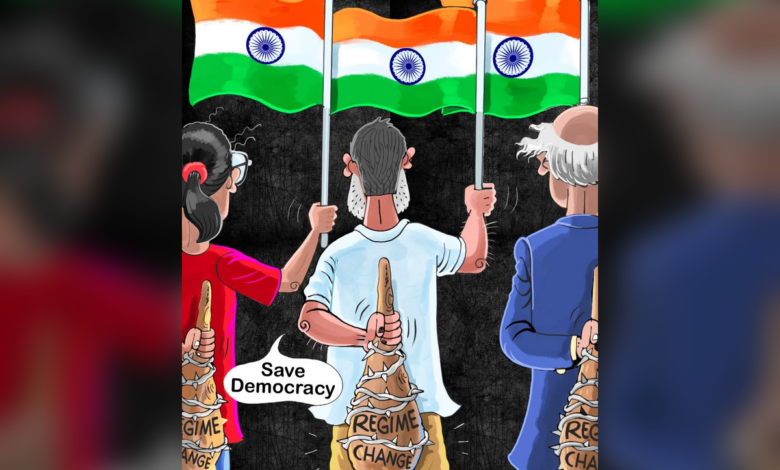
More than 100 people were detained during the October 16 Connaught Place demonstration, including CJP founder Abhijeet Dipke and AISA president Neha Bora, as around 2,000 demonstrators gathered to demand Chief Election Commissioner Gyanesh Kumar’s resignation.
The CJP protest has now drawn opposition leaders and prominent public figures into a wider confrontation over electoral accountability, the right to protest and the Modi government’s response.
CJP founder Abhijeet Dipke had been detained earlier in October, two of the organisation’s leaders were in Tihar Jail, and the Supreme Court was examining challenges involving the Election Commission and Delhi Police.
By October 17, 2026, a protest over India’s electoral rolls had become a wider confrontation involving student activists, opposition leaders and prominent public figures. The immediate demand was the resignation of Chief Election Commissioner Gyanesh Kumar.
The larger question was whether this was a fight for electoral accountability, a campaign against Narendra Modi and the BJP, or a convergence of both. The agitation has brought together people whose objectives are not necessarily identical.
CJP founder Abhijeet Dipke has focused on the Election Commission and alleged irregularities in the Special Intensive Revision (SIR) of electoral rolls. Senior advocate Prashant Bhushan has publicly called for regime change. Student activist Neha Bora has appeared alongside Congress leaders Rahul Gandhi and Priyanka Gandhi Vadra, while YouTuber Dhruv Rathee announced a demonstration in London against alleged electoral fraud.
The BJP has portrayed the agitation as an attempt to undermine the government and discredit democratic institutions. Protesters argue that the Election Commission must answer questions about voter registration and that authorities must justify their handling of demonstrations. The Supreme Court’s involvement has added a legal dimension to the confrontation, but it has not established that every allegation against the Commission or police is correct.
Two mistakes must be avoided when examining this conflict. The first is to dismiss every complaint as an opposition conspiracy simply because Congress leaders have joined the protests. The second is to treat the presence of prominent political figures, demonstrations or international attention as proof that electoral manipulation has occurred.
A movement can raise legitimate concerns while opposition parties see an opportunity to weaken the government. Activists can share a platform while disagreeing over the ultimate objective. And a government can face serious questions about its conduct without every allegation against it being proven.
The evidence must therefore be examined on three fronts:
—what happened during the electoral-roll revision,
—what the protest organisers actually want,
—and whether the state’s response has respected the law.
Only then can the political convergence be assessed fairly.
To understand why this dispute has become so combustible, it is necessary to return to the event that first brought CJP into direct confrontation with the Modi government. The organisation did not begin with voter rolls. It began with a different controversy, a different minister and a demand that ultimately succeeded.

It Started With NEET And Dharmendra Pradhan’s Resignation
The Cockroach Janta Party began as a satirical online platform in May 2026 before becoming the public face of a youth-led agitation over the NEET-UG examination controversy.
Allegations of a paper leak and examination irregularities triggered anger among students and families. The controversy struck at a particularly sensitive point: millions of young people depend on competitive examinations for access to medical education, and even the perception that the process has been compromised can destroy confidence in the system.
CJP made the resignation of Union Education Minister Dharmendra Pradhan a central demand.
Students and supporters gathered at Delhi’s Jantar Mantar, turning an examination-related grievance into a broader demand for accountability. The protesters also called for examination reforms, compensation for families of students who had died by suicide, and the withdrawal of cases against demonstrators.
The agitation lasted 36 days. On July 25, Pradhan resigned, and CJP announced that it was ending its protest after the Centre accepted key demands. The government said it would initiate the withdrawal of FIRs against protesters and provide compensation, within the applicable rules, to families of students who had died by suicide. The two sides also agreed to continue discussions on broader examination reforms.
The outcome gave CJP a tangible political victory: a minister had stepped down following sustained public pressure, and the government had negotiated with the protesters.
But by October, CJP had returned to the streets over a different issue. This time, the target was Chief Election Commissioner Gyanesh Kumar, and the central grievance concerned the SIR of electoral rolls. The organisation alleged that the revision process raised serious questions about electoral fairness and demanded the CEC’s resignation.
The transition matters. The NEET agitation concerned examination integrity and the Education Ministry. The new campaign concerns voter registration, the Election Commission’s decision-making and the right of eligible citizens to participate in elections. They are separate controversies, even if CJP presents both as questions of institutional accountability.
The change also raises a legitimate question about the movement’s political direction. CJP has demonstrated that it can mobilise public anger over different issues.
Form 6, SIR And The Election Commission. What Exactly Is The Electoral Controversy?
The immediate controversy centres on the Election Commission’s Special Intensive Revision of electoral rolls and a declaration added to the online version of Form 6, which new voters use to apply for registration.
The declaration asked applicants whether their own names, or those of their parents or grandparents, appeared on the electoral roll from the previous SIR. Where applicable, applicants were also asked to provide details such as the constituency, polling-part number and serial number. The online form could not be submitted without answering the question, even though the declaration itself was not marked mandatory.
Critics argued that the requirement could create difficulties for first-time voters, particularly those whose parents or grandparents did not appear on the earlier rolls or who could not readily access the relevant records. The issue was not simply whether the Election Commission could seek additional information. It was whether this declaration could be added through the online process without amending the rules governing the statutory form, and whether the requirement risked placing an unreasonable burden on eligible applicants.
The Commission’s position was that Form 6 itself had not been amended and that a separate declaration had been introduced for the SIR exercise. It said the prescribed form would be used outside the SIR period. The declaration was subsequently removed from the online portal in states where the revision had concluded, although it remained available in states where the exercise was ongoing at the time of reporting.
The controversy became more serious after it was reported that Election Commissioners Vivek Joshi and Sukhbir Singh Sandhu had objected to the change. Joshi recorded his objection on May 16, arguing that Form 6 could not be altered without amendments to the Registration of Electors Rules, 1960. Sandhu concurred on May 19.
A wider report stated that the two commissioners had raised objections on record 14 times over ten months to decisions taken by the Commission under Chief Election Commissioner Gyanesh Kumar.
The Supreme Court’s intervention has made the question of authorisation central.
On October 5, Chief Justice of India Surya Kant said the Court had not approved the modified Form 6 and indicated that it wanted to examine the Election Commission’s records to establish what had changed and who had authorised it. On October 12, the Court clarified that it had neither approved nor disapproved the modified form. The question remained undecided, with related pleas listed for October 27.
On October 15, the Supreme Court issued notice to the Election Commission on the Form 6 modification as part of a wider set of petitions concerning the Commission’s conduct and the SIR process. It also issued notices to Gyanesh Kumar and Election Commissioners Sandhu and Joshi in proceedings brought by opposition leaders.
The wider SIR exercise has intensified the dispute. Reuters reported that more than 130 million names had been removed from electoral rolls during the revision process. Among the categories reported were deceased voters, people who had relocated and people who could not be traced.
The Election Commission has maintained that the exercise is intended to remove duplicate and ineligible entries. Critics argue that eligible voters may also have been excluded, particularly among people who have migrated or struggle to establish their details.
The central questions are specific: who authorised the Form 6 declaration, what rules governed its use, how many eligible voters were affected, and what remedy is available to them? Those questions should be answered through records, data and judicial scrutiny – not settled by the political claims of either side.
Could Voter-Roll Revision Have Affected State Elections Too?
The SIR controversy has implications beyond the disputed Form 6 because electoral-roll revisions can affect who is able to cast a ballot.
Bihar was among the earliest major tests of the exercise ahead of its 2025 Assembly election. The process was subsequently expanded to other states and Union territories, raising questions about whether verification procedures were consistently applied and whether eligible voters had sufficient opportunities to correct errors.
In Bihar, the Election Commission conducted verification, published draft electoral rolls and allowed claims and objections before finalising the lists. The Commission said the exercise was necessary to remove deceased, duplicate and otherwise ineligible entries.
Critics questioned whether the process placed an excessive burden on voters who had migrated or struggled to produce the required information. These concerns merit examination, but they do not by themselves prove that the Bihar election result was manipulated.
West Bengal has also become a focus of the wider dispute. The scale of deletions and the process for challenging them have prompted concerns about electoral participation. Opposition parties have alleged that the revision could disproportionately affect Muslim voters and other groups less likely to support the BJP.
The BJP and the Election Commission have rejected allegations of deliberate manipulation. These remain contested claims; establishing whether the process produced a partisan advantage would require examining who was removed, whether those voters remained eligible, how appeals were handled and whether the rules were applied consistently.
The issue is not limited to one state. In May 2026, the Election Commission announced a further phase of SIR covering 16 states and three Union territories, with the stated objective of ensuring that no eligible citizen was left out and no ineligible person was included. The scale of the exercise makes transparent procedures, clear voter notification and accessible appeals essential.
- Three questions must remain separate.
- Were eligible voters wrongly removed?
- Were any errors concentrated in particular communities or constituencies?
- And is there evidence that the process was deliberately designed or applied to favour a political party?
The fundamental issue is not whether electoral rolls should be cleaned up. Accurate rolls matter. The test is whether the process protects the integrity of the register without denying eligible citizens their right to vote. If the Election Commission can demonstrate that it has done so, it should make that case transparently. If the evidence reveals wrongful exclusions, those errors must be corrected and responsibility established.
Who Is CJP, Who Is Behind The Agitation, And What Does It Actually Want?
The political identity of the Cockroach Janta Party has become a subject of debate in its own right. CJP founder Abhijeet Dipke has emerged as the public face of the agitation, while student organisations, opposition leaders and civil society figures have helped expand its reach.
But the presence of these different groups does not automatically mean they operate under a single leadership or share the same end goal.
CJP’s stated demands in the current agitation are specific: it wants Chief Election Commissioner Gyanesh Kumar to resign and has called for accountability over the Special Intensive Revision (SIR) of electoral rolls.
Dipke has framed the campaign as a fight against alleged electoral irregularities and a lack of transparency within the Election Commission. He has distinguished his organisation’s demands from the broader political ambitions expressed by some of its allies.
Questions have also been raised about CJP’s political affiliations. The Indian Express reported that a section of the Congress leadership had viewed the organisation with suspicion, with some considering it an offshoot or front of the Aam Aadmi Party. The same reporting described a shift in Congress’s approach, with Rahul Gandhi’s office reaching out to Dipke and seeking to involve him in a gathering of INDIA bloc leaders, civil society representatives and student activists.
The movement’s wider network is visible in the participation of the All India Students’ Association (AISA), whose president, Neha Bora, has been among the prominent figures at the demonstrations. Advocate Prashant Bhushan and other public figures have also appeared alongside CJP representatives. Their participation has expanded the campaign beyond the organisation’s original base, while bringing different political positions into the same space.
This is where the distinction between a movement’s leadership and its allies becomes important. CJP can demand the CEC’s resignation while Bhushan advocates regime change. AISA can participate because of its objections to the SIR process and the treatment of protesters. Congress can support the agitation because it believes the Election Commission must answer questions and because the issue challenges the BJP politically. These positions overlap, but they are not interchangeable.
The central issue is not whether CJP has political allies. It plainly does. The question is whether those allies have agreed on a common objective beyond the Election Commission. The statements made by Bhushan, Bora and Congress leaders help explain why that question has become central to the agitation.
Prashant Bhushan Calls For Regime Change. Neha Bora, Rahul Gandhi And Priyanka Vadra Enter The Picture
The debate over the agitation’s real objective intensified after senior advocate Prashant Bhushan publicly said that regime change was part of the movement’s purpose. His remarks at a press conference on October 15 brought into the open a question that had been building as opposition leaders and student activists joined CJP’s campaign: was the demand for Gyanesh Kumar’s resignation the destination, or a starting point for a wider challenge to the Modi government?
The distinction is substantive. Demanding the resignation of a Chief Election Commissioner is a demand directed at a constitutional office-holder. Calling for regime change means seeking to replace the government. The two positions can coexist within a political movement, but one does not prove the other.
Dipke has drawn a line between his organisation’s stated objective and Bhushan’s broader position. According to Loksatta, the CJP founder said the movement was focused on alleged opacity within the Election Commission, the CEC’s resignation and a transparent process for appointing a replacement – not simply on changing the government; although Bhushan’s statement was more direct – regime change!
Neha Bora’s involvement has added another political dimension. As president of AISA, she represents an organised student movement with its own political identity. Her participation alongside Rahul Gandhi and Priyanka Gandhi Vadra in the opposition mobilisation over electoral integrity made her one of the most visible student activists in the campaign. It also sharpened debate over the role of Left student organisations in a protest increasingly supported by opposition parties.
Bora also attracted criticism after referring to Bangladesh’s 2024 Gen-Z uprising in discussions about youth mobilisation. The comparison was interpreted by BJP leaders as evidence of a more ambitious effort to challenge the government.
Congress’s involvement is more direct and demonstrable. Rahul Gandhi publicly backed CJP leaders after their detention, and the party reached out to Dipke for a meeting involving INDIA bloc leaders, civil society representatives and student activists. Priyanka Gandhi Vadra’s participation in the opposition march further demonstrated that the dispute had become part of a larger political mobilisation against the government’s handling of electoral integrity.
For Congress, the issue offers both a constitutional argument and a political opportunity. Questions about voter registration and the independence of the Election Commission are matters of public concern. They also give the opposition a way to challenge the credibility of a government it wants to defeat. Recognising that political incentive does not, by itself, invalidate the underlying allegations.
The BJP, meanwhile, has used Bhushan’s regime-change remarks to argue that the agitation’s real purpose is to destabilise the government. What emerges is a coalition of participants with overlapping and sometimes competing aims.
CJP wants action against the CEC. Student activists are raising concerns about voting rights and police restrictions. Congress is using the dispute to challenge the government. Bhushan has explicitly advanced regime change.
That is a genuine political convergence. Whether it amounts to a coordinated campaign beyond the shared protests remains a separate question, one that cannot be answered through photographs, speeches or joint appearances alone.
Dhruv Rathee Takes The Protest To London. Why Internationalise An Indian Political Dispute?
Meanwehile, YouTuber Dhruv Rathee announced a demonstration in London for October 17, calling on supporters to assemble outside Parliament Square near the statue of Mahatma Gandhi. The proposed protest was intended to draw international attention to allegations of electoral fraud in India. Rathee’s announcement followed his detention in Gurugram ahead of a planned demonstration, after which he was released.
Rathee’s involvement gives the controversy a reach beyond the students and activists organising demonstrations inside India. With a substantial online audience and a history of criticising the Modi government, he can bring the dispute to viewers who might not otherwise follow the details of the SIR exercise or the arguments over Form 6.
But internationalising a domestic political dispute raises two distinct questions.
—Is an overseas demonstration a legitimate way to draw attention to concerns that organisers believe are not being addressed at home?
—And does taking the campaign abroad risk presenting contested allegations as established facts before they have been tested?
The first question has a straightforward democratic answer: peaceful protest abroad is not inherently illegitimate. Indian citizens and others concerned about India’s democratic institutions can seek international attention for their concerns. A government cannot establish that a criticism is false simply by pointing to the fact that it was made outside the country.
The second question requires greater care. Allegations about voter deletions, electoral procedures and the conduct of the Election Commission must be supported by evidence wherever they are presented. The scale of reported deletions and the disputes over the online Form 6 declaration justify scrutiny, but neither automatically proves deliberate electoral fraud. A demonstration can publicise a claim; it cannot establish the claim’s truth.
The government’s critics can argue that international attention may encourage transparency and increase pressure on institutions to answer legitimate questions. The counterargument is that presenting unresolved allegations as proven wrongdoing could damage public confidence without first establishing the facts. Both concerns are relevant, and neither can be settled simply by labelling the campaign patriotic or anti-national.
There is also a clear distinction between an international protest and a foreign-directed operation. Rathee’s announcement establishes that he intended to take the issue to London.
Police Crackdown, Detentions And The Supreme Court. Is The Government Handling Dissent Lawfully?
The confrontation has moved beyond the electoral-roll dispute into a second constitutional question: how far can authorities go to prevent demonstrations they believe could disrupt public order?
Delhi Police denied CJP permission to hold its planned October 10 demonstration at Jantar Mantar, citing the short notice provided by organisers and concerns about public order. Authorities imposed restrictions, tightened security and detained protesters and political figures.
The scale of the detentions varied by day: Reuters reported that police said 2,400 people were detained on October 10, most of whom were released that night. During the separate October 16 demonstration in Connaught Place, more than 100 people were detained, according to The Indian Express.
That later protest drew around 2,000 demonstrators, while more than 25,000 police and paramilitary personnel were deployed across the New Delhi district and nearby areas. These figures relate to different events and should not be combined into a single detention total.
The dispute over Jantar Mantar then became more complicated. Delhi Police told the Delhi High Court that Jantar Mantar had been removed from the list of designated protest sites and that Ramlila Maidan, Burari Ground and CBD Ground would serve as alternatives. The change gave authorities a formal basis for restricting demonstrations at Jantar Mantar, but it also raised questions about whether the alternative venues were practical and whether the right to protest was being meaningfully preserved.
The situation escalated on October 13, when CJP members entered the barricaded Jantar Mantar site through an alternative route, unfurled the national flag and raised slogans before being detained. Police alleged that the group had entered a restricted area unlawfully. CJP supporters argued that the action was a peaceful demonstration. The fact of the entry and detention is distinct from the competing claims about its legality and significance.
CJP leaders Saurav Das and Ashutosh Ranka were subsequently remanded to five days of judicial custody over the alleged unlawful entry and related conduct. Police argued that releasing them could lead to further breaches of public order; the court accepted the custody request at that stage.
The authorities have also defended the wider restrictions. In an affidavit responding to the Supreme Court’s notice, Delhi Police cited intelligence inputs and earlier protest-related incidents, including clashes and alleged violations, as reasons for preventive action. The police said the measures were intended to avert disorder and maintain public safety. Those are the authorities’ stated justifications; whether the restrictions were proportionate and lawful remains a matter for judicial scrutiny.
The Supreme Court’s intervention has become central to that scrutiny. On October 15, it issued notices to Chief Election Commissioner Gyanesh Kumar and Election Commissioners Sukhbir Singh Sandhu and Vivek Joshi in proceedings brought by opposition leaders.
The Court also issued notice on the challenge to Jantar Mantar’s removal as a designated protest site and directed law enforcement agencies to preserve CCTV footage and other digital material relating to the protests. It also took up the Form 6 modification. These are significant procedural developments, but they are not final findings that the Election Commission or police acted unlawfully.
The legal balance is not difficult to state, even if applying it is complicated. The Constitution protects freedom of speech and peaceful assembly, while allowing reasonable restrictions in the interests of public order. Authorities can regulate demonstrations, impose lawful conditions and act against genuine threats. But preventive policing cannot become a blanket method of stopping peaceful dissent, and restrictions must be supported by reasons proportionate to the risks identified.
The protesters also have obligations. A constitutional right to assemble does not confer immunity from lawful restrictions or permit entry into a restricted site. Organisers must comply with valid orders, and police can act where there is evidence of unlawful conduct. Yet an alleged breach by some protesters does not automatically justify every restriction imposed on all demonstrators.
The central issue is therefore not whether the police had any authority to act. They did have powers to manage public order. The question is whether those powers were exercised lawfully, proportionately and without unnecessarily preventing peaceful protest.
The courts must examine the records, the police’s stated grounds, the CCTV footage and the circumstances of the detentions. The Election Commission must answer questions about electoral procedures; the police must justify their restrictions; and protesters must substantiate their allegations. Accountability cannot mean that one institution is scrutinised while another is exempt.
A Global Student Revolt Or A Copycat Protest Trend?
India is not the only country witnessing youth-led demonstrations turn into a broader challenge to political authority. In France, student protests have spread from high schools to elite universities.
In Albania, a movement that began with opposition to a controversial coastal development has expanded into a nationwide confrontation over corruption and the government’s conduct. These developments offer useful comparisons with CJP’s evolution, but they do not establish that the movements are connected.
In France, high-school students began protesting in September 2026 over inadequate school facilities, teacher shortages and the deterioration of public education. By October 13, students at several prestigious institutions, including CentraleSupélec, Sciences Po and the École Normale Supérieure, had joined demonstrations and blockades. Their grievances extended beyond school conditions to public-service funding, the cost of education for international students, corporate influence over universities and anxiety about employment prospects.
The French protests illustrate how a specific grievance can attract a wider constituency. Students from institutions with comparatively privileged access to education joined a movement that began among high-school students, arguing that deteriorating public services and uncertain employment prospects affected young people across social groups. Solidarity expanded the movement’s reach, but the protests remained rooted in France’s own education system and political circumstances.
Albania presents a more dramatic comparison.
The so-called Flamingo Revolution began on May 31, 2026, with opposition to a luxury hotel and resort project associated with Jared Kushner and Ivanka Trump in ecologically sensitive coastal areas. The protest subsequently broadened into a movement against corruption, poor living conditions and the conduct of Prime Minister Edi Rama’s government.
By October 13, student participation had helped push the demonstrations into a more confrontational phase. Reuters reported that thousands marched in Tirana on October 16, with clashes, property damage and demands for Rama’s resignation.
India’s CJP followed its own path. It emerged from the NEET-UG examination controversy, secured a political outcome after demanding Dharmendra Pradhan’s resignation, and later shifted its focus to the SIR process and Gyanesh Kumar. The involvement of student organisations, opposition parties and public figures has widened the agitation, while Bhushan’s call for regime change has made its political objectives more contested.
Is Anyone Pushing India Towards Civil Conflict?
The political language surrounding CJP has become increasingly confrontational.
Prashant Bhushan has openly called the agitation a fight for regime change. Neha Bora has expressed solidarity with Bangladesh’s Gen-Z movement and said Indian protesters draw inspiration from youth-led struggles elsewhere.
The BJP has responded by accusing Congress and its allies of seeking regime change along the lines of Bangladesh and using young people to create unrest. Defence Minister Rajnath Singh and BJP president Nitin Nabin have both made that argument publicly.
Those statements establish that the dispute has become a contest over political legitimacy as well as electoral procedures.
BJP leaders have accused opposition figures and CJP of acting with the support of foreign powers. Other political statements have alleged that overseas interests are directing the agitation.
The government has a responsibility to address credible concerns about electoral administration and to justify restrictions imposed on peaceful protesters. The Election Commission must explain its procedures and correct any errors established by evidence. Protest organisers, in turn, must substantiate their claims and comply with lawful restrictions. Opposition parties are entitled to challenge the government, but political rhetoric cannot substitute for proof.
India has constitutional mechanisms for resolving these disputes: judicial review, electoral procedures, parliamentary accountability, public scrutiny and elections. Their effectiveness depends on whether institutions respond transparently, whether courts can examine contested decisions and whether political actors accept lawful outcomes.
The immediate test is concrete. Were eligible voters wrongly excluded? Was the disputed Form 6 declaration authorised and implemented lawfully? Were restrictions on protests proportionate? Have allegations of police excesses been supported by evidence? These questions can be investigated and answered. Claims of civil conflict cannot be justified merely by the intensity of the political confrontation.
The greater danger is that political leaders on either side may find it more useful to portray opponents as enemies than to resolve the underlying dispute. That can erode trust, make compromise harder and increase the risk of further confrontations. Avoiding that outcome requires evidence, restraint and accountability – not accusations that outrun what is known.
The Last Bit, Are These Forces Pushing India Towards A Banana Republic?
The CJP agitation has brought several questions together: the integrity of electoral rolls, the independence of the Election Commission, the right to protest and the opposition’s ambition to remove the Modi government.
The convergence is real. Whether it represents a coordinated campaign to undermine the government is a different question, and the available evidence does not settle it.
The BJP argues that the agitation has moved beyond electoral reform and become an attempt to destabilise the government. That argument draws support from Bhushan’s explicit call for regime change and Bora’s stated inspiration from Bangladesh’s youth movement.
Congress, meanwhile, maintains that challenging the government is a legitimate function of the opposition. CJP says its immediate objective is to secure accountability from the Election Commission, including Gyanesh Kumar’s resignation. Each position reflects a different political interest, and none should be accepted without scrutiny. The distinction matters because democratic accountability and political competition are not mutually exclusive.
The more consequential test concerns the institutions involved. If eligible voters have been wrongly removed from electoral rolls, the errors must be identified and corrected.
If the Election Commission’s procedures are lawful, the Commission should be able to demonstrate that transparently. If protesters have been unlawfully detained or prevented from assembling peacefully, the courts must examine those actions. And if demonstrators have broken the law, the authorities must establish the facts and follow due process.
A functioning democracy cannot demand unquestioning faith in its institutions. It must allow them to be questioned – and require them to answer. Equally, allegations of electoral manipulation cannot become established facts simply because they are repeated at rallies or amplified online. The burden is on those making the allegations to produce evidence, while the institutions concerned must respond with records, explanations and remedies where necessary.
The evidence presented in this article raises serious questions about the disputed Form 6 declaration, the administration of voter-roll revision and the restrictions placed on protesters. It also shows that the movement has attracted participants with different political objectives, including some who openly seek regime change.
The Modi government faces pressure from several directions, but pressure alone does not establish that it is losing control or that India is approaching political collapse.
The relevant test is how the institutions respond.
Can the Election Commission explain its decisions? Can the courts scrutinise disputed actions independently? Can police maintain public order without unnecessarily suppressing peaceful dissent? Can protesters and opposition parties substantiate their allegations rather than rely on rhetoric?
The real test is not whether the agitation brings down the Modi government. It is whether India’s institutions can withstand scrutiny, correct wrongdoing where it exists and protect democratic rights regardless of which party benefits.