Cash In The Ashes: The Infamous Case Of Justice Yashwant Varma
The discovery of substantial unexplained currency notes at the official residence of a High Court judge after a fire in March 2025 forced a rare bipartisan parliamentary inquiry. The subsequent findings of proved charges on unexplained cash failure to preserve evidence and evasive explanations have reopened long standing questions about how allegations of financial impropriety are handled inside the Indian higher judiciary. Drawing on parliamentary data complaint statistics historical cases of similar cash related controversies and the near total absence of successful removals this examination maps the structural features that allow such episodes to recur while public accountability remains limited.

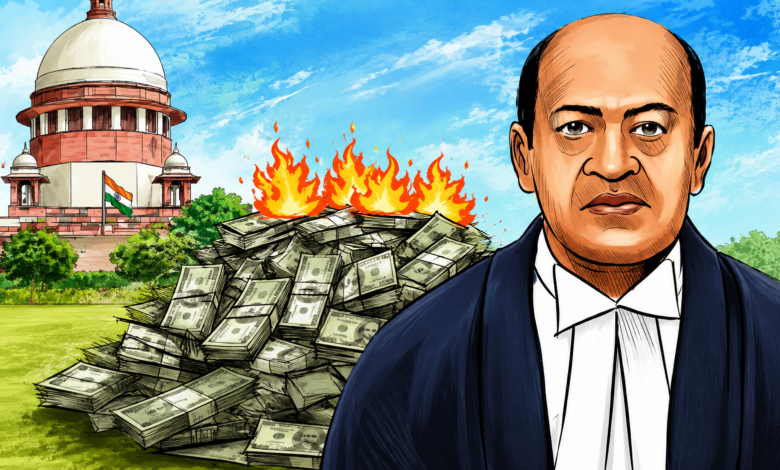
The night of 14 March 2025 a fire broke out at the official residence of Justice Yashwant Varma then a sitting judge of the Delhi High Court at 30 Tughlak Crescent New Delhi. Fire service and police personnel who responded reported seeing substantial quantities of five hundred rupee notes described in testimony as bundles heaps and stacks some burnt half burnt wet and scattered inside a storeroom that formed part of the official residential premises. Photographs and video material later made public corroborated the presence of the currency. The notes were never seized counted or inventoried. By the following morning the evidentiary condition of the storeroom had been disturbed and the currency was no longer available.
Justice Varma was not present in Delhi at the time. He later stated that neither he nor his family had placed any cash in the storeroom and suggested the possibility of a conspiracy or planting. An in house committee constituted by the then Chief Justice of India examined more than fifty witnesses including fire officers police personnel and household staff. That committee concluded that the storeroom was under the covert or active control of the judge and his family and that there was sufficient substance in the allegations to warrant initiation of removal proceedings. The Supreme Court Collegium transferred him to the Allahabad High Court and directed that no judicial work be assigned to him.
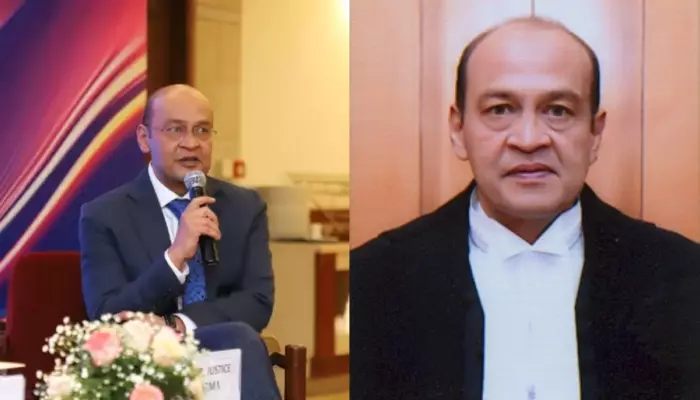
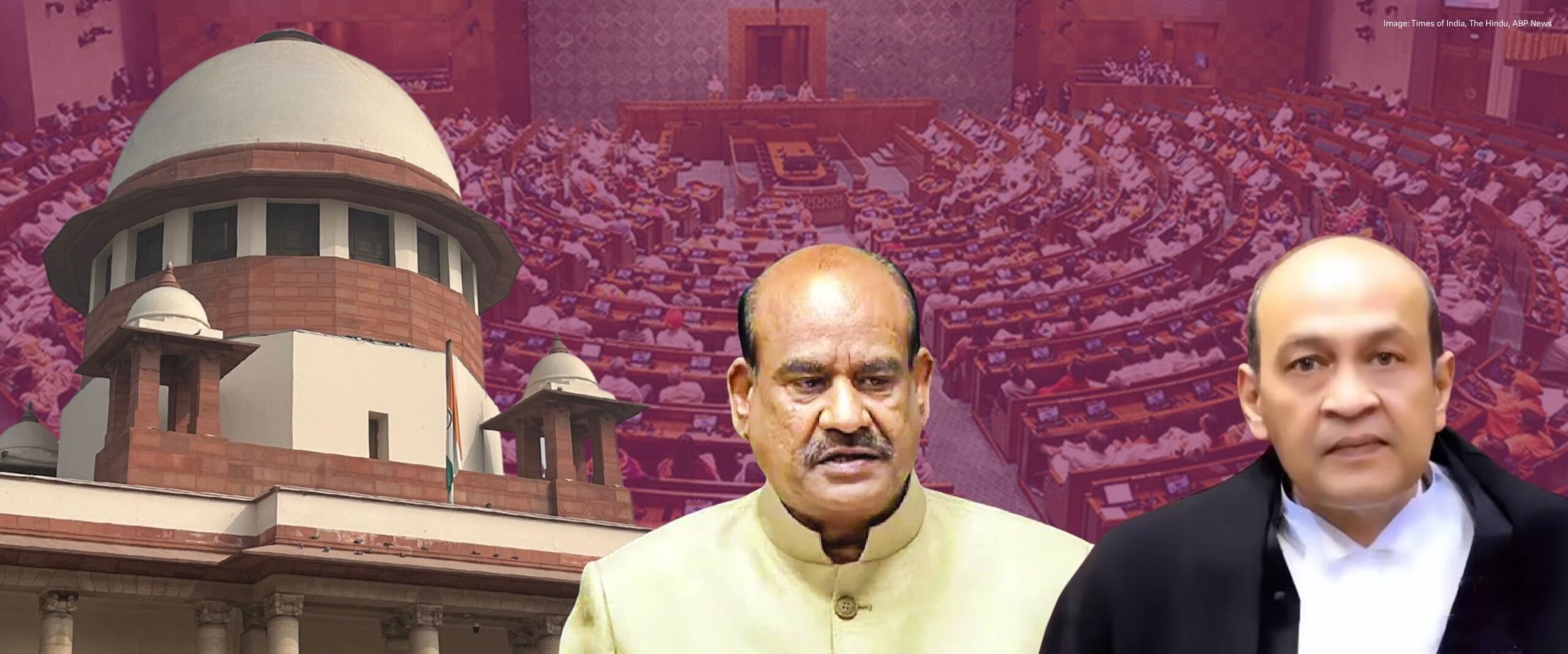
Nearly two hundred members of Parliament from both the ruling side and the opposition later signed a motion seeking his removal under the Judges Inquiry Act 1968. The Lok Sabha Speaker admitted the motion and constituted a three member inquiry committee consisting of a Supreme Court judge a High Court Chief Justice and a distinguished jurist. In August 2026 that committee tabled its report in both Houses of Parliament.
The panel found all three framed charges proved. First substantial unexplained five hundred denomination currency notes were found in the storeroom within the official residential premises and the judge failed to furnish a satisfactory explanation regarding their presence source or ownership. Second material evidence was not secured or preserved the evidentiary condition of the storeroom was disturbed before lawful sealing and inspection and the later non availability of the notes remained unexplained.
The finding rested on failure to preserve and resulting loss of evidence rather than on proof of personal physical removal by the judge. Third the explanations offered particularly the reply dated 22 March 2025 and subsequent stands were evasive incomplete and misleading when tested against the evidence of independent official witnesses and corroborative material. The committee recorded that the explanations did not exhibit the candour transparency and institutional responsibility expected in the circumstances.
Justice Varma resigned in April 2026. Once a resignation becomes effective the primary purpose of a removal motion is rendered moot and the proceedings effectively lapse. This sequence is not unique.
Cash Vs Justice: Blast From The Past
In August 2008 a packet containing fifteen lakh rupees was delivered to the residence of Justice Nirmaljit Kaur of the Punjab and Haryana High Court. The delivery was allegedly intended for another judge of the same court Justice Nirmal Yadav whose name sounded similar.
An FIR was registered the matter was transferred to the Central Bureau of Investigation and a special court eventually tried the case. After more than three hundred hearings spanning roughly fifteen years and involving multiple judges the special CBI court acquitted Justice Nirmal Yadav and the other accused in March 2025 citing procedural lapses in the investigation. An earlier three judge in house committee had concluded that the cash was meant for Justice Yadav but the criminal trial ended in acquittal.
Earlier still Justice V Ramaswami faced removal proceedings in the early 1990s over allegations of extravagant and irregular expenditure on his official residence while he was Chief Justice of the Punjab and Haryana High Court. A parliamentary inquiry committee found him guilty on multiple counts. When the motion reached the Lok Sabha in 1993 the required special majority could not be achieved because members of the then ruling party abstained.
Justice Soumitra Sen of the Calcutta High Court was found by an inquiry committee to have misappropriated funds while acting as a court appointed receiver before his elevation. The Rajya Sabha passed the removal motion but he resigned before the Lok Sabha could vote. Justice P D Dinakaran facing a range of serious allegations including land related charges resigned on the day the inquiry committee under the Judges Inquiry Act was to begin its sittings.
Across the history of independent India no judge of the Supreme Court or a High Court has been successfully removed through the full constitutional process of proved misbehaviour or incapacity followed by addresses of both Houses of Parliament. Motions have been moved several times. Some were rejected at the admission stage some produced inquiry findings of guilt that never secured the required voting majorities and some ended in resignation that rendered further parliamentary action infructuous.
The constitutional threshold is deliberately high. Article 124 clause 4 and the corresponding provisions for High Court judges require a majority of the total membership of each House and a majority of not less than two thirds of the members present and voting. The Judges Inquiry Act 1968 adds the requirement of a three member committee whose finding of guilt is a precondition for the motion to proceed to voting.
Parallel to the formal removal process sits the in house procedure adopted by the Supreme Court in 1997. Under this mechanism the office of the Chief Justice of India receives complaints against sitting judges. Parliamentary data released in early 2026 recorded 8630 such complaints over the decade from 2016 to 2025. The annual numbers fluctuated but rose markedly after the pandemic years reaching 1170 in 2024 and remaining above 1100 in 2025.
The government reply to Parliament supplied the counts but no break up by nature of allegation no information on how many were found frivolous how many led to formal inquiry how many resulted in transfer advice or resignation and no public record of outcomes. Most High Courts publish neither a detailed code of conduct for judges nor the results of any disciplinary steps. Asset declarations remain limited. One systematic review found that only about thirteen percent of High Court judges had their asset details in the public domain with the large majority of those declarations concentrated in three courts.
Case pendency provides structural context. At the end of 2025 more than fifty million cases remained pending across the subordinate courts High Courts and the Supreme Court. Roughly one in three cases in the subordinate judiciary had been pending for more than five years. Long delays create conditions in which litigants may seek informal influence over listing or hearing dates.
Vigilance reports and occasional surveys have recorded complaints of illegal gratification at the level of court registries and clerical staff though systematic data on the higher judiciary remain scarce. The World Justice Project Rule of Law Index has consistently placed India’s score on absence of corruption in the judiciary below the global median. Transparency International perception surveys have similarly registered public concerns especially at the district court level.
These figures do not prove that corruption is rampant among the higher judiciary. They do demonstrate that the mechanisms designed to detect investigate and publicly resolve allegations of financial impropriety operate with extreme opacity and with extremely high thresholds for any visible consequence.
When currency is found inside official residential premises and then disappears before it can be inventoried the absence of a preserved chain of evidence becomes itself a central finding. When thousands of complaints are received over a decade and almost none of the outcomes are published public confidence is inevitably affected. When the only formal route to removal requires bipartisan political will and a special majority that has never been achieved the practical result is that resignation often becomes the effective end of the matter.
The constitutional design deliberately protects judicial independence from executive or legislative interference. That protection is essential. At the same time the same design has produced a system in which serious allegations once raised can remain unresolved in the public domain for years or can end without a conclusive public finding of either guilt or complete exoneration. The Varma inquiry is notable because a parliamentary committee did reach proved findings on the three charges and because the motion enjoyed support across party lines. Even then the resignation intervened.
Similar patterns appear in the limited number of earlier cases that reached public attention. Cash delivered to the wrong residence in 2008 produced a fifteen year criminal trial that ended in acquittal. Financial irregularities alleged against Ramaswami produced a committee finding of guilt that failed on the floor of the House. Misappropriation findings against Sen produced a successful vote in one House followed by resignation. Land and other allegations against Dinakaran produced resignation on the eve of the inquiry. In each instance the institutional response stopped short of a completed removal.
The critique therefore centres not on an assertion that every judge is corrupt but on the observable features of the accountability architecture. Complaint volumes are high while outcome transparency is near zero. Asset disclosure is voluntary in practice for most judges. The in house process remains largely internal. The constitutional removal process is so demanding that it has never produced a completed removal. Evidence that is not immediately secured can vanish and the disappearance itself becomes a charge. These structural characteristics allow individual episodes of unexplained currency or financial irregularity to recur without generating systemic correction visible to the public.
Reform proposals that remain within constitutional bounds include mandatory and timely public disclosure of asset declarations by all higher judiciary judges publication of anonymised statistics on the disposal of complaints received under the in house procedure clearer timelines for the completion of inquiries under the Judges Inquiry Act and stronger protocols for the immediate sealing and forensic preservation of any material found at official residences during emergencies. None of these steps would lower the high threshold required for proved misbehaviour. They would however reduce the opacity that currently surrounds both the receipt of allegations and the handling of physical evidence.
The Indian higher judiciary performs an indispensable constitutional function. Its independence must be preserved. The same independence however cannot become a shield against transparent investigation when substantial unexplained currency appears inside official premises and then disappears before it can be counted. The parliamentary findings of August 2026 the long history of incomplete removal attempts the 8630 complaints whose outcomes remain largely unknown and the persistent gap between public expectation and institutional process together form a data driven case for stronger accountability mechanisms. The alternative is continued erosion of public trust each time a similar episode surfaces and then fades without a conclusive public resolution.