Ferrari’s First EV Was Supposed To Change The Brand Instead It Just Became A $40 Million Collectible Raising A Much Bigger Question About The Prancing Horse
Ferrari's first electric car has just sold for a record $40 million, turning a controversial new model into a collector's trophy. But beneath the headline price lies a bigger question: can Ferrari embrace electric cars, new customers and fresh competition without sacrificing the scarcity and prestige that built its business?

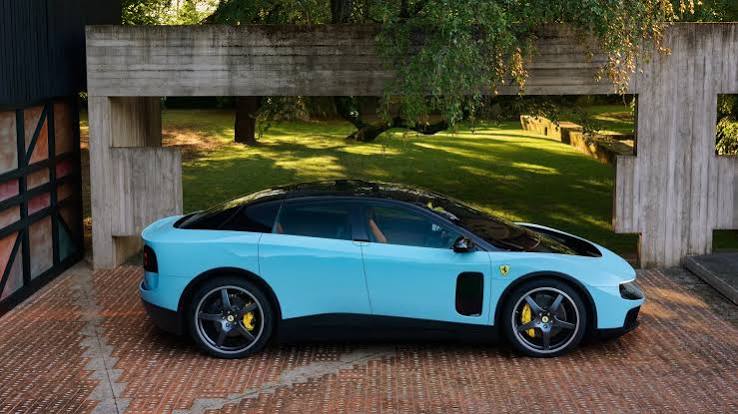
Ferrari’s first electric car has just become the most expensive new car ever sold at auction. The one-off Luce fetched $40 million at RM Sotheby’s in California, more than 35 times the car’s usual price, with the proceeds going to the Ferrari Foundation’s educational programmes.
The car sold was not an ordinary Luce. It was the first production example, finished in a unique white specification and fitted with bespoke components, including special wheels and customised brakes. Sotheby’s described the sale as a rare opportunity to own the first production Ferrari to enter the electric era.
The buyer was not identified.
The result also pushed the Luce well beyond Ferrari’s previous charity-auction record. In 2025, a bespoke Ferrari Daytona SP3 sold for $26 million, with the proceeds also supporting the carmaker’s education initiatives.
The $40 million price tag, however, says little about what a standard Luce costs. This was a one-off collector’s car whose value was driven by its provenance, exclusivity and place in Ferrari’s history.
And that history is significant.
The Luce is the first production Ferrari powered entirely by electricity, marking the company’s entry into a market already dominated by Tesla and a growing field of Chinese and European EV makers.
For Ferrari, however, the car’s journey to the auction block has been anything but straightforward.
The Ferrari That Wasn’t Supposed To Look Like This
The Luce was supposed to mark a new chapter for Ferrari. Instead, its May unveiling triggered an unusually loud backlash.
The criticism was not really about whether Ferrari could build an electric car. It was about whether it should.
For decades, Ferrari has built its identity around dramatic styling, powerful engines, racing heritage and the emotional connection between driver and machine. The Luce challenged several of those conventions at once.
It was electric. It had five seats. And its design moved away from some of the visual cues traditionally associated with the marque.
The Backlash Was Bigger Than Expected
The reaction quickly moved beyond online car forums.
Italy’s deputy prime minister Matteo Salvini criticised the move, while former Ferrari chairman Luca Cordero di Montezemolo warned that the company was potentially putting the identity of the brand at risk.
Ferrari’s share price also fell the day after the launch, adding an investor dimension to what had initially looked like a debate among car enthusiasts.
The underlying concern was simple: if Ferrari changed too much, could it remain Ferrari?
That question matters because Ferrari is not selling an ordinary product. Its customers are buying into decades of history, racing victories and exclusivity. The engine may be part of that experience, but it is also part of the mythology surrounding the badge.
Ferrari’s Answer Was To Keep Moving
Ferrari’s chief design officer Flavio Manzoni pushed back against the criticism, arguing in May that resistance was part of the innovation process and expressing confidence that the car would eventually win people over.
The company also appears to have designed its transition carefully rather than treating the Luce as a wholesale break with its existing business.
That distinction is important.
Ferrari is not attempting to become an electric-car manufacturer in the way Tesla or BYD has. It is trying to introduce electric technology without giving up the scarcity, pricing power and exclusivity that underpin the Ferrari business.
And that brings us to the unusual person involved in shaping how that transition looks.
The Jony Ive Factor, When Ferrari Brought In an Apple Design Mind
The Luce does not just represent Ferrari’s first move into electric cars. It also reflects an unusual design collaboration.
Behind the project is Sir Jony Ive, the British designer best known for shaping the look and feel of Apple’s most iconic products, including the iPhone.
That makes the Luce an interesting departure for Ferrari. The company has spent decades developing a recognisable visual language of its own, one built around low-slung sports cars, aggressive proportions and the unmistakable presence of the prancing horse.
Ive comes from a very different design world.
His work at Apple was built around stripping products down to their essential elements and making technology feel intuitive, desirable and premium. Bringing that philosophy into Ferrari inevitably raises a bigger question about what the company wants its next generation of cars to look and feel like.
The Electric Ferrari Needs More Than A New Powertrain
Moving from petrol to electricity is not simply a matter of replacing an engine with a battery.
Electric cars give designers different possibilities. They have different proportions, different packaging requirements and a different relationship between the mechanical components and the cabin.
That gives Ferrari an opportunity to rethink the car itself. But it also creates a problem.
The more Ferrari changes the design, the interior and the driving experience, the more traditional customers may wonder whether the company is moving away from the cars they fell in love with. That tension sits at the centre of the Luce.
Ferrari has to make an electric car that feels new enough to justify its existence while still feeling sufficiently Ferrari to command the prices its customers are accustomed to paying.
And That Is Where The $40 Million Matters
The extraordinary auction result offers Ferrari something far more useful than publicity.
It provides evidence that, at least at the extreme collector end of the market, a Ferrari does not necessarily need a combustion engine to command an extraordinary price.
The $40 million buyer was not simply purchasing an electric vehicle. They were buying the first chapter of Ferrari’s electric history.
And that distinction could become increasingly important as Ferrari begins to build a business around a very different kind of powertrain.
Ferrari Doesn’t Need To Sell Millions Of Cars, The Business Model Is Built Around Scarcity
To understand why the Luce matters, it helps to understand what Ferrari is actually trying to achieve.
It is not chasing the kind of volumes that define the mainstream car industry.
In 2025, Ferrari shipped 13,640 cars worldwide, slightly fewer than the 13,752 it delivered a year earlier. Yet those relatively small volumes generated €7.15 billion in revenue. Ferrari’s adjusted operating profit margin reached 29.5%, while adjusted EBITDA stood at €2.77 billion, giving the company a 38.8% EBITDA margin.
That is the unusual part of the Ferrari business.
The company does not need to put more cars on the road simply to grow. It can make more money by making each car, each customer and each purchase more valuable.
Ferrari’s market share also needs to be viewed differently from that of a mass-market carmaker.
In its defined Luxury Performance Car Industry, Ferrari held a 23% share across its 25 largest markets in 2024. That market includes two-door luxury sports cars with more than 500 horsepower and a retail price above €180,000. The company also held a 14% share of the broader luxury-performance market when high-riding four-door cars were included.
In other words, Ferrari has managed to capture a significant portion of an extremely expensive niche while keeping production deliberately limited. That is precisely why simply comparing Ferrari’s sales with those of Tesla, Porsche or Mercedes can be misleading.
Ferrari is playing a different game.
The More Important Number Is What Each Customer Is Worth
A large part of that strategy comes from the mix of cars Ferrari sells and the money it can extract from each one.
Personalisation has become increasingly important to Ferrari’s financial performance, while its portfolio also includes special series, supercars and one-off vehicles designed for individual customers. The company describes these unique, tailor-made cars as the highest expression of its personalisation strategy.
The $40 million Luce sits at the extreme end of that philosophy.
It is not representative of Ferrari’s normal pricing. It is representative of what can happen when scarcity, history, personalisation and the Ferrari badge all come together in a single object.
And that is important for the electric transition.
Ferrari does not need its first EV to become a volume seller. It needs the car to prove that the company can introduce a completely different powertrain while preserving the pricing power that has made its business so profitable.
The Luce’s $40 million auction result may be an extreme example, but the principle behind it is very much the same one Ferrari has used for years.
Ferrari’s advantage is not simply that its cars are expensive. It is that the company has built an entire business around making limited supply feel more valuable.
That strategy is set to continue. Ferrari says it plans to preserve exclusivity by keeping each model in limited volumes, while introducing an average of four new cars a year between 2026 and 2030. Its 2030 line-up is expected to comprise roughly 40% combustion-engine cars, 40% hybrids and 20% electric models.
The company is therefore not treating electrification as a reason to suddenly increase production. Quite the opposite.
Personalisation is becoming an increasingly important part of the equation.
Ferrari says 100% of its clients’ cars are now uniquely personalised, while it plans to expand its Tailor Made operations with new centres in Tokyo and Los Angeles. The company also says it had 90,000 active clients as of its 2025 strategy update, with 45% of its collectors being new since 2022.
That helps explain why Ferrari can grow without dramatically increasing the number of cars it sells.
A customer can spend more on the car they already intend to buy. A limited-edition model can command a much higher price. A bespoke commission can turn an already expensive Ferrari into something effectively unique.
The Luce auction simply takes that model to its most extreme point.
And Ferrari Wants Even More From The Same Model
Ferrari’s 2030 plan targets around €9 billion in annual revenue and at least €3.6 billion in EBITDA, with growth expected to come largely from a richer product mix and greater personalisation rather than simply higher volumes.
That is the key to understanding Ferrari’s electric strategy. The company does not need the Luce to become the next Tesla Model 3. It needs wealthy customers to look at an electric Ferrari and think: I still want that one.
If Ferrari can make that happen, the powertrain may change without the business model having to.
So Who Is Ferrari Actually Competing With?
Ferrari’s biggest competitive advantage is also what makes comparisons with other carmakers difficult.
In its own definition of the luxury performance market, Ferrari held a 24% market share across its 25 largest markets in 2025. But the company is quick to point out that market share is not its main objective. Ferrari deliberately manages supply against demand to protect exclusivity and pricing power.
That means Ferrari does not need to outsell Lamborghini, Porsche or Aston Martin to win. It needs to remain the car that customers are willing to wait for and pay more for.
Ferrari’s conventional competitors include Lamborghini, McLaren, Aston Martin, Rolls-Royce and Bentley, while Porsche, Mercedes-Benz and Land Rover compete with it in some segments.
These brands are all fighting for broadly the same pool of wealthy customers, but their strategies are increasingly diverging. Some are pushing deeper into SUVs. Others are expanding hybrids or reconsidering the speed of their EV transition.
Ferrari, meanwhile, is trying to keep all three technologies alive.
Its 2030 plan envisages a product mix of combustion, hybrid and fully electric cars rather than an immediate switch to one powertrain.
The EV Competition Is A Different Problem
Then there is the electric competition.
Ferrari is entering a market where companies such as Tesla and a growing group of Chinese EV manufacturers have already spent years developing electric technology, software and battery expertise.
But Ferrari does not need to beat them on range, production volumes or charging infrastructure. Its challenge is much narrower and arguably much harder.
Can Ferrari convince a customer who could buy almost any electric performance car that this is the electric car they must have?
That is why the Luce’s early sales matter.
The car reportedly reached Ferrari’s target of just under 500 units for 2026 within two months of launch, with strong demand from China.
For a company that sold 13,640 cars globally in 2025, 500 cars is hardly transformative in volume terms. But that is precisely the point. Ferrari isn’t trying to turn the Luce into an electric mass-market success. It is testing whether the Ferrari badge can carry its enormous pricing power into the electric era.
China Could Be The Surprise In Ferrari’s EV Bet
If Ferrari’s first electric car was meant to be a cautious experiment, the early response has been difficult to ignore.
The Luce reportedly reached its unofficial 2026 sales target of just under 500 cars within two months of launch, with strong demand from China helping drive the result. Ferrari has not publicly disclosed the target, but the figure was reported by the Financial Times.
That is significant not because 500 cars would transform Ferrari’s business. It would not. Ferrari delivered 13,640 cars globally in 2025, meaning even 500 Luce deliveries would represent only a small fraction of its annual volumes.
What matters is who is buying it.
China has become one of the world’s most important EV markets, with consumers far more accustomed to electric vehicles than Ferrari’s traditional customer base may be. That could give the Luce an advantage.
The reported demand from China suggests Ferrari may be finding customers who do not see an electric powertrain as a betrayal of the brand’s history. Instead, they may see it as the next piece of technology to have – particularly wealthy buyers who are already comfortable with high-end electric vehicles.
That also gives Ferrari access to a potentially different customer profile.
The Financial Times reported that Ferrari was targeting a new generation of wealthy buyers in markets including China and technology hubs such as Silicon Valley, where the response from some tech entrepreneurs has reportedly been positive.
But Ferrari Is Not Betting The Company On The Luce
The numbers make that clear. Ferrari is reportedly targeting around 2,500 Luce cars by 2030, or roughly 600 a year. That would still represent only around 5% of the company’s annual sales at current volumes.
So even if the Luce succeeds, Ferrari will remain overwhelmingly a business built around combustion engines and hybrids for years to come.
The strategy is much more controlled than that of a conventional carmaker rushing to replace its entire fleet. Ferrari is effectively asking a much smaller question: Can it attract a new generation of wealthy customers to the brand without alienating the ones who built its reputation?
So far, the answer from the Luce’s early sales appears to be yes.
But the bigger test will be whether Ferrari can turn that early interest into a profitable electric business while maintaining the extraordinary margins that make its model so different from almost every other carmaker.
Ferrari Is Not Going All-In On Electric Cars
The Luce may be Ferrari’s biggest technological shift in decades, but it is not a sign that the company is preparing to abandon petrol engines.
Ferrari’s own 2030 plan makes that clear. The company expects its line-up by the end of the decade to comprise roughly 40% internal-combustion cars, 40% hybrids and just 20% fully electric vehicles. It also plans to launch an average of four new cars a year between 2026 and 2030.
That makes the Luce less of an overnight transformation and more of a carefully controlled experiment. Ferrari is giving electric cars a place in its portfolio without allowing them to define the entire business.
The scale is revealing.
Ferrari sold 13,640 cars in 2025, while the Luce reportedly reached its first-year target of just under 500 cars within two months of launch. Ferrari has a longer-term target of around 2,500 Luce cars by 2030.
Even if Ferrari reaches that target, the Luce would remain a very small part of the company’s overall sales.
That is deliberate.
Ferrari’s chief executive Benedetto Vigna has said the company expects to preserve its industry-leading margins despite the transition to electric vehicles, helped by keeping volumes limited.
The company therefore does not have to convince millions of drivers to go electric. It only has to convince a few hundred wealthy customers at a time.
Ferrari’s Bigger Bet Is On Profitability
And that strategy appears to be working for the broader business.
Ferrari generated €7.15 billion in revenue in 2025, with an operating profit of €2.11 billion and a 29.5% operating margin. Its order book extends through the end of 2027.
In July 2026, Ferrari raised its full-year revenue outlook to around €7.6 billion and lifted its adjusted EBIT forecast to at least €2.26 billion, with stronger-than-expected demand for personalisation helping drive the upgrade.
That is perhaps the most important detail in the entire EV story. Ferrari isn’t trying to maximise the number of electric cars it sells. It is trying to make sure that whatever technology sits underneath the bonnet, the Ferrari business remains extraordinarily profitable.
And if the Luce can do that while bringing a new generation of wealthy buyers into the brand, Ferrari may have found a way to change its cars without fundamentally changing its business.
Ferrari’s Order Book Is Already Doing The Heavy Lifting
The company entered 2026 with an order book extending towards the end of 2027, giving it considerable visibility even as it changes its product line-up.
That gives Ferrari something many automakers do not have: the ability to experiment with new technology without putting the entire business on the line.
The Luce can be limited. Hybrid models can continue. Combustion-engine cars can remain part of the portfolio. And ultra-expensive limited editions can continue pushing margins higher.
In the second quarter alone, Ferrari’s adjusted EBITDA rose 7% to €755 million, despite deliveries falling year-on-year. The improvement was helped by the €3.6 million F80 supercar and increased customer spending on personalisation.
The Real Test Comes Over The Next Four Years
The Luce is therefore only one piece of a much larger transition.
Ferrari has already demonstrated that customers will pay enormous amounts for exclusivity. It now has to demonstrate that the same customers will pay those prices for a Ferrari whose powertrain is fundamentally different.
And the early signs are encouraging.
Ferrari says it is “very pleased” with Luce orders, with interest coming from both existing customers and new buyers. The company has also said the response has not altered its broader EV strategy.
That matters because Ferrari’s EV strategy was never about replacing petrol cars overnight.
It was about finding out whether electric technology can coexist with the thing Ferrari has spent decades building.
- Pricing power.
- Scarcity.
- Exclusivity.
- And above all, the belief that a Ferrari is worth paying more for simply because it is a Ferrari.
Can Ferrari Change Without Losing What Makes It Ferrari?
The $40 million Luce is not proof that Ferrari has suddenly cracked the electric-car market. It is something more interesting. It is proof that Ferrari’s history can make even a controversial new technology extraordinarily valuable.
The auctioned car was a one-off “Chassis 0”, created through Ferrari’s Tailor Made programme, and the entire $40 million proceeds will go to the Ferrari Foundation. The result set a new record for the highest price paid for a new car at auction, surpassing the $26 million paid for the bespoke Daytona SP3 in 2025.
That does not mean a regular Luce is suddenly worth $40 million. It isn’t. The real significance lies elsewhere.
The Last Bit, Ferrari Is Trying To Change The Car Without Changing The Feeling
For decades, Ferrari’s formula has been remarkably consistent. Limited supply. High prices. Strong performance. Racing heritage. Personalisation. And, above all, the feeling that owning one puts you inside a club that very few people can enter.
Electric power challenges one part of that formula.
The Luce has to prove that Ferrari can remove the combustion engine without removing the emotional and financial reasons people want a Ferrari in the first place.
So far, the early response has given the company reason to be confident. Ferrari has said it is pleased with demand for the Luce, while the car reportedly reached its initial sales target far faster than expected.
But the real test will not be one spectacular auction. It will be what happens when Ferrari has an entire generation of electric and hybrid cars on sale.
That may be the biggest lesson from the auction. The buyer did not spend $40 million because the Luce has an electric powertrain. They spent it because this particular Ferrari is the first of its kind.
It is a piece of Ferrari history, wrapped in a bespoke specification, with a provenance that can never be replicated.
And that may be exactly how Ferrari intends to approach the electric era.
The technology can change. The customer can change. The design can change. But if Ferrari can preserve the scarcity and desire attached to the badge, the business underneath may remain remarkably familiar.
The Luce therefore represents something bigger than Ferrari’s first electric car. It is Ferrari testing whether the world’s most powerful luxury-car badge can survive the one thing it has never had to give up before – the engine.