645-Crore Question: How The State And Central Machinery Collectively Failed The Public In The IDFC Bank Scam

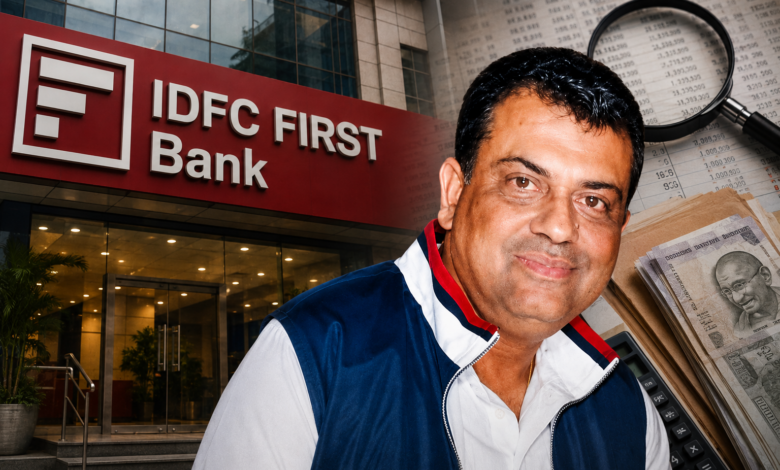
There are scams that happen despite the system, and there are scams that happen because of the system. The IDFC First Bank fraud unfolding in Haryana and Chandigarh belongs firmly to the second category. This was not a lone bank manager pulling off a clever heist in the dead of night.
It was a slow, sustained, and apparently routine siphoning of public money. The money meant for schools, pollution control, panchayats, municipal corporations, and renewable energy projects, that continued for roughly a year, across at least eight government departments and two Union Territory bodies, involving senior IAS officers, bank employees, jewellers, real estate developers, and a small constellation of shell companies. By the time it was caught, the figure being discussed by the CBI and the Enforcement Directorate had climbed past Rs 645 crore.
That number deserves to be sat with for a moment, because the scale of it is not just financial, it is institutional. A fraud of this size and duration does not survive on the ingenuity of the fraudsters alone. It survives on the indifference, negligence, or complicity of the very machinery that exists to prevent it. This write-up is an attempt to ask, plainly and without theatrics, what that machinery was doing while public money disappeared into fixed deposits that were never created, accounts that were never approved, and companies that appear to have existed for no purpose other than to make stolen money look clean.
It is important to be precise about what is established fact and what remains allegation. Several officers named in this piece are currently facing investigation, and in some cases chargesheets, from the CBI and the ED under the Prevention of Money Laundering Act. As per Indian law, an accusation is not a conviction, and due process must run its course. But the pattern that emerges from official press releases, court filings, and reporting from multiple credible outlets is itself worth examining, not to pronounce guilt, but to ask hard questions about how the state’s financial architecture allowed this to happen, and kept allowing it, for far too long.
Anatomy of a Preventable Disaster: How Public Money Was Allowed to Vanish in Plain Sight
The mechanics of the fraud, as laid out by the Enforcement Directorate and the CBI, are almost banal in their simplicity, which is precisely what makes them so damning. Government departments were meant to park surplus funds as fixed deposits with banks. Instead, according to the ED’s press release following its March 2026 search operations, the accused persons diverted these government funds without any authorisation, even though the money was supposed to have been kept safely as fixed deposits.
The modus operandi, once it is spelled out, should embarrass every layer of oversight that was supposed to catch it. Officials at IDFC First Bank’s Sector-32 branch in Chandigarh, most prominently a former branch manager and a relationship manager at AU Small Finance Bank, allegedly lured government departments with a very high interest rate to park idle funds, an offer that should itself have triggered scrutiny, since interest rates that far outstrip market norms are a classic red flag in banking fraud.
Deposits were promised. Deposits were never made. Instead, funds were routed through a shell entity, Swastik Desh Projects, before being layered through the accounts of jewellers to simulate legitimate gold purchases and, from there, into real estate ventures, luxury property, and, as investigators allege, suitcases of cash.
What should alarm the public even more than the fraud itself is how it was discovered. It was not caught by an audit. It was not caught by the Reserve Bank of India’s supervisory mechanisms, nor by the state’s own finance department, nor by any of the internal control systems that are supposed to exist precisely for this purpose. It came to light almost by accident, when an official in the Development and Panchayats Department tried to close an account and transfer its balance to another bank, only to discover that the amount on paper bore no relationship to the amount actually sitting in the account. That is not a system working. That is a system getting lucky.
Once one department’s discrepancy surfaced, the dam broke. Similar gaps turned up in the Haryana State Pollution Control Board, the Haryana School Shiksha Pariyojna Parishad, the Haryana State Agriculture Marketing Board, the Municipal Corporation of Panchkula, and eventually in Chandigarh’s own civic bodies — the Chandigarh Smart City Limited, the Municipal Corporation Chandigarh, and CREST, the Chandigarh Renewable Energy and Science & Technology Promotion Society. Eight Haryana departments. Two Chandigarh bodies. One bank branch. Roughly a year of undetected theft.
The most damning detail in the CBI’s own account of the Pollution Control Board case is not the amount lost, though at approximately Rs 169 crore, it was the single largest departmental loss in the entire scam, but how the account itself came into existence.
According to the CBI, the account through which HSPCB’s funds were routed was opened in what the agency itself has described as a clandestine manner, without any documented approval anywhere in the department. No file. No sanction. No trail. And in a detail that reads less like negligence than design, the mobile number registered against that account did not belong to any HSPCB employee — it belonged, investigators allege, to someone entirely outside the department, seemingly to keep transaction alerts away from anyone who might have noticed something was wrong.
This is the part that ordinary citizens are entitled to be furious about. An account holding public money, running for the better part of a year, generating fraudulent debit transactions large enough to empty out Rs 169 crore, and not a single internal check — not the treasury, not the finance department, not the board’s own accounts wing — flagged it until someone stumbled onto it while trying to shut the account down. If that is not an indictment of the state’s financial control systems, it is hard to imagine what would be.
The Bureaucracy That Looked Away: Sanctions, Suspicions, and a Culture of Institutional Silence
If the first failure was procedural, the second is far more troubling. It is a failure of judgment, and in some cases, according to the CBI’s own allegations, of deliberate favouritism by the very officers entrusted with safeguarding public funds.
Consider the case of the CBI’s allegations against the officer who handled investment decisions for the Pollution Control Board. According to the agency, IDFC First Bank had at one point been expressly placed on an exclusion list for the board’s investment process — and yet, the CBI alleges, quotations from that same excluded bank were repeatedly entertained and accepted anyway.
The agency has gone further, alleging that a quotation letter submitted in support of these investment decisions bore no official stamp, no branch identification, and no name of any signing bank official — a document so bare of institutional accountability that its acceptance, if the allegation holds, would represent an almost wilful abandonment of due diligence. The CBI has also alleged that competing banks’ quotations were misrepresented to make IDFC First Bank appear more favourable, and that a further Rs 8 crore in surplus funds was parked in the bank’s savings account without even the formality of inviting competing quotations, on nothing more than an unverified assumption that it offered the best rate.
If these allegations are borne out, what they describe is not a system that was tricked. It is a system that was, at least at points, walked through the front door. Then there is the question of what happened once the alarm was raised. This is arguably the most indicting part of the entire episode, because it does not require proving intent to defraud — it only requires looking at timelines. IAS officer Pankaj Aggarwal, according to reporting, was suspected in connection with the scam and an FIR by the State Vigilance and Anti-Corruption Bureau had already been registered by 23 February 2026.
And yet, just over three weeks later, on 19 March, he was appointed Principal Secretary of Irrigation and Water Resources, Adviser to the Haryana Saraswati Heritage Board, and Principal Secretary of Mines and Geology — despite the fraud investigation already being underway. A system with functioning internal accountability does not promote or reassign officers under active investigation for a public-money scam into fresh positions of financial responsibility. That this happened is, on its own, a fair basis to question whether Haryana’s administrative machinery treats corruption allegations against senior officers as a serious disqualifier, or as a temporary inconvenience to be managed quietly.
The pattern of institutional slowness continues even after suspects went missing. Pardeep Kumar, the former Member Secretary of the Haryana State Pollution Control Board and the officer accused of overseeing the single largest departmental loss in the scam, was reportedly suspended in April 2026 after his alleged involvement came to light. Yet he was not arrested until the very last day of his government service — 30 June 2026, the day of his superannuation — after having reportedly gone off the grid, with his phone switched off and his residence unattended for days, while the CBI attempted to locate him.
An accused officer facing serious allegations was able to evade a central investigating agency for an extended period, right up until his retirement, at which point the practical and pension-related consequences of any eventual action would look very different than if he had been apprehended while still in service. Whether that timing was coincidence, administrative sluggishness, or something else is a fair and necessary question — not an accusation, but a question the system owes the public an answer to.
It is also worth noting, in fairness, that Kumar’s legal counsel has sought anticipatory bail on the ground that he was not solely responsible for these decisions and that, as Member Secretary, he functioned under the supervision of the board’s chairman — a defence that will be tested in court, and one that itself points to a structural question this article will return to: in India’s bureaucratic hierarchies, where does individual accountability actually sit when funds are diverted through an office rather than an individual?
By the time the CBI’s investigation had widened, eight IAS officers were reported to be under the scanner across various batches and seniorities — from a 1991-batch officer who chaired the Pollution Control Board when the funds were first deposited, to a 2012-batch officer arrested for the Municipal Corporation Panchkula losses. That range — spanning more than two decades of service seniority — is itself a signal. This was not the isolated lapse of one rogue official. It was a fraud that moved comfortably across departments, across officer generations, and across the ordinary boundaries that are supposed to separate one government body’s finances from another’s.
Politics Over Probity: When an Investigation and an Election Collided
No honest accounting of institutional failure in this case can avoid the moment where the scam and electoral politics intersected; because it happened in full public view, and it raises questions that go beyond financial mismanagement into the territory of institutional integrity itself. Pankaj Aggarwal, already under a vigilance FIR in connection with the bank fraud, was appointed Returning Officer for the March 2026 Rajya Sabha elections in Haryana, a role of significant constitutional weight, responsible for overseeing the conduct and counting of one of the state’s most closely watched electoral contests.

That election became mired in controversy of its own, with the Congress party alleging that votes cast for its candidates were arbitrarily rejected while contested votes favouring the BJP-backed independent candidate were accepted. The party went so far as to draw a parallel with the widely reported Chandigarh mayoral election controversy involving returning officer Anil Masih, and submitted a memorandum to the Haryana Governor alleging that Aggarwal had acted with what it called deliberate arbitrariness.
Set aside, for a moment, which political party’s account of the vote-counting dispute one finds more persuasive, that is genuinely contested terrain and reasonable people can disagree on it. What is not contested is the sequence of events: an officer already under investigation for a public funds scam was handed one of the most sensitive constitutional responsibilities in the state’s electoral calendar, just weeks after the fraud FIR against him was registered.
Congress leaders have publicly alleged that the government “used” a compromised officer for electoral advantage, precisely because his vulnerability to the ongoing probe made him more, not less, pliable to political direction. The state government has not offered a comparably detailed public explanation of why an officer under active vigilance investigation was considered suitable for a Returning Officer’s role at all.
This is where the “state and central machinery” in question stops being an abstraction and becomes a specific, answerable set of choices. Someone decided to post Aggarwal as Principal Secretary in March 2026, after the FIR. Someone decided he was fit to be Returning Officer for a Rajya Sabha election. Those were not accidents of bureaucratic rotation; they were decisions, made by named authorities, that either reflect a genuine failure to connect an ongoing corruption investigation to a live administrative appointment, or reflect something considerably less innocent.
Both possibilities are troubling. One suggests a state machinery so poorly coordinated that its vigilance wing and its appointments desk do not talk to each other. The other suggests a machinery that coordinates just fine, but chooses political convenience over institutional propriety when it counts.
The Congress’s subsequent political response, demanding a white paper on how every government department, board, corporation, and autonomous body across Haryana has parked public funds, and questioning why no departmental action had been initiated against any of the accused officers even after chargesheets were filed, is worth taking seriously not because of who is asking it, but because of what it is asking.
It is, at its core, a demand for basic transparency: which department deposited how much, in which bank, under what approvals, and whether prescribed financial and RBI-linked procedures were actually followed. That such a basic demand needs to be made publicly, months into a scam of this size, says something uncomfortable about how little transparency exists by default.
It is only fair to note that opposition parties have an obvious political incentive to amplify a scandal of this nature, and that public criticism from a rival party is not, by itself, evidence of wrongdoing. The state government, for its part, did refer the matter to the CBI and has suspended several implicated officers, actions that should be acknowledged rather than waved away.
But acknowledging those steps does not settle the deeper question this section raises: whether the machinery that allowed a vigilance-flagged officer to preside over a state election in the first place was functioning as designed, or whether institutional safeguards were quietly set aside because the political stakes of that particular election mattered more, in that moment, than the optics, or the ethics, of the appointment.
The Cost of Complicity: What 645 Crore Could Have Built, and What Society Actually Lost
It is easy, in the language of CBI press releases and court filings, for a number like “Rs 645 crore” to become abstract; a statistic to be cited and then forgotten. It should not be. This was not anonymous wealth. It was money drawn from the specific accounts of the Haryana State Pollution Control Board, the Haryana School Shiksha Pariyojna Parishad, the Haryana State Agriculture Marketing Board, the Development and Panchayats Department, the Municipal Corporation of Panchkula, and Chandigarh’s renewable energy and smart-city bodies.
Every one of those names corresponds to a public function that ordinary people depend on- school infrastructure, pollution monitoring in a region that regularly chokes under some of the worst air quality in the world, agricultural marketing support for farmers, panchayat-level rural development, municipal services, and renewable energy promotion in a country that has publicly committed to an ambitious clean-energy transition.
When Rs 169 crore vanishes from a pollution control board’s account, it is fair to ask what monitoring stations went unbuilt, what enforcement staff went unhired, what compliance mechanisms went unfunded, in a state that sits at the heart of North India’s annual air quality crisis. When tens of crores vanish from a school education and agriculture account, it is fair to ask what infrastructure projects, what farmer welfare schemes, what classroom upgrades were quietly deprioritised or delayed because the money that was supposed to be earning safe interest in a fixed deposit was instead being funnelled through jewellers’ accounts to simulate gold purchases that never happened.
When a renewable energy promotion society’s funds are diverted, it is fair to ask how many solar or clean-energy initiatives, in a period when climate commitments are being loudly proclaimed at every international forum, were quietly starved of capital because that capital had already been stolen.
This is the actual, tangible cost of the scam — not merely a dented balance sheet, but a slow erosion of the state’s capacity to do the things it exists to do. And there is a second, less visible cost that may prove even more corrosive over time: the erosion of public trust in the basic promise that government money, once collected through taxes and cesses from ordinary citizens, will be used for the purposes it was collected for.
Every taxpayer who dutifully pays into a system that allows 645 crore to disappear through fraudulent debit notes and forged fixed deposit receipts is entitled to ask a simple, unglamorous question: if this money can vanish so easily from eight different departments, what confidence should anyone have in the departments that have not yet been audited closely enough to catch a similar fraud?
There is also a quieter, human cost buried in the investigation’s details that deserves attention: the funds allegedly did not simply vanish into the ether. According to investigators, a substantial share was allegedly layered through jewellers to simulate gold purchases, and channelled into real estate ventures, hotel and property development projects in Mohali, apartment schemes, and other private commercial ventures, while proceeds were also allegedly diverted directly into the personal accounts of some of the accused and their family members.
Public money, in other words, does not appear to have simply disappeared; on the allegations as they currently stand, it appears to have been converted, allegedly, into private wealth — glittering, tangible, and enjoyed, while the departments it was stolen from continue to operate on tighter budgets than they should have needed to.
It would be too simple to reduce this to a morality tale about individual greed, however. The deeper cost to society is systemic; where every rupee that a state government must now spend on forensic audits, legal proceedings, CBI and ED investigations, and administrative reshuffles triggered by this scam is itself a rupee that is not being spent on the public services those departments were created to deliver. The scam, in other words, keeps costing the public even after the fraud itself has stopped, through the sheer administrative and legal weight of cleaning it up.
Accountability on Paper, Impunity in Practice: Why the System Still Protects Its Own
The final, and perhaps most uncomfortable, question this case raises is not about the individuals accused, but about the machinery around them, because that machinery has, so far, moved with a caution and slowness that sits oddly against the scale of what is alleged to have happened.
Consider the sequencing. The fraud is reported to have run for roughly a year before detection. Once detected, it took the state government weeks to even refer the case to the CBI, initially routing it through the state’s own Vigilance and Anti-Corruption Bureau before escalating it. Even after the CBI had filed seventeen chargesheets in the Haryana leg of the case alone — against bank officials, government servants, private individuals, and shell companies — reports as recent as this scam’s later stages note that formal chargesheets against the implicated IAS officers themselves were still pending, even as arrests proceeded under separate legal provisions.
Congress leaders have publicly and pointedly asked why no departmental action, the internal administrative process that exists independently of criminal prosecution, had been initiated against any of the named officers well after their alleged roles became public knowledge. That is not an unreasonable question. Departmental proceedings do not require a criminal court’s verdict; they exist precisely so the state can act on internal probity concerns on its own timeline. Their apparent absence, so far into this case, suggests a machinery more comfortable delegating accountability to outside investigators than exercising its own oversight function.
This selective pace of accountability becomes starker when set against how swiftly the machinery moved when its own political interests were, arguably, at stake. An officer already under a corruption FIR was cleared for a sensitive Returning Officer’s role within weeks. A retiring officer accused of overseeing the scam’s single largest departmental loss was tracked down and arrested only on the literal last day before his pension and service benefits would have crystallised in the ordinary course.
These are not proof of a conspiracy — they may well be nothing more than bureaucratic coincidence and institutional sluggishness, and it would be irresponsible to assert otherwise without more evidence than is currently public. But they are, at minimum, evidence of a system in which the wheels of internal accountability turn markedly slower than the wheels of political and administrative convenience. And that asymmetry, more than any single officer’s alleged wrongdoing, is what the public has the strongest claim to be angry about.
It should also be said, in fairness, that the CBI’s and ED’s own investigative work in this case, where more than ninety bank accounts frozen, nineteen premises searched in a single coordinated operation spanning five cities, seventeen chargesheets filed within months, and multiple arrests including of senior serving and retired officers — represents a level of institutional response that should not be dismissed. Central investigating agencies have, on the available record, pursued this case with real intensity once it was formally in their hands.
The criticism this article makes is not that no one is investigating; it is that the preventive machinery, the layer of financial rules, sanction requirements, internal audits, and administrative vigilance that was supposed to stop this before it happened, or catch it within weeks rather than a year — failed almost completely, and that the disciplinary machinery within the state government, as distinct from the criminal justice process, has moved with visible reluctance even as the criminal case has advanced.
That distinction matters because it points to where reform actually needs to happen. Punishing individuals after the fact, however necessary, does not fix a system that allowed an account to be opened without documented approval, that allowed a bank explicitly placed on an exclusion list to keep receiving business anyway, that allowed a state’s largest pollution-control account to be drained of Rs 169 crore without a single internal red flag, and that allowed an officer under an active corruption FIR to be handed a fresh position of financial and constitutional trust weeks later. Those are not failures that arrests alone will fix.
They require the state to ask itself, honestly and publicly, why its own internal controls — audit cycles, sanction hierarchies, treasury reconciliation, RBI-aligned deposit rules — did not do the job they exist to do, and why political and administrative convenience appears, on the available evidence, to have repeatedly taken precedence over probity.
Conclusion: A Scam With a Thousand Small Signatures
The IDFC First Bank scam will likely be remembered, in the retelling, as a story about a handful of dramatic characters — an absconding hotelier, a bank manager who resigned quietly before the scale of the fraud emerged, an IAS officer arrested on the very day of his retirement. But the more important story, and the one least likely to make for a gripping headline, is the story of everything that had to go quietly wrong, again and again, for a fraud of this magnitude to run undetected for as long as it did.
It required a bank explicitly placed on an exclusion list to keep winning government business anyway. It required an account to be opened without any recorded departmental approval. It required a state’s finance department, treasury systems, and audit mechanisms to miss the diversion of hundreds of crores across eight separate departments for the better part of a year.
It required, at least according to the allegations now before the courts, officers to look past irregular quotations, unstamped documents, and unusually generous interest rates without asking the obvious questions. And it required, after the fraud was finally caught, a state machinery that moved fast enough to appoint an already-suspected officer to a sensitive election role, but has moved considerably more slowly on internal departmental accountability for the underlying fraud itself.
None of this required a criminal mastermind. It required, at every level, a small failure of diligence, a small deferral of responsibility, a small assumption that someone else would catch what one’s own office had missed. That is what makes this case worth examining as more than a crime story — it is a case study in how institutional accountability quietly erodes, one overlooked sanction and one convenient appointment at a time, until Rs 645 crore of public money is simply gone.
The investigation is ongoing, more arrests are reportedly not ruled out, and the courts will, in time, determine individual guilt or innocence under due process of law. But the public does not need to wait for a final verdict to ask the state and central machinery a simpler question: not just who took this money, but why it was ever this easy to take.