Why Indian Judiciary Can Not Take Action On BPTP & Its Directors Like China Took On Evergrande
Why The BPTP Directors Are Still Roaming Free Despite Multiple Raids, Complaints, FIR, Attachment Of Property & Consumer Complaints

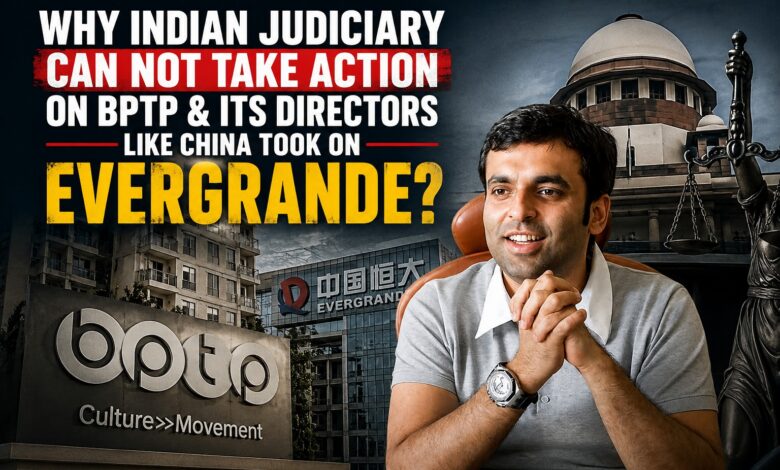
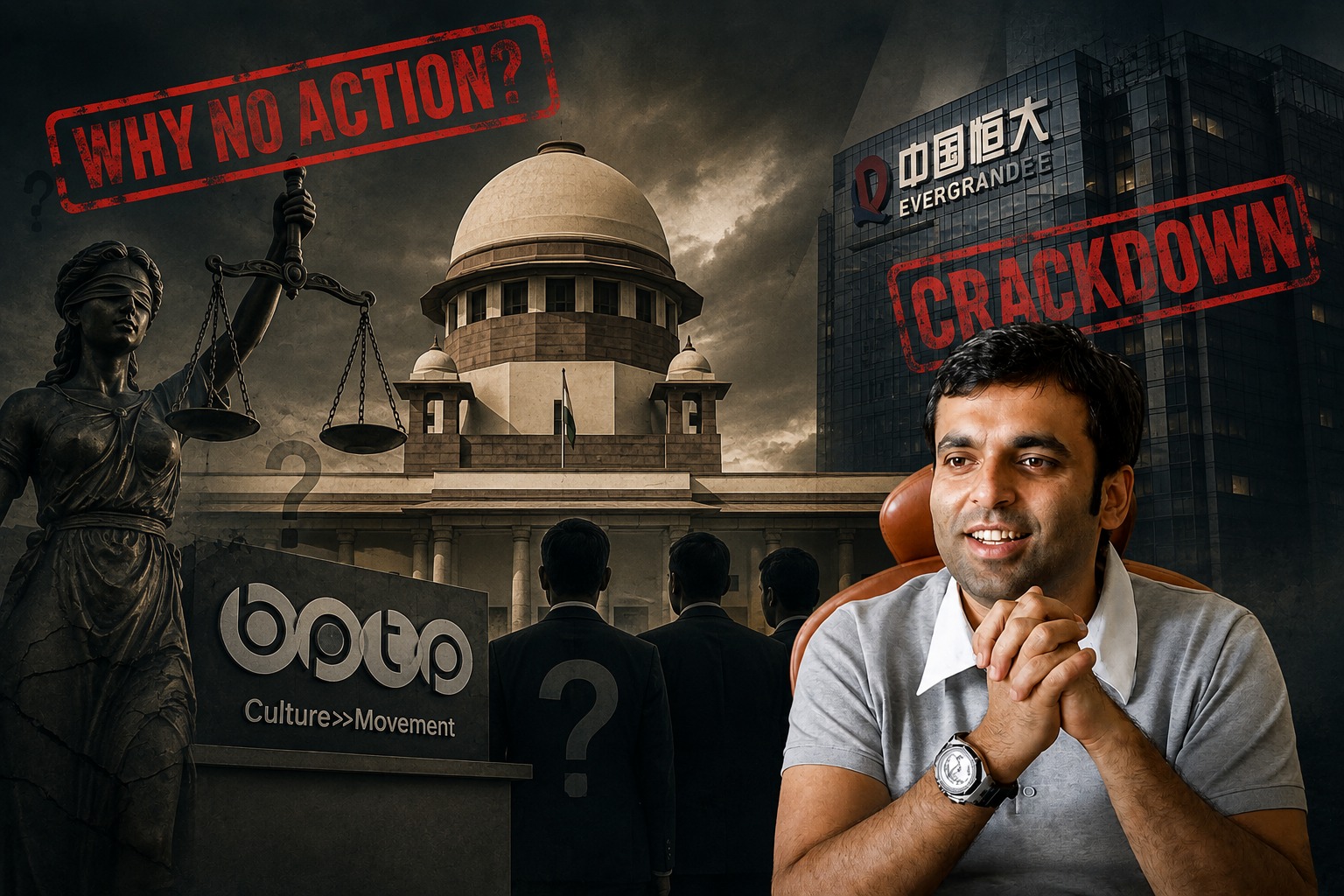
In August 2026, a Chinese court sentenced Hui Ka Yan, founder of Evergrande, to life imprisonment and ordered the confiscation of all his personal assets. The court described the scale of the fraud, the unfinished projects, the diversion of homebuyer money and the social harm as exceptionally large and heinous. The message was unambiguous: when a builder takes the life savings of ordinary citizens and leaves them without homes, the state will strip him of freedom and wealth.
In India, the public record against BPTP Limited and its Chairman and Managing Director Kabul Chawla tells a very different story.
For more than fifteen years, BPTP has faced a continuous stream of criminal complaints, FIRs, consumer cases, RERA proceedings, Income Tax searches, an Enforcement Directorate FEMA investigation and, most recently, a CBI FIR registered under the Supreme Court’s monitoring of the builder-bank nexus. Yet the directors remain free. No life sentence. No full confiscation of personal wealth. No decisive end to the suffering of the thousands of homebuyers who paid almost the entire price of their flats and plots and are still waiting.
The documented past that refuses to disappear
The record begins early. In December 2011, a Patiala House Court issued a non-bailable warrant against Kabul Chawla in a case involving alleged cheating and criminal breach of trust over a commercial plot transaction of approximately ₹40 lakh. Public reporting indicates that the warrant has remained outstanding for more than fourteen years.
In 2014, a Faridabad court directed registration of an FIR against Chawla and a BPTP executive after buyers alleged that they had paid for plots in Parklands Sector 85, received incomplete agreements with blank pages, and still received neither possession nor proper conveyance. In 2015, another FIR under Sections 420 and 406 IPC was registered in Gurugram over a flat booking of approximately ₹25 lakh that produced neither the flat nor a refund. In December 2016, three separate FIRs were registered against BPTP and eight individuals, including Chawla, over alleged non-delivery of plots in the SVP project, Sector 102, involving approximately ₹3 crore collected from three investors.
These are not anonymous internet posts. They are court-directed or police-registered cases. Parallel to them ran hundreds of consumer complaints and large batches of Haryana RERA proceedings. HARERA has recorded consolidated complaints involving dozens of allottees in projects such as Spacio, and has passed specific refund orders — one directing return of approximately ₹1.25 crore with interest, another approximately ₹1.45 crore after limited forfeiture.
The National Consumer Disputes Redressal Commission and state commissions have repeatedly examined delayed possession, subvention-scheme defaults, forfeiture and deficiency in service. Park Serene became a public scandal when more than 200 retired military officers protested after paying 95–100 per cent of the price and still waiting for apartments. Parklands, by BPTP’s own earlier reported figures, involved the pre-sale of over 10,000 apartments and more than 5,000 plots. Many of those buyers continue to service bank EMIs and pay rent for the homes they actually live in.
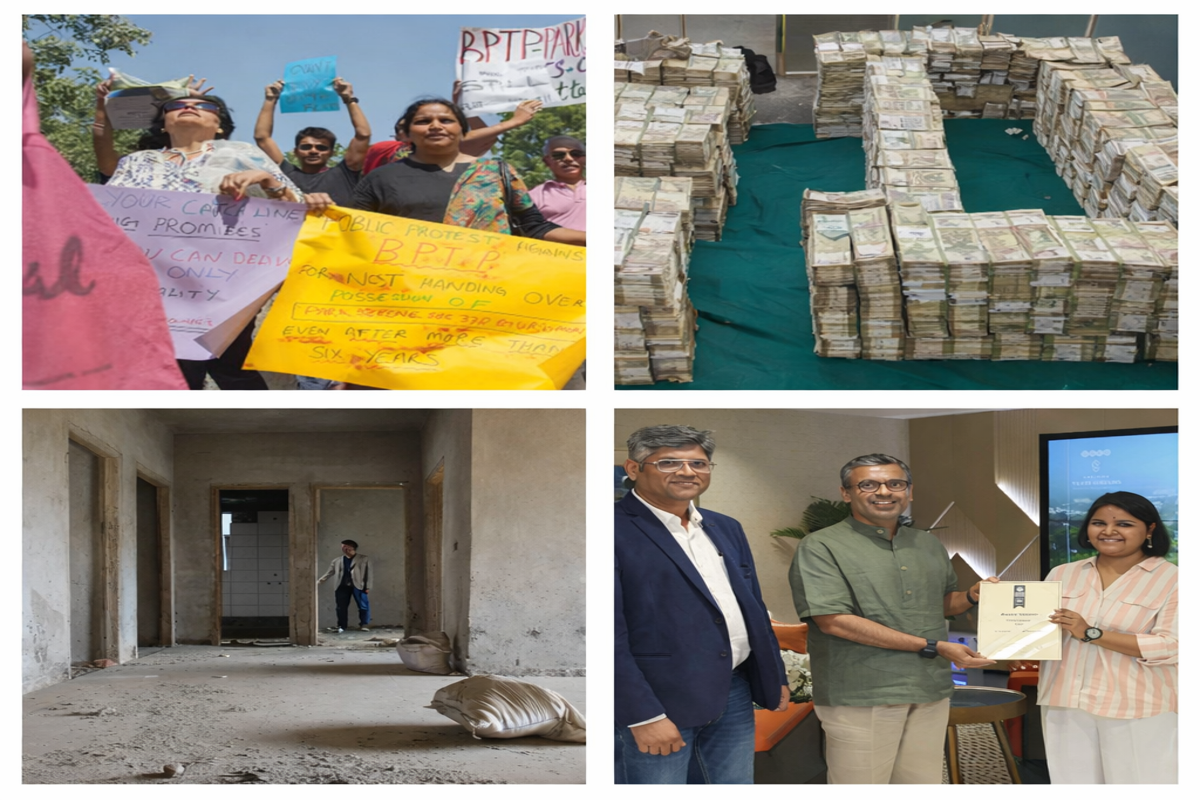
In August 2025 the Enforcement Directorate conducted searches at BPTP offices and the residences of Kabul Chawla and Whole-Time Director Sudhanshu Tripathi under FEMA. The official release stated that BPTP had received more than ₹500 crore (₹322.5 crore from CPI India I Ltd and ₹215 crore from Harbour Victoria Investment Holding Ltd, both Mauritius entities) structured with put/swap options that allegedly violated the then-prevailing FDI rules.
The agency recorded that RBI had directed removal of the impermissible clauses and that BPTP had not complied. It further stated that Chawla was the beneficial owner of multiple foreign entities, one of which had been used to acquire costly immovable property in New York — the same $19.4 million Time Warner Center apartment earlier examined by The New York Times. The source of funds for that property was placed under examination. Documents were seized and lockers frozen. The investigation remains ongoing.
In April 2026 the CBI registered FIR RC2192026E0001 at EO-I, New Delhi, naming BPTP, its unknown directors and promoters, and unknown officials of a bank, in connection with the Pedestal @70A project and an alleged subvention scheme. The FIR forms part of the Supreme Court-monitored investigation into builder-bank collusion. Searches were conducted. The case is at the investigation stage.
Bail is the rule, jail the exception — and the system knows it
This is the heart of the Indian problem. A person can face multiple FIRs alleging cheating and criminal breach of trust, a long-pending non-bailable warrant, extensive adverse consumer and RERA findings, an ED FEMA investigation involving hundreds of crores, and a fresh CBI FIR under Supreme Court monitoring — and still walk free. Bail remains the default. Custody is the exception. The result is predictable: the accused use the time and the resources generated by the very projects under dispute to retain senior counsel, file repeated applications, and keep the cases alive for years and sometimes decades.
Trials drag. Witnesses grow weary of endless adjournments. Documents disappear or become contested. Civil recovery, even after a favourable consumer or RERA order, is frequently stayed, modified or rendered practically impossible by further litigation or insolvency manoeuvres. When companies are pushed toward insolvency, the founders often continue to enjoy personal assets that were never meaningfully attached at the outset. The common man who paid from lifetime savings, took a bank loan, and continues to pay both EMI and rent is the only party left permanently poorer.
Judges draw salaries. Lawyers collect fees. The state collects court fees. The builder continues to operate, launch new projects, and, in some cases, explore capital-market options. The homebuyer is left with an order that may never be fully executed and a life that has been permanently damaged by inflation, lost years and broken promises.
The China contrast that exposes the Indian failure
China did not wait for Evergrande to collapse completely. Once the scale of unfinished projects and diverted funds became clear, authorities moved. The founder received life imprisonment. Personal assets were confiscated. The signal to every other developer was unmistakable.
In India the signal is the opposite. Multiple agencies may investigate. FIRs may be registered. Searches may be conducted. Consumer commissions and RERA authorities may pass refund and interest orders. Yet the individuals at the top remain free, the cases remain pending, and the systemic culture of delay and bail continues to protect those with resources and connections.
Political influence and the ability to prolong litigation are widely perceived as additional shields. Whether every allegation against BPTP and its directors will ultimately be proved in a court of law is a matter for trial. What is already proved by the public record is that the Indian system has allowed a pattern of serious allegations, regulatory findings and enforcement actions to coexist with continued freedom and operational continuity for more than a decade and a half.
The spider’s web
The old saying remains accurate: the law is a spider’s web; it catches the small flies and lets the large ones break through. Ordinary citizens who default on a small loan face swift consequences. Large real-estate promoters facing allegations involving hundreds of crores and thousands of homebuyers often face years of process without final accountability.
Indian judiciary and law-enforcement agencies must decide whether the protection of the common man’s life savings is a central constitutional value or a secondary inconvenience. Granting repeated bail and allowing cases of this magnitude to drag for decades while homebuyers suffer is not neutral procedure. It is a form of institutional mockery of the very people the justice system is supposed to protect.
Till when will the Indian legal system continue to let the common man pay the price while those accused of large-scale real-estate wrongdoing continue to enjoy the fruits of the system’s delays? The Evergrande sentence answered that question in China with finality. In the case of BPTP and its directors, the Indian answer is still being written — in adjournments, interim protections, and the quiet continuation of business as usual.