First Ethanol Failed the Engines, Now It Is Failing the Kitchen: How India’s E20 Push Turned India From Sugar Exporter Into Sugar Importer?
Consumers Pay Twice: Lower Mileage from E20, Compromised Vehicle Engines and Record Sugar Prices as the Same Cane That Filled Fuel Tanks Emptied Domestic Stocks

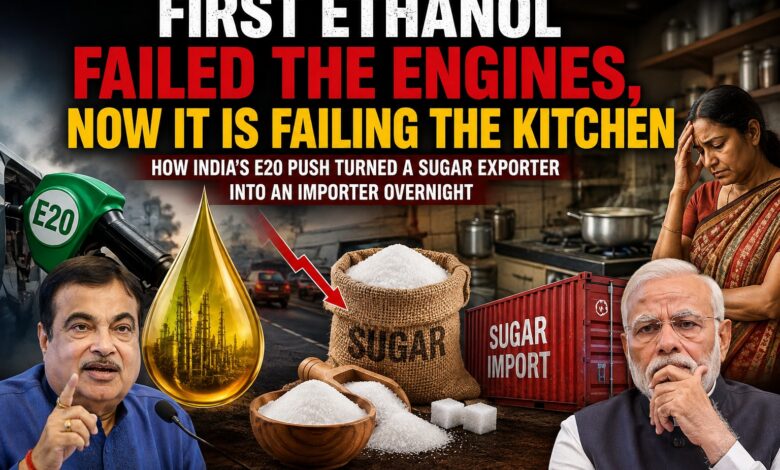
The ethanol blending programme was presented to the Indian public as a clean, strategic success. It would cut the oil import bill, improve energy security, support farmers, and advance climate goals. In practice the policy has delivered a double failure that ordinary households are now forced to absorb in their daily budgets. First it degraded the performance of millions of vehicles already on the road.
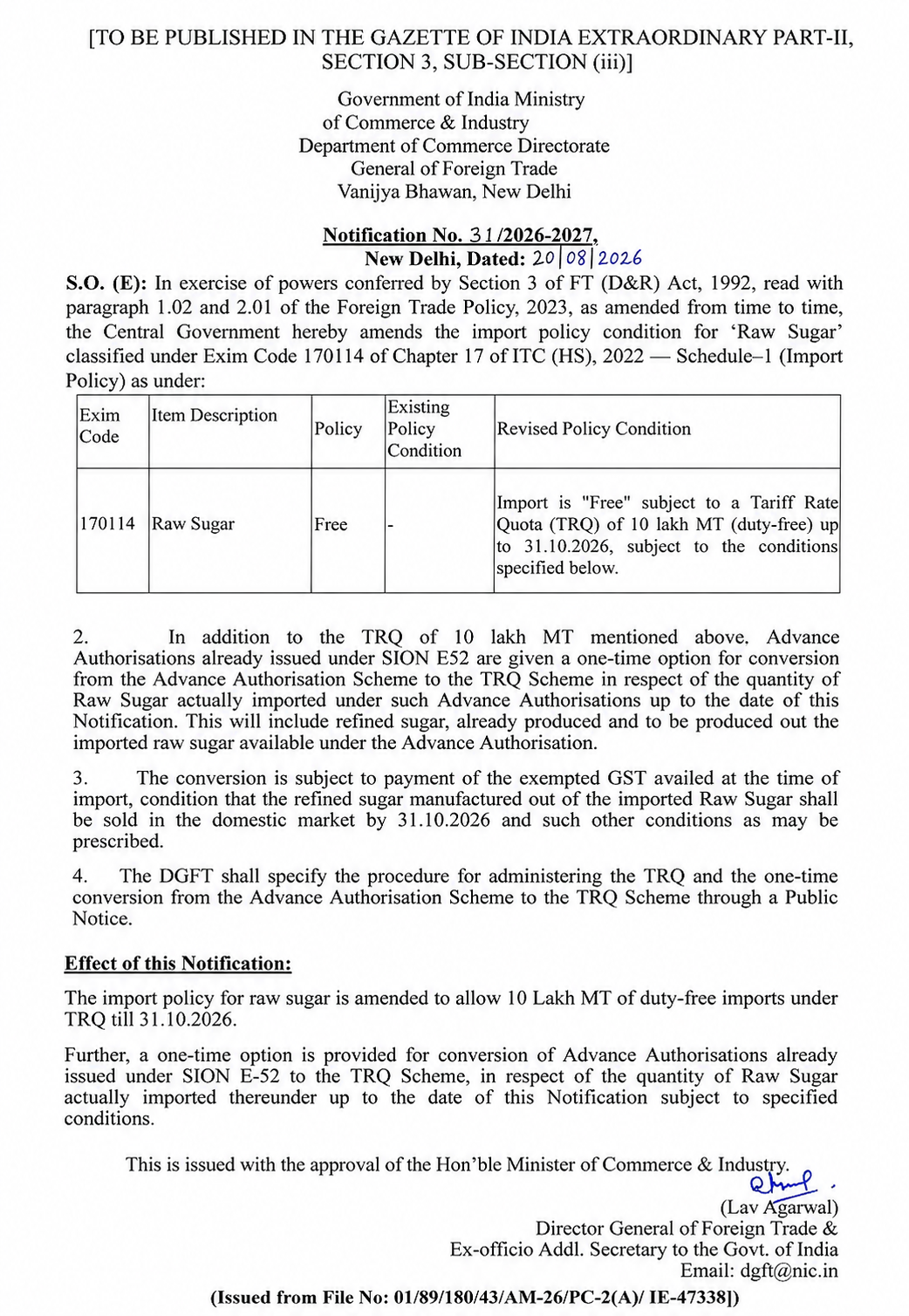
Then the same aggressive diversion of sugarcane into fuel distilleries tightened domestic sugar supplies so severely that India, once a major exporter of the commodity, has been compelled to authorise duty-free imports of one million tonnes of raw sugar, the first such move in nearly a decade. The sequence is not accidental. It is the predictable result of a policy that prioritised blending targets over food-security buffers, rainfall variability, cane yields, disease incidence, and the real costs borne by consumers.
India’s sugar exports reached approximately 110 lakh tonnes in the 2021-22 season.
That figure marked a high point of surplus capacity and earned substantial foreign exchange while supporting mill liquidity and cane payments to farmers. By August 2026 the same country had restricted exports, then banned them until the end of September, and finally opened a tariff-rate quota allowing one million tonnes of raw sugar to enter duty-free until 31 October.
The import decision was notified on 20 August 2026 by the Directorate General of Foreign Trade. It came after domestic prices had already surged. The all-India average retail price stood at around Rs 52.30 per kilogram on 18 August, roughly 13 per cent higher than the Rs 46.34 recorded a year earlier. Wholesale rates in Kolhapur, one of the country’s most important sugar trading centres, rose nearly 20 per cent from the beginning of August to a record Rs 5,350 per 100 kilograms.
In Punjab retail prices touched Rs 65 per kilogram. In parts of Mumbai and Bhopal they ranged between Rs 58 and Rs 63. The timing amplified the pain. Ganesh Chaturthi, Dussehra and Diwali were approaching, seasons when demand for sweets, mithai and sugar-intensive processed foods traditionally rises sharply.
Around three million tonnes of sugar equivalent were diverted to ethanol production in the current season. Independent estimates place the figure in a similar range, with some industry assessments citing approximately 2.4 million tonnes after accounting for the quantities supporting the E20 programme. That diversion is not a marginal adjustment. It represents a direct subtraction of sweetener from the food balance sheet.
The same sugarcane cannot supply both markets at previous volumes. When production faced additional pressure from lower recovery rates linked to crop disease and uneven monsoon rainfall in key growing regions such as Maharashtra and Karnataka, the buffer stocks that once permitted comfortable exports disappeared. Opening stocks for the season were reported near 4.7 million tonnes. Net production after diversion left total availability tight relative to estimated consumption of around 28 million tonnes.
Once residual exports and festive demand were factored in, projected closing stocks fell to uncomfortable levels, in some assessments below four million tonnes. The government responded first by limiting exports, then by imposing stockholding restrictions on bulk consumers, and finally by permitting imports. The policy celebrated for reducing dependence on imported crude oil was now forcing the expenditure of foreign exchange on imported sugar.
Consumers are paying the cost twice, once at the fuel pump and once in the kitchen. Carmakers have publicly acknowledged a three to 3.5 per cent reduction in fuel efficiency for pre-2023 vehicles running on E20 blend. Drivers experience the difference in fewer kilometres per litre and higher monthly fuel expenditure. At the same time the same households confront elevated sugar prices that feed directly into the cost of daily tea, homemade sweets, bakery items and packaged foods. The ethanol transition was framed as a collective national gain.
For many families it has translated into lower vehicle range and more expensive sugar. India’s Chief Economic Adviser has argued in public writing that the government should hold the blending target at 20 per cent until the food-versus-fuel trade-off is properly calculated rather than assumed away. That statement is itself an official recognition that the original policy calibration did not adequately account for the full set of constraints.
The government’s current corrective measures only sharpen the indictment. Having encouraged sugarcane-based ethanol through administered pricing, procurement incentives and mandatory blending targets, authorities are now considering restrictions on further diversion from sugarcane and a greater shift toward corn and rice as alternative feedstocks. Simultaneously they are importing sugar to cool domestic prices. In short, the state is attempting to unwind the very trade-off it previously accelerated. The sequence reveals a policy that advanced faster than the underlying supply realities could support. Rainfall patterns, cane yields, disease pressure and rising domestic food demand were treated as secondary variables rather than binding limits on how much cane could safely be redirected into fuel.
The numbers form a coherent and unforgiving record. Exports of 110 lakh tonnes in 2021-22 demonstrated that India possessed surplus capacity under earlier conditions. Diversion of roughly three million tonnes to ethanol in the recent season reduced that surplus by a material quantity. Production shortfalls linked to weather and recovery rates compounded the effect. Prices responded with speed. Wholesale benchmarks in major centres set records.
Retail averages moved firmly above Rs 52 per kilogram, with sharper spikes in several states. The authorisation of one million tonnes of duty-free raw sugar imports is not a routine trade facilitation measure. It is an emergency response after nearly ten years without such imports. The last comparable permission dated to the 2016-17 season. The fact that the government felt compelled to act in August 2026, just weeks before peak festive demand, underscores how thin the domestic buffer had become.
Critics of the ethanol programme had warned for years that sugarcane is simultaneously a fuel feedstock and a food crop. Those warnings were frequently dismissed as theoretical or as resistance to progress. They are no longer theoretical. The same cane that filled blending targets is now cited by market participants and analysts as a contributing factor in the shortage that forced the import decision.
Other elements are also at work: lower sugar recovery percentages, patchy rainfall in cane-growing belts, and possible inventory behaviour by traders and stockists. Yet the scale of diversion is large enough that it cannot be treated as incidental. When three million tonnes leave the sugar balance sheet in a single season, the impact on availability is structural rather than marginal.
The original justification for rapid ethanol expansion rested on two main pillars: reducing the crude-oil import bill and improving energy security. Both objectives remain legitimate in principle. The execution, however, subordinated food-security considerations and the practical realities of the existing vehicle fleet. Millions of older cars, two-wheelers and commercial vehicles were never engineered for sustained operation on high-ethanol blends. The acknowledged mileage penalty of three to 3.5 per cent is not an abstract engineering statistic.
For households that already stretch fuel budgets, it translates into real additional expenditure every month. When that penalty coincides with higher sugar prices, the cumulative burden becomes visible in household accounts. A family that spends more to travel the same distance and more to sweeten the same cup of tea experiences a clear net loss, irrespective of the national arithmetic on oil imports.
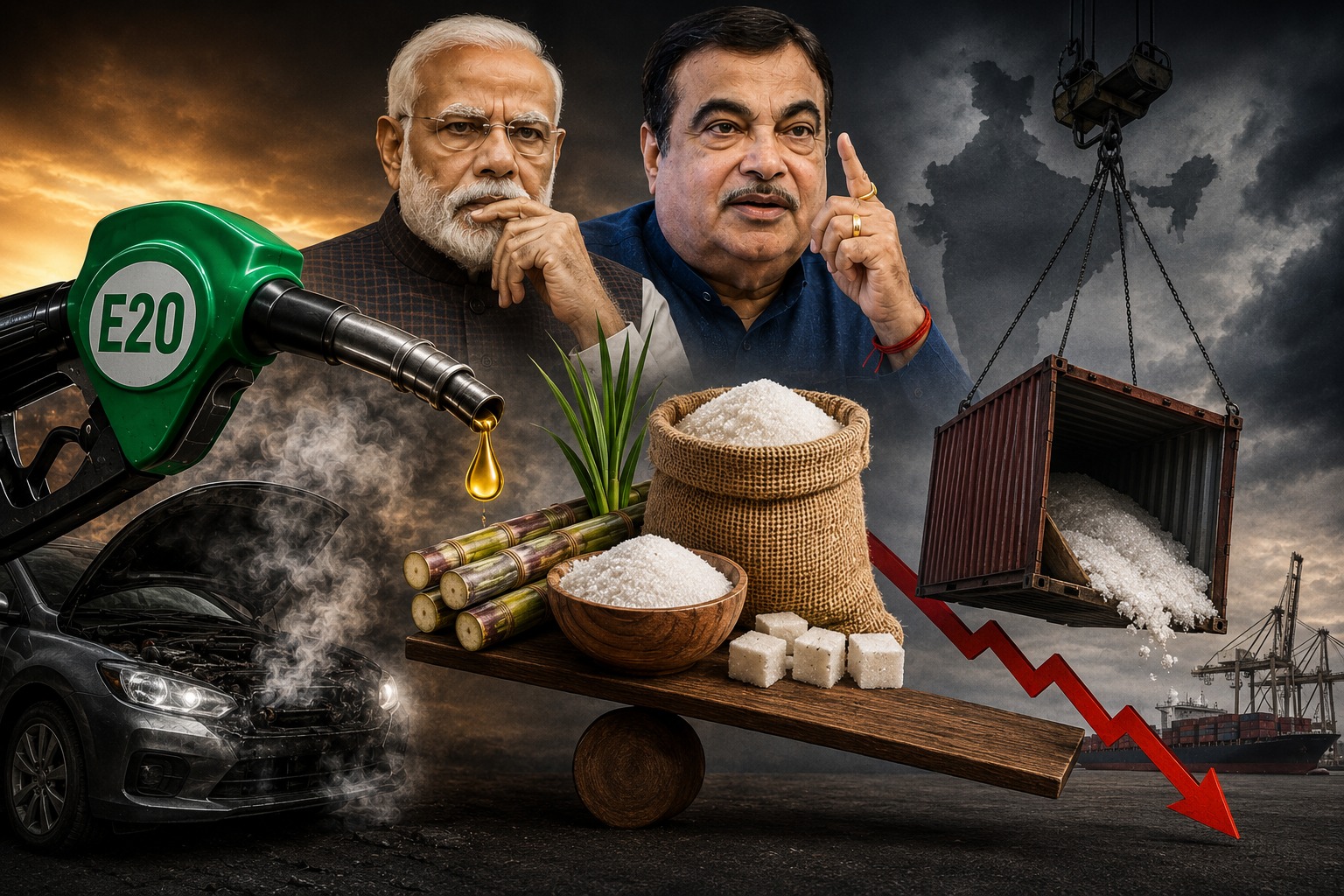
The reversal from exporter to importer is particularly stark and politically awkward. India had used surplus sugar to earn foreign exchange, improve mill cash flows, and clear cane dues owed to farmers. That surplus has been absorbed by ethanol diversion and production shortfalls. The country is now preparing to spend foreign exchange to bring sugar back into the domestic market.
The irony requires little embellishment. A programme designed in part to conserve foreign exchange on petroleum is contributing to foreign-exchange outflows on a basic food commodity. The Chief Economic Adviser’s public call to pause further increases in blending until the trade-off is rigorously costed stands as the clearest official acknowledgment that earlier ambition outran the available evidence on supply elasticity and consumer impact.
Looking ahead, the government confronts a constrained and unattractive set of options. Restricting sugarcane-based ethanol will help protect sugar availability and moderate prices, but it will slow progress toward higher blending percentages or force greater reliance on grain-based ethanol. Grain-based routes carry their own implications for food security and for the prices of rice and maize. Continuing high levels of cane diversion risks further price spikes, deeper import dependence, and continued public discontent.
Importing sugar provides temporary relief and may calm markets ahead of the festive season, yet it also signals that domestic production and policy incentives are no longer aligned. None of these paths is costless. All of them were made more difficult by the earlier decision to push diversion aggressively before adequate buffers, alternative feedstocks, and contingency mechanisms were firmly in place.
The ethanol narrative is no longer a straightforward story of green fuel and reduced oil dependence. It has become a case study in policy sequencing failure. Blending targets were advanced on an accelerated timetable. Price incentives and procurement preferences were provided to encourage mills to divert cane juice and B-heavy molasses into ethanol. Diversion volumes rose. Vehicle owners began absorbing measurable mileage losses.
Sugar stocks tightened. Prices rose. Exports were curtailed and then banned for a period. Imports were authorised under a duty-free quota. Corrective restrictions on cane-based ethanol are now under active consideration. Each step followed the previous one with a logic that becomes fully visible only in retrospect. The households that fill both fuel tanks and sugar containers have been left to manage the cumulative cost in real time.
Deeper examination of the diversion figures reveals the scale of the reallocation. Three million tonnes of sugar equivalent is not a trivial quantity in the context of India’s domestic consumption, which is estimated near 28 million tonnes. Even if other factors such as lower recovery and weather damage account for part of the tightness, the ethanol channel removed a volume large enough to matter at the margin where prices are set.
Market participants in Kolhapur and other centres watched wholesale rates climb almost 20 per cent in a matter of weeks. Retail prices followed. The government response of stock limits on bulk consumers and duty-free import permission confirms that official assessments also judged the situation serious enough to warrant exceptional measures.
The vehicle side of the ledger is equally concrete. Pre-2023 cars and two-wheelers constitute a large share of the circulating fleet. Manufacturers have confirmed efficiency penalties in the three to 3.5 per cent range when these vehicles run on E20. That penalty compounds over tens of thousands of kilometres. For a household driving 1,000 kilometres a month, the extra fuel required is measurable and recurring. When sugar prices simultaneously rise by 13 per cent year-on-year and more in some markets, the dual burden is not abstract. It appears in the weekly grocery bill and the monthly fuel receipt.
The export-to-import reversal carries longer-term implications for India’s position in the global sugar market and for the credibility of its agricultural trade policy. In 2021-22 the country shipped 110 lakh tonnes and earned foreign exchange while supporting domestic industry. The subsequent tightening has forced a retreat from that role. Importing even one million tonnes under a temporary duty-free window may stabilise prices in the short run, but it also broadcasts that domestic balances have deteriorated. Traders and producers in other exporting countries take note. Domestic mills and farmers observe that the same policy environment that once supported large exports is now managing scarcity.
Policy design that treats sugarcane as an almost unlimited feedstock for fuel inevitably collides with the crop’s role in the food system. Sugarcane is water-intensive, regionally concentrated, and subject to the same climatic variability that affects other agricultural commodities. Disease pressure and recovery rates can shift output by several million tonnes from one season to the next. An ethanol programme that locks in high diversion volumes without corresponding buffers or rapid feedstock-switching capacity leaves the sugar market exposed. That exposure has now materialised in the form of record wholesale prices, elevated retail rates, and the first duty-free import authorisation in nearly a decade.
The corrective steps under discussion, including limits on further cane diversion and greater use of corn and rice, illustrate that the original pathway has encountered binding constraints. Shifting to grains may ease pressure on sugar, yet it introduces new questions about cereal availability and prices. Holding the blending target at 20 per cent, as suggested by the Chief Economic Adviser, would at least allow time for a fuller accounting of the food-versus-fuel calculus. Continuing to push higher blends without that accounting risks repeating the same cycle of shortage, price spike, and emergency import.
The record assembled from official notifications, price data, export statistics, and industry assessments is consistent. India exported 110 lakh tonnes of sugar in 2021-22. It is now importing one million tonnes duty-free. Roughly three million tonnes have been diverted to ethanol in the recent season. Retail sugar prices have reached averages above Rs 52 per kilogram, with higher levels in multiple markets. Pre-2023 vehicles lose three to 3.5 per cent efficiency on E20.
The government that accelerated the diversion is now managing the resulting shortage through export bans, stock limits, and imports. That sequence does not require rhetorical exaggeration. The numbers, the timeline, and the policy reversals themselves constitute a detailed critique of an approach that treated food and fuel as interchangeable without sufficient safeguards for either consumers or supply stability.
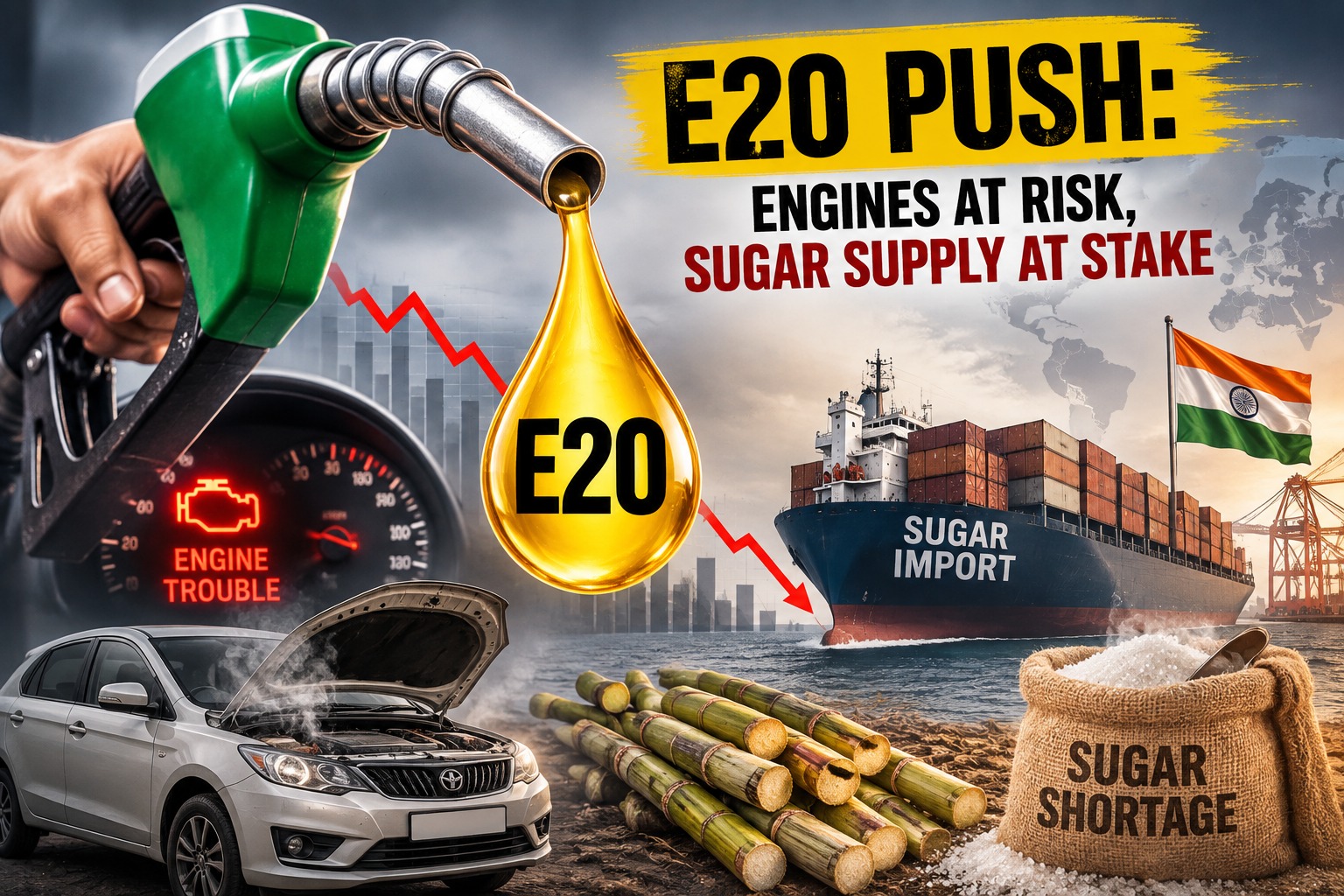
The cost of that approach is being paid in households across the country. Drivers notice the drop in mileage. Families notice the rise in the price of sugar. Both are direct consequences of the same policy choice: to prioritise rapid increases in ethanol blending over a careful balancing of competing claims on sugarcane. The import of one million tonnes of raw sugar is the visible symptom.
The deeper failure is the absence of adequate contingency planning for the moment when diversion, weather, and demand would inevitably converge. That moment has arrived. The corrective measures now being considered are necessary, yet they also confirm that the original trajectory was unsustainable. The ethanol programme’s first failure was felt in vehicle engines. Its second failure is being felt in the kitchen. Both were foreseeable. Both were inadequately prevented.