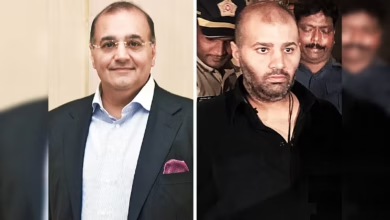
Rohan Developers Under Insolvency, Harresh Mehta Under Investigation: What Do Homebuyers, Occupants And Creditors Stand To Lose?
Three numbers dominate the Rohan–SBI case: ₹280 crore allegedly lost by the bank, ₹155 crore said to have reached Ruby Mills on 10 February 2012, and a ₹50-crore deposit requested two days earlier. Headlines treat them as interchangeable. They are not. This article reconstructs the alleged trail date by date, tests the CBI's theory against its own chronology, and confronts what remains unexplained: the ₹125 crore beyond the Ruby transaction, the fate of the deposit, the interest said to be outstanding, and the recoveries reported since. Who is alleged to have received what, and when? Why can nobody say yet?


₹280 Crore, ₹155 Crore, ₹50 Crore: Why Does the Public Still Not Know Who Is Alleged to Have Received What in Rohan Developers-Harresh Mehta Saga?
Financial crime stories rise or fall on arithmetic. A fraud is, at bottom, a claim about money: where it started, where it went, who held it at the end, and what they knew. The case involving Harresh Mehta, or Harresh Navnitrai Mehta, associated with Mumbai’s Rohan Developers and Rohan Lifescapes, has been reported in headlines that fuse three very different figures into one. The result is a reader who sees a name beside “₹280 crore” and concludes that a man is alleged to have taken ₹280 crore. On the record available, he is not.
A statement of what is established must come first. Harresh Mehta was arrested by the CBI on 20 May 2023 and granted bail by the Special CBI Court at Thane in June 2023. No conviction against him in the State Bank of India case could be verified, and he denies involvement. Every figure below that is attributed to the CBI is an allegation, not a judicial finding. This article does not ask whether Harresh Mehta is guilty. It asks something more basic and more uncomfortable: after more than a decade, can the money trail the CBI describes be stated clearly, tested against its own dates, and explained to the public? So far, it cannot.
Three Numbers, Three Layers
The three headline figures sit at different levels of the allegation. The first, ₹280 crore, is the overall amount the CBI says SBI was cheated of through credit facilities extended to Rajput Retail Limited, later renamed Shreem Corporation Limited, on the strength of allegedly fabricated documents. The second, ₹155 crore, is a subset: the sum the CBI says was credited to Ruby Mills Limited on 10 February 2012 in connection with the purchase of floors in The Ruby, a commercial building at Dadar. The third, ₹50 crore, is narrower still: a deposit that Harresh Mehta’s side says was an ordinary commercial arrangement and that the CBI alleges was his or Rohan’s share of the proceeds.
Put as proportions, the layers are stark. Even on the CBI’s most aggressive reading, the sum alleged to have reached a Rohan-related entity is less than a fifth of the amount in the headline. Sloppy reporting inflates the accused’s alleged role and quietly deflates the scrutiny due to everyone else in the chain, including the borrower, the property seller and the lender.
The ₹155 Crore: A Sum Built from Two Loans
The ₹155 crore is composed of two facilities. According to the CBI’s case as reported by The Indian Express during the proceedings against Harresh Mehta, SBI sanctioned a ₹139-crore term loan for the purchase of the 14th and 16th floors and part of the 15th floor of The Ruby. It also sanctioned a ₹16-crore short-term loan to Rajput Retail. The two together make ₹155 crore, which the CBI says was credited to Ruby Mills on 10 February 2012.
The composition deserves attention because it reveals something about the structure of the deal. A term loan is long-dated financing meant for an asset purchase, in this case floors of a commercial building. A short-term loan is working capital. Why did funds from both facilities end up in a single credit to the property seller? Was the short-term facility drawn to top up the purchase price, and if so, with what justification in the loan documentation?
The briefing records the sum but not the sanction conditions, and the stated purpose of each loan is exactly the sort of detail on which a diversion theory rests. If the term loan was sanctioned for the purchase of specific floors, then the question is whether those floors were actually conveyed, in what form, and to whom.
February 2012: Reading the Calendar
The CBI’s allegation turns on three dates within a span of twelve days. On 8 February 2012, the agency says, Rohan Developers, through Harresh Mehta, requested a ₹50-crore Inter Corporate Deposit from Ruby Mills. On 10 February 2012, Ruby Mills received the ₹155 crore funded through SBI facilities. On 20 February 2012, the Letter of Intent for the purchase of the floors was executed.
Read in that order, the sequence has a certain logic that the agency has leaned on. A request for ₹50 crore preceded by two days the arrival of ₹155 crore. The consideration for a property purchase arrived ten days before the document recording the intention to buy. A commercial transaction ordinarily runs in the opposite direction, with the paper leading and the money following. The CBI treats the inversion as one circumstance suggesting that the deal was not a straightforward property purchase.
It is a fair point, and it is also an incomplete one. 10 days between a payment and a letter of intent is unusual, but unusual is not unlawful. Large property transactions in India are sometimes funded in tranches, with advance payments preceding formal documentation, particularly between parties with an existing relationship. The honest question is what else the agency has beyond the dates. Were there board resolutions, loan sanction notes, emails, call records or ledger entries showing that the three events were linked by design rather than by coincidence? The reported record offers the chronology but not the connecting tissue.
The Ten-Day Gap and the Bank’s Role
The gap also points a finger the CBI’s narrative has not obviously followed. A lender released, according to the agency, ₹155 crore for the purchase of floors in a building before the Letter of Intent for the purchase existed. Who within SBI approved the disbursement, on what documents, and against what security? Banks ordinarily make disbursements against evidence of the transaction, such as an agreement, a sale deed or at least a binding offer, and not on the strength of a purchaser’s assurance.
The 2018 chargesheet named one SBI relationship manager, V.N. Kadam. It did not, on the reported record, name a sanctioning committee, a credit officer or a branch head, though the investigation into “certain other private persons and bank officials” was kept open. If the money left the bank before the paperwork existed, then either the paperwork was misrepresented to the bank, as the CBI alleges, or the bank’s controls failed to ask for it. Both explanations can be true, but only one has been the subject of arrests. The public is entitled to ask why scrutiny of the borrower’s side has so far dwarfed scrutiny of the lender’s.
The ₹50 Crore: What the CBI Says
The ₹50-crore deposit is the point at which the money trail reaches Harresh Mehta personally. The CBI alleges that on 8 February 2012, Rohan Developers requested an Inter Corporate Deposit from Ruby Mills on reported terms of ₹50 crore for six months at 10 percent interest. The agency’s theory is that this amount represented Harresh Mehta’s or Rohan’s share of the alleged crime proceeds, that it was subsequently deployed as loans or advances to an associate company, and that it was never returned.
In the CBI’s schematic, the trail runs from SBI to Rajput Retail, from Rajput Retail to Ruby Mills as ₹155 crore, and from Ruby Mills to a Rohan-related entity as ₹50 crore. The elegance of that chain is also its vulnerability. A line on a diagram is not proof of tracing.
For a court to accept that the ₹50 crore was SBI’s money, it would need to be shown, with bank statements and ledger entries, that the specific funds leaving Ruby Mills were traceable to the funds arriving from Rajput Retail, or alternatively that the arrangement as a whole was a contrivance. Money is fungible, and Ruby Mills was a company with its own funds and its own business. The mere fact that a deposit left it two days before a large credit arrived does not by itself establish where the deposit came from.
The ₹50 Crore: What Harresh Mehta Says
Harresh Mehta’s account is different in kind, not merely in degree. His bail application, as reported, argued that Mindset Estates, and not he personally, was the developer or holder of development rights in the Ruby project. It argued that he had no connection with the alleged fraudulent dealings between Rajput Retail and SBI, and that the ₹50 crore was a separate Inter Corporate Deposit, not a diversion of loan proceeds. In other words, he does not dispute that a deposit was sought. He disputes what it was.
That framing sharpens the central evidentiary question. If the ₹50 crore was a standalone ICD, then there should be a deposit agreement or board approval, a transfer from Ruby Mills, and a record in the books of both companies. There should also be a rationale for why Ruby Mills, a company that was also selling floors worth ₹155 crore, chose to lend ₹50 crore to a Rohan entity in the same fortnight. If it was a share of proceeds, one would expect a different pattern: no genuine commercial rationale, informal terms and perhaps no interest paid. Both stories predict documents. The public has seen neither side’s.
What an ICD Is, and What Makes One a Conduit
An Inter Corporate Deposit is, in general terms, a short-term unsecured loan from one company to another, commonly used by cash-rich companies to place surplus funds and by cash-needy ones to bridge gaps. They are routine in Indian corporate life, which is precisely why they can also be misused.

The features that distinguish a genuine ICD from a disguised conduit are mostly evidentiary. A genuine deposit typically has a written agreement, a stated purpose, interest actually serviced, repayment on or near the due date, an entry in audited financial statements and a lender with a business reason to lend. A conduit tends to look different: terms that are commercially irrational, interest never paid, repayment never demanded, a lender who is itself a recipient of questionable funds, and a borrower that immediately passes the money to related entities.
The CBI’s allegation that the ₹50 crore was “subsequently used as loans and advances to an associate company” is, notably, an allegation about onward use. But a borrower is generally free to use borrowed money as it likes, and onward lending to a group company is not in itself a crime. It becomes relevant only if the original funds were tainted and the borrower knew.
That knowledge is the missing piece. Even if the CBI traces the money perfectly, it must still show that Harresh Mehta knew, or had reason to know, that the funds originated in an alleged fraud on SBI. A man who borrows ₹50 crore from a counterparty with an ongoing property dealing is not, without more, a participant in that counterparty’s other transactions.
The Associate Company: A Gap in the Public Record
The alleged onward use of the ₹50 crore as loans and advances to an associate company is stated but not detailed. Which associate? In what amounts? On what dates and on what terms? The briefing, understandably, does not say. But this is the segment of the trail that would most directly support the CBI’s theory, because it is where ordinary borrowing starts to look like layering.
The Rohan Group, as an Income Tax Appellate Tribunal order records, comprises multiple entities, including Rohan Developers, Goodwill Properties and Silver Arch Builders & Promoters, and the briefing is firm that these should not be treated as one legal entity. Inter-company lending across a real-estate group is common and often legitimate, driven by project-level cash needs.
It is also a standard route by which funds are moved to obscure their origin. Which of the two this was cannot be known without the books of the associate company. A reporter or court-watcher should ask whether the CBI has produced those books, whether the associate’s auditors flagged the advances, and whether any of the money found its way back, whether to Harresh Mehta, to the Guptas or to anyone else in the chain.
The Unexplained Balance: What of the Other ₹125 Crore?
The briefing says the loans were obtained on fabricated documents and that SBI was cheated of roughly ₹280 crore in total, but it describes only the Ruby transaction in detail. The balance is, on the public record, a blank.
Several possibilities exist, and none is resolved by the sources available. The ₹280-crore figure may include other facilities sanctioned to Rajput Retail beyond those used for The Ruby. It may include interest, penal charges or accrued dues alongside principal, as headline “fraud amounts” sometimes do. It may represent the bank’s total exposure rather than the alleged diversion.
Or it may reflect further diversions that the CBI has alleged but that have not been publicly described. Each reading changes the character of the case. If the ₹280 crore is total exposure, then the “fraud” may be considerably smaller than the headline. If it includes separate diversions, then the Ruby transaction, and Harresh Mehta’s alleged connection to it, is only part of a larger scheme whose other parts remain untold.
This matters for fairness in both directions. An accused linked to a ₹50-crore strand of a ₹280-crore case is entitled to have that strand isolated from the headline. The public, meanwhile, is entitled to know where the remaining ₹125 crore went, and whether anyone has been asked to account for it.
Interest: The Ledger That Keeps Running
The CBI also alleges that interest relating to the larger transaction remained outstanding, a claim that adds a temporal dimension to the arithmetic. The reported terms of the ICD were 10 percent interest over six months.
The point is not the number. It is the question of who has been keeping the ledger. Outstanding interest implies that someone computed it, someone is owed it, and someone has claimed it. Is the claimant SBI, which would imply the CBI treats the ICD as part of the bank’s loss? Is it Ruby Mills, which would imply an ordinary creditor’s claim against a borrower? Or is it the resolution professional of Shreem Corporation, in an insolvency that has since absorbed much of the original dispute? The answer determines whether the interest is evidence of a fraud, a commercial debt, or both. The briefing offers no answer.
Recoveries: When the Money Starts Moving Back
The most complicating feature of the financial trail is that money has also moved the other way. According to The Times of India, as reported during the bail proceedings, Ruby Mills had received roughly ₹101 crore from Rajput Retail in connection with the transaction. Bharat Shah had deposited ₹22.5 crore and was prepared to deposit another ₹78.5 crore. The two sums add to ₹101 crore, which suggests the offered deposits were designed to match that figure. The Thane court reportedly observed that the term-loan amount could therefore be considered secured.
Later insolvency records involving Shreem Corporation refer to ₹101 crore being received from Ruby Mills by the resolution professional. There is a puzzle here that the briefing does not resolve. The bail-stage report describes ₹101 crore as received by Ruby Mills from Rajput Retail, while the insolvency record describes ₹101 crore as received by the resolution professional from Ruby Mills. These could be the same sum moving in opposite directions at different stages, two separate sums that happen to match, or a muddle in secondary reporting. Which it is matters greatly, because it determines whether the ₹101 crore is a partial refund of the ₹155 crore or something different.
Taken at face value, the gap between ₹155 crore credited and ₹101 crore dealt with is ₹54 crore, a figure that sits suspiciously close to ₹50 crore. It would be irresponsible to read anything into that. The figures come from different sources, at different stages, and may simply coincide. But a rigorous reconstruction cannot ignore the near-match. It should be tested against the court file and, if it dissolves, said to dissolve.
Repaid, Written Off or Never Returned?
The final question is the plainest. What happened to the ₹50 crore? The CBI says it was not returned. Harresh Mehta’s account, as reported, does not claim repayment, but neither does the briefing say whether he asserted it. The public record does not show whether the deposit was repaid, whether interest was serviced, whether the amount was written off in the books of Ruby Mills or Rohan, or whether it was settled through the insolvency process of Shreem Corporation or through the separate insolvency of Rohan Developers, which entered the Corporate Insolvency Resolution Process on 6 February 2025.
Each outcome carries a different meaning. A deposit repaid, even late, supports the argument that it was a loan. A deposit written off by a lender that was also a participant in the alleged fraud suggests something stranger. A deposit never repaid and never pursued fits the CBI’s theory but also fits a simple commercial default.
Whether an unrecovered ICD appears among the claims in the Rohan Developers CIRP is an obvious thing to check: the IBBI records show sixteen unsecured financial-creditor claims totalling ₹324.97 crore in an April 2025 statement, of which eleven, about ₹175.65 crore, were admitted. Whether Ruby Mills filed a claim, and whether the claim was admitted, would tell a reader a great deal. The briefing does not say.
What the Arithmetic Cannot Yet Tell Us
Strip the case to its numbers, and the established core is slender. It is reported that SBI sanctioned ₹139 crore and ₹16 crore to Rajput Retail. It is alleged that ₹155 crore reached Ruby Mills on 10 February 2012. It is alleged that a ₹50-crore deposit was requested on 8 February. It is reported that the Letter of Intent followed on 20 February. And it is reported, at the bail stage, that ₹101 crore was received and ₹22.5 crore deposited, with a further ₹78.5 crore offered.
Everything connecting those facts into a single story of diversion is inference, and inference is not yet evidence. The CBI has not publicly shown, on the available record, a tracing of the ₹50 crore to the ₹155 crore, a statement of the remaining ₹125 crore, an account of the interest, or a resolution of the ICD’s fate. Harresh Mehta, for his part, has offered an alternative explanation but, on the reported record, no public documentary proof of it.
The Larger Indictment
The deeper failing is institutional. Large bank-fraud cases are announced by a single number, and that number then does all the work. It names the case, anchors the headline and defines the scale of the alleged wrong. But a single number is not an accounting. It obscures how much was disbursed and how much diverted, how much recovered and how much written off, and who held the money at each stage. When a ₹280-crore label is attached to a ₹155-crore transaction and a ₹50-crore deposit, the real trail is blurred and the accountability that should flow from tracing it is blurred with it.
The public interest requires something better. It requires that the agency publish, at least in the court record, a reconciliation: what was sanctioned, what was disbursed, what was diverted, what was recovered and what remains. It requires that the bank explain its own sanctioning and disbursement decisions. And it requires that the accused be told, precisely, which strand of the money he is alleged to have touched. Until those things are done, anyone claiming to know where the money went is guessing.
If the figures in this case can be reduced to a single clear ledger, the ledger will serve everyone, including the accused if he is innocent and the bank if it was defrauded. If they cannot, the reason deserves to be asked loudly. A ₹280-crore case that cannot account for its own numbers after more than a decade is not only a story about one man, one deposit or one building at Dadar. It is a story about whether India’s institutions can follow the money at all.