
In June 2026, the Bihar cabinet made a significant step in the Bihar Sugarcane Industries Investment Incentive Policy 2026, under which any investor setting up a new sugar mill can get up to 40 acres of government land, on a 30-year land lease for a token sum of Re 1.
Sugarcane Industries Minister Sanjay Kumar called Bihar “the first state in the country” to build an incentive framework this generous for one sector. On top of the land, the policy throws in a full refund of stamp duty and registration charges, a five-year 100% reimbursement of State GST on sugar production, and capital subsidies of up to ₹100 crore for large mills. This is part of the state’s broader Saat Nischay-3 plan to revive closed sugar mills and build 25 new ones.
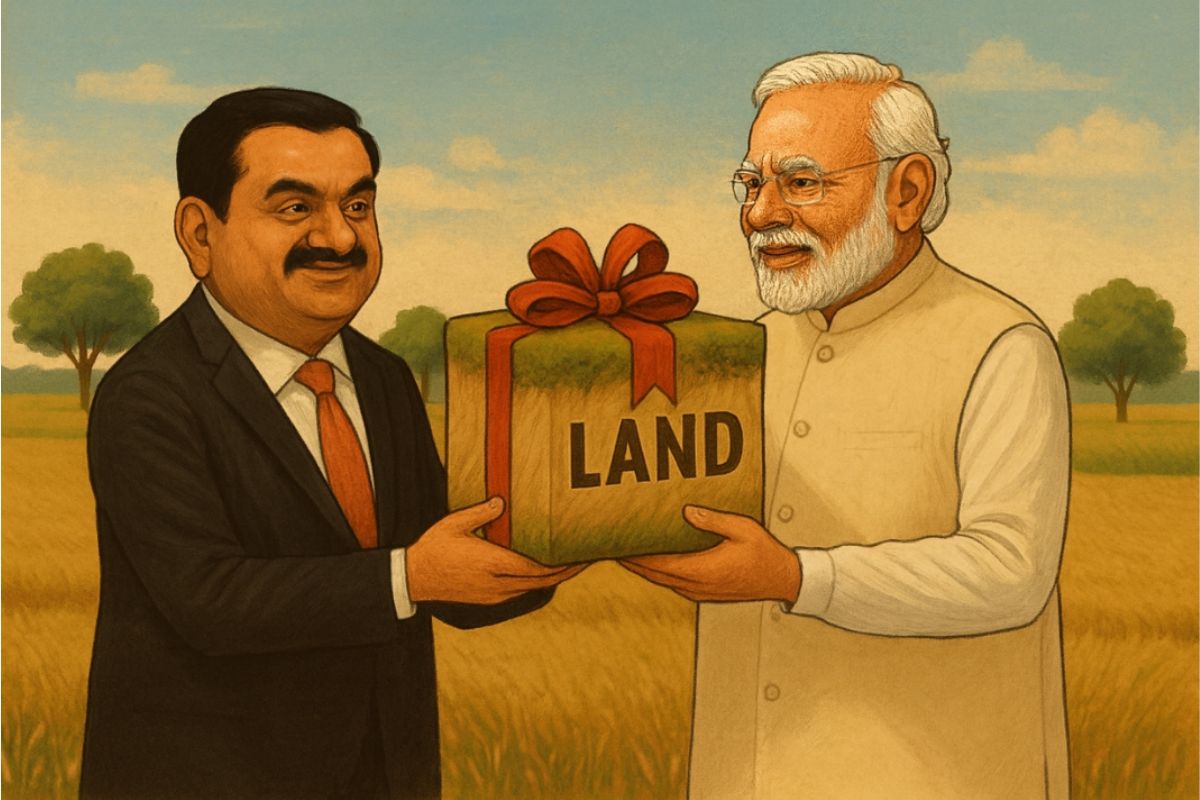
This looks like fairly standard industrial-policy language where the idea seems like an incentive to revive a dying sector. But anyone who has followed Bihar’s land deals over the last year will recognise something else. Because this is almost exactly the language that have been heard before, in September 2025, like Re 1, decades-long lease, government land, “transformational investment”, to hand 1,020 to 1,050 acres of farmland in Bhagalpur’s Pirpainti block to Adani Power.
Is this a coincidence of phrasing? Or it is a pattern where government land is given to private players? The problem is not the land is given to private players; but the consequences of such an event. What we ask is, do these private players generate sustainable employment, like what they are suppose to do, or is it just in favour of capitalism, which is eventually hurting the common man?
The Adani-Bhagalpur Precedent
On 13 September 2025, Adani Power signed a 25-to-33-year Power Supply Agreement with the Bihar State Power Generation Company Ltd (BSPGCL) to build a 2,400 MW, three-unit, coal-based “ultra-super-critical” thermal power plant at Pirpainti in Bhagalpur, at an estimated cost of ₹25,000–29,000 crore. Two days later, Prime Minister Narendra Modi laid the foundation stone from Purnea, calling it Bihar’s largest private-sector investment.
The numbers that followed are what turned this into a national story:
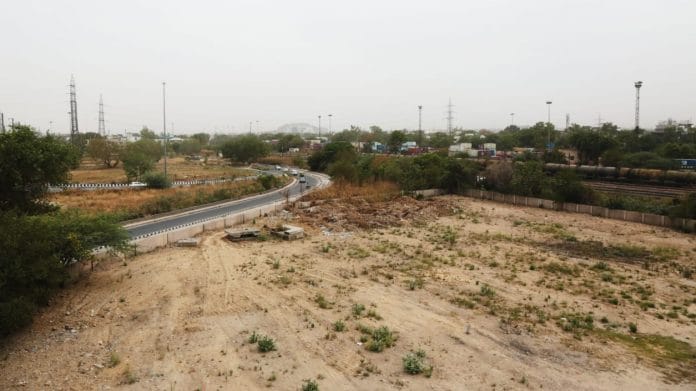
- 1,020.6 acres of land across five mouzas, acquired originally from 856 local farmers, was leased to Adani Power for Re 1 per acre, per year, for a period reported variously as 25 and 33 years across official statements and opposition claims.
- The land carried roughly 10 lakh trees — mango, litchi, teak, sal, shisham, mahogany — much of it productive orchard land, not the “barren” land the state initially classified it as, according to villagers cited by independent ground reports.
- Compensation rates varied wildly across the same villages. One farmer in Harinkol told reporters that neighbours had received ₹42 lakh, ₹60 lakh, and ₹80 lakh per acre for comparable land — with no uniform benchmark applied.
- Congress leader Pawan Khera alleged the deal effectively meant “land, trees and coal all handed to the Adani group for nothing,” pointing to the ₹6.075-per-unit tariff Adani will charge Bihar, compared with ₹3–5 per unit in Maharashtra and Uttar Pradesh.
- The National Alliance of People’s Movements (NAPM) called it “a blatant instance of crony capitalism” and demanded the project be scrapped, citing Bhagalpur’s existing pollution burden — the city ranked the second-most polluted in India and 31st globally in January 2024 rankings, and already hosts the 2,340 MW Kahalgaon Super Thermal Power Station a few kilometres away.
- Villagers said attempts to meet PM Modi during his September visit to raise these grievances ended in detentions; a local BJP MLA was quoted at a public meeting warning, “Jo virodh karega, usko jail bhej diya jaayega” (whoever protests will be sent to jail).
The government’s defenders pushed back hard, and their numbers deserve equal billing. The Bihar Index, a pro-government handle, put out a “fact check” claiming 96% of landowners had already received compensation, with only 4% pending due to incomplete paperwork, and not government refusal. They also pointed out, accurately, that Adani Power won the project through a competitive Tariff-Based Competitive Bidding (TBCB) process against JSW Energy, Torrent Power and the Bajaj Group’s Lalitpur Power, and that its ₹6.075/unit bid was the lowest of the four; meaning, on paper, Bihar got the cheapest power on offer, not a backroom favour.
Both things can be true at once, and that is precisely the uncomfortable zone Indian land deals tend to occupy, where a legally clean bidding process sitting on top of a deeply unequal, badly compensated land-acquisition history that goes back over a decade.
Where the Adani deal actually came from
The Pirpainti land wasn’t fresh land grabbed for Adani in 2025. The project was first proposed in 2014 as a public-sector 1,320 MW plant by NHPC. The state had already acquired roughly 1,350 of the required acres by 2021, under the old rates, frozen at 2013-14 valuations, before farmer protests stalled it. It was then briefly re-proposed as a solar plant in 2021 (also via NHPC), shelved again, and finally revived as a coal plant in early 2024, this time opened to private bidding.
So the “Re 1 to Adani” headline obscures an older story, where the government land-banked for over a decade at frozen compensation rates, repackaged and auctioned to a private conglomerate the moment coal economics looked favourable again, while the original farmers were still owed money for a 2014-vintage acquisition, some linked to the unresolved ₹100-crore-plus Srijan NGO compensation scam, in which government disbursement funds meant for landowners were allegedly siphoned off years before Adani ever entered the picture.
The current status — what has actually changed since
As of the most recent publicly tracked filings (Global Energy Monitor, updated through mid-2026):
- The Expert Appraisal Committee (EAC) recommended Terms of Reference for the project in late September 2025.
- A formal Terms of Reference certificate was issued in October 2025.
- The project was granted Environmental Clearance in April 2026, meaning, seven months after the political furore, the plant has cleared its key regulatory hurdle and construction-stage approvals are now in motion.
- Separately, Bihar’s August 2025 Industrial Investment Promotion Package clarified that the Re 1 land rate is not, technically, exclusive to Adani, but it applies to any investor bringing ₹1,000 crore and creating 1,000 jobs, with Fortune 500 firms automatically qualifying for 10 free acres. In other words, the Re 1 principle is now baked into Bihar’s general industrial policy, and Adani was simply the debut.
That last point matters enormously for understanding what’s happening with the sugar policy a year later. This isn’t a one-off scandal. It’s becoming the state’s standard operating model for attracting capital which includes handing over land almost free, recover value through jobs, tax, and tariff revenue later. The sugar mill policy of 2026 is the same instrument applied to a second sector.
Does Giving Away Land Actually Create Sustainable Employment?
This is the question that gets asked the least, and answered the most carelessly, on both sides of the debate.
The Pirpainti project’s official job estimates are 10,000–12,000 jobs during construction and roughly 3,000 permanent jobs once operational, for a project covering over 1,000 acres and ₹25,000+ crore in investment. That works out to roughly one permanent job for every three acres surrendered. Whether that ratio constitutes “development” depends entirely on what those 3,000 jobs are, who gets them, and how long they last, are the questions that history in this exact sector gives reason to be sceptical about.
Consider Adani Power’s earlier, near-identical project in Godda, Jharkhand, where the company acquired 558 acres for a power plant in 2017 under a similar jobs-for-land pitch from then-CM Raghubar Das’s government. Villagers who surrendered two or more acres were promised either permanent jobs or ₹5 lakh compensation.
Years later, multiple ground reports, and the farmers themselves, who are still pursuing legal claims, say the jobs that materialised were largely casual, contract-based positions, not the secure employment that was promised, even for people who completed the company’s own training programmes. If that is the template, then “10,000–12,000 jobs” at Pirpainti needs an asterisk: construction-phase jobs are, by definition, temporary, and contract labour does not show up in the same column as “sustainable employment” no matter how the press release rounds it.
This is not an argument that private investment can’t create jobs. Bihar’s industrial base is thin and it badly needs capital. It’s an argument that the ratio of land surrendered to durable employment created is the actual metric that should be in every press release, and it almost never is. Compare, when a government that genuinely wanted to maximise employment-per-acre would weigh labour-intensive agro-processing or food-park models against capital-intensive, low-headcount coal or sugar-refining models before deciding how to allocate land that, once leased away for 30 years, cannot be reallocated to a better use even if a better use appears in year five.
The Sugar Sector Bihar Is “Reviving” — And Why That’s Not a Simple Story
The sugar incentive policy is perhaps, being sold as restoring lost glory. Bihar once had 130 sugar factories in the 1930s, producing up to 40% of India’s sugar. Today it has 28 registered mills, of which 18 are shut and only 9 operational, crushing about 473 lakh quintals of cane a year with a recovery rate of roughly 9.6%, well below the national benchmark. The reasons for that collapse are structural and well documented, which includes ageing machinery, poor cane productivity, the “levy sugar” obligation that forces mills to sell a share of output below cost to ration shops (an industry-estimated loss of ₹250–300 crore a year), and chronic underinvestment.
Those are real problems, and a serious incentive policy is a reasonable response to them. But “free land for 30 years” does not fix variety degradation, irrigation gaps, or recovery rates, but it fixes one input cost for whichever investor is large enough to mobilise the capital to build a 3,500–5,000 TCD mill in the first place. That is a meaningful detail, as schemes that are pitched as helping “Bihar’s farmers” are, by construction, designed around the capital threshold of large corporate players, not smallholder cane growers or cooperatives, who have no realistic way to access a 40-acre, ₹100-crore-subsidy package on their own.
Is it wrong if we say that cheap land only solves one input cost and fails to address systemic agricultural roadblocks like sugarcane variety degradation, poor irrigation, or poor sugar recovery rates? There are critics of these capital-heavy models, who often point to the recommendation of agricultural economists (such as the Ashok Dalwai Committee on Doubling Farmers’ Income) that public funds are more efficiently spent directly on farm-level infrastructure (like micro-irrigation and seed quality) rather than disproportionately subsidizing large processing plants.
This is not relevant, nor irrelevant: Enter the Gadkari Family — A National Pattern, Not (Yet) a Bihar One
Here the comparison we asked for needs to be stated with precision, because precision is exactly what is missing from most viral versions of this story: there is no public evidence that Nitin Gadkari’s sons or their companies are bidders in, or beneficiaries of, Bihar’s 2026 sugar land policy specifically. What does exist, extensively documented in business and political reporting, is a parallel, national-level controversy about the Gadkari family’s position in India’s ethanol and sugar economy, which is structurally the same industry the Bihar scheme is designed to court.

The facts, as reported:
- Union Minister Nitin Gadkari founded the Purti Group, a Nagpur-based sugar-and-agro conglomerate. He has since formally distanced himself from it, but his sons remain central to its successor entities.
- Nikhil Gadkari is associated with CIAN Agro Industries & Infrastructure Ltd, which entered the ethanol business in February 2024. Its revenue reportedly rose from ₹17–18 crore in June 2024 to ₹510–523 crore in June 2025, a roughly 30-fold jump in one year, while its stock price climbed 2,184%, from ₹37.45 in January 2025 to ₹638 in August 2025, according to figures cited by Congress and repeated across multiple outlets.
- Sarang Gadkari is linked to Manas Agro Industries and Power, also part of the Purti Group network, alongside entities such as Purti Power and Sugar Ltd, Mahatma Sugar and Power Ltd, and Wainganga Sugar and Power Ltd.
- All of this has unfolded in the same years that Nitin Gadkari, as Union Road Transport Minister, has been the government’s most vocal champion of the ethanol blending programme, which pushed India to E20 (20% ethanol-blended petrol) five years ahead of its original 2030 target.
- Congress leader Pawan Khera has publicly called this a “conflict of interest” and demanded a Lokpal inquiry, asking whether the institution would “dare investigate Gadkari and his sons.”
- Gadkari’s response, on record: his sons’ companies account for “less than 0.5%” of India’s total ethanol output, drawn from roughly 500–550 supplying industries nationwide, with pricing set centrally by Cabinet, not by him personally. He has also publicly stated his sugar/ethanol/power businesses predate the policy and that “my brain is worth 200 crore a month,” rejecting any suggestion he needs to profit from family business.
No regulator, not SEBI, not the Lokpal, has opened a formal inquiry into these allegations as of this writing. The charge, as one outlet put it, “doesn’t need proving, it just needs smelling”, which is a fair description of how political optics work, but a poor substitute for an actual finding of wrongdoing. Readers should treat the Gadkari-family ethanol story as exactly what it currently is- a serious, well-documented conflict-of-interest allegation, denied by the minister, unresolved by any institutional probe, and not a proven scandal.
So why does it belong in a Bihar land-lease story at all?
The Bihar 2026 policy explicitly extends its Re 1 land and tax benefits beyond sugar milling into “allied industries such as distilleries, ethanol production facilities, power generation units and compressed biogas (CBG) plants”, precisely the segment of the sugar economy.
The structural question worth asking is not “did Gadkari’s sons get this Bihar land” because there is no evidence they did, but, we have seen policies engineered to reward scale, capital and existing ethanol/sugar infrastructure will, almost by mathematical necessity, be claimed by the handful of players who already have that scale and capital. In a market with 500–550 ethanol suppliers nationally, only a small number can mobilise the capital to build a 5,000 TCD integrated sugar-ethanol-power-CBG complex inside Bihar’s incentive window. Whoever they turn out to be, the design of the policy itself, majorly, pre-selects for incumbents over new entrants or farmer cooperatives, regardless of whose name ends up on the lease.
The Real Pattern: Land Policy as the Soft Underbelly of Indian Crony-Capitalism Debates
Strip away the specific names, Adani, Gadkari, Bihar’s sugar minister, and a structural pattern remains, and it is backed by independent, non-partisan research, not opposition talking points:
- Land Conflict Watch, an independent research network, currently tracks over 780 ongoing land conflicts in India, affecting approximately 9.4 million people.
- A 2016 analysis by the Rights and Resources Initiative and the Tata Institute of Social Sciences found that land conflicts had stalled high-value projects worth ₹1,926.2 billion (~US$28.8 billion), roughly a quarter of all stalled high-value investment in the country at the time.
- The Centre for Policy Research’s Land Rights Initiative, studying every Supreme Court land-acquisition case between 1950 and 2016, found that 95% of disputes arose from administrative non-compliance with legal acquisition procedure, meaning the process, not just the price, is where most of the unfairness originates. Roughly half of those procedural failures were attributed to administrative unwillingness, not mere incapacity, to follow the law.
- Separately, an estimated 7.7 million people are affected by conflicts over 2.5 million hectares of land, with disputed investments exceeding ₹14 lakh crore nationally.
This is the legal grey zone the academic literature on India’s land-acquisition regime describes, where a country with over a thousand active central and state land laws, frequently contradicting each other, operating under a 2013 Land Acquisition Act (LARR) that was designed to strengthen farmer consent and compensation rights but is repeatedly worked around, not through outright illegality, but through re-characterisation.
Land “acquired” from farmers a decade ago at old valuations gets relabelled and “leased” to a new private operator at today’s market price for power or sugar, while the original landowners remain stuck with yesterday’s compensation cheque, or no cheque at all. Re-leasing already-acquired government land sidesteps the fresh-consent and fresh-valuation protections the 2013 Act was built to guarantee, because on paper, no new “acquisition” from a private citizen has technically occurred.
What This Means, And What To Actually Watch For
None of this proves a conspiracy. Competitive bidding for Pirpainti was real; Adani’s tariff bid genuinely was the lowest of four bidders; a large share of Bhagalpur’s farmers have, per the government’s own count, been paid.
Equally, the broader case that Indian industrial land policy systematically favours large, politically networked incumbents over smallholders and new entrants is not an opposition fantasy; it is backed by a decade of independent land-conflict data, Supreme Court litigation patterns, and repeated, near-identical controversies (Pirpainti, Godda, and now the structural design of Bihar’s 2026 sugar policy) that keep producing the same imbalance: cheap land and big subsidies flow to whoever already has scale, while the compensation, displacement and procedural risk fall on whoever has the least bargaining power.
The honest, falsifiable test for the new sugar policy is not whether it “looks like” the Adani deal. It’s three concrete things any reader can track over the next two years: who actually wins the 40-acre leases (a handful of existing large agro-conglomerates, or genuinely new entrants and farmer cooperatives); whether permanent jobs created match the press-release ratios the way Pirpainti’s 3,000-job promise will be tested against Godda’s broken one; and whether Bihar publishes a transparent, public list of lease beneficiaries and bidding criteria, the single easiest reform that would do more to settle this debate than any op-ed, including this one.
Until that transparency exists, every Re 1 land deal in Bihar will keep inviting the same question this one already has: is it industrial policy, or is it just the cheapest way to turn public land into private leverage, one nominal rupee at a time?