Warren Buffett Saw The Derivatives Time Bomb Coming. India’s Retail Traders Built A Boom Around The Time Bomb
Warren Buffett once called derivatives “time bombs”. More than two decades later, India’s retail options market is showing why that warning still matters. Nearly 88% of individual F&O traders lost money in FY26, burning ₹91,685 crore collectively even as regulation, shrinking participation and tighter rules attempted to cool the country’s speculative trading frenzy.

In 2002, Warren Buffett issued a warning that sounded almost apocalyptic. Derivatives, he wrote, were “time bombs” for those who dealt in them and for the wider economic system. He described them as potentially lethal instruments whose dangers could remain hidden until an event exposed their toxicity.
More than two decades later, the warning has acquired a distinctly Indian setting.
The market is no longer dominated by banks and sophisticated institutions trading complex contracts behind closed doors. Millions of ordinary Indians have entered the derivatives market through a smartphone, a trading app and the promise that a relatively small amount of money can produce a disproportionately large return.
The result is now difficult to dismiss as a niche market phenomenon.
A recent Securities and Exchange Board of India study found that 88% of individual futures and options traders – roughly nine out of every ten – lost money in FY26. Options alone accounted for about 92% of the aggregate losses suffered by individual traders. Their combined net loss stood at approximately ₹91,685 crore.
There is an even more revealing number buried inside that loss figure.
The number of active individual traders actually fell by around 20%, from 98.1 lakh in FY25 to 78.6 lakh in FY26. New entrants dropped by about 40%. Yet the average loss per trader edged up to roughly ₹1.17 lakh.
In other words, the crowd has thinned. The money being lost has fallen in aggregate. But for those who remain at the table, the game has hardly become safer.
That is what makes Buffett’s old warning relevant again.
India has spent the past few years trying to cool a retail derivatives frenzy that regulators increasingly see as excessive speculation. Transaction costs have been raised, trading rules have been tightened and investors have repeatedly been warned about the dangers of leveraged F&O trading. The measures have had an effect: participation and volumes have come down.
But a smaller crowd does not necessarily mean a safer crowd. The more uncomfortable question is whether India has actually defused the time bomb or merely reduced the number of people standing around it.
And that question takes the story well beyond one year’s trading losses. It goes to the heart of how India became a nation of retail traders, why options became the instrument of choice, what keeps people coming back after repeated losses — and whether regulation can change behaviour once the lure of quick money has taken hold.
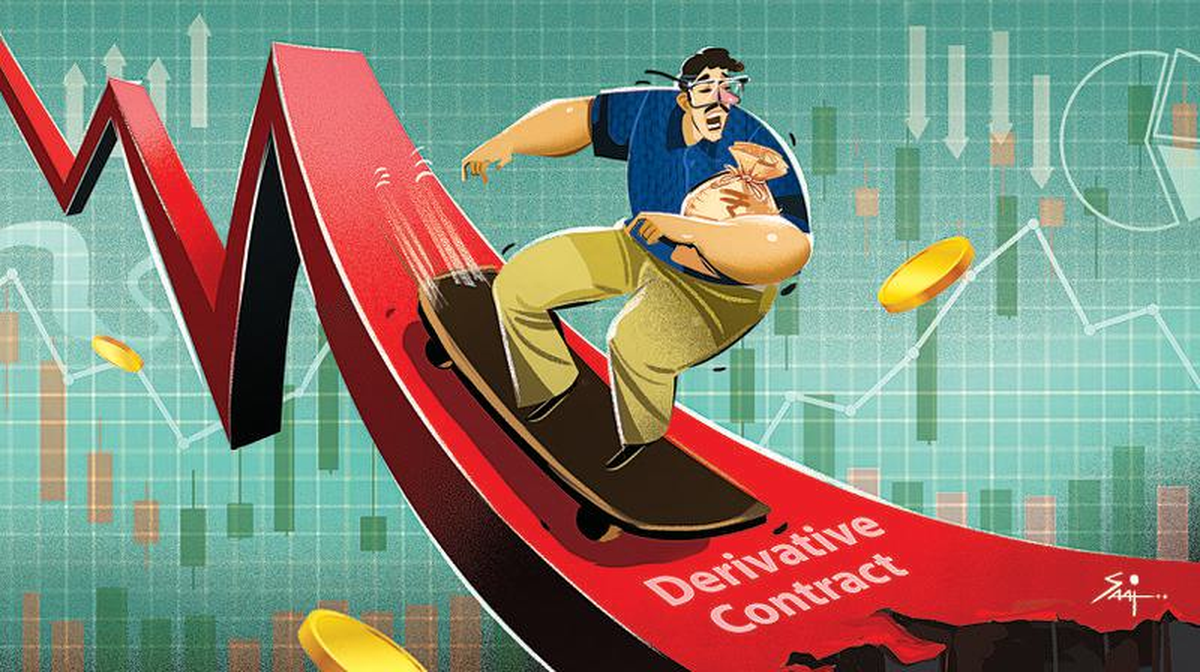
The Casino Got Smaller. The Losses Didn’t Disappear.
For years, the retail F&O story in India was one of relentless expansion. More accounts. More traders. More turnover. More bets placed on the next move in an index or stock. FY26 finally broke that pattern.
The number of individual traders in the equity derivatives segment fell for the first time in years. SEBI’s latest study puts the FY26 participant base at about 87.7 lakh, down roughly 18% from the previous year. The Finance Ministry has separately reported that the number of unique individual investors fell from 98.10 lakh to 78.60 lakh after regulatory measures were introduced.
That retreat matters because it came after a series of interventions designed precisely to make speculative derivatives trading harder and more expensive.
SEBI raised the minimum contract size for index derivatives, reduced the frequency of weekly expiries and introduced measures requiring option premiums to be collected upfront. The regulator’s broader objective was straightforward: reduce excessive speculation and protect retail investors from taking risks they may not fully understand.
The numbers suggest the measures did have an impact.
Aggregate net losses suffered by individual traders fell from about ₹1.12 lakh crore in FY25 to ₹91,685 crore in FY26. Equity-derivatives turnover also declined, falling to around ₹202 trillion from ₹213 trillion.
On paper, that looks like progress.
But there is a catch.
The loss pool shrank partly because the pool of participants shrank. The people who walked away took their potential losses with them. Those who stayed continued to struggle: 87.7% of individual traders still lost money, and the average loss per trader actually increased to roughly ₹1.17 lakh, from around ₹1.14 lakh the year before.
So the regulatory crackdown has achieved something important. It has slowed the retail derivatives machine. It has not, however, changed the basic equation facing the people still operating it.
And there is another number that makes the equation even harder to ignore: retail traders spent approximately ₹25,000 crore on transaction costs in FY26 while the overwhelming majority still ended the year in losses.
The problem, therefore, may not simply be that too many people were trading.
It may be that the people who continue to trade are still approaching a highly leveraged, high-frequency product with the wrong expectations, the wrong incentives and, in many cases, far less capital and information than the professionals on the other side of the trade.
That is where India’s options story gets more uncomfortable.
Because once the crowd begins to thin, the next question is not why are so many people trading? It is why are the people who remain still willing to keep playing?
India Turned Options Into A Mass-Market Bet
The retail options boom did not happen overnight. It was built, piece by piece, on the back of easier access, cheaper trading and a financial market that increasingly arrived on a smartphone screen.
A demat account could be opened in minutes. Trades could be executed from anywhere. Options contracts offered the possibility of taking a large market position with relatively little capital. And as online brokers competed for customers, the distance between an ordinary investor and a highly leveraged derivatives trade became almost frictionless.
Then came the expiry-day culture.
That is not the behaviour of someone patiently building a long-term investment portfolio.
It is a market increasingly organised around what happens next – the next expiry, the next price move, the next trade.
And options are perfectly suited to that psychology. A trader does not need to buy an entire stock or index exposure outright. A relatively small premium can provide exposure to a much larger position. If the market moves sharply in the right direction, the payoff can look spectacular. If it moves the other way, the premium can evaporate just as quickly.
That asymmetry is part of the attraction.
It is also part of the danger.
The growth of India’s retail derivatives market therefore cannot be explained simply by saying that Indians suddenly became more interested in finance. It was also a story about access. The barriers that once separated sophisticated derivatives markets from ordinary households steadily came down.
And once the barriers disappeared, the language of trading changed too.
Options were no longer simply instruments used by institutions to hedge risk or manage portfolios. They became products that could be discussed in trading groups, demonstrated through app screens and sold through the promise of quick returns.
The numbers show what that transformation produced.
Even after the regulatory crackdown, individual traders remained overwhelmingly concentrated in options, which accounted for about 92% of their aggregate F&O losses in FY26.
This is the crucial shift in the story. India did not merely create a larger class of investors.
It created a vast class of short-term market participants, many of whom entered a sophisticated, leveraged product with the expectation that speed itself could become a source of wealth.
And once that expectation takes hold, the market is no longer just about financial literacy. It becomes a question of behaviour. Because the hardest part of options trading may not be understanding a call or a put.
It may be resisting the temptation to place the next trade.
The ₹1 Lakh Dream
There is a peculiar promise at the heart of India’s retail options boom: you do not need much money to make a lot of money.
That is precisely what makes options so seductive.
A trader does not need the capital required to buy a large equity position outright. With an options contract, a relatively small premium can provide exposure to a much larger market position. If the underlying moves sharply in the expected direction before expiry, the percentage gain can look extraordinary. The trade can appear almost magical.
The losses can be just as unforgiving.
SEBI’s latest study offers a glimpse into the behaviour behind the headline numbers. Nearly 97% of traders in its behavioural sample were predominantly options buyers. More strikingly, among traders who remained active for more than 100 days, just 42% of the sample accounted for 94% of turnover and 87% of losses.
In other words, this is not simply a story about people occasionally taking a punt on the market. For a significant group, trading has become a repeated activity. And repetition does not appear to have produced the result one might expect.
Among traders who participated continuously over five years, 65.6% lost money in every single year. Even among those who had accumulated losses of more than ₹10 lakh, around 88% continued trading.
That is where the mathematics of options collides with the psychology of the trader. A loss does not necessarily end the game. It can create the urge to win the money back.
One bad trade becomes another. A missed rally creates the fear of missing the next one. A winning trade can reinforce the belief that the strategy works. A losing streak can be interpreted not as evidence that the strategy is flawed, but as a temporary setback that the next trade will correct.
The market therefore becomes a loop: trade, lose, try again, lose again and keep believing the next position could change everything.
SEBI’s data makes the persistence particularly striking. The proportion of loss-makers actually increased with longer participation, rather than falling neatly as traders gained experience. The evidence does not prove that experience itself causes losses, but it certainly challenges the comforting assumption that simply spending more time in the derivatives market will eventually teach a trader how to beat it.
Then there is the question of capital.
Around 77% of traders in SEBI’s behavioural sample deployed peak margin of less than ₹1 lakh. Yet having a small amount of capital did not mean having small exposure to risk. Traders with smaller equity portfolios accounted for a disproportionately large share of aggregate losses. Those with equity portfolios below ₹1 lakh contributed roughly 70% of the aggregate F&O losses in the profitability study.
The ₹1 lakh dream, then, comes with a darker mathematical reality.
For someone with limited savings, options can make the market appear accessible in a way traditional investing does not. But the same leverage that makes a large gain possible can make a small capital base dangerously vulnerable to repeated losses.
And once the objective shifts from building wealth to recovering yesterday’s loss, the trade is no longer being made for the same reason.
That may be one of the hardest problems for regulation to solve.
A rule can increase the contract size. A charge can make trading more expensive. An expiry can be removed. But it cannot easily regulate the thought that says: One more trade. This time I’ll get it back.
The Regulator Tries To Defuse The Bomb
India’s market regulator did not sit back and watch the retail derivatives boom run its course.
SEBI began tightening the rules in late 2024, targeting precisely the features that had helped turn index options into a mass-market, short-duration trading product. Weekly index derivatives were rationalised.
Contract sizes were increased. Option buyers were required to pay premiums upfront. Risk coverage on expiry days was strengthened, while position limits came under closer intraday monitoring. Further measures in 2025 sought to streamline expiry days across exchanges and strengthen the way risks were monitored and disclosed.
The objective was not to kill derivatives.
That distinction matters.
Futures and options are legitimate financial instruments. They allow investors and institutions to hedge exposure, manage risk and express views on markets. The regulatory concern was the scale of speculative retail participation — particularly where relatively small investors were repeatedly taking short-term, leveraged positions they might not fully understand.
And the crackdown appears to have changed the market.
The number of unique individual investors in equity derivatives fell from 98.10 lakh in FY25 to 78.60 lakh in FY26. Aggregate retail losses fell from ₹1.12 lakh crore to ₹91,685 crore, while overall equity-derivatives turnover declined from ₹213 lakh crore to ₹202 lakh crore.
By one measure, that is a clear regulatory success. The retail F&O machine has slowed. But the data refuses to offer a clean victory lap. The average loss per individual trader actually rose from ₹1.14 lakh to ₹1.17 lakh. Nearly 87.7% of individual traders still lost money in FY26.
The regulator has therefore managed to reduce the size of the crowd without eliminating the underlying problem.
There is another wrinkle. Trading activity remains heavily concentrated around expiry. SEBI’s study found that 59% of index-options turnover took place on the expiry day itself, while about 75% occurred on the expiry day or the preceding day.
That tells us something important about the nature of the market.
The rules may have made derivatives harder to trade at the margins. They have not necessarily removed the appetite for the very behaviour regulators are worried about: short-duration, high-intensity bets built around a narrow window of time.
And there is a cost to this enormous churn. Retail traders spent around ₹25,000 crore on transaction costs in FY26, even as almost nine in ten continued to lose money.
So the regulatory experiment has produced an intriguing result. Fewer traders. Lower aggregate losses. Lower turnover. But a persistently brutal experience for those who remain.
That raises the uncomfortable possibility that the problem was never simply the number of people trading options.
It may be the nature of the game itself and the extraordinary gap between the retail trader sitting behind a phone and the professional market participant sitting on the other side.
Because once that gap becomes visible, the question changes. It is no longer just why are retail traders losing? It is who is equipped to win this game and who isn’t?

The People On The Other Side Of The Trade
There is another number in SEBI’s latest findings that changes the way the retail-loss story should be read.
While individual traders collectively lost about ₹91,685 crore in FY26, proprietary traders recorded gross trading profits of roughly ₹44,000 crore. Foreign portfolio investors made another ₹14,000 crore. And for proprietary traders and FPIs, about 99% of the profits came from entities classified as algo traders.
The figures do not mean that every rupee lost by a retail trader landed in the pocket of a proprietary trading firm. Markets do not work that neatly. A trader can lose because an option expires worthless, because of the spread, because of volatility, because of timing or because another participant took the opposite position.
But the contrast is impossible to ignore.
On one side is the individual trader, often operating with limited capital and trading from a phone. On the other are professional firms with sophisticated technology, quantitative models, large pools of capital and the ability to process market information at a speed no individual can realistically match.
The playing field is therefore not merely unequal in size. It can be unequal in information, execution, technology, risk management and discipline.
SEBI’s behavioural study makes the capital divide even more striking. Traders with equity portfolios below ₹1 lakh accounted for roughly 70% of the aggregate individual F&O losses.
That is a particularly uncomfortable finding because the very feature that makes options attractive to a small investor – the ability to take market exposure without putting up the full value of the underlying asset – can also magnify the consequences of being wrong repeatedly.
Meanwhile, the professional side of the market has been transformed by algorithms.
The fact that 99% of the profits earned by proprietary traders and FPIs came from algo entities does not mean algorithms automatically win every trade. It does, however, underline how far the modern derivatives market has moved from the image of a lone trader studying a chart and making a clever call before expiry.
This is the part of the retail-options story that can get lost behind the headline “nine out of ten traders lose.”
It is not simply that retail traders are making bad bets.
They are entering a market where some of the most sophisticated participants have spent years building systems designed to price, hedge and execute those very bets.
And yet the retail trader keeps coming back. That persistence points to another force behind India’s derivatives boom – one that cannot be explained by market structure alone.
The trader is not just competing against another trader. Increasingly, the trader is competing against the machine, the clock and their own psychology. And somewhere between those three sits an industry that has made trading faster, easier and far more accessible than it was a decade ago.
That is where the next part of the story begins.
Then The Finfluencers Arrived
The retail options boom did not grow on market mechanics alone. It grew alongside a parallel information economy – one in which the next trade, the next strategy and the next supposed market opportunity could be delivered directly to a trader’s phone.
India’s own investor survey shows how powerful that ecosystem has become. 62% of surveyed investors said they make some investment decisions based on recommendations from financial influencers, while 56% identified social-media finfluencers as a source of information about securities-market products. YouTube was the most-used platform for such information, followed by Instagram and Facebook.
That does not mean every financial influencer is selling bad advice. Many provide useful explanations of markets, taxation, investing and financial products.
The problem begins when education starts looking like promotion.
For an options trader chasing quick returns, a complicated derivatives strategy can be reduced to a thumbnail, a chart and a promise. A winning trade can be displayed in seconds. A losing trade can disappear just as quickly. The result is an information environment where the visibility of success can be far greater than the visibility of failure.
SEBI has itself acknowledged the behavioural risks. Its investor-awareness material has pointed to optimism bias among individual F&O traders – the tendency to overestimate the likelihood of gains while underestimating the risk of losses. It has also warned about unregistered influencers who may promote products or strategies for compensation that is not always disclosed.
And the influence is no longer confined to traditional financial advice.
Telegram groups, WhatsApp communities, Reddit forums and other online investment communities have become part of the information chain. SEBI’s investor survey found that 34% of investors use online investment communities for information about securities-market products.
That matters because trading is inherently social.
A trader sitting alone in front of a screen can still be surrounded by hundreds of people telling them what the market is about to do. A losing position can suddenly feel less like a personal mistake when an entire online community is predicting the same rebound.
The danger is not simply misinformation. It is reinforcement.
If a trader is already convinced that the next expiry could deliver a big return, an online ecosystem offering constant strategies, calls and success stories can make stepping away feel like missing an opportunity rather than avoiding a risk.
That is particularly powerful in a market built around extremely short time horizons.
The clock is ticking. The expiry is approaching. The premium is moving. Someone online is claiming to have made money.
And suddenly, the easiest decision is not to stop trading. It is to place one more trade. That is why the finfluencer question belongs inside the F&O story rather than sitting separately as a social-media problem.
India has not merely made derivatives easier to access. It has built an ecosystem capable of selling the excitement of derivatives at the speed of the market itself. And for regulators, that creates a much harder problem than changing a contract size or reducing the number of expiries.
You can regulate the product. It is much harder to regulate the dream attached to it.
Not Everyone Is Losing
There is an important complication to the retail F&O story.
If nearly nine out of ten individual traders are losing money, it does not follow that everyone in the derivatives market is losing. In fact, the latest SEBI data shows a market split sharply along the lines of size, sophistication and technology.
Proprietary traders recorded gross trading profits of about ₹44,000 crore in FY26, while foreign portfolio investors made roughly ₹14,000 crore. And about 99% of the profits generated by proprietary traders and FPIs came from algorithmic trading entities.
That does not mean the market is a simple machine in which every rupee lost by a retail trader becomes a rupee of profit for a professional trader. Markets do not work that cleanly. There are spreads, hedging costs, transaction charges, changes in volatility and thousands of trades between participants.
But the contrast still matters.
The retail trader is often trying to predict where the market will move next. The professional trading firm is far more likely to be thinking about pricing, probability, volatility, execution and risk across thousands of positions.
That is a very different game.
It is also why the idea that a retail trader simply needs to become “better” at reading charts can be misleading. A professional operation may have quantitative models, automated execution, vast amounts of historical data and systems capable of reacting to market movements in fractions of a second.
The individual trader has a phone. The professional trader may have an infrastructure. And the latest numbers suggest that this technological divide is not merely theoretical. SEBI found that algorithmic entities accounted for virtually all of the profits earned by proprietary traders and FPIs in FY26.
There is another divide that is even more basic: money.
Retail traders with equity portfolios of less than ₹1 lakh accounted for around 70% of aggregate individual F&O losses in FY26.
That finding cuts through one of the most seductive ideas in options trading — that a small amount of capital can be turned into a large amount of money simply by choosing the right trade.
It can. But the same leverage works in reverse.
For someone with a large portfolio, a bad trade can be absorbed as part of a broader risk strategy. For someone with limited savings, repeated losses can consume a meaningful share of their capital surprisingly quickly.
This is why the retail F&O problem cannot be reduced to a question of financial literacy.
Knowing what a call option is does not make someone capable of competing with an algorithmic trading firm.
Understanding implied volatility does not eliminate the psychological pressure of watching a position move against you.
And learning another “strategy” does not change the mathematics of repeatedly paying transaction costs while trying to extract short-term profits from an extraordinarily competitive market.
There are individual traders who succeed. Some are highly disciplined. Some have genuine expertise. Some have developed sophisticated systems of their own. And some simply get the market right for long enough to make money.
But their existence should not obscure the larger pattern. The market is not telling retail traders that winning is impossible. It is telling them something more uncomfortable: Winning consistently is a very different proposition from winning occasionally.
And that distinction becomes crucial when the next part of India’s derivatives story comes into view – the enormous ecosystem built around keeping people engaged with the market in the first place.
The Business Of Keeping Traders In The Game
There is another side to India’s derivatives boom that is easy to miss when the discussion is reduced to traders winning or losing.
Trading itself is a business.
Every order generates activity. Every position opened and closed creates a transaction. Every expiry brings another burst of volume. And even when a trader loses money, the market around that trader continues to collect fees, taxes and other transaction-related costs.
SEBI’s latest data puts a striking number on that ecosystem. Individual traders spent approximately ₹25,000 crore on transaction costs in FY26, even as nearly 88% of them ended the year with losses.
That does not mean brokers simply pocketed ₹25,000 crore. The amount includes the wider cost of participating in the market — including statutory charges, exchange-related costs and other expenses. But it shows just how expensive the pursuit of short-term trading can become when multiplied across millions of transactions.
And this is where India’s retail-options story becomes bigger than the individual trader.
The ecosystem includes brokers, exchanges, market makers, technology providers, data platforms and a rapidly expanding digital infrastructure built around making markets accessible. None of that is inherently problematic. Markets need intermediaries. Exchanges need liquidity. Brokers provide access. Market makers provide the other side of trades and help keep markets functioning.
The question is what happens when access becomes almost frictionless while the product itself remains extraordinarily difficult to trade profitably.
That distinction matters.
A smartphone can make placing an options trade as easy as ordering food. It cannot make the underlying risk easier to understand.
A trading app can show a position turning profitable in seconds. It cannot tell a trader whether that profit came from skill, luck or a temporary move in volatility.
And a platform can make the next trade available instantly. It cannot make the next trade a good one.
The economics of the market also help explain why activity can remain remarkably persistent even when the odds are poor.
SEBI’s data shows that derivatives activity continues to cluster around expiry. Around 59% of index-options turnover occurred on the expiry day, while about 75% occurred on the expiry day or the preceding day.
That concentration is important because expiry is where the promise of quick money becomes most intense.
The clock is running down. Option premiums can move rapidly. Positions can multiply or collapse in value within hours. For a trader, it can feel like the market is offering one final opportunity to get the call right.
For the ecosystem around that trader, it is another day of extraordinary activity. This does not make brokers or exchanges responsible for individual losses. Nor does it mean that every participant is benefiting from retail losses.
But it does expose a structural tension. The trader wants to win. The market infrastructure needs the trader to keep trading. Those are not necessarily the same objective.
And once that distinction is understood, the retail F&O problem begins to look less like a story about a few reckless traders and more like a question about an entire financial ecosystem that has become exceptionally good at putting a trade within reach.
The next question is even harder. If regulation can make trading more expensive and harder, but technology can make it easier, faster and more compelling, which force wins in the end?
Has India Actually Defused The Time Bomb?
For all the changes SEBI has introduced, the most important question is still unanswered: has India actually made retail derivatives trading safer, or has it simply made the market smaller?
The evidence points in both directions.
The regulatory measures have clearly altered behaviour. The number of individual traders has fallen sharply. Aggregate losses have declined from around ₹1.12 lakh crore in FY25 to ₹91,685 crore in FY26. The active trader base has contracted for the first time in years.
Those are not insignificant achievements.
But the regulator’s own numbers also show how stubborn the underlying problem remains. 87.7% of individual F&O traders still lost money in FY26. The average loss rose to roughly ₹1.17 lakh. And activity remains heavily concentrated around expiry, with 59% of index-options turnover taking place on the expiry day itself.
The behaviour has changed. The appetite has not disappeared.
That distinction matters because the retail derivatives problem was never simply about excessive volumes. It was about what people were doing with those volumes – repeatedly taking short-term, leveraged positions in a product where the probability of sustained success is brutally difficult for an individual trader.
SEBI is now watching the information ecosystem around that behaviour as closely as the trades themselves.
In August 2026, the regulator cautioned investors about people displaying live trading strategies and real-time market calls on social-media platforms, warning that such sessions could involve unregistered advisory activity.
That is revealing.
The regulator has moved from trying to make the product itself harder to trade to confronting the ecosystem that can encourage people to trade it.
Because the modern retail trader does not encounter an option contract in isolation.
- They encounter it through an app.
- They hear about it through a video.
- They discuss it in a WhatsApp or Telegram group.
- They watch someone execute a trade live.
- And then they place their own trade.
SEBI’s 2025 investor survey found that 62% of investors said they make some investment decisions based on recommendations from financial influencers, while 56% identified financial influencers as a source of information about securities-market products. Online investment communities were also cited by 34% of investors.
That makes the regulator’s task considerably harder.
- It can change expiry rules.
- It can increase contract sizes.
- It can raise the cost of trading.
- It can warn investors.
- But it cannot easily regulate the psychological machinery that turns a market opportunity into an irresistible urge to participate.
And that may be the real test of Buffett’s time-bomb analogy. A bomb does not become harmless simply because fewer people are standing around it.
The question is whether the fuse itself has been removed.
India has undoubtedly shortened the reach of the retail F&O market. It has reduced participation and brought down the enormous aggregate losses that had triggered alarm.
But if the remaining traders are still losing at extraordinary rates, if expiry-day speculation remains intense and if an increasingly sophisticated digital ecosystem continues to sell the possibility of quick money, then the underlying problem has not disappeared.
It has merely become more concentrated. And that leaves India with a final, uncomfortable problem. The next generation of market participants is likely to have more access to financial markets than any generation before it.
The question is whether they will also have more reasons to understand the risks before they start trading.
The Next Generation Of Traders
The most important consequence of India’s retail-options boom may not be sitting in the FY26 loss figures at all. It may be sitting in the millions of people who have now learned to see the stock market differently.
For a generation of Indians, market participation no longer necessarily begins with a mutual fund, a long-term equity investment or a financial adviser. It can begin with an options chain, an expiry-day trade and the belief that a small amount of capital can produce a quick return.
The scale of that shift is extraordinary. Individual participation in equity derivatives had climbed from 42.74 lakh traders in FY22 to 98.1 lakh in FY25, before falling to around 78.6 lakh in FY26 after SEBI’s regulatory measures. Turnover, meanwhile, had risen from ₹115 lakh crore to ₹213 lakh crore over the same period before easing to ₹202 lakh crore.
That means the recent decline should not be mistaken for a return to the old market. India has already created a huge population of people who have experienced derivatives trading firsthand.
Some will leave permanently. Some will return when volatility rises. And some will keep trading because the losses themselves have become part of the story.
That is perhaps the most difficult behavioural problem to solve.
A person who loses money in a mutual fund may decide to change the fund. A person who loses money in an options trade can convince themselves that the next trade will be different. The market gives them an immediate opportunity to try again.
There is no natural stopping point. And India’s digital financial ecosystem has made that cycle extraordinarily easy to repeat.
The regulator can make contracts larger. It can reduce expiries. It can increase risk requirements. It can warn investors. Those measures can reduce participation, and the latest numbers suggest they have.
But the underlying attraction remains. Speed. Leverage. Access. The possibility of a spectacular win. That is why the retail F&O debate cannot end with the question of how many traders have been pushed out of the market.
The harder question is what kind of financial culture India is creating for those coming in next.
Because the country is still moving towards greater financialisation. More households are entering capital markets. More people have access to trading technology. More market information is being consumed through social media and digital platforms.
The opportunity is enormous. So is the responsibility.
If the first lesson a new investor learns is that markets are a place to build wealth slowly, regulation and financial education have a very different task.
If the first lesson is that the market can turn ₹10,000 into ₹1 lakh before lunch, no amount of disclosure buried inside a trading application is likely to compete with that fantasy.
That is ultimately where Buffett’s old warning returns.
He was not warning merely about a particular contract or a particular market.
He was warning about the risks created when financial instruments become so complex, leveraged and interconnected that their dangers are easier to underestimate than to understand.
India’s retail-options boom is a smaller, more personal version of that problem.
The time bomb may not be exploding across the financial system.

The Fuse Is Still Burning
Perhaps the most revealing way to read India’s retail F&O numbers is not as a verdict on whether SEBI has succeeded or failed.
It is as evidence of how difficult the underlying problem is to solve. The regulator has managed to shrink participation. Aggregate losses have fallen. New entrants have declined sharply. The rules around index derivatives have become tighter. On several measures, the market is unquestionably less frenetic than it was at its peak.
But the behaviour that created the alarm has not disappeared.
Millions of individuals remain willing to trade derivatives. Options still dominate the retail loss pool. Expiry-day activity remains intense. And the overwhelming majority of individual traders continue to lose money.
That leaves India in an unusual position. It has managed to reduce the size of the problem without eliminating the behaviour behind it. And that is where Warren Buffett’s warning becomes more useful than a convenient headline.
When Buffett and Charlie Munger described derivatives as “time bombs” in Berkshire Hathaway’s 2002 annual letter, they were not talking about an individual losing money on an options trade. Their concern was much broader: leverage, opacity, counterparty exposure and the difficulty of understanding how much risk could be accumulating inside the financial system.
India’s retail-options problem is obviously not the same phenomenon. There is no suggestion that ordinary traders losing money on index options pose the kind of systemic threat Buffett was describing.
But there is a striking parallel in the underestimation of risk.
A product can look simple on a trading screen while behaving very differently underneath. A small premium can create exposure to a much larger position. A position that looks manageable can be repeated dozens or hundreds of times. A loss that seems recoverable can become the reason for taking another, larger risk.
And unlike a traditional investment, an option comes with a clock.
This is ultimately why the FY26 numbers matter.
The ₹91,685 crore loss is enormous. The 88% loss-maker figure is staggering. The ₹25,000 crore transaction-cost bill is significant. But the most revealing statistic may be the one that appears less dramatic: the average loss increased even after millions of traders left the market.
That suggests the fuse has not gone out. It may simply be burning among a smaller, more persistent group. For regulators, brokers, exchanges and investors alike, that leaves a much harder question than whether retail participation should be higher or lower.
Can a market built around speed, leverage and constant opportunity ever be made genuinely safe for the people least equipped to navigate it?
There may be no regulatory rule that can answer that question completely.
Because ultimately, the most dangerous feature of the retail-options boom may not be the option itself. It may be the belief that the next trade will be different. And that is a risk no contract-size increase, expiry-day restriction or warning banner can completely regulate.
Buffett’s time bomb was a warning about derivatives. India’s version may be something quieter. Not one catastrophic explosion. Just millions of small bets, repeated often enough, until the losses become a permanent feature of the game.