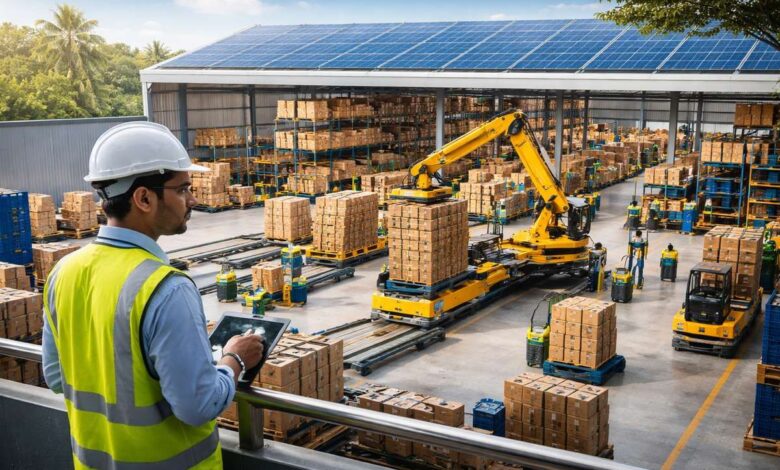
India’s warehousing sector is undergoing one of its most significant transformations in decades. Fuelled by the GST-led consolidation of logistics infrastructure, surging e-commerce volumes, and the Production-Linked Incentive (PLI) scheme driving manufacturing growth, the demand for automated warehouse solutions has reached an inflection point. The India Warehouse Automation Market was estimated at USD 0.56 billion in 2025 and is projected to reach USD 1.29 billion by 2030, growing at a CAGR of 18.14%. Indian robotics as a whole raised approximately $780 million across 95 rounds in 2025 alone — the fastest growth rate among any top-10 global robotics markets.
The shift in 2026 is notably pragmatic. Decision-makers are moving beyond proof-of-concept deployments toward ROI-driven, hybrid systems that blend autonomous mobile robots (AMRs), automated storage and retrieval systems (AS/RS), AI-powered software, and conveyor-based sortation. Cloud WMS platforms, digital twins, and AI orchestration engines are seeing particularly strong demand as enterprises look to unlock latent capacity from their existing hardware investments.
Here is a comprehensive look at the ten most impactful warehouse automation providers operating in India in 2026.
1. Addverb Technologies — Noida
Founded: 2016 | Funding Raised: ~$66.9 Million | Annual Revenue (FY25): ₹334 Crore | Employees: ~1,876
Addverb Technologies is India’s most prominent home-grown warehouse robotics and automation company. Founded in 2016 by Satish Shukla and Sangeet Kumar, the company offers an end-to-end suite of automation solutions — from autonomous mobile robots (AMRs) and AS/RS systems to pallet shuttles and its proprietary Warehouse Management System, Mobinity. Mobinity orchestrates multi-vendor robotic fleets and injects machine learning into slotting, labour assignment, and energy management.
Backed strategically by Reliance Industries and Reliance Retail — which acquired a significant stake in 2022 — Addverb has used that alliance to scale both domestically and internationally, with a presence in Australia, Asia, Europe, and the United States. In 2025, the company announced the development of a humanoid robot for production, signalling its ambition beyond conventional intralogistics. With 1,876 employees and revenues of ₹334 crore in FY25, Addverb is the benchmark for Made-in-India warehouse robotics. Industry analysts identify it as the domestic leader sustaining technology leadership through in-house AMR production and AI-driven orchestration software.
Why it matters: Addverb is the only Indian company offering a truly integrated hardware-plus-software stack at scale, making it the default choice for large enterprises seeking end-to-end domestic automation.
2. GreyOrange — Gurugram (R&D and Engineering)
Founded: 2011 | Total Funding: ~$170 Million+ | Global Headquarters: USA
GreyOrange is the most globally recognised warehouse automation brand of Indian origin. Founded by Samay Kohli and Akash Gupta, the company maintains its core R&D and engineering operations in Gurugram while operating commercially from the United States. In 2026, GreyOrange has effectively repositioned itself less as a hardware robotics company and more as a “fulfillment operating system” provider, having commoditized its own hardware to focus on the high-margin capabilities of its GreyMatter™ AI software platform.
GreyMatter orchestrates multi-robot fleets in real time, making dynamic decisions on task allocation, routing, and throughput optimization. Its clients include Flipkart, Decathlon, Walmart, and major global 3PL operators. GreyOrange dominates sortation robotics for large-format e-commerce hubs in India and received follow-on funding rounds through 2025. Its strategy of pairing proprietary software intelligence with a hardware-agnostic approach makes it particularly appealing in enterprise deployments where multiple robot brands coexist.
Why it matters: GreyOrange’s GreyMatter platform sets the standard for AI-driven warehouse orchestration in India, particularly for high-velocity e-commerce fulfilment environments.
3. Falcon Autotech — Noida
Founded: ~2008 | Installations: 1,800+ across 15 countries
Falcon Autotech is one of India’s most experienced and widely deployed intralogistics automation companies. With over 15 years of operational history and more than 1,800 installations across 15 countries, Falcon combines proprietary software with robust hardware to deliver comprehensive automation systems across six focused product lines: robotics, sortation, Put-to-Light (PTL), weight and dimensioning (DWS), conveyor systems, and automated storage.
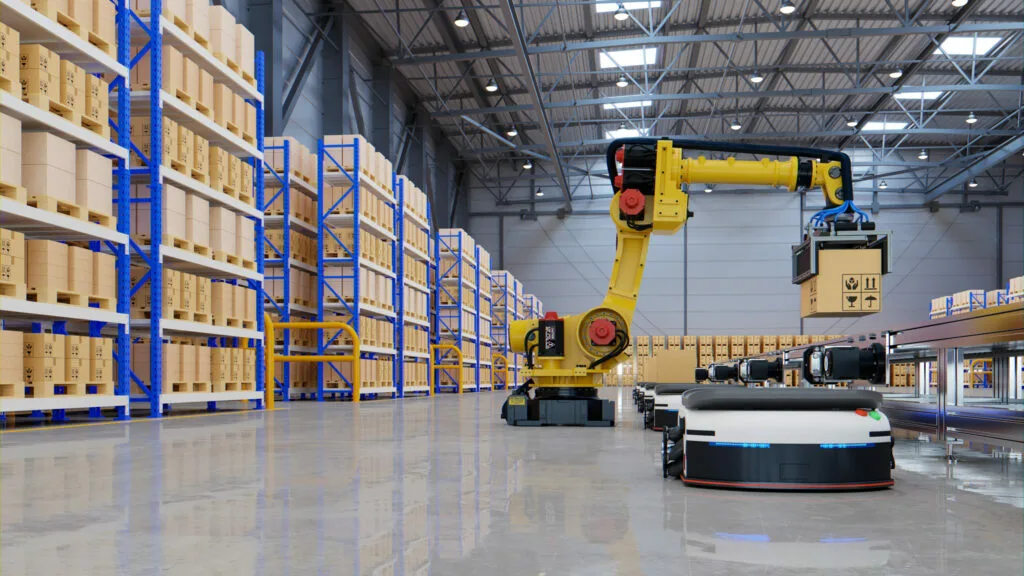
The company serves a wide cross-section of industries — e-commerce, courier/express/parcel (CEP), fashion, FMCG, automotive, and pharmaceuticals — offering both greenfield system design and brownfield retrofit solutions. Its NEO ASRS/GTP (Goods-to-Person) system is among its flagship products, designed for high-density storage with flexible robot accessibility. Falcon is a prominent exhibitor at global logistics automation events including Parcel+Post Expo 2026, reflecting its active international sales presence. Analysts identify it as a key mid-market penetration player in India’s warehouse automation landscape.
Why it matters: Falcon Autotech’s depth across six product lines and proven track record across sectors makes it a go-to partner for companies seeking proven, modular automation rather than first-generation deployments.
4. Ati Motors — Bengaluru
Founded: 2017 | Funding Raised: ~$35.5 Million | Stage: Series B
Ati Motors is among India’s fastest-growing autonomous mobile robot (AMR) manufacturers, building robots specifically designed for indoor and outdoor industrial environments. Its flagship Sherpa series of AMRs — which includes tugging, lifting, and pallet-moving variants — is designed to integrate into existing workspaces without requiring infrastructure changes and can work alongside legacy robotic systems.
In January 2025, Ati Motors raised $20 million in a Series B funding round led by Walden Catalyst and NGP Capital, with participation from True Ventures and Blume Ventures, specifically to fuel global expansion of its AI-powered robotics workforce. In mid-2025, the company launched the Sherpa 10K high-capacity autonomous tug and the Sherpa Mecha, a dual-armed mobile manipulator for manufacturing environments. The company also showcased its robots at Automate 2025 in the US, signalling its global commercial push. Ati Motors is safety-certified for human-robot collaborative environments and is backed by Tamarind Innovation Ventures, among others.
Why it matters: Ati Motors’ infrastructure-free deployment model and expanding Sherpa product family make it uniquely suited for Indian manufacturers and 3PLs that want to automate progressively without facility overhauls.
5. Unbox Robotics — Bengaluru
Founded: 2019 | Funding Raised: ~$28.2 Million | Annual Revenue (FY25): ₹14.9 Crore
Unbox Robotics is a supply chain robotics specialist that has built one of the most innovative parcel and order sorting systems in India. Its flagship product, UnboxSort, is a vertical robotics sortation system that addresses the challenge of space-constrained fulfilment centres, using a three-dimensional sorting architecture that dramatically increases throughput per square foot compared to traditional flat sorters.
The company has raised $28.2 million across 10 rounds from 55 investors including 3one4 Capital and Sixth Sense Ventures. UnboxSort has been deployed by major e-commerce and retail logistics operators in India, and the company launched its US market entry with UnboxSort in 2023, demonstrating international viability. As of 2025, Unbox Robotics has 105 employees and continues to expand its client base. A MoU with HuT Labs for collaborative R&D in robotics reflects its growing ecosystem approach.
Why it matters: Unbox Robotics solves one of India’s most specific fulfilment challenges — high-velocity sorting in tight urban warehouse spaces — with a proprietary vertical architecture that global peers have not addressed at this scale.
6. Armstrong (Armstrong Dematic) — Bengaluru
Founded: 1992 | Employees: ~533
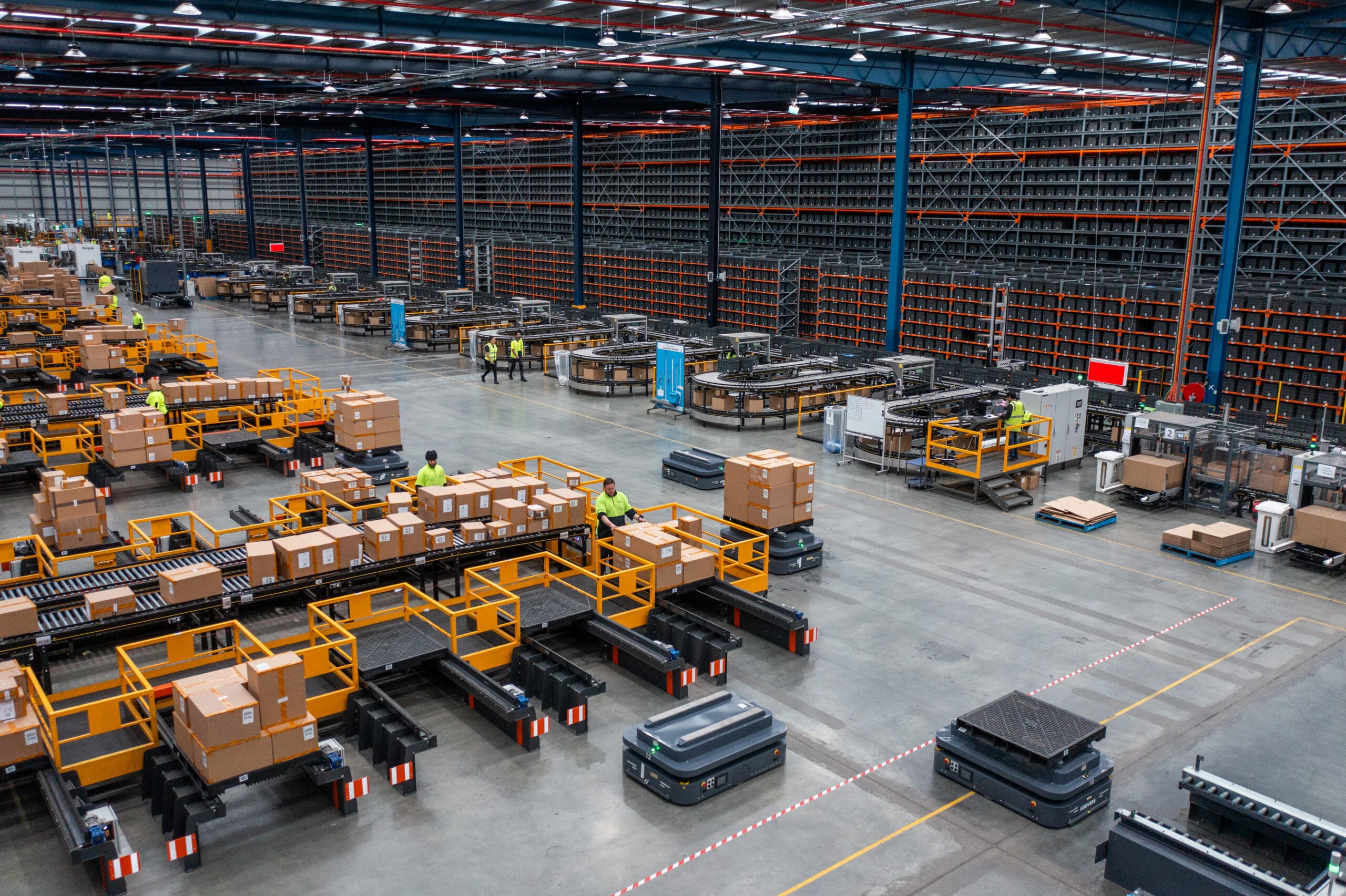
Armstrong, now operating as Armstrong Dematic in India following a technology partnership, is one of India’s longest-running and most decorated intralogistics automation companies. The company brings over two decades of expertise in designing and deploying end-to-end intelligent intralogistics solutions using robotics, AI, machine learning, and business intelligence.
Armstrong automates inbound, outbound, storage, and sorting operations, with clients across sectors including FMCG, e-commerce, retail, and manufacturing. The company has won the CII National Award for Best Intralogistics Automation Solution Provider and has also held an exclusive distribution relationship with Pitney Bowes for sorting machines in India. With 533 employees as of mid-2025, Armstrong remains a dominant brownfield automation integrator across India’s existing warehousing estates. Industry reports consistently rank it among the top five intralogistics automation companies to watch in 2025–26.
Why it matters: Armstrong’s depth in project execution for brownfield environments — where most of India’s warehousing upgrades happen — gives it a strong and sticky client base that new-age AMR companies are yet to fully penetrate.
7. Daifuku India — Hyderabad
Founded (India operations): 2008 (Japan HQ: 1937) | India Manufacturing: Hyderabad (full-scale from April 2025)
Daifuku is one of the world’s largest material handling and warehouse automation companies, and its India operations have become increasingly significant in 2025–26. In April 2025, Daifuku commenced full-scale operations at its new manufacturing plant in Hyderabad, expanding local production of AS/RS systems, sorters, and STVs (Sorting Transfer Vehicles) for both domestic supply and potential export.
This investment signals a long-term commitment to the Indian market that few global automation majors have matched with manufacturing capital. Daifuku serves pharmaceutical, automotive, e-commerce, and cold chain sectors, with high-bay AS/RS systems deployed at large brownfield campuses in logistics hubs like Bhiwandi and Sriperumbudur. In 2026, Daifuku’s global guidance emphasizes “balanced automation” — hybrid systems that combine AS/RS with AMRs based on operational fit — a philosophy well aligned with the evolving needs of Indian warehouse operators.
Why it matters: Daifuku’s local manufacturing commitment in Hyderabad makes it one of the few global automation majors treating India as both a market and a production hub, improving lead times and service coverage significantly.
8. Godrej Material Handling — Mumbai
Founded (automation division): 1970s (part of Godrej & Boyce)
Godrej Material Handling, a division of Godrej & Boyce Manufacturing, is one of India’s most trusted names in warehouse equipment and automation. The company offers a comprehensive range of products including forklifts, reach trucks, pallet shuttles, and AS/RS systems, and has been actively showcasing shuttle-based pallet systems paired with AMRs at India industry events in 2025.
The company’s approach — combining local manufacturing credentials with multinational technology transfer — positions it strongly in the mid-to-large enterprise segment. Its focus on shuttle systems for high-density pallet storage addresses the specific needs of India’s GST-consolidated large-format distribution centres, where space efficiency and storage density are paramount. Godrej’s established service network across India gives it a maintenance and support advantage that pure-play startups cannot easily replicate.
Why it matters: Godrej’s trusted brand, pan-India service coverage, and manufacturing depth make it the natural choice for enterprises that prioritize reliability and after-sales support alongside automation capability.
9. NIDO Machineries — Coimbatore
Founded: 2003 | Sector: Conveyor and Sortation Automation
NIDO Machineries (NIDO Group) is a Coimbatore-based intralogistics automation provider that has steadily built a reputation for conveyor systems, sorters, dimension-weight-scan (DWS) systems, Put-to-Light (PTL), and warehouse management software. The company’s philosophy is centred on simplifying automation to make it accessible to mid-market operators, a critical differentiator in a market where many SME warehouse operators are still on their automation journey.
NIDO serves clients in e-commerce, retail, FMCG, and manufacturing sectors across India and select international markets. Its software layer, which manages material flow and data integration, is designed to work alongside third-party WMS platforms, reducing integration friction. The company is listed among the top 100 warehouse automation companies in India by industry researcher Ensun, and its tier-2 city roots give it an understanding of operational environments that many metro-centric competitors lack.
Why it matters: NIDO’s mid-market focus and modular product portfolio make it one of the most accessible automation partners for India’s fast-growing tier-2 distribution centre market.
10. Craftsman Storage Systems — Coimbatore
Parent: Craftsman Automation Limited (NSE/BSE Listed)
Craftsman Storage Systems is the warehousing and storage automation division of Craftsman Automation Limited, a publicly listed precision engineering and manufacturing company. The division specialises in Pallet AS/RS and Miniload AS/RS systems — automated high-bay storage solutions that maximise vertical space utilisation in warehouses handling palletised goods and smaller bin-stored SKUs respectively.
Being a division of a listed manufacturing conglomerate gives Craftsman Storage Systems significant advantages: deep engineering capability, access to capital, and strong credibility with large industrial clients. The company serves automotive, FMCG, e-commerce, and pharmaceutical sectors. Its focus on optimising storage density within existing footprints aligns precisely with the 2026 investment theme of extracting more capacity from existing warehouses rather than building new ones.
Why it matters: Craftsman Storage Systems brings the rigour of a listed precision manufacturer to warehouse automation, offering institutional-grade reliability in AS/RS deployments for India’s most demanding storage environments.
The Bigger Picture: India’s Warehouse Automation Landscape in 2026
The India Warehouse Automation Market is at a structural inflection point driven by four converging forces. First, GST-led consolidation has created larger, more automation-worthy warehouses that justify capital-intensive AS/RS and AMR investments. Second, e-commerce growth — anchored by Flipkart, Amazon, Meesho, and Blinkit — is pushing throughput demands beyond what manual operations can sustain. Third, PLI scheme-driven manufacturing expansion is creating new high-volume storage and dispatch requirements. Fourth, ONDC’s open-network fulfilment protocols are decentralising warehousing toward tier-2 cities, opening an entirely new market for modular, cost-efficient automation.

Software is the next frontier. Cloud WMS platforms, digital twins, and AI orchestration engines are growing at a 28.45% CAGR through 2030, as enterprises realize that data-rich control layers deliver step-change returns on earlier hardware investments. Companies like Addverb — with its Mobinity platform — and GreyOrange — with GreyMatter — are already building the software moats that will define competitive advantage in the next phase of India’s warehousing revolution.
For enterprises evaluating automation in 2026, the choice is no longer whether to automate, but which combination of AMRs, fixed automation, and intelligent software delivers the fastest and most defensible return.