Why Cars24 Was Bleeding Money Since Last 5 Years?
The Long Burn: Cars24's Financial Reckoning and the Road Ahead

There is a particular kind of corporate optimism that persists even as the numbers tell a different story. Cars24, once the poster child of India’s used-car technology revolution, is grappling with exactly that tension. The Gurugram-based platform, which promised to make buying and selling pre-owned vehicles as seamless as ordering groceries, is heading into its would-be IPO year having just posted a second consecutive year of net losses crossing the Rs 500 crore mark, a sharp revenue contraction, and a leadership exodus that stripped away three of its most senior executives in the span of a few weeks. Though, just a month ago, the company became profitable; however, we need to know what went wrong in the last 5 years?
Cars24 operates as a full-stack platform for pre-owned vehicle commerce. At its core, it buys used cars from individual sellers through physical inspection centres spread across Indian cities and sells them to buyers, either through its own retail storefronts or via a B2B auction channel used by dealers. In addition to this buy-sell model, the company has built ancillary revenue lines: Loans24, a financing vertical that facilitates third-party vehicle loans; insurance and warranty services; parking fees; and service charges.
The model sounds elegant. The execution is anything but. Cars24 is, at its heart, an inventory-heavy business masquerading as a technology platform. Every car it sells had to first be bought, inspected, potentially refurbished, insured while in stock, stored, and then marketed to buyers. This means the company’s cost structure is dominated by one massive line item: procurement.
In FY25, procurement of vehicles accounted for 81% of Cars24’s total expenditure, a figure that leaves precious little margin for the company to absorb operational, marketing, or technology costs. Every rupee of revenue earned comes with roughly Rs 1.11 spent. That single metric captures the core problem: Cars24 is, year after year, a loss-making machine at the unit level.
The FY25 Numbers: A Deeper Look
The financial year ended March 2025 was, in many ways, a year of reversal. After recording a sharp 25% revenue jump in FY24, a performance that had briefly suggested the company was finding its footing- Cars24 India’s gross revenue fell 10% to Rs 6,233 crore in FY25, down from Rs 6,910 crore a year earlier.
The core business bore the brunt. Revenue from auction and retail car sales — which makes up approximately 92% of total income — dropped 11% to Rs 5,733 crore in FY25 from Rs 6,432 crore in FY24. The decline was attributed to a slowdown in transaction volumes across both auction and retail channels.
Income from financial services stood at around Rs 215 crore, generated primarily through Loans24. The rest came from service-related income. The company also recorded Rs 125 crore in non-operating income from interest on deposits, commercial papers, and debentures — a passive income stream that softened the blow slightly, pushing total income to Rs 6,358 crore.
On the cost side, despite the revenue contraction, the company could not match the decline with proportional savings. Vehicle procurement fell 9% to Rs 5,555 crore, but this modest reduction was undermined by other cost pressures. Employee benefits expenses rose 15% to Rs 604 crore, including Rs 36.5 crore in ESOP costs. Marketing and advertising spend was cut sharply — down 25% to Rs 106 crore — a sign of deliberate frugality, though one that raises questions about brand visibility in a competitive market.
Total expenditure for FY25 came in at Rs 6,898 crore, against total income of Rs 6,358 crore. The result: a net loss of Rs 543 crore, up 9% from Rs 498 crore in FY24. The efficiency metrics are equally sobering. Return on Capital Employed (ROCE) stood at a negative 21.13%. The EBITDA margin deteriorated further to negative 6.77%. As of March 2025, the company’s cash and bank balances stood at just Rs 155 crore, a relatively thin cushion for a company burning hundreds of crores annually.
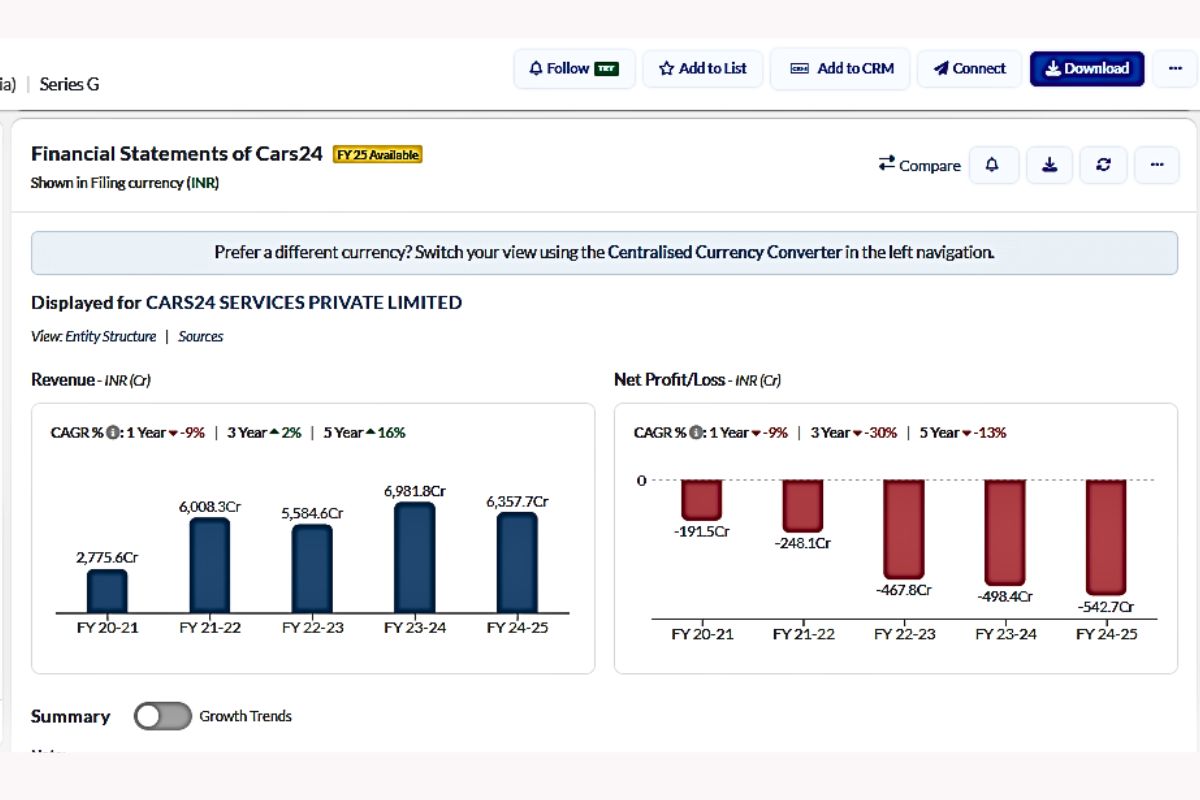
The five-year revenue trajectory from Tracxn tells the fuller story: from Rs 2,775.6 crore in FY20-21, the company climbed steadily to a peak of Rs 6,981.8 crore in FY23-24, before retreating to Rs 6,357.7 crore in FY24-25. The net loss curve is even more instructive as losses went from Rs 191.5 crore in FY20-21 to Rs 248.1 crore in FY21-22, then widened dramatically to Rs 467.8 crore in FY22-23, briefly narrowed to Rs 498.4 crore in FY23-24, and then expanded again to Rs 542.7 crore in FY24-25. Five consecutive years of losses, with the average creeping steadily upward.
The Funding Drought
Cars24’s financial difficulties are compounded by a fundraising situation that is, at best, uncomfortable. The company’s last external funding round was in December 2021, when it raised $400 million at a valuation of $3.3 billion, making it one of the most well-capitalised startups in India’s used-car space at the time. Its investors include heavy hitters like SoftBank, Tencent, DST Global, and Alpha Wave.
But that round is now nearly four-and-a-half years old. Then came the funding crunch as the global venture capital landscape tightened dramatically. SoftBank, once the most aggressive tech backer in Asia, has pulled back significantly from later-stage growth investing. The era of deploying capital at loss-making startups in the hope of market dominance has largely given way to a demand for clear profitability trajectories.
Cars24 has not raised external funding in the last three years. With cash and bank balances of Rs 155 crore as of March 2025 and losses running at Rs 543 crore annually, the company is navigating a narrow corridor. Its current assets stand at Rs 1,988 crore, which provides some buffer, but working capital in inventory-heavy businesses is a notoriously illiquid form of cash.
The company’s response has been to push toward an IPO, with CEO Vikram Chopra announcing a timeline of six to twelve months for a public listing. The company also plans to reverse-flip its holding structure from Singapore to India, a procedural but symbolically important move that signals its intent to access domestic capital markets. As of June 2026, however, no Draft Red Herring Prospectus (DRHP) has been filed with SEBI, and no investment bankers have been formally appointed.
The IPO play is a double-edged proposition. On one hand, it could provide the fresh capital injection the company needs to sustain operations and invest in growth. On the other hand, public markets are far less forgiving than private investors. For a company still spending Rs 1.11 to earn a rupee of revenue, the scrutiny of institutional investors, analysts, and retail shareholders could be unsparing.
Leadership: The Exits That Speak Loudest
If the financial numbers have been a slow burn, the leadership exodus of early 2026 has been more of an abrupt fire alarm.
Between March and April 2026, a cascade of senior departures unfolded in quick succession in Cars24. Himanshu Ratnoo, who had been promoted to CEO of the India used-cars business in 2024, the unit that contributes more than half of Cars24’s total business resigned in March 2026.
Co-founder and COO Mehul Agrawal, who had been with the company for over eleven years, stepped back from his operational role in April, announcing he would transition to the board. A day before Agrawal’s announcement, co-founder and CMO Gajendra Jangid stepped down from his executive role into a mentorship advisory capacity. Director of Engineering Ankit Bhalla also departed around the same period. We have enough history to get hint that top management exodus is a compromising signal for the company.
Simultaneously, the company laid off approximately 200 to 250 employees, primarily from product and technology teams. It was later announced that Cars24 was closing its Bengaluru office. Employees at that location were asked to relocate to the headquarters in Gurugram, or else exit the company.
The departures carry particular weight given their timing. Founders exiting operational roles months before a anticipated IPO can be read charitably, as a deliberate restructuring to bring in professional management and streamline governance ahead of public listing. It can also be read more critically, as senior leadership choosing to step away from a difficult operating period rather than steward the company through it.
To be fair, founder transitions before IPOs are common in the Indian startup ecosystem. What makes Cars24’s situation unusual is the clustering, three co-founders or senior leaders leaving within weeks of each other, and the fact that it follows years of consistent losses without a clear inflection point toward profitability. CEO Vikram Chopra has taken direct charge of India operations following Ratnoo’s exit, a consolidation of power that reflects both confidence and pragmatism.
Geographic Retreat: Pruning for Survival
Cars24 has also quietly pulled back from markets it once entered with fanfare. The company has exited Thailand, Indonesia, and Saudi Arabia, consolidating its international presence around India, the UAE, and Australia. Within these markets, the UAE operations have reportedly reached profitability, a proof point the management has highlighted when discussing the broader business model’s viability. This is again a sign of problem, as we have historical anecdote that a company shuts its doors in foreign lands and draft its wheels in domestic soil only, when there is uncontrolled turbulence!
The company has also wound down Inspare, one of its ancillary initiatives, and scaled back teams on projects such as FourDoor, its consumer car-care service. These zig- zag ride again is worth questioning! These pruning exercises reflect a company that is rationalising aggressively, cutting anything that does not contribute directly to its core used-car retail and financing revenues.
The acquisitions, however, continue. In the past year, Cars24 purchased Team-BHP, the beloved automotive community and review platform, and more recently acquired CarInfo, a vehicle information and management service, followed by VehicleInfo in March 2026. These moves signal a longer-term bet that owning the customer’s informational journey, from researching a car, to buying it, to managing it will create a defensible ecosystem with higher lifetime value per customer. Whether this thesis pays off in the near term remains to be seen. Mis-calculated acquisitions, as seen in case of Byju’s is again troublesome.
Comparing the Landscape: Spinny, CarDekho, and the Sector’s Difficult Arithmetic
Cars24 does not exist in isolation. It competes in a market with several well-funded rivals, and a comparative look at their finances reveals how broadly the used-car sector struggles even as some players manage the challenge more nimbly.
Spinny is the most instructive comparison. Founded in 2015 and backed by Tiger Global, Accel, General Catalyst, and Abu Dhabi Growth Fund with over $676 million raised to date, Spinny posted revenue of Rs 4,657 crore in FY25, a 25% jump from Rs 3,730 crore in FY24. More significantly, it managed to cut net losses by 28% to Rs 423 crore from Rs 590 crore in the previous year. Spinny’s per-unit expense-to-revenue ratio is identical to Cars24’s at Rs 1.11, a reminder that the structural challenge is sector-wide but its trajectory is materially different: growing revenue while shrinking losses, versus Cars24’s shrinking revenue and growing losses.
Spinny’s procurement costs totalled Rs 4,309 crore in FY25, representing 83.3% of overall costs almost exactly Cars24’s 81%. The business models are structurally similar, which makes Spinny’s ability to grow revenue while cutting losses all the more noteworthy. The difference appears to lie in execution focus: Spinny has concentrated on consumer retail (it derives 97.7% of its revenue from direct car sales) and has been disciplined in cost management, cutting employee expenses by 13.8% and marketing by 11.3%.
CarDekho Group operates a different model, it is more of a marketplace and financial services platform than a full-stack inventory holder, which gives it a different risk and cost profile. The Jaipur-headquartered company reported net revenue growth of 54% to Rs 2,074 crore in FY24, driven significantly by its insurance and lending arms, InsuranceDekho and Rupyy. CarDekho has also signalled IPO ambitions, making it another candidate in what industry observers are calling a race to Dalal Street for India’s used-car platforms.
CarTrade Tech, the only publicly listed entity in this space, offers a different data point. Operating primarily as a marketplace and digital services platform rather than an inventory holder, CarTrade recorded an 85% surge in profit in FY25, a performance that sets a benchmark and simultaneously illustrates the gap between asset-light marketplace models and the full-stack approaches of Cars24 and Spinny.
The broader market context is, admittedly, constructive. India’s used-car market processes roughly six million transactions annually, but only around 1.2 million flow through organised platforms like Cars24, Spinny, and CarDekho, meaning 80% of transactions still happen through informal dealer networks. The organised segment has grown from 18% market share in FY17 to around 25% today. The long-term direction is clear. The question is which players have the financial endurance to be standing when the formalisation wave arrives in full force.
The H1 FY26 Green Shoots: Real Turnaround or Window Dressing?
Cars24 has pointed to early FY26 data as evidence of a turning tide. The company reported that adjusted net revenue rose 18% year-on-year to Rs 651 crore in the first half of FY26 (April to September 2025), while adjusted EBITDA loss narrowed by 36% to Rs 162 crore. Retail transactions now contribute more than half of vehicle gross merchandise value. Loan disbursements through Loans24 reportedly rose 38%.
These are encouraging numbers, but they come with important caveats. First, they are “adjusted” metrics, which typically strip out certain costs and may not align with the accounting definitions used in RoC filings. Second, the company specifically noted that December 2025 was its strongest-ever month in terms of profitability, but a single month of strong performance does not constitute a systemic shift. Third, the H1 FY26 revenue of Rs 651 crore is “adjusted net revenue,” not gross revenue — making direct comparison to FY25’s Rs 6,233 crore gross revenue meaningless without a consistent apples-to-apples framework.
The management’s decision to report in adjusted net revenue terms ahead of an IPO is a common pre-listing practice, but it also means that the cleaner picture will only emerge when full-year FY26 filings are submitted. Until then, investors and observers are working with incomplete data.
What the IPO Story Must Overcome
The path to a successful IPO for Cars24 runs directly through a set of unresolved questions that public market investors will ask with considerable rigour. The first is profitability trajectory. 5 consecutive years of losses, with no inflection point on EBITDA, will demand a compelling and credible narrative about when and how the company turns cash-flow positive. The management’s answer, focus on retail over wholesale, expand Loans24, deepen the ecosystem through acquisitions is coherent in theory but has not yet translated into numbers.
The second is the funding gap. Three years without external capital, against a backdrop of annual losses exceeding Rs 500 crore, suggests the company has been conserving capital aggressively. But conservation has limits. The IPO is not just about growth capital, it is also about extending runway. The third is governance and leadership continuity. The wave of senior exits, however strategically framed, creates uncertainty about execution capacity at a critical juncture.
The fourth is competitive intensity. Spinny is improving faster. CarTrade is profitable and listed. CarDekho is diversifying into financial services. The window for Cars24 to assert dominance based on scale alone is narrowing. None of these concerns are fatal. Indian public markets have shown appetite for loss-making new-age businesses, Zomato, Nykaa, and Paytm all listed while unprofitable, with mixed subsequent performances. But post-listing scrutiny is relentless, and investor patience for sustained losses has demonstrably shortened since 2021.
At the end: Running on Restructuring, Not Revenue
Cars24 is a company in the middle of a genuine transformation of cutting costs, rationalising markets, making acquisitions to deepen the platform, and trying to shift its revenue mix toward higher-margin channels. These are the right instincts. But instincts are not numbers, and the numbers, for now, still point in the wrong direction. Revenue is declining. Losses are growing. Cash is thin. Leadership has shifted. The IPO clock is ticking.
The used-car market in India is real, large, and underpenetrated. The opportunity that Cars24 identified in 2015 when it was founded has not disappeared. What has changed is the context: capital is no longer cheap, investors are no longer patient, and competitors are executing with sharper discipline. For Cars24, the question is no longer whether the market is big enough. It is whether the company can get its financial house in order before the runway runs short — and whether the story it tells public market investors in the months ahead is one of genuine recovery, or one last chapter of optimism before a reckoning.