Is Ola The Next Byju’s?
How Ola Cabs Lost 99% of Its Value While Its Founder Chased AI Dreams!

There is a moment in the lifecycle of a failing institution when the numbers become so large, so consistently bad, and so systematically ignored that they stop feeling real. Ola Cabs, or Ola Consumer, as it rebranded itself in August 2024 is approaching that moment. This is an attempt to make the numbers feel real again, because the people who will be hurt by them, which includes retail investors who may be invited into an IPO, employees who are considering joining, drivers who depend on the platform, and consumers who use it daily, deserve clarity before they make decisions involving this company.
The single most damning number in Ola Consumer’s story right now is not a rupee figure, it is a percentage. The 99%.
That is how much Vanguard, one of the world’s most sophisticated institutional asset managers, with $10 trillion in assets under management has effectively written down its stake in ANI Technologies, the parent entity of Ola Consumer. According to filings with the US Securities and Exchange Commission (SEC), Vanguard values its holding in the company at approximately $728,000 as of February 2026. Based on its proportionate stake, this implies a total company valuation of just $70.3 million, or roughly ₹580 crore at current exchange rates.
To appreciate what this means, consider the context. Vanguard first invested in Ola in 2015, writing a cheque of $51.7 million when the company was valued at approximately $5 billion. The company went on to reach a peak valuation of $7.3 billion in December 2021. So Vanguard has not simply lost money on a bad trade. It has watched the company it backed at $5 billion be repriced, by its own fund, to $70 million. That is not a correction. That is an erasure.
For comparison, what does a healthy company at a comparable revenue stage look like? Rapido, Ola’s most dangerous domestic competitor recently raised $240 million at a valuation of $3 billion, making it 42 times more valuable than Ola Consumer in the eyes of the market, despite the fact that Rapido was founded four years after Ola and entered the market with just $2 million in initial capital. Uber’s India subsidiary, a market Ola once co-dominated, received a fresh infusion of $330 million from its parent in early 2026, nearly five times the entire current implied value of Ola Consumer.
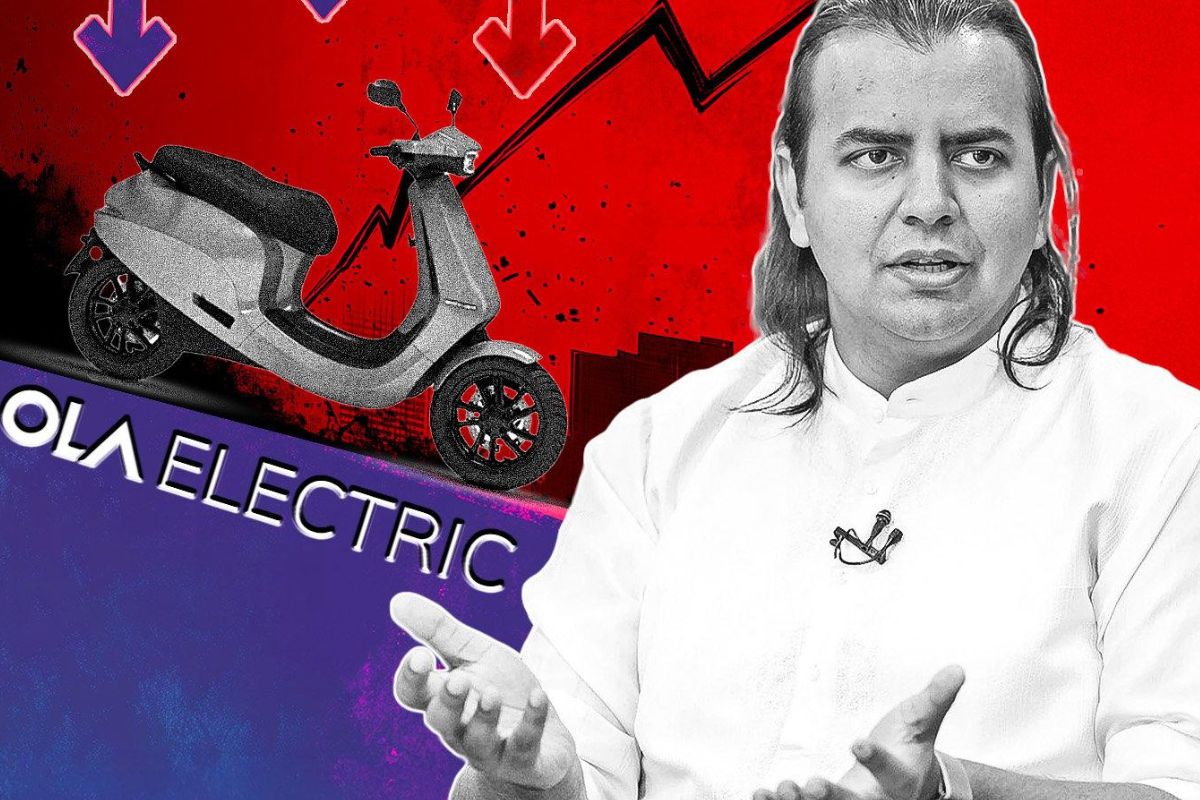
There is a secondary number that amplifies this absurdity. Ola Consumer holds a 3.6% residual stake in the listed entity Ola Electric Mobility. At current market prices, that stake alone is worth approximately $73 million, which means the ride-hailing business that Bhavish Aggarwal built over 14 years is, by Vanguard’s reckoning, worth less than zero when you strip out the Electric stake. The business itself has negative implied value in the eyes of one of its oldest institutional investors. This is the headline number. Everything else is explanation.
To understand Ola’s financial trajectory, you must trace it from the beginning, because the patterns are not new, and they have simply become impossible to ignore.
ANI Technologies was founded by Bhavish Aggarwal and Ankit Bhati in 2010. In its early years, financial data is fragmentary, but the structural DNA was set early: a platform business that subsidised rides to acquire users, funded entirely by venture capital rather than by the economics of the business itself.
OLA- the start of fall…
By FY2018, Ola was already a ₹28 billion (₹2,800 crore) revenue company on an operating basis, but the losses were proportionally enormous, which shows a pattern that would define every subsequent year. In FY2019, the net loss stood at approximately ₹2,593 crore, and the company was burning cash across multiple verticals simultaneously: Ola Foods, Ola Financial Services, Ola Electric (then nascent), and the international expansion into Australia, the UK, and New Zealand.
The COVID years, FY2020 and FY2021, are where the business model’s fragility became fully visible. Ride-hailing demand collapsed. Ola had no ability to generate revenue without rides, and it had no margin of safety built into the business. What the pandemic exposed is what analysts had been quietly noting for years: that Ola was a logistics business disguised as a technology company, and when the underlying physical activity stopped, there was nothing to fall back on.
In FY2022, revenue from operations recovered to ₹1,679 crore on a consolidated basis, but the net loss was a staggering ₹1,522 crore, a loss-to-revenue ratio of approximately 91%. Put differently: for every ₹100 Ola earned in FY2022, it was losing ₹91. That is not a growth-stage startup burning cash to acquire users. That is a business with a fundamental cost problem.
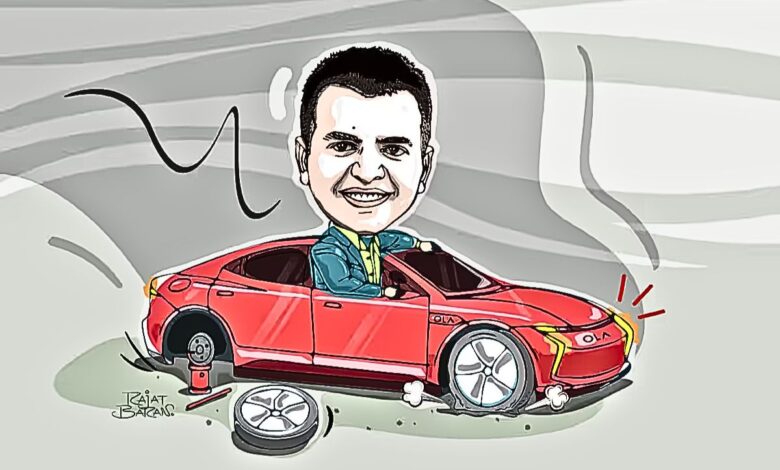
And then came the date after 2 years, in 2 tyres, of Ola’s burning scooter (pun intended). FY2024 is where the story turns dark again. Consolidated revenue actually dipped modestly, settling around ₹2,011 crore, and the loss widened to ₹328 crore. The company rebranded from Ola Cabs to Ola Consumer in August 2024, ostensibly to reflect a broader portfolio vision. What the rebrand actually reflected was a business that had ceded its identity in the very market it helped create.
FY2025 is the definitive chapter. Revenue collapsed by 42%, not a slowdown, but a collapse, falling to ₹1,170 crore. Net losses more than doubled to ₹662 crore. The loss-to-revenue ratio, which had improved so promisingly in FY23, ballooned back to 57%. Employee expenses fell by a third (the company had been shedding headcount aggressively), yet losses still accelerated. This tells you something important: the revenue problem is structural, not operational. Cutting costs has not bent the loss curve because the revenue is the problem.
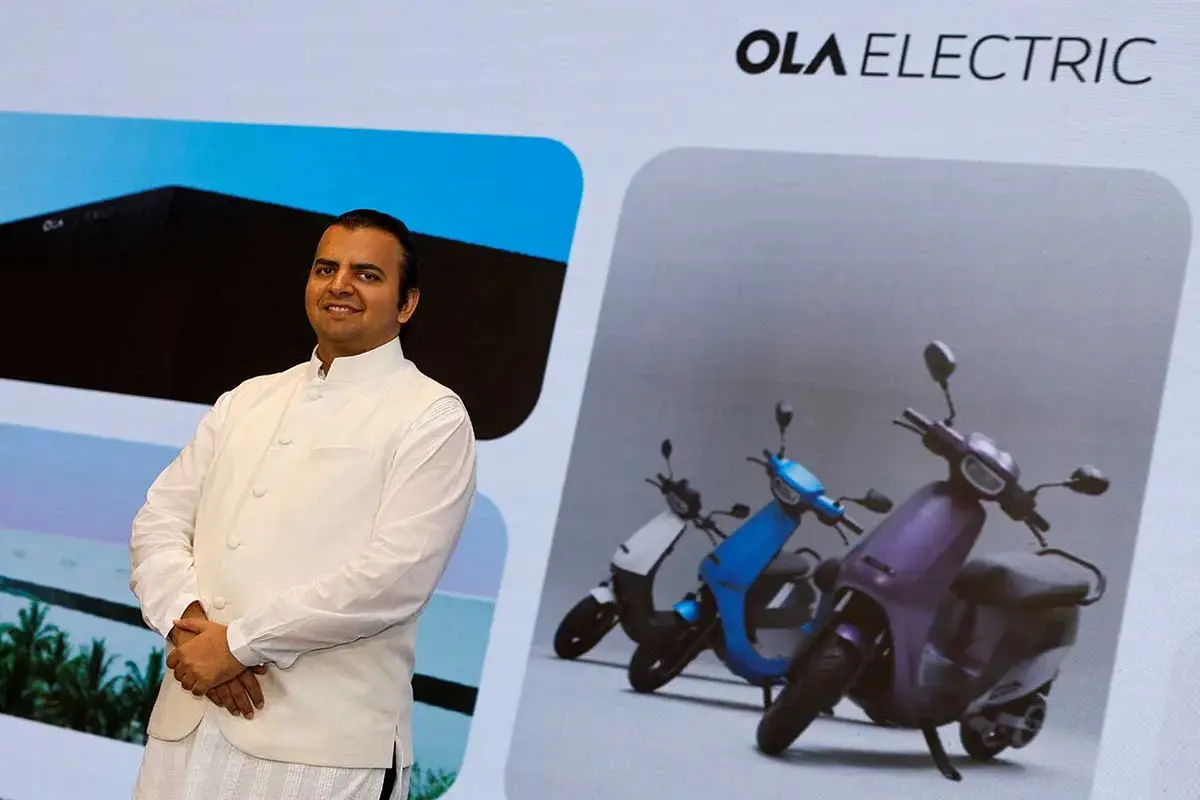
The cumulative scorecard through FY2025. ANI Technologies has accumulated losses of more than ₹21,212 crore at the group level. The company has received total external funding of approximately ₹31,441 crore. It has spent, in round numbers, more than two-thirds of everything it has ever raised. And it is still losing money. What does this trajectory tell us about the business model’s fundamental economics? It tells us that a business which cannot turn structurally profitable after 14 years of operation, across multiple economic cycles, with access to billions of dollars in patient capital, has a model problem, and not a timing problem.
The three dominant expense categories in ANI Technologies’ books are, in order of magnitude: driver incentives and platform costs, employee expenses, and technology and infrastructure costs. These three together account for the vast majority of the company’s operating expenditure.
Driver incentives are the original sin of the ride-hailing business model everywhere in the world. To attract supply (drivers), platforms pay incentives above and beyond the ride economics. To attract demand (riders), they subsidise fares. The margin in between, the platform’s commission, typically 15-20% of the ride value is supposed to cover all other costs and eventually generate a profit. The problem is that in India’s hyper-competitive market, neither side of the equation has ever been allowed to operate at market rates.
Ola has historically offered discounts to riders and bonuses to drivers simultaneously, which means the platform commission is being spent before it is even collected. When Ola’s FY25 revenue fell 42%, it was not because fewer people were taking rides in India — urban mobility demand was rising. It was because Ola was losing rides to Rapido and Uber, which means it was losing the pricing power battle.
Employee expenses, at ₹205 crore in FY25, tell a secondary story. Note that this figure represented a reduction of more than a third from the ₹333 crore of FY24, meaning Ola has been in active retrenchment. In 2022, the company laid off approximately 200 employees citing “macroeconomic conditions,” a phrase that serves as corporate euphemism for “we cannot sustain our cost structure.” Additional rounds of layoffs followed in subsequent years. The irony is painful: the company built a reputation, particularly under Bhavish Aggarwal‘s leadership of Ola Electric, of investing aggressively in new technology verticals, AI, electric vehicles, semiconductor chips, while simultaneously retrenching the workforce that runs the original business.
Technology spending is the category that most demands scrutiny. A genuine technology company, one that owns proprietary algorithms, builds defensible software infrastructure, and generates network effects that create barriers to competition would show increasing returns to technology investment over time. Ola’s technology expenditure, by contrast, has not visibly produced any proprietary capability that its competitors cannot access or replicate.
The matching algorithm that connects riders and drivers is not meaningfully different from Uber’s or Rapido’s. The app is not more reliable. The pricing model is not more sophisticated. The driver onboarding process is not more efficient. If you strip away the brand name, what remains is a software layer sitting on top of a fleet of independent contractors — a description that applies equally to every other player in the market.
The harder question, as Ola mulls an IPO: when the venture capital subsidies stop, when the driver incentives are rationalised to market rates, when the promotional fares are eliminated, then what remains? The answer, based on the FY25 numbers, is a business that generated ₹1,170 crore in revenue and lost ₹662 crore doing it. That is what remains.
The single most important question any investor asks before committing capital is: what does this company own that a well-funded competitor cannot replicate in 18 months? In the venture capital vocabulary, this is called the moat — the sustainable competitive advantage that protects returns once the market matures. For Ola Consumer, answering this question honestly requires intellectual courage, because the honest answer is: very little.
Consider the candidate moats one by one. Brand recognition is real. Ola is one of India’s most recognised startup names, with 14 years of advertising, press coverage, and consumer mind share. But brand alone does not retain users when a competitor offers lower fares and shorter wait times. The FY25 revenue collapse is evidence that brand loyalty has a price, and that price is competitiveness.
Data is another frequently cited moat for platform businesses. Ola has accumulated over a decade of ride data, origin-destination pairs, pricing elasticity, driver behaviour, peak-hour patterns across hundreds of Indian cities. This is genuinely valuable. However, the competitive advantage derived from this data has not materialised in any observable way. Ola’s surge pricing is not demonstrably more accurate than Uber’s. Its demand forecasting has not produced any structural pricing advantage. And Rapido, starting from scratch in 2015, was able to build a competitive data infrastructure quickly enough to overtake Ola as Uber’s primary rival in India by 2025. This suggests that the data moat is real but not decisive.
Driver network is a third candidate. Ola has spent years and billions of rupees onboarding and retaining drivers across India. But driver loyalty in the platform economy is notoriously thin, as drivers routinely operate across multiple platforms simultaneously, migrating to whichever pays better incentives in a given week. There is no exclusivity, no switching cost, and no structural barrier to a competitor building a comparable driver network with sufficient capital. Rapido proved this point by building a two-wheeler and auto-rickshaw network that Ola never prioritised.
The uncomfortable conclusion is that Ola Consumer, as it stands today, owns a brand name and a depleting user base. A well-funded competitor, which both Uber and Rapido already are, can replicate its functional capabilities in less than 18 months. The evidence for this claim is not theoretical: Rapido has already done it.
The financial history of ANI Technologies is, in one sense, the history of Indian startup venture capital itself — a story of cascading rounds at escalating valuations, driven by global capital chasing emerging market growth stories, with the underlying business economics serving as a minor character in a much larger narrative about asset pricing.
Ola’s funding journey begins with a seed round in 2011 and accelerates dramatically through the mid-2010s. Tiger Global led the Series A in March 2012. By 2014, DST Global was in. By October 2014, SoftBank led a transformational Series D at a $1 billion valuation, Ola’s first unicorn moment, writing a cheque that took the company’s total funding to approximately $277 million. The SoftBank relationship would define the next phase of Ola’s growth: Masayoshi Son’s Vision Fund philosophy of flooding markets with capital to achieve dominance was applied to Ola with characteristic aggression.
The Series F in late 2015, worth $500 million, valued Ola at $5 billion and brought in Baillie Gifford, Falcon Edge, Tiger Global, SoftBank, DST Global, and critically Vanguard, which invested $51.7 million. By October 2017, a Series I round worth $1.1 billion — the largest single round in Ola’s history, led by Tencent — pushed total fundraising past $3.8 billion and valuation into the multi-billion dollar range. The company was expanding internationally, launching in Australia, New Zealand, and the UK, running multiple verticals simultaneously, and burning cash at a rate that only the Vision Fund era’s extraordinary liquidity could sustain.
The peak came in December 2021: a $139 million round led by Edelweiss PE, with IIFL, Hero Enterprise, and others participating, at a valuation of $7.3 billion. This is the number against which all subsequent markdown is measured. In hindsight, it also marks the moment when the global venture capital cycle began to turn. Interest rates rose. Capital became expensive. The “growth at all costs” philosophy gave way to demands for profitability. And Ola, which had raised nearly $3.84 billion across 25 rounds from 150 investors over a decade, suddenly found itself in a world that no longer rewarded the behaviour it had been funded to exhibit.
The last external funding round for Ola Consumer (as of mid-2026) was that December 2021 round, nearly four and a half years ago. The company has been operating on internal resources and whatever cash remains from prior rounds since then. Its accumulated losses of ₹21,212 crore against total external funding of approximately ₹31,441 crore imply that the company has consumed more than two-thirds of all capital ever raised, with no path to profitability visible in its most recent financials.
The debt position compounds the pressure. According to FY25 filings, Ola Consumer carries debt obligations exceeding ₹586 crore. The company has stated it has “adequate liquidity” to meet obligations, and its net worth stood at ₹2,025 crore at the end of FY25, down nearly 50% from ₹3,991 crore in FY24. If revenue continues its FY25 trajectory and losses continue to widen, that net worth buffer will erode further.
What happens if the next funding round does not close? The company has publicly approved an IPO process, with the board greenlighting the proposal in September 2024 and the company booking ₹18.8 crore as a prepaid expense toward the IPO process in FY25. An IPO is, in this context, not merely a liquidity event — it is a necessity. The retail public market may be the only remaining source of capital willing to fund this business. The timing of that revelation — given a 42% revenue decline and a 99% valuation markdown by Vanguard — should give every prospective retail investor pause.
It would be unfair, and analytically wrong, to evaluate Ola Consumer in isolation from the market it inhabits. India’s ride-hailing market is large, structurally underserved, and genuinely growing. Urban mobility demand is expanding as India’s middle class grows, as fuel prices make personal vehicle ownership more expensive at the margin, and as traffic congestion makes the time cost of driving unbearable in tier-1 cities. None of this is in question. The question is whether Ola Consumer is positioned to capture the growth that is undeniably coming.
The three most dangerous competitors, and what they are doing better:
Rapido is the most instructive case study in competitive displacement. Founded in 2015 with $2 million in initial capital, compared to Ola’s billion-dollar war chest, Rapido focused on the segment of Indian urban mobility that Ola and Uber dismissed: two-wheelers and auto-rickshaws. In a country where two-thirds of registered vehicles are two-wheelers and where traffic congestion makes car-based rides expensive and slow, Rapido built a genuinely differentiated product.
Its asset-light model, where riders on their own bikes, with lower capital requirements and lower per-ride costs, generates economics that a four-wheeler cab aggregator simply cannot match. By August 2025, Uber CEO Dara Khosrowshahi had publicly named Rapido as Uber’s biggest competitor in India, explicitly describing Ola as a distant third. In May 2026, Rapido raised $240 million at a $3 billion valuation — 42 times the current implied valuation of Ola Consumer. Prosus, which led the round, is a sophisticated global technology investor. This is not a speculative bet; it is a considered judgment about which Indian mobility company has a viable long-term model.
Uber India is a different kind of threat. One of sustained competitive pressure backed by a parent with $60+ billion in global market capitalisation. Uber infused $330 million into its India subsidiary in early 2026, a direct response to Rapido’s growing market share. Uber’s advantage over Ola is not primarily technological — it is operational discipline and global learning. Uber’s pricing algorithms, driver retention strategies, and demand forecasting capabilities are informed by operations in 70+ countries. Ola, by contrast, has been steadily retreating from international markets. Its UK and Australian operations have been wound down or significantly scaled back. Uber’s global scale is a compounding advantage that Ola, with its current capital constraints, cannot match.
Namma Yatri and similar open network models represent a third, more structural threat. Backed by Google and built on India’s Open Network for Digital Commerce (ONDC) infrastructure, Namma Yatri operates without the platform commission model entirely, connecting drivers and riders directly, charging a fixed subscription fee to drivers rather than a percentage of every ride. This model, if it scales, threatens the fundamental premise on which Ola and Uber are built. Bhavish Aggarwal has spoken about ONDC in the context of building Indian digital infrastructure, but Ola Consumer has not adopted it for its own ride-hailing business — preferring to defend the commission model from which it extracts revenue.
Is the market itself growing fast enough to rescue a structurally inefficient player? The answer depends on the time horizon. In the short term, a rising tide does lift all boats, and Ola benefits from India’s structural urbanisation story regardless of competitive dynamics. In the medium term — three to five years — the window is almost certainly closing. A company that lost 42% of its revenue in a single year in a growing market is not losing to macroeconomics. It is losing to competitors. That distinction matters enormously for the investment thesis.
The juxtapositions speak for themselves. In August 2024, when Bhavish Aggarwal announced the rebrand from Ola Cabs to Ola Consumer, he described it as a move to “integrate financial services, cloud kitchens, and electric logistics under one umbrella,” positioning the company as a broader consumer platform rather than a single-category ride-hailing business. The rebranding was presented as strategic expansion. The FY25 numbers present a different narrative: revenue from product sales — including all the ancillary verticals — fell by two-thirds to just ₹90 lakh. The broader consumer platform generated less product revenue than many small kirana stores. The integration strategy, in financial terms, has produced nothing measurable.
In June 2022, Ola Electric, then still closely associated with Ola Consumer in public perception issued a statement saying it was “on track to surpass $1 billion run rate by end of this year” and that “the future forecast looks even stronger.” The actual FY23 revenue for Ola Electric was $335 million — approximately one-third of the stated run rate target. The operating loss was $136 million. The projection was missed by a factor of three.
Aggarwal, in various public interviews and social media posts, has consistently positioned himself and his companies as pioneers of Indian self-reliance in technology, building AI chips, language models (Krutrim), and electric vehicles as India-first alternatives to Western technology dominance. In May 2024, he announced he would move Ola’s cloud infrastructure away from Microsoft Azure, following a public dispute with LinkedIn over content moderation. The announcement generated significant press coverage. As of the available public record, there is no independent verification that this infrastructure migration has been completed or that it has produced any measurable cost saving for a company bleeding ₹662 crore annually.
In FY25, as Ola Consumer’s revenue was collapsing, the company booked ₹18.8 crore as prepaid expenses toward an IPO. The decision to spend money on IPO preparation while reporting a 42% revenue decline and a loss that has more than doubled invites scrutiny. An IPO, as noted, may be a financial necessity rather than an opportunistic exit. Booking these costs creates public accountability for the timeline — a company that has started spending on an IPO has committed itself to a path it may find difficult to abandon even if market conditions deteriorate further.
Intellectual honesty demands that we engage seriously with the case for Ola Consumer’s survival and eventual profitability. Let us do that without condescension.
The bull case rests on four planks, each of which is real, even if individually insufficient.
First, the India mobility market is genuinely large and growing. India adds approximately 30-35 million new urban residents every year, and the shift from private vehicle ownership to platform-based mobility is a structural, multi-decade trend. Even at current market share levels, Ola operates in a market that will likely be two to three times larger in revenue terms by 2035 than it is today. A business that can simply hold its position while the market grows has a reasonable path to improved economics through operating leverage.
Second, Ola Consumer is not starting from zero. It has a functioning technology platform, a driver network spanning hundreds of Indian cities, a consumer brand with real recognition, and, critically, a 3.6% stake in Ola Electric that, if the EV market recovers, could serve as a capital source without diluting equity. The company’s net worth, while declining, is still positive at ₹2,025 crore. It is not insolvent. It is unprofitable, which is a different problem.
Third, the EBITDA positive moment in FY23, when the India mobility business generated ₹250 crore in EBITDA proves that the unit economics can work. The FY25 collapse was driven partly by market share loss and partly by the restructuring of operations following the rebrand. If Ola can stabilise its driver supply, stop losing market share to Rapido, and rationalise its cost structure in the remaining verticals, the FY23 profitability inflection is theoretically repeatable.
Fourth, the IPO, if it happens, would provide fresh capital that could fund the driver incentive war long enough to regain competitive parity. Indian public markets have shown appetite for loss-making technology companies — Zomato, Paytm, and Ola Electric itself have all accessed public capital successfully (if controversially). If Ola Consumer can present a credible profitability roadmap, there may be institutional and retail demand for the shares.
For the bull case to materialise, the following would have to be simultaneously true: the market share haemorrhage to Rapido must stop; the revenue must recover to at least FY23 levels; the cost structure must remain at FY25 levels or lower; the IPO must close at a valuation sufficient to fund 18-24 months of operations; and Bhavish Aggarwal must demonstrate that his attention and managerial bandwidth is focused on Ola Consumer rather than the constellation of Krutrim, Ola Electric, and semiconductor ventures that currently compete for his time.
That is a long list of simultaneous requirements. Each is individually achievable. All together, they require a level of execution that Ola Consumer’s recent track record does not obviously support.
These are the questions that Ola Consumer’s founders, board, and investors have not publicly answered in any meaningful detail. They are the questions a shareholder, a prospective employee, a driver-partner, or a consumer deserves answered before making any decision involving this company.
Question 1: Ola Consumer’s consolidated revenue declined 42% in FY25 in a growing Indian ride-hailing market. What specific operational decisions or competitive dynamics caused this? And what specific, measurable initiatives are in place to reverse the trend — not in narrative terms, but in the company’s internal OKRs and financial forecasts?
Question 2: The company has approved an IPO and has begun spending on the process. What is the target valuation range for the IPO? Given that Vanguard — an existing investor — has valued the company at $70 million, and given the FY25 financial results, how does the company intend to justify a materially higher public market valuation to retail investors?
Question 3: Bhavish Aggarwal is simultaneously the founder and chief executive of Ola Consumer, Ola Electric, and Krutrim (an AI venture), while also announcing investments in semiconductor manufacturing and Indian social media infrastructure. Which of these ventures receives the majority of his operational time and attention? And what corporate governance structure exists to ensure that Ola Consumer’s ride-hailing business — which employs thousands of people and carries ₹586 crore in debt — is receiving the management focus its financial condition demands?
Question 4: The accumulated losses of ANI Technologies stand at ₹21,212 crore on a group basis. The company has received approximately ₹31,441 crore in total funding. Given that more than two-thirds of all capital raised has been consumed without producing a sustainably profitable business, what is the board’s honest assessment of when — and under what specific conditions — the company will reach net profitability? Not EBITDA. Net profitability.
Question 5: Rapido now has a market valuation of $3 billion, is backed by Prosus and WestBridge, and has been named by Uber’s CEO as the company’s primary competitor in India — ahead of Ola. What is Ola Consumer’s specific strategic response to Rapido’s two-wheeler and auto-rickshaw model, which appears to generate better unit economics at lower price points? If the response is to compete on four-wheelers alone, what is the rationale for that strategic choice in a market where Uber is simultaneously strengthening its four-wheeler presence with $330 million in fresh capital?
Question 6: The company’s net worth fell from ₹3,991 crore in FY24 to ₹2,025 crore in FY25 — a decline of nearly 50% in a single year, driven by operating losses. At this rate of net worth erosion, without an equity raise, the company’s balance sheet becomes materially stressed within two to three years. What is the board’s contingency plan if the IPO is delayed, rejected, or closes at a valuation too low to provide meaningful operational runway?
Question 7: For prospective employees: Ola Consumer laid off over 200 employees in 2022 and has continued headcount rationalisation through FY25 (employee expenses fell by a third). What is the current headcount, and what is the company’s hiring plan for FY26? Are salaries being paid on schedule? And given the company’s financial position, what ESOP or equity compensation structures are in place — and at what strike price, given that the market implied valuation has fallen 99% from its peak?
India’s startup ecosystem, in the space of two years, has produced two cases of near-total valuation destruction that deserve to be studied together, because the patterns they share are more instructive than the details that distinguish them.
BYJU’S, the edtech giant founded by Byju Raveendran reached a peak valuation of $22 billion by 2022, making it the most valuable Indian startup in history. By 2024, its valuation had crashed to under $250 million — a 99%+ decline that mirrored, in percentage terms if not in absolute magnitude, what we are now witnessing with Ola Consumer. A US Bankruptcy Court, in a landmark February 2025 ruling, established $533 million in fraudulent transfers from Byju’s US subsidiary to a hedge fund operating out of a Miami IHOP restaurant. The company’s auditors — Deloitte — had already refused to sign its books. Three investor-board members had resigned. The CFO had quit after six months.
The BYJU’S collapse and the Ola Consumer markdown share a set of structural similarities that are not coincidental — they reflect systemic failures in how India’s startup ecosystem has managed the transition from venture-funded growth to sustainable business.
Both companies were built on subsidy-driven growth models. BYJU’S gave away free content and then converted users through aggressive sales tactics; Ola subsidised rides and driver incentives. In both cases, the revenue figures looked impressive while masking the cost of acquisition. In BYJU’S case, the Ministry of Corporate Affairs’ investigation found that “poor corporate governance and compliance practices” contributed to the mounting losses, not just market conditions. Governance investigated, not fraud prosecuted.
Both companies pursued aggressive diversification at exactly the wrong moment. BYJU’S spent over $2.5 billion on acquisitions — Aakash Institute, WhiteHat Jr, Epic, Great Learning — without the cash flow to integrate or sustain them. The diversification was not driven by strategic clarity but by the availability of cheap capital and the pressure to demonstrate that the business could scale into adjacent markets. Ola Consumer followed a structurally identical pattern: Ola Foods, Ola Financial Services, Ola Electric, Ola Cars, and now the broader “Ola Consumer” umbrella — each a new vertical, each requiring capital, each announced with strategic fanfare and abandoned or restructured when the funding environment tightened.
Both companies had founders who were simultaneously their most powerful asset and their most significant governance liability. Byju Raveendran’s personal charisma built BYJU’S into a $22 billion company and his personal opacity accelerated its collapse. The MCA investigation found that Byju’s had not fully disclosed acquisition details to all directors, and that board meetings to approve major transactions were called on short notice — patterns consistent with a founder who had conflated personal authority with corporate accountability. The parallels to Bhavish Aggarwal’s management style, which we address in the following section, are structural rather than moral.
The critical difference, and it matters enormously. Byju’s collapse involved alleged financial fraud that a US court has substantiated. There is no equivalent allegation against Ola Consumer. The comparison is not about character — it is about pattern. The pattern is a venture-funded Indian startup, founded by a charismatic and controlling founder, that grew on subsidy economics, diversified aggressively at peak valuation, and is now facing a reckoning as the funding environment has normalised. This pattern does not require fraud to be catastrophic for investors and employees. Simple operational failure, sustained over years, is sufficient.
The lesson from BYJU’S that Ola Consumer’s stakeholders should absorb is this: valuation is not value. A $22 billion valuation and a $7.3 billion valuation are both fictional numbers when they are not grounded in the business’s actual cash-generating capacity. The fiction is sustainable only as long as enough people agree to maintain it. When they stop — when auditors refuse to sign books, when asset managers file SEC markdowns, when competitors raise money at multiples of your implied value — the unwinding is rapid and brutal. BYJU’S unwound in eighteen months from $22 billion to insolvency. Ola Consumer’s unwinding, from $7.3 billion to $70 million, has taken four years and is not yet complete.
Every institution reflects the temperament of its founder. Understanding Bhavish Aggarwal is not optional for understanding Ola Consumer’s current condition — it is essential.
Aggarwal is, by any measure, a genuinely exceptional entrepreneur. He co-founded Ola at 25, scaled it to a $7.3 billion company with operations across four countries, and had the strategic foresight to pivot into electric vehicles early enough that Ola Electric became India’s dominant EV two-wheeler brand for a period. He has raised nearly $4 billion across multiple ventures, built manufacturing facilities, and navigated a regulatory environment that would have defeated less determined founders. These are real achievements. They deserve acknowledgment.
They also do not insulate the business from the consequences of his leadership style.
In 2022, Aggarwal was publicly criticised for creating what former employees described as a toxic work environment. Reports documented specific incidents: tearing up presentations over missing page numbers, using Punjabi epithets at subordinates, and reportedly making an employee run laps around a field for a minor mistake. Aggarwal’s response, when confronted with these accounts, was notable for its absence of contrition. He reportedly acknowledged that “passions and emotions run high” and that he was “not building a me-too company” — framing his behaviour not as a management failure but as a necessary feature of building something ambitious. This is a founder who has publicly described his management style as a feature, not a bug.
The consequence has been a pattern of high-profile executive exits that is unusual even by startup standards. Among the departures: the CEO of Ola Cars, Ola’s CFO, and Ola Electric’s chief marketing officer, all of whom reportedly exited due to his leadership approach. Institutional memory, relationship networks, and strategic continuity walked out the door with each departure. Every time a senior executive leaves a company carrying the kind of financial complexity that ANI Technologies does, the cost of their replacement — in time, in institutional knowledge, and in management bandwidth — is real, even if it does not appear directly on the income statement.
The focus problem may be the most consequential. In the span of three years, Aggarwal has been simultaneously the chief executive of a ride-hailing business losing hundreds of crores annually, the driving force behind Ola Electric’s IPO and subsequent operational challenges, the founder of Krutrim — an AI and large language model venture positioned as India’s first AI unicorn — and the announced architect of Indian semiconductor manufacturing and indigenous social media infrastructure.
In May 2024, he announced he was moving Ola’s cloud infrastructure away from Microsoft Azure in response to a LinkedIn content moderation dispute involving gender pronouns. The announcement was made in real time on social media, without apparent board deliberation, and was presented as a principled stand for Indian technological sovereignty.
There is nothing wrong with holding strong views on technological sovereignty. The question is whether those views, and the public battles they generate, are the most valuable use of the chairman’s time when the company he chairs is losing 42% of its revenue in a single year. The answer, based on the FY25 numbers, appears to be no.
The deeper pattern is one that venture capitalists and management scholars have named the founder’s dilemma: the skills and qualities that build a business from zero to one — audacity, impatience, the willingness to move faster than the consensus — are frequently misaligned with the skills required to take a business from one to sustainable profitability — process discipline, delegation, governance, and the intellectual humility to acknowledge when a strategy is not working. Aggarwal has demonstrated the first set of qualities in abundance. The FY25 financial results raise serious questions about whether he has developed the second.
This is not a moral judgment. It is an operational one. The company is in a financial crisis. Its founder’s public attention is divided across four or five simultaneous ventures. Its management team has experienced repeated senior exits. Its revenue has collapsed in a growing market. These facts, taken together, describe a company that urgently needs focused, disciplined leadership — and raises a question that Ola Consumer’s board should be answering publicly: who, specifically, is running the ride-hailing business? And who is accountable for the FY25 numbers?
Ola Consumer is not dead. It is a company with ₹2,025 crore in net worth, a functioning technology platform, a recognisable brand, and a growing market beneath it. It could, under specific conditions articulated in the bull case above, recover its footing.
But the distance between “could recover” and “will recover” is where the accountability lies. The journey from $7.3 billion to $70 million in implied valuation is not a market aberration or a victim of circumstances. It is the cumulative result of a series of choices: to diversify aggressively instead of deepening the core; to chase multiple frontiers simultaneously instead of winning one; to build a founder-as-brand narrative instead of an institution; and to frame financial deterioration in the language of ambition rather than the language of accountability.
Retail investors considering any future IPO of Ola Consumer deserve to know all of this before they receive a prospectus written by investment bankers whose job is to make the story look its best. Prospective employees deserve to know the financial condition of the company they are joining before they accept stock options that may be worth considerably less than they are told. Drivers who depend on the platform deserve a company that is viable long enough to protect their livelihoods. And consumers deserve a service provider that is economically sustainable — because platform businesses that fail do not simply close quietly. They take their users, their drivers, and their data with them.
The numbers are a matter of public record. The questions are a matter of public interest. The reckoning has already begun.