Jaypee’s Wish Town: A Wish Granted, But Not The Homes!
Years after a tribunal-approved rescue promised relief to over twenty thousand stranded families, Jaypee Wish Town still presents a troubling gap between certificates and keys. Occupancy approvals exist for 42 towers, yet buyers report non-functional lifts, incomplete services and shifting deadlines. Regulators have issued notices, governments have formed committees, tribunals have appointed experts, and investigators have arrested the promoter accused of diverting buyers' money. Why, with so many watchdogs, does the homebuyer remain the only party without a home? This article interrogates the numbers, the institutions, the promises and the silences behind one of India's most prolonged real estate failures.

Occupancy Certificates in Hand, Keys Still Out of Reach: How Many More Years Must Wish Town’s Homebuyers Wait?
Jaypee’s Wish Town: A Wish That Remained In Air!
On the surface, the news from Noida’s Wish Town looks like progress. Suraksha Group, which acquired Jaypee Infratech Limited, said at a press conference on July 30, 2026 that it had completed construction of 84 towers comprising 7,913 dwelling units, and that Occupancy Certificates had been received for 42 towers comprising 4,213 units. In any other housing market, a developer announcing that more than four thousand homes had cleared the legal threshold for habitation would be congratulated. In Wish Town it prompts a harder question. If the paperwork says people can move in, why are so many of them still waiting?
The answer, according to homebuyers, is that a certificate is not a home. Homebuyers raised concerns over delayed possession, incomplete infrastructure and construction quality even as occupancy certificates were issued for several towers, and, according to a Times of India report relayed by Business Today, they told Noida Authority officials that essential services and supporting infrastructure remained incomplete in parts of the township.
A flat without a functioning lift in a high-rise tower is not a home in any meaningful sense, least of all for the elderly, the disabled, or families with young children. This distinction between legal habitability and practical habitability is the central fault line of the entire Wish Town story, and the institutions responsible for policing it appear to have drawn the line in the wrong place.
It looks at the numbers the developer has offered, the complaints the buyers have raised, the oversight bodies that have been created, the criminal allegations against the earlier promoter, and the unanswered questions that remain. The tone is deliberately interrogative, because the available record suggests that the public has been given far more reassurance than explanation.
The Arithmetic of Delay: What 84, 42 and 159 Really Mean
Numbers dominate this story, and they deserve scrutiny. A company official told the Times of India that construction had been completed in 84 of the project’s 159 towers, covering 7,913 units, and that OCs had been obtained for 42 towers covering 4,213 flats, while applications for another 28 towers covering 2,385 flats had been submitted.
Set beside the company’s own July statement, which said applications had been made for 26 more towers covering 2,229 dwelling units, the figures shift between reports. The difference of two towers and 156 units may reflect a later filing or a reporting variation, but the company has not, in the sources reviewed here, explained the discrepancy. When the figures that define a homebuyer’s future move without explanation, it is reasonable to ask how carefully they are being tracked, and by whom.
Consider the proportions, which are my own calculation from the cited figures and not statistics reported by the company. If 84 of 159 towers are complete, then roughly 53 percent of the towers are built. Only 42 of 159, about 26 percent, hold occupancy certificates. In unit terms, 4,213 of the 7,913 completed units, around 53 percent, have OCs.
That leaves approximately 3,700 completed homes without them. A tower that is built but cannot be lawfully occupied is, for the buyer, indistinguishable from a tower that has not been built at all. The developer’s headline figure of “84 completed towers” therefore overstates what a buyer can actually use, and the true measure of progress is the smaller figure of 42.
This matters because of the human cost of each additional month. These are not speculative investors; the Jaypee rescue was described as providing relief to over 20,000 homebuyers stranded for years. Behind the figure of 4,213 units are thousands of families who may have been paying rent while servicing home loans, a double burden that compounds with every month of delay.
Behind the figure of roughly 3,700 completed but uncertified units are families who have been told their homes are built yet cannot enter them. The number of people who have waited, and are still waiting, exceeds anything a press release can capture. Who compensates a family for a decade of rent paid in the shadow of an unfinished promise? No document reviewed for this article suggests an answer.
Six and a Half Months: The Pace Nobody Wants to Discuss
The most revealing test of any recovery claim is the speed of progress, and here the record is sobering. In January 2026, Suraksha Group said it had completed nearly 6,000 residential units across 63 towers, with OCs secured for 31 towers comprising 3,135 units and applications filed for an additional 32 towers covering 2,854 units. By July 30, the same developer reported 84 completed towers and 42 towers with OCs.
Compare the two snapshots. Between mid-January and the end of July, a span of roughly six and a half months, the count of towers with OCs rose from 31 to 42, an increase of 11 towers and, by my arithmetic, 1,078 units. Completed towers rose from 63 to 84, an addition of 21 towers.
In January, the developer had applications pending for 32 towers; by July, applications were pending for 26 towers, with approvals described as expected shortly. The inference is uncomfortable. Applications that were already lodged in January had, by the company’s own account, produced only 11 additional certificates by July. Why does an application take more than half a year to convert? Is the delay at the developer’s end, in structural audits and fire clearances, or at the regulator’s end, in processing?
The company’s own July statement offers a partial explanation. Structural audits had been completed for seven towers comprising 583 units, with Fire NOC received for two of them and approvals for the rest still in process, while audits were underway for another nine towers comprising 888 units.
In other words, as of the end of July, only seven towers had cleared structural audits among those awaiting further steps, and just two had their fire clearance. These are the most basic safety checks in construction. That towers described as “completed” were still waiting for structural audits and fire approvals raises a pointed question: what exactly did “completed” mean when the announcement was made? A tower cannot be considered finished if its structural soundness and fire safety have not been verified.
Dark Lifts and Dead Services: The Meaning of “Usable Possession”
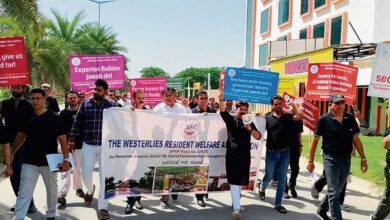
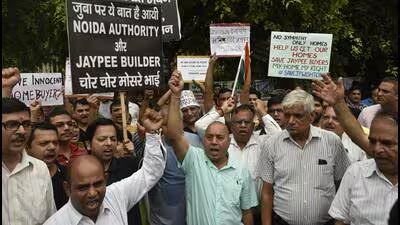
The buyers’ complaint is precise, and it should not be dismissed as rhetoric. At a recent meeting, at least 100 buyers shared frustrations over unfinished buildings, non-working elevators and delayed possession, even though some towers had already received occupancy certificates.
One buyer, Mahesh Tyagi, summarised the problem in a statement that deserves attention: he said that despite certificates being issued, usable possession was delayed because essential services and supporting infrastructure were unavailable, incomplete or non-functional, and that construction and handover targets had changed repeatedly.
The phrase “usable possession” is critical. It reframes the issue from a question of legal compliance to a question of lived reality. An occupancy certificate is a regulatory instrument certifying that a building conforms to approved plans and basic safety norms. It does not, by itself, guarantee that the lifts run, the water flows, the electricity is stable or the common areas are finished. If a certificate can be issued while those services are missing, then either the certification standard is too weak or the inspection that precedes it is too shallow. Either possibility is a failure of the regulatory system and not merely of the developer.
The repeated shifting of deadlines compounds the injury. Despite promises to finish everything within 40 months, buyers are still waiting for their homes and working elevators. For a family that has already waited years, each revised target is not an abstraction. It is a postponed school admission, a deferred retirement plan, a delayed return from rented accommodation. Who is accountable when targets move repeatedly and no penalty follows? The developer has described its progress as consistent with the approved resolution plan, yet the buyers’ experience tells a different story, and the gap between those two accounts has not been resolved by any independent public finding.
The 12,000-Worker Allegation
One of the sharpest charges involves labour. Buyers alleged that Suraksha Group was required to deploy 12,000 workers to ensure timely completion but claimed that the required workforce was not deployed. This is a concrete, checkable claim, and its checkability is exactly why it matters. A construction schedule is a function of labour, materials and finance. If the workforce was indeed far smaller than the figure the buyers cite, then slow progress is explained, and the question shifts from why the work is slow to why it was allowed to be slow.
Suraksha Group has disputed the allegations and said it is executing the project according to the approved resolution plan. That response, as reported, is a general denial and not a specific rebuttal. It does not say how many workers are on site. It does not publish a labour deployment record. In a project that is supposed to be monitored by committees at several levels, the absence of a simple, public headcount is striking. If the figure of 12,000 workers is wrong, correcting it takes one document. If it is right and unmet, the committees have an obvious place to begin. The public deserves to know which is true.
A Rescue Built on Large Promises
To judge the present, one must remember what was promised. In the bidding process, Suraksha Group won the fourth round of bidding in 2021 with 98.66 per cent of votes, and under the resolution plan it was to infuse Rs 250 crore in Jaypee Infratech and arrange a Rs 3,000 crore loan for completing around 20,000 apartments over the next four years. A winning vote share of 98.66 percent signals overwhelming creditor confidence. It also signals how desperate the creditors, many of them homebuyers themselves, were for any credible exit.
The National Company Law Tribunal approved the resolution plan of the consortium of Suraksha Realty and Lakshdeep Investments and Finance on March 7, 2023, three months after concluding its hearing and reserving the order. Yet, Suraksha acquired JIL through the insolvency resolution process in 2024, and the appellate tribunal had to step in, as NCLAT permitted the group to begin construction at Wish Town on a Friday in March 2024.
The timeline is itself an indictment. Approval came in March 2023, the green light for construction came a year later, and by July 2026 slightly more than half of the towers were described as built. For buyers whose original flats were promised years earlier, the “rescue” has consumed another several years.
The earlier history makes the delay even harder to forgive. According to a 2018 Hindustan Times report, Jaypee Infratech and Jaypee Associates had proposed in 2007 to build 32,000 flats under the integrated Wish Town project, promised delivery from 2011-12 onwards, and by then had delivered around 12,000 flats and plots while failing to deliver around 20,000 flats in Wish Town and Jaypee Aman.
The same report noted that homebuyers filed a plea in the Supreme Court in September 2017 to protect their interests. A project promised for 2011 is still, in 2026, in the process of being finished. That is a delay of well over a decade, and it is difficult to describe it as anything other than a systemic collapse of promise-keeping.
The Oversight Maze: Committees Upon Committees
The most striking feature of the current situation is the density of oversight, and the apparent inability of that oversight to produce keys. The NCLT order that approved the plan led to the formation of a five-member Implementation and Monitoring Committee that includes the interim resolution professional, representatives of Suraksha, and a homebuyer representative from the Committee of Creditors. That body was meant to ensure expeditious implementation. Years later, buyers are still petitioning for answers.
Now there are more bodies. The concerns come weeks after the Uttar Pradesh government constituted a five-member committee to examine Suraksha Group’s work at Wish Town, and, as another report put it, that committee is meant to check whether work is actually progressing as promised and how funds are being used. Separately, the NCLT appointed a two-member committee to assess the progress of construction of projects of Suraksha-controlled Jaypee Infratech and submit a comprehensive status report, and took note of the anguish of homebuyers.
A further report indicates that the tribunal directed an independent expert committee to examine homebuyer grievances, including financial demands and interest calculations, with each member to be paid an honorarium of Rs 2,50,000 per month until further orders.
Pause on that arrangement. A resolution-plan monitoring committee, a state government committee, a tribunal-appointed progress committee, an expert grievance committee, and a regional authority issuing notices: five layers of scrutiny over a single township. What does it say about the system that after all of this, the principal complaint is the one a resident notices on the first day, a lift that does not work?
If monitoring were effective, the monitors would have caught the problem long before the buyers reached the Noida Authority’s door. The proliferation of committees can look like accountability, but it may equally be a way of diffusing it, with each body able to point to another.
There is also the matter of cost and conflict. The honorarium of Rs 2.5 lakh per month per member, paid until further orders, is a recurring public expense in a case where buyers already feel financially drained. Who pays it, and how is the committee’s independence protected from the entities it examines? The sources reviewed do not say. The question is not whether expert oversight is valuable, but whether it is being delivered with the urgency and transparency that stranded buyers deserve.
The Regulators’ Turn: YEIDA’s Notice and the Noida Authority’s Inspection Promise
Regulators have also stirred. The Yamuna Expressway Industrial Development Authority issued a notice to Suraksha Realty over prolonged delays in completing about 17,000 apartments in the project, following repeated complaints from homebuyers. The buyers’ welfare society argued that Suraksha failed to uphold the resolution plan approved by the NCLT and later upheld by the appellate tribunal, citing insufficient labour deployment, breach of RERA timelines, deferred amenities and opaque communication. The society asked for a monitoring committee that would include buyer representatives, developer officials and authority officials.
Notice the language of that complaint: opaque communication. In a recovery that rests on public trust, opacity is not a minor flaw. It means buyers learn of changes in schedule through press releases and rumour, not through formal channels they can rely on. If the developer is truly on track, openness would be its best defence. Why has it not been more forthcoming?
Meanwhile, at the Noida Authority, OSD Santosh Kumar told buyers that officials would inspect the project tower by tower to address their concerns. That is a welcome commitment, but it arrives late. A tower-by-tower inspection after certificates have been issued implies that the certificates were issued before such inspection was done, or that the inspections that preceded them were insufficient. Buyers are entitled to ask why verification is happening after certification and not before. The sequence appears backwards.
The Criminal Backdrop: What ED Says Happened to Buyers’ Money
None of this unfolds in a vacuum. The reason the rescue was necessary at all lies in allegations of what happened to buyers’ money. On November 13, 2025, the Enforcement Directorate arrested Manoj Gaur, former executive chairman and CEO of Jaiprakash Associates and former CMD of Jaypee Infratech, in a money laundering case involving alleged cheating of homebuyers to the tune of around Rs 14,599 crore.
He was arrested under Section 19 of the Prevention of Money Laundering Act, and the ED alleged that funds collected from thousands of homebuyers for construction were diverted for purposes other than construction. These are allegations made by an investigating agency, not findings of a court, and Mr Gaur is entitled to the presumption of innocence. But the scale of the allegation demands attention.
The ED’s account is detailed. The money-laundering investigation stems from multiple FIRs filed by the Economic Offences Wings of Delhi and Uttar Pradesh Police based on complaints from homebuyers of the Jaypee Wishtown and Jaypee Greens projects. The agency had carried out searches on May 23 at 15 premises linked to Jaypee Infratech, Jaiprakash Associates and associated entities, seizing a large volume of financial and digital records.
According to a separate report, in claims admitted by the NCLT, the companies formerly headed by Mr Gaur collected INR 145.9 billion (USD 1.64 billion), and the ED alleges a significant portion was diverted to related entities including Jaypee Sewa Sansthan, Jaypee Healthcare and Jaypee Sports International. The ED further stated that Mr Gaur is the managing trustee of Jaypee Sewa Sansthan, which received part of the diverted funds.
The enforcement action did not stop at arrest. In January 2026, the ED’s Delhi zonal office provisionally attached immovable assets with a current market value of about Rs 400 crore under the PMLA, as part of a wider probe into alleged large-scale misappropriation of funds collected for the Jaypee Wishtown and Jaypee Greens projects. Another report adds that the probe also alleged diversion of assets of JIL and JAL to other entities, including Page 3 Bullidtech, which is controlled and beneficially owned by Honey Katiyal.
Rs 400 Crore Against Rs 14,599 Crore: A Comparison That Should Trouble Everyone
Place the two ED figures side by side, a comparison I draw myself. The agency alleges cheating on the order of Rs 14,599 crore. The assets it has provisionally attached are worth about Rs 400 crore. On simple arithmetic, the attached assets are under 3 percent of the alleged amount. This is not a criticism of the ED’s progress, since attachments are provisional and investigations are ongoing, but the proportion is a sobering indicator of how much of the alleged loss remains unaccounted for.
What does this mean for the homebuyer? It means that even in the best case, where every attached rupee is eventually applied to the cause, the sum is a small fraction of what buyers collectively paid. It means the completion of Wish Town depends not on recovered diverted funds but on fresh capital from a new owner, and on that owner’s willingness and capacity to deliver.
The entire burden of making buyers whole has thus been transferred onto the acquirer and the buyers themselves, while the question of who pays for the alleged diversion remains open. It is worth asking whether the burden has been distributed fairly. Buyers who paid in good faith, and then waited for years, now find that their deliverance depends on the operational discipline of a company that is itself being accused of falling short.
There is also a damning human dimension. A figure like Rs 14,599 crore is so large that it risks becoming abstract. It represents the savings of ordinary salaried families, often accumulated over decades, sometimes borrowed against future income.
Each rupee in that total was a decision by a family to trust a developer’s promise. The ED says that trust was betrayed. If that is ultimately established in court, the question is not merely one of punishment, but of restitution: will the system ever return to those families what was taken, or will recovery be measured only in concrete and cement that arrives years late?
The Developer’s Defence, and Its Limits
Fairness requires giving the developer’s case its due. The company has made real claims of achievement. It stated that Ganga water supply has been made available across Wish Town in Sectors 128, 129, 131, 133 and 134, and that RERA registration has been obtained for Wish Point, a commercial development in Sector 134.
Jash Panchamia, executive director of Jaypee Infratech, said the company’s focus was on accelerating completion while strengthening infrastructure and quality of life, citing OCs for 42 towers, expanded water supply, enhanced power infrastructure and community amenities. These are not trivial. A township of this scale cannot function without water and power, and 4,213 units with OCs is a larger number than the zero that existed when insolvency began.
Yet even these claims invite interrogation. The statement that water supply “has been made available” across the sectors does not say that every tower is connected, that pressure is adequate, or that the supply is continuous. The reference to “enhanced power infrastructure” does not specify capacity, load or reliability. And the assertion that approvals for pending OC applications are “expected shortly” is a prediction, not an achievement. Press-conference language is built from verbs of intention; buyers live in the world of verbs of completion. Between “made available” and “working in my flat” lies the precise gap that the buyers’ complaints describe.
There is also a structural issue. The developer is simultaneously the executor of the project, the author of the progress figures, and the party whose performance is being judged. In such circumstances, the figures it publishes should be treated as claims and not findings until verified by an independent body. The five-member state committee and the tribunal’s expert panel could serve that function, but their reports, as of the sources reviewed, have not been made public. Until they are, the public is left to weigh the developer’s account against the buyers’, with no neutral arbiter.
What Remains Unanswered
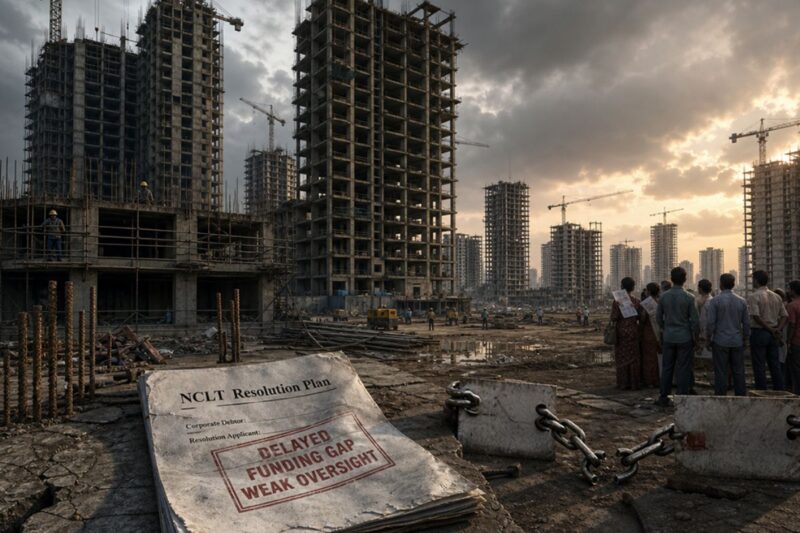
Several questions arise from the record, and none has a satisfactory public answer.
First, what is the true count of buyers who have received usable possession, as distinct from certificates? The developer reports OCs and completions; buyers report handovers delayed by missing services. No source reviewed gives the number of families actually living in their homes, which is the only metric that finally matters.
Second, why did OC applications filed by January take until July to produce only 11 additional certified towers, and what role did structural audit and fire clearance delays play? If these are regulatory bottlenecks, they should be identified and fixed. If they are developer delays, they should be penalised.
Third, how are the many oversight bodies coordinated, and which one is ultimately responsible for ensuring that a certificate is not issued for a tower with non-functioning lifts? Overlapping jurisdictions can produce an absence of responsibility.
Fourth, what is the plan for the roughly 3,700 completed units without certificates, and for the remainder of the 159 towers that are not yet built? The company has said it will begin securing certificates once audits and fire clearances are complete, but the timeline is not given in the sources reviewed.
Fifth, what compensation, if any, will be owed to buyers for the delay itself? The tribunal’s expert committee is examining financial demands and interest calculations, but the outcome has not been reported. Without a clear answer, years of delay may be absorbed entirely by those who can least afford it.
Conclusion: A Certificate Is Not a Home
The story of Jaypee Wish Town is often told as one of rescue, and in a narrow sense it is: a stalled project has moved, towers have risen, and certificates have been issued. But a rescue is judged by whether the people it was meant to save are safe, and by that standard the record so far is unconvincing. Buyers report missing services; regulators are issuing notices; tribunals and governments are appointing committees; and the earlier promoter faces serious allegations of diverting the very money that was meant to build these homes.
The most troubling aspect is not any single failing, but the pattern. Deadlines slip, numbers shift, oversight multiplies, and the buyer remains the one party who cannot walk away. Every institution in the chain has had its moment of action, yet the lift, the most mundane test of a finished building, is reported not to work. That should concern anyone who believes that the insolvency process was supposed to deliver homes and not just resolutions.
The remedy is not more committees but more transparency: publish the labour deployment, publish the audit and fire clearance status tower by tower, publish the number of families in occupation, and make the oversight reports public. Until then, the figure of 42 towers will remain what it is today: a number on paper, offered to people who asked for something else entirely. They asked for a home. It is fair to ask how much longer they must wait.