Nayan N raheja Bail Denied, For How Long He Will Remain Abscond?
The Delhi High Court has refused anticipatory bail to Nayan N Raheja on 15 October 2026. Justice Amit Bansal found the twin conditions under the Prevention of Money Laundering Act unmet and recorded repeated failure to appear before the Enforcement Directorate despite multiple summonses and a formal undertaking of cooperation. Nearly ₹2,699 crore allegedly collected from around 4,600 homebuyers with about ₹1,353 crore claimed as diverted. Projects still incomplete years after promised dates. The order raises one blunt question that every unpaid EMI and every empty flat already answers in silence. For how long will the person whose bail has been denied twice continue to stay away from the investigation that the law requires him to face.

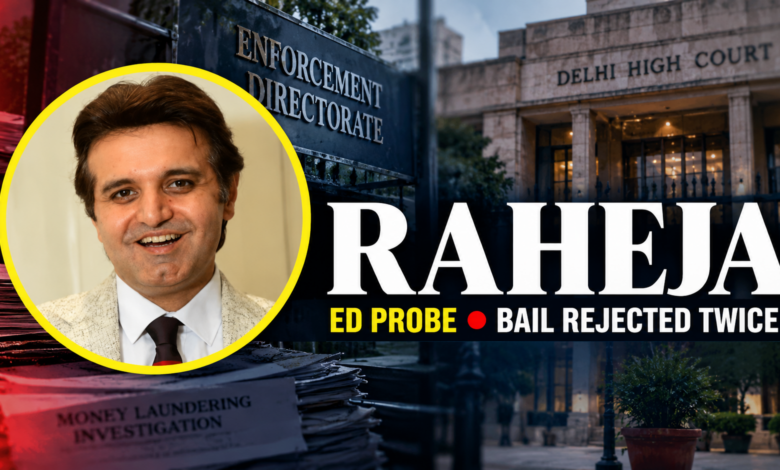
The Delhi High Court has closed the door on anticipatory bail for Nayan N Raheja!
On 15 October 2026 Justice Amit Bansal dismissed the plea of Nayan N Raheja in the Enforcement Directorate money laundering case. The court examined the material placed before it and held that it could not be said the applicant is not guilty of the offence of money laundering. It also held that it could not be said he would not continue such activity if bail were granted. The investigation remains open. His role is still under examination.
On top of these findings the court noted that he had failed to join the investigation properly even after giving undertakings. The reasons offered for not appearing in person were found unjustified. This is the second refusal. The Saket special court under the Prevention of Money Laundering Act had already rejected the same request on 19 September 2026. Two courts have now applied the same legal filter and reached the same conclusion. Pre arrest protection is not available. The natural next question is simple and disturbing.
For how long will Nayan N Raheja stay away after the courts, have said he is not entitled to stay protected from arrest!
The Enforcement Directorate has placed clear figures before the courts. Raheja Developers Limited is said to have collected money from around 4,600 homebuyers. The amounts spoken of range from ₹2,425.99 crore to nearly ₹2,699 crore. A substantial part of that money is alleged to have been diverted through related entities and group companies instead of being used to complete the flats and hand over possession. The alleged diversion figure stands around ₹1,353 crore in several court papers.
Provisional attachments of properties linked to the company and to family members have already reached an estimated market value of about ₹2,399 crore. These numbers are not distant accounting entries. They are the total of savings that ordinary families poured into builder buyer agreements over many years. Every crore represents months and years of salaries EMIs and sacrificed expenses that were meant to secure a home.
Specific allegations concerning Nayan N Raheja himself appear in the record. In papers connected to his petition seeking to quash the Enforcement Case Information Report it is stated that he is alleged to have received ₹1.23 crore from the proceeds of crime. Properties valued at ₹14.10 crore belonging to him have been provisionally attached. Bank accounts have been frozen. His residence has been placed under surveillance. The agency maintains that investigative material indicates he looked after the affairs of the parent company or was connected with subsidiaries into which homebuyer funds were moved for non construction purposes.
The defence position has been that he held directorship only for limited periods years ago that his shareholding is only 0.81 percent and that he receives payment only for architectural advice. Two courts have so far declined to treat that explanation as sufficient to meet the strict twin conditions required for anticipatory bail under the Prevention of Money Laundering Act.
The non cooperation aspect is the part that the Enforcement Directorate lawyers have pressed most strongly and the part that both courts have accepted as decisive. Summonses under section 50 of the Prevention of Money Laundering Act were issued repeatedly. The special court recorded 7 summonses with personal appearance and cooperation on only 2 occasions and failure on 5. Reports before the High Court speak of 9 summonses issued between April and August 2026. Responses came in the form of claims of being out of station or requests to appear through video conferencing. Full personal participation did not follow. An undertaking of complete cooperation had already been recorded by the Delhi High Court on 30 July 2026.
Even after that formal assurance the pattern of limited appearance continued. The High Court treated this conduct as a factor that itself disentitled the applicant from anticipatory bail. When a person gives an undertaking to a High Court and then does not fully present himself the investigation is directly compromised. Officers cannot put questions. Documents cannot be confronted. Digital evidence cannot be tested through detailed examination. The trail of money that the agency is trying to follow remains incomplete because the person whose role is under scrutiny stays away.
This is not a minor procedural lapse. It strikes at the foundation of how serious economic offences are meant to be investigated. The Prevention of Money Laundering Act arms the Enforcement Directorate with the power to summon and to record statements precisely so that the movement of alleged proceeds of crime can be traced.
When those summonses are treated as optional the entire process slows down. The courts have now twice recorded that this pattern of non appearance does not deserve the exceptional shield of anticipatory bail. After two such findings the question becomes unavoidable. For how long will the person whose protection has been refused continue to remain outside the reach of the investigating agency.
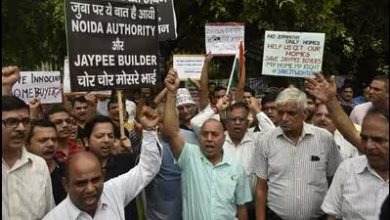
The homebuyers who funded these projects live with the daily consequences of the alleged diversion. They are not speculative investors. They are families who placed their life savings into the hope of a permanent roof. Many paid 90 percent or more of the total sale consideration. They took home loans from banks. They paid the EMI every month while also paying rent for the temporary accommodation they continued to occupy. The original possession dates passed. Extended dates also passed.
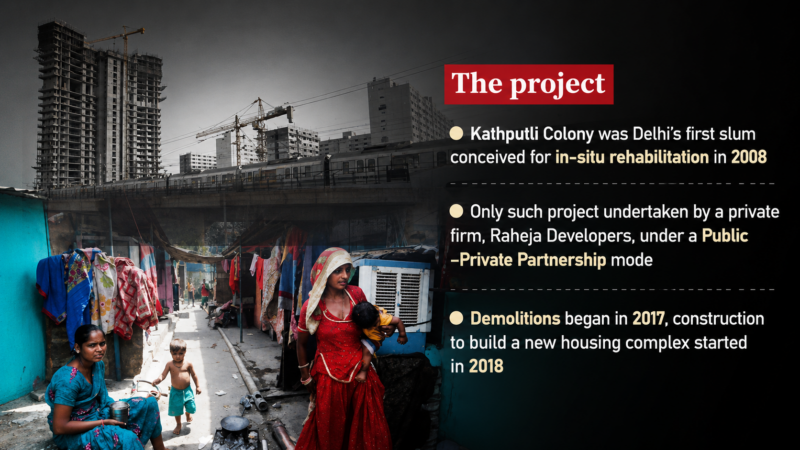
Projects launched more than a decade earlier remain unfinished. Raheja Revanta was launched in 2011 with possession promised in 36 months for independent floors and 48 months for high rise towers. An extended deadline of July 2022 was also mentioned. In 2026 the project is still incomplete and has entered insolvency proceedings. Other projects under the same developer name show the same long pattern of delay. When the Enforcement Directorate states that a large portion of the collected money was not applied to construction the homebuyers experience that statement as the reason their flats were never finished and their dual burden of EMI and rent never ended.
Do the people who control these large builder groups believe they stand above the ordinary reach of the law? That is the question that rises again and again from the sequence of events. Summonses issued by a premier investigating agency are not polite invitations that can be accepted or declined at convenience. An undertaking given to the High Court is not an empty formality. Yet the judicial record shows repeated failure to appear. The special court noted it.
The High Court confirmed it. At the same time projects continue to move into insolvency. Homebuyers continue to approach the National Company Law Tribunal because every other forum has already been tried. The pattern creates the appearance of a system in which those with resources can slow every process while ordinary families are left carrying the unpaid loans and the unfinished flats.
The wider picture of builder related fraud across the country makes the situation even more disturbing. The Central Bureau of Investigation has already filed 21 chargesheets in homebuyer fraud cases under the directions of the Supreme Court. These chargesheets cover multiple companies and multiple cities. They describe false assurances fraudulent representations and diversion of funds collected for construction.
The existence of CBI’s 21 such chargesheets shows that the problem is not confined to one developer or one city. It is a widespread pattern in which homebuyers pay and the homes do not arrive. When a matter of this magnitude involving thousands of crores and thousands of families reaches the stage of two successive refusals of anticipatory bail the expectation is that the investigation will now proceed without the barrier of pre arrest protection. Surrender becomes the logical and necessary next step so that the remaining questions can be answered in the proper forum.
The sense of helplessness among homebuyers is difficult to capture in calm language. They responded to attractive advertisements and confident promises. They paid the booking amount. They paid every construction linked instalment as demanded. They watched the construction sites remain incomplete year after year. They sent emails and made calls. They approached the Real Estate Regulatory Authority. They filed consumer complaints.
Some of them finally joined together and filed insolvency petitions because no other route produced results. Each of those steps consumed time money and emotional strength. While they struggled through these processes the individuals whose names appear in the investigation papers were able to move higher courts seeking protection from arrest. The imbalance is stark and painful. One side possesses the resources to keep litigating for anticipatory bail. The other side continues to wait for keys that never arrive or for refunds that never materialise.
The High Court has made clear that at the anticipatory bail stage it does not conduct a full trial on every financial transaction. It applies the statutory filter that the law itself has created. That filter has now been applied twice with identical results. The twin conditions are not satisfied. The record of non appearance after summonses and after a formal undertaking has been held against the applicant.
The investigation continues. In this situation the demand that the person surrender is not an emotional outburst. It is the direct consequence of the judicial findings. When courts have declared that pre arrest protection is unavailable the person concerned should present himself before the investigating agency and face the process. Remaining outside only strengthens the perception that the investigation is being delayed at the direct cost of the homebuyers who have already waited for years.
The money trail the Enforcement Directorate is attempting to reconstruct is not an academic exercise. It is an effort to determine what happened to the funds that were collected for the specific purpose of building and delivering homes. If large sums were moved into related entities or used for other purposes the people who paid those sums have a right to know the full details.
If the role of any individual is under examination that individual has a corresponding duty to cooperate fully. The courts have now recorded that cooperation has been incomplete. The High Court has refused anticipatory bail on that ground among others. The path forward is therefore clear. The investigation must be allowed to reach its conclusion. The person whose bail has been denied must surrender so that the remaining questions can be put and answered without further obstruction.
The broader landscape of builder related cases strengthens the case for firmness. When the Central Bureau of Investigation has already placed 21 chargesheets on record the investigating agencies have signalled that these matters will not be ignored. Progress in individual cases nevertheless often remains slow. Homebuyers watch the years pass. Their children grow up in rented houses. Their retirement savings are consumed by interest payments on loans taken for flats that were never completed. The feeling of powerlessness is real and widespread.
In this atmosphere every judicial order that refuses special protection to those who have not fully cooperated becomes a necessary step toward restoring some balance. The Delhi High Court order of 15 October 2026 is one such step. It must now be followed by actual surrender and by a thorough investigation that finally addresses the questions the homebuyers have been asking for more than a decade.
What happens next will determine whether the system has the capacity to match its own legal standards. Anticipatory bail has been denied. The twin conditions have been found unmet. The non cooperation has been judicially recorded. The scale of the alleged collections and diversion is part of the public record. The incomplete projects are visible to anyone who visits the sites or reads the insolvency notices.
In these circumstances the demand that Nayan N Raheja must surrender to the Enforcement Directorate is neither excessive nor premature. It is the minimum the situation requires. The homebuyers who paid their hard earned money and are still waiting for their homes deserve a complete and unhindered investigation. Anything less than full cooperation after two judicial refusals of anticipatory bail will only deepen the belief that some individuals remain beyond the ordinary operation of the process while ordinary families continue to bear the full cost of delayed and denied homes.
Behind the technical language of twin conditions section 50 summonses provisional attachments and insolvency commencement dates stand real people. A young couple who booked a flat as their first home and continue to pay rent. Parents who wanted to provide their children a stable place to grow. Senior citizens who invested their retirement savings and now face uncertainty in old age. These people do not have the option of staying away from their own difficulties.
They face the bank every month. They face the landlord every month. They face the incomplete construction site every time they pass it. When courts refuse anticipatory bail to a person whose cooperation has been found incomplete the least that can be expected is that the investigation will now move forward without further barriers. Surrender is the step that removes those barriers.

The pattern of delayed projects diverted funds and prolonged litigation has inflicted damage that will take years to repair. The 21 chargesheets already filed by the Central Bureau of Investigation in homebuyer fraud matters are only one measure of how extensive the problem has become. Each chargesheet represents another group of homebuyers who were promised homes and received excuses instead. The Raheja investigation with its far larger figures sits inside the same landscape.
The refusal of anticipatory bail is a necessary decision. The next necessary decision is for the person concerned to surrender and face the questions the Enforcement Directorate has been attempting to ask. Until that occurs the homebuyers will continue to feel that the system operates differently for those who possess the resources to keep delaying and for those who simply paid their money and waited.
The High Court has applied the law as it stands. The special court had already done the same. The record of limited appearance after multiple summonses and after a formal undertaking is now part of the judicial findings. The allegations of large scale diversion of homebuyer funds remain under investigation. In this situation the call for surrender is both legally coherent and morally required.
The people who have waited for their homes for more than ten years should not have to wait any longer for the investigation to reach the individuals whose roles are under examination. Nayan N Raheja bail has been denied. The question that remains is how long he will remain abscond. The answer should be no longer. He must surrender to the Enforcement Directorate now so that the process the courts have protected can finally move forward without further compromise.