The Builder Mafia Files: How Banks, Bureaucrats And Developers Looted India’s Homebuyers?
The Death of a Dream: How India's Builder-Bank-Bureaucrat Nexus Turned Homeownership Into a National Crisis


In most Indian households, a home is not a purchase. It is a project that consumes a generation. Parents liquidate fixed deposits. Provident fund withdrawals are timed to coincide with “final” instalments. Gold passed down by grandmothers is pledged or sold. A child’s higher-education fund is quietly diverted, with a silent promise that it will be replenished “once the flat is registered.” A retired father co-signs a loan he will spend his pension repaying. None of this is exceptional, but it is the ordinary, unremarkable arithmetic of buying a flat in urban India.
What is supposed to follow is equally ordinary: a fixed possession date, a set of keys, and the modest dignity of moving in. For an extraordinary number of Indian families, what follows instead is a decade or more of half-built towers, shifting completion dates, EMIs paid against homes that do not exist, rent paid for homes they cannot occupy, and a slow, grinding education in how little power an ordinary buyer has against a developer, a bank, and the regulatory machinery that is supposed to stand between them.
This is not a story about a few rogue companies. Amrapali, Unitech, Jaypee Infratech, Supertech and dozens of lesser-known builders are not isolated villains in an otherwise functioning market; but they are the visible peaks of a structural pattern that has played out across Delhi-NCR, the Mumbai Metropolitan Region (MMR), Pune, Bengaluru, Hyderabad, Chennai and Kolkata for nearly two decades. As recently as 2025 and 2026, the Supreme Court of India directed the Central Bureau of Investigation (CBI) to probe what it itself described as an “unholy nexus” between builders and bank officials, which is a live proof that this is not a problem confined to the pre-RERA era, but one that continues into the present.
The greatest casualties of India’s real estate economy are not the builders who go bankrupt or the banks that take haircuts, but they are the ordinary middle-class buyers, the common man, who keep paying, year after year, for homes that may never arrive, propped up by a system in which builders, lenders, bureaucrats and regulators have each, in their own way, failed to act in time. This is not merely a market failure. It is a governance failure, documented in Supreme Court judgments, government data, regulatory filings and criminal investigations spanning more than a decade.
Decades of Builder Exploitation — The Anatomy of a Broken Promise
Long before RERA existed, the relationship between an Indian homebuyer and a developer was structurally one-sided. Builders drafted the Apartment Buyer’s Agreement; buyers signed it because there was no alternative draft on offer. Courts have repeatedly noted this imbalance.
In the case involving DLF Southern Homes and Annabel Builders, where 339 flat buyers had booked apartments in Bengaluru, the National Consumer Disputes Redressal Commission record showed that while a delay in possession by the developer entitled the buyer only to a modest contractual penalty of roughly Rs 5 per square foot per month, a buyer who defaulted on payment faced a far harsher and more immediate consequence. The Supreme Court later observed of such agreements that the obligations were not “mirrored” between the two sides, and that the terms binding the purchaser were considerably more stringent than those binding the developer.
Delayed possession as the default, not the exception. Builders routinely promised possession in 36 months and delivered, if at all, in 8–12 years. The Jaypee Infratech case is illustrative: the company launched close to 50,000 flats in Noida and along the Yamuna Expressway between 2009 and 2010, but had completed only around 12,000 by the time it entered insolvency proceedings in 2017.
Diversion of buyer funds away from the project they were paid for. A Supreme Court-ordered forensic audit of Unitech’s accounts, cited by Canara Bank in a complaint that led to a CBI case against the company’s promoters; found that the company had collected Rs 14,270 crore from 29,800 homebuyers, of which Rs 5,036.05 crore had not been utilised on the 74 residential projects it was meant to fund. The same audit found that Unitech subsidiaries had routed Rs 1,745.81 crore into ten companies based in Cyprus between 2007 and 2010.
Sale of the same inventory to multiple buyers, and false advertising of inflated carpet area. These practices recur across consumer court judgments and RERA complaints nationally, though disaggregated national data quantifying the precise number of dual-allotment cases is not centrally published; the 32nd Avenue Group doing this adding their contribution to Builder fraud.
Illegal construction beyond sanctioned plans. The Supertech Emerald Court case in Noida is the starkest example. In 2009, residents of the project discovered that the builder, having already constructed the complex, began digging into land originally earmarked for a garden and shopping complex to build two additional 40-floor towers, Apex and Ceyane, that were never part of the sanctioned plan shown to buyers. The Allahabad High Court ordered the towers demolished in 2014; the Supreme Court upheld that order in 2021 and the actual demolition, the tallest structure ever razed in India, took place in August 2022.
Hidden charges and arbitrary maintenance costs. These are widely documented in RERA and consumer-forum case law, though no single national audit quantifies their aggregate financial impact; the Ministry of Housing and Urban Affairs’ RERA framework was explicitly designed, among other things, to compel pre-disclosure of such charges in the registered Agreement for Sale.
One-sided default clauses. In the Wing Commander Arifur Rahman Khan case against DLF Southern Homes, buyers placed before the Supreme Court a clause under which a buyer who defaulted on an instalment was charged 15% interest for the first ninety days and an additional 3% penal interest thereafter, 18% in total, while the builder’s own liability for delay was capped at a flat Rs 5 per square foot per month, regardless of how long the delay extended.
These were not anomalies; they were standard industry practice, repeatedly upheld in form (if eventually struck down in substance) by India’s higher courts.
A Decade in Numbers (2016–2026)
Registered grievances and the scale of the problem
As of July 1, 2024, the Economic Survey 2023–24 recorded that more than 1,30,186 real estate projects and 88,461 real estate agents had been registered under RERA across India, and that state RERAs had collectively resolved 1,24,947 consumer complaints.
By early 2026, individual state authorities showed sharply divergent performance: Uttar Pradesh RERA had disposed of 86.71% of 60,021 registered complaints; Maharashtra RERA had cleared 82.03% of 34,485 complaints; Karnataka RERA had resolved 81.54% of its caseload; and RERA Gurugram, despite ranking only third nationally by complaint volume, had achieved the country’s highest disposal rate at 93.62% of 17,893 complaints, having cleared its entire backlog dating back to 2018 only by early 2025.
The very fact that a “fastest in the country” disposal rate still implies an average resolution timeline of 12–15 months, a target the authority is now trying to bring down to 6–9 months, illustrates how slow even the best-performing regulator remains for an aggrieved buyer.
Stalled and delayed housing stock: a moving, worsening picture
Property consultancy Anarock has tracked stalled and delayed housing inventory across India’s seven largest residential markets, Delhi-NCR, the Mumbai Metropolitan Region, Pune, Bengaluru, Hyderabad, Chennai and Kolkata, at several points over the past decade. The trend, while not strictly comparable year-on-year because Anarock periodically changes its base year and methodology, illustrates the scale of the crisis:
| Reference period | Stuck / delayed units (7 cities) | Estimated value | Notes |
| As of 2018 | ~5,75,900 units | Rs 4,64,330 crore | Projects launched in or before 2013 (Zee Business/Anarock, 2018) |
| As of May 2020 | ~4,79,940 units | Rs 4,48,129 crore | Projects launched in or before 2014; NCR’s Noida–Greater Noida belt alone accounted for 1,65,348 units worth Rs 1,18,578 crore (DNA India/Anarock, 2022) |
| As of H1 2021 | ~6,28,630 units (of which 1,73,730 “completely stalled”) | Rs 5,05,415 crore | Delhi-NCR’s share of the completely stalled stock rose to 66% (Business Standard/Anarock, 2021) |
Within the completely-stalled category as of 2021, nearly 71% of the affected units (about 4.49 lakh homes) fell within the price-sensitive band of under Rs 80 lakh — confirming that the burden falls disproportionately on middle-class, not luxury, buyers. A separate, independent estimate commissioned by SBICAP Ventures from PropEquity in 2019, the analysis that led to the creation of the government’s SWAMIH fund, put the number of stalled or stressed housing units even higher, at roughly 4.58 lakh units across about 1,500 projects, requiring an estimated Rs 55,000 crore in last-mile funding to complete.
Insolvency and the real estate sector
The Insolvency and Bankruptcy Code (IBC), 2016 was not designed with homebuyers in mind, but it became, almost by accident, one of the principal forums in which they sought relief, so much so that the Economic Survey 2023–24 noted that the IBC had become the most-favoured remedy for the real estate sector, ahead of both the Consumer Protection Act, 2019 and RERA itself (Business Standard, August 2024). Key, verified data points include:
- Jaypee Infratech entered the Corporate Insolvency Resolution Process (CIRP) in August 2017 after an IDBI Bank-led consortium petition. By December 2019, its Committee of Creditors, comprising 13 banks and roughly 21,000–22,000 homebuyers, who together held 57.66% of the voting share, approved a resolution plan submitted by the state-owned National Buildings Construction Corporation (NBCC) with 97.36% of the vote. Admitted claims stood at Rs 13,364 crore for homebuyers and Rs 9,783 crore for lenders.
- According to IBBI chairperson Ravi Mittal, large real estate insolvency cases, including Jaypee Infratech, Kohinoor CTNL Infrastructure and SARE Gurugram, have yielded creditor recoveries exceeding 60%, well above the broader system average. Across all sectors, rescued companies under the IBC have outnumbered liquidated companies by roughly 2.5 times, and cumulative creditor realisation under the Code had reached approximately Rs 3.4 trillion by June 2024.
- The headline recovery figures, however, mask significant unevenness. Independent analysis of IBBI data shows that excluding a handful of very large, high-recovery cases, aggregate recovery rates for financial creditors typically fall to roughly 30–35% of admitted claims, and liquidation, not revival remains the single most common outcome of an admitted insolvency case. The average time taken to complete a CIRP has stretched to around 630 days, against a statutory outer limit of 330 days.
City-wise concentration of the crisis
Delhi-NCR, and within it, specifically the Noida–Greater Noida belt, has consistently accounted for the largest share of India’s stalled housing stock, ranging from roughly 52% to 70% of the total stuck/delayed inventory across the seven major cities in various Anarock surveys between 2018 and 2022. The Mumbai Metropolitan Region has typically held the second-largest share, with Pune, Bengaluru, Hyderabad, Chennai and Kolkata together accounting for a smaller but still substantial residual share.
Government intervention through SWAMIH
The Special Window for Affordable and Mid-Income Housing (SWAMIH) Investment Fund, approved by the Union Cabinet in November 2019 and managed by SBICAP Ventures (a State Bank of India subsidiary), was the government’s principal policy response to stalled housing. As of December 15, 2025, the fund, with a raised corpus of roughly Rs 15,531 crore, had delivered approximately 61,000 completed homes across 110 of the 145-plus projects it supports across 30 cities, and is projected to eventually deliver more than 1 lakh homes benefiting over 4 lakh people.
The government announced a second, Rs 15,000-crore tranche (SWAMIH Fund-2) in the Union Budget 2025-26 to extend this support. That a dedicated, multi-thousand-crore government fund was necessary at all to rescue projects that buyers had already paid for is itself among the strongest evidence that the ordinary legal and regulatory machinery, RERA, consumer courts, and bank oversight, had failed to prevent the crisis in the first place.
How Regulatory Failure Became Institutional Harassment
RERA was enacted in 2016 explicitly to correct the asymmetry — mandatory escrow of 70% of project receivables, registration of projects before sale, disclosure of carpet area, and time-bound adjudication of complaints. A decade on, the gap between RERA’s design and its delivery has itself become a documented source of buyer harassment.
Disposal delays remain the norm, not the exception. Even RERA Gurugram, the best-performing authority in the country in early 2026, conceded that its own average disposal time stood at 12–15 months, with a stated aspiration, not yet an achievement, of bringing this down to 6–9 months. For an authority created specifically to deliver “speedy and effective” justice to homebuyers, by the regulator’s own description, a 12–15-month wait for adjudication, layered on top of years of construction delay, constitutes a second, regulatory-stage harassment.
RERA’s structural carve-outs have diluted its protective intent. Industry and legal analysis has noted that several states exempt projects once they cross a defined construction threshold (commonly cited as 60% completion in some states) from full RERA oversight, precisely the late stage of a project at which delays, cost overruns and finishing defects are most likely to occur, according to Anarock’s own research commentary accompanying its 2018 stalled-inventory report.
The Supreme Court itself has expressed scepticism about RERA’s effectiveness. According to legal commentary tracking Supreme Court rulings through early 2026, the Court has made pointed observations questioning whether RERA, in practice, has sometimes operated to the advantage of defaulting builders rather than the consumers it was meant to protect, and has urged state governments to strengthen enforcement.
Banks and housing finance companies have repeatedly disregarded their own regulator’s warnings. The Reserve Bank of India, as far back as a July 2015 master circular, flagged that “innovative” housing loan products, commonly known as subvention or builder-pays-EMI schemes, exposed both banks and individual borrowers to additional risk in the event of builder default, project delay, or dispute, and directed banks to link loan disbursal to construction milestones rather than disbursing upfront.
The National Housing Bank reiterated this in a circular dated July 9, 2019, explicitly directing housing finance companies to stop funding subvention-linked products. Despite both circulars, banks continued to disburse 70–80% of sanctioned loan amounts upfront to builders in numerous documented instances; when builders subsequently defaulted on their committed EMI payments, banks turned to the individual homebuyer, who had received no flat, for recovery.
Courts have had to step in where regulators did not. In one Delhi High Court matter, Justice Rekha Palli granted homebuyers an interim stay against bank recovery action after finding that lenders had disbursed loans against incomplete construction in clear violation of the RBI and NHB circulars cited above, and that the financial hardship of the COVID-19 pandemic compounded the injustice of forcing buyers to absorb a default that was, by the regulator’s own design, not supposed to fall on them.
Insolvency tribunals are themselves under-resourced. Analysts note that India operates with only around 16 National Company Law Tribunal (NCLT) benches nationally to handle the country’s entire corporate insolvency caseload, a capacity constraint that contributes directly to the roughly 630-day average CIRP timeline against a 330-day statutory ceiling.
The cumulative effect of slow RERA adjudication, diluted regulatory coverage, ignored RBI/NHB lending norms, and an overstretched insolvency tribunal system is that the institutions built to prevent homebuyer harm have, in practice, often become an additional layer of delay that buyers must out-wait — a second front in the same war, rather than a shield against it.
The Builder–Bank–Politician–Bureaucrat Nexus
No single documented case captures the full architecture of this nexus more starkly than the ongoing CBI investigation that the Supreme Court itself ordered into builder–bank collusion across the National Capital Region. On April 29, 2025, responding to petitions from homebuyers — reports place the number at over 1,200 in the initial wave, rising into the thousands as more complainants came forward — the Supreme Court directed the CBI to register preliminary enquiries against builders and unnamed bank officials in the NCR.
The bench, according to multiple verified news reports, described the relationship it was probing as an “unholy nexus” between developers and financial institutions, and separately warned that any delay in the investigation would only deepen the suffering already inflicted on homebuyers. The Court’s intervention expanded in phases: 28 cases were registered in the first phase, and a further 22 cases — specifically targeting suspected builder–bank collusion — were ordered in September 2025, bringing the total under investigation to 50 cases spanning projects in Delhi-NCR, Mohali, Mumbai, Kolkata, Bengaluru and Prayagraj.
By May 2026, the CBI had filed nine chargesheets in this single investigative track, against companies including Rudra Buildwell Constructions, Dream Procon, Jaypee Infratech, AVJ Developers, CHD Developers, Shubhkamna Buildtech, Sequel Buildcon, Logix City Developers and Manju J Homes India, along with officials of banks including ICICI Bank, HDFC Bank and the State Bank of India.
According to the CBI’s own public statements, its investigators uncovered documentary and oral evidence pointing to “misuse of official position, diversion and misutilisation of funds, and fraudulent conduct against homebuyers” — language used by the agency itself in describing its findings. A coordinated raid operation in mid-April 2026 covered 77 locations across eight states in a single day, reflecting the geographic spread of the alleged conspiracy.
The mechanics described in these chargesheets and reports mirror the structural pathway long alleged by homebuyer associations:
- A developer secures land, sometimes through political or bureaucratic relationships that smooth allotment or zoning approvals, a pattern most visible in the original Noida/Greater Noida Authority allotments to Jaypee Infratech, Amrapali and Unitech. Not only in Noida belt, the Gurugram land also favours certain builders who have good political connections, as seen in case of BPTP.
- The developer secures bank project finance and, separately, individual home loans for buyers, sometimes under subvention arrangements that the developer’s own lenders had been explicitly warned against by the RBI and NHB.
- Loan proceeds, instead of being ring-fenced for the specific project against which they were disbursed, are diverted to other group companies, to unrelated ventures, or in the documented Unitech case, to offshore entities in Cyprus.
- Regulatory bodies, like municipal authorities issuing building permissions, RERA registering the project, banks monitoring construction-linked disbursal — either fail to detect the diversion or, per the CBI’s current chargesheets, allegedly collude with it.
- The project stalls. The buyer continues paying EMIs on a loan secured against an unbuilt or partially built asset.
- The developer, facing insolvency or prosecution, has limited capacity to repay; banks pursue recovery from the only solvent party left in the chain — the buyer.
- The buyer is left bearing both the EMI and, frequently, ongoing rent for alternative accommodation — a double payment documented across multiple Supreme Court and consumer-forum cases.
It is important to note, in the interest of factual precision, that as of mid-2026 these CBI cases remain at the chargesheet stage; chargesheets are formal allegations supported by an investigative agency’s evidence, not final judicial findings of guilt, and the accused retain the right to contest the charges in trial. The Supreme Court’s characterisation of an “unholy nexus,” however, and the scale of the agency’s parallel 50-case, multi-state investigation, together constitute the strongest contemporaneous institutional acknowledgment that builder–bank collusion at the expense of homebuyers is not historical folklore but an active, currently prosecuted phenomenon.
Case Study — The Ambernath Housing Allegations (Mumbai Metropolitan Region)
A note on sourcing before proceeding: unlike the Amrapali, Jaypee, Unitech and Supertech cases discussed elsewhere in this report, each backed by Supreme Court judgments, IBBI/NCLT orders, or CBI chargesheets; the allegations surrounding housing projects in Ambernath, in Maharashtra’s Thane district, have not, as of this writing, produced a corresponding court judgment, IBBI order, or filed FIR that is part of the public record.
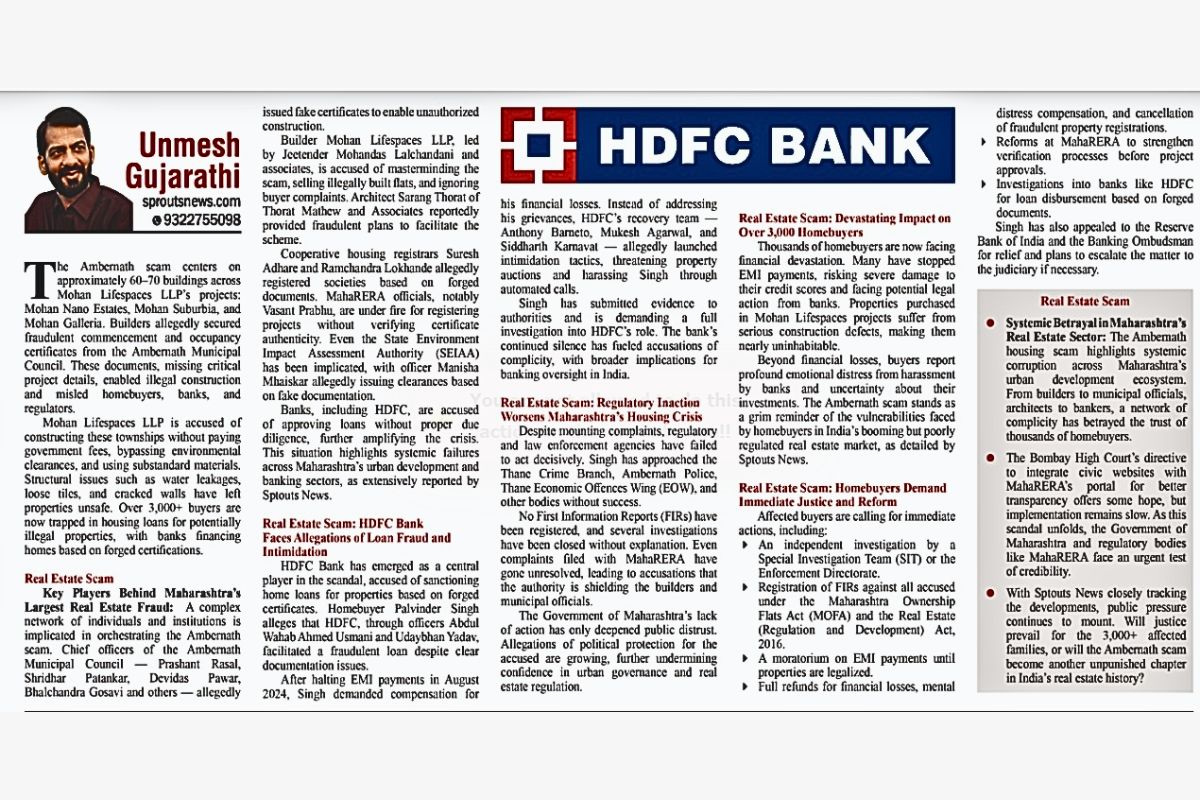
The available material consists primarily of homebuyer petitions, consumer advocacy campaigns, and legal-advice forum posts rather than adjudicated findings. In keeping with this investigation’s commitment to relying only on verifiable records, the following account is presented explicitly as a set of documented allegations raised by homebuyers and advocacy groups, not as established fact, and the builder and named individuals are entitled to a presumption of innocence pending any formal investigation or judicial finding.
According to these petitions, homebuyers allege that two township projects in Ambernath, marketed as affordable housing aimed at Mumbai’s middle class, were built and sold on the basis of commencement and occupancy certificates that were allegedly forged or improperly issued by Ambernath Municipal Council officials, in some cases without the payment of statutory government fees. The petitioners claim that a single fraudulent certificate was used as the basis for constructing more than sixty residential buildings of seven to eighteen storeys, and that environmental clearance was obtained only after construction was substantially complete rather than before it began, in alleged violation of standard procedure.
The petitions further allege that the Maharashtra Real Estate Regulatory Authority (MahaRERA) registered the projects without independently verifying the authenticity of the underlying municipal certificates, and that a bank approved home loans against the same allegedly fraudulent documentation, leaving buyers, by the petitioners’ account, repaying loans secured against homes whose legal status is now in dispute. Petitioners place the number of affected homebuyers at “over 3,000,” though this figure originates from the advocacy campaign itself and has not been independently verified through a government or judicial source.
The petitioners state that a complaint was filed with state authorities in May 2024 and that, as of the most recent available petition update, no hearing had taken place and no First Information Report (FIR) had been registered, despite what petitioners describe as a preliminary inquiry by the Thane Crime Branch. Petitioners have called for a judicial probe, criminal prosecution, cancellation of the disputed certificates, and compensation for affected buyers; none of these demands had been judicially adjudicated as of this writing.
What the Ambernath case, even treated with appropriate evidentiary caution, illustrates is structural: it shows the same vulnerability points recurring at the municipal level that the Amrapali and Jaypee cases revealed at the state development authority level.
If municipal commencement and occupancy certificates can be challenged as the foundation of a township-scale development, and if a state RERA authority’s registration process does not independently verify the authenticity of those certificates before registering a project for sale to the public, the basic documentary safeguards that RERA was meant to provide are only as reliable as the weakest link in the local government chain that produces the underlying paperwork. Until and unless an FIR, judicial proceeding, or government inquiry produces a verified factual record, however, this case should be read as illustrative of a risk pattern, not as a proven scandal on the scale of Amrapali or Jaypee.
Housing Scams of Delhi-NCR — The Big Four
Amrapali Group
Amrapali proposed to construct approximately 42,000 flats across Noida and Greater Noida, with buyers booking apartments between 2010 and 2014 on the promise of 36-month possession (Chadha & Chadha Law Offices, 2020). More than 2,500 homebuyers eventually approached the courts over non-delivery; the case, formally titled Bikram Chatterji & Ors. v. Union of India & Ors., became one of the most significant consumer-protection interventions in Indian judicial history.
The Supreme Court ordered a forensic audit of the group’s accounts, directed the Debt Recovery Tribunal to sell unencumbered commercial assets to fund completion, and on July 23, 2019 cancelled Amrapali’s RERA registration, directing that the National Buildings Construction Corporation (NBCC) take over and complete the stalled projects under the Court’s direct supervision. In a follow-up ruling on June 10, 2020, the Supreme Court ordered banks and financial institutions to restructure the loans of affected homebuyers even where those loan accounts had already been classified as non-performing assets, and capped the interest that Noida and Greater Noida Authorities could charge developers for delayed lease payments at 8% (Chadha & Chadha; multiple verified sources, 2020).
By the most recent status report placed before the Supreme Court in February 2025, NBCC had completed approximately 25,000 flats between 2020 and December 2024, with No Objection Certificates issued for around 20,000 of them; 12,550 existing homebuyers and roughly 1,000 new buyers had received possession letters after document verification, while NBCC had sold 6,686 originally-defaulted units to raise Rs 3,177 crore toward completion costs, and around 1,000 homebuyers who opted for refunds instead of possession were being paid in verified batches.
As of January 2025, however, homebuyer representatives told the Court that of roughly 20,000 completed flats, only 7,000 had actually been handed over, with 13,000 still pending allocation — illustrating that even fifteen years after the original 36-month possession promise, and six years after the Supreme Court’s landmark intervention, full resolution remains incomplete.
Unitech Limited
Unitech collected Rs 14,270 crore from 29,800 homebuyers, of which a Supreme Court-ordered forensic audit found Rs 5,036.05 crore had not been spent on the 74 residential projects it was meant to fund, with related findings of Rs 1,745.81 crore routed into Cyprus-based entities between 2007 and 2010. The company’s managing directors, Sanjay Chandra and Ajay Chandra, were arrested in April 2017 on allegations of siphoning more than Rs 5,000 crore from buyers in the company’s Wild Flower and Anthea projects in Greater Noida and Gurugram, where possession had been promised for 2012 and never delivered.
Both brothers spent roughly two and a half years in custody before being granted bail; separately, Sanjay Chandra had already been a named accused in the unrelated 2G spectrum allocation case, in which the Supreme Court found that the then-telecom minister had acted to favour select companies at the cost of the public exchequer. On January 20, 2020, the Supreme Court accepted a Central Government proposal to take over management of Unitech, intending to provide relief to roughly 12,000 affected homebuyers, with the Court appointing a retired judge to monitor preparation of a resolution framework.
Jaypee Infratech Limited
Jaypee Infratech launched close to 50,000 flats in Noida and along the Yamuna Expressway in 2009–10 but had completed only around 12,000 by the time the Reserve Bank of India referred it, alongside eleven other companies, to insolvency proceedings in 2017 after IDBI Bank petitioned the NCLT over an unpaid loan of Rs 526 crore. Roughly 21,000–22,000 homebuyers, alongside 13 banks and around 900 fixed-deposit holders, were recognised as financial creditors with voting rights in the Committee of Creditors — a status homebuyers secured only after Parliament amended the IBC in 2018 specifically to classify them as financial creditors, a direct legislative response to the scale of the Jaypee crisis.
NBCC’s resolution plan, approved with 97.36% of creditor votes in December 2019, proposed completing more than 20,000 pending flats and was the subject of extensive subsequent litigation; in its March 24, 2021 judgment in Jaypee Kensington Boulevard Apartments Welfare Society v. NBCC (India) Ltd., the Supreme Court declined to approve the modified plan as it stood and remanded the matter to the Committee of Creditors, while clarifying important principles, including that homebuyers, as a class of financial creditors, are bound by majority decisions within that class, and that adjudicating authorities cannot themselves rewrite a resolution plan beyond remanding it for reconsideration.
Supertech Limited (Emerald Court Twin Towers)
Supertech’s Emerald Court project in Noida Sector 93A was the subject of litigation beginning in 2009, after residents discovered the builder constructing two additional 40-floor towers, Apex and Ceyane, intended to hold 915 flats and 21 shops, on land that had originally been designated, in the plans shown to buyers, for a garden and shopping complex. The Emerald Court Owner Residents Welfare Association, whose core organising members included a retired CRPF officer and several other residents, spent close to Rs 1 crore in legal fees over more than a decade of litigation.
The Allahabad High Court ordered demolition in April 2014; the Supreme Court upheld that order on August 31, 2021, and on August 28, 2022 the towers — taller than the Qutb Minar — were brought down through a controlled implosion using more than 3,700 kilograms of explosives across 9,640 drill holes, the largest demolition operation of its kind in Indian history. The Supreme Court separately directed that all affected homebuyers be refunded with 12% interest, and ordered the builder to pay the Emerald Court Residents’ Welfare Association Rs 2 crore.
Other documented cases
Ansal Properties, Logix Group entities (notably Logix City Developers, which features in the CBI’s ongoing builder-bank nexus chargesheets discussed in Section 4), Earth Infrastructure, and the 3C Company (Three C Shelters) have each been named in Anarock’s market research as among the developers whose Delhi-NCR projects remain stalled or significantly delayed, and several, including Logix and entities connected to broader NCR developer networks, now also appear as named parties in the CBI’s active criminal investigation.
Verified, case-specific judicial detail comparable to the Amrapali, Unitech, Jaypee and Supertech matters is more limited in the public record for several of these companies at the time of writing; where such detail is unavailable, this report declines to speculate rather than presenting estimated figures as fact.
The Supreme Court’s Strongest Observations Against Builder Malpractice
Across more than a decade of litigation, the Supreme Court has built a consistent body of jurisprudence that is unusually direct, for an apex court, in its criticism of developer conduct and one-sided contracting.
In the case of 339 Bengaluru flat buyers against DLF Southern Homes and Annabel Builders, the Court found that the buyers’ agreement did not reflect an even bargain, observing that the contractual terms binding the purchaser were considerably more stringent than the obligations imposed on the developer, and that the agreement had, in substance, been drafted entirely by the developer. The Court went on to hold that flat purchasers suffer real harassment from a developer’s default, because buyers structure major life decisions — financing, relocation, family planning — around an expected possession date that the developer alone controls.
In the related DLF Home Developers v. Capital Greens Flat Buyers Association matter, the Supreme Court rejected the developer’s claim that delays caused by stop-work orders following fatal construction-site accidents, and by delays in municipal building-plan approval, constituted force majeure events excusing liability. The Court held that delays in obtaining routine building approvals are a foreseeable business risk that a developer must account for when committing to a possession date, and awarded buyers additional compensation at 6% per annum over and above the contractual rate, rejecting the argument that an exit offer extended to buyers extinguished their separate right to claim compensation for the underlying delay.
In the Amrapali matter, the Court’s repeated interventions, cancelling the company’s RERA registration, ordering a forensic audit, directing banks to restructure buyer loans despite NPA classification, and capping development-authority interest charges, collectively reflect a judicial view that ordinary civil remedies were inadequate to the scale of harm involved, requiring instead direct, continuing supervisory control by the Court itself.
In the Jaypee matter, the Court’s March 2021 ruling clarified that the “commercial wisdom” of a Committee of Creditors carries substantial weight under the IBC, but also imposed important checks — requiring upfront cash payment to dissenting financial creditors and insisting that any resolution plan transparently account for funds and assets, including the Rs 750 crore that the promoter group, Jaiprakash Associates, had been required to deposit with the Court’s registry.
Most recently, in a September 2025 ruling concerning a buyer who had waited more than a decade for possession of a plot in Haryana, the Supreme Court held that the same interest rate a developer charges buyers for delayed instalments must apply, in mirror image, when the developer itself defaults on possession, raising the buyer’s compensation from the 9% initially awarded by the National Consumer Disputes Redressal Commission to 18%, on the principle that “equity and fairness require equal treatment” between the two sides of an apartment buyer’s agreement.
And in a ruling reported in mid-2026, the Court held that a homebuyer’s right to seek compensation for delayed possession survives even after the buyer has physically taken possession of the unit, and that the existence of an arbitration clause in the buyer’s agreement does not, by itself, strip a consumer forum of jurisdiction over an already-admitted complaint.
Taken together, these judgments do not merely resolve individual disputes; they constitute a sustained judicial critique of an industry practice, one-sided contracting, weaponised force majeure claims, and the treatment of buyer funds as freely fungible capital, that the country’s legislature and regulators had, until RERA and subsequent IBC amendments, largely left unaddressed.
How Banks Continue to Recover EMIs From Victims?
Perhaps the cruellest dimension of India’s housing crisis is the “double payment” trap: a buyer who has taken a home loan for a flat that is never delivered must continue servicing that loan, typically while simultaneously paying rent for alternative accommodation, for as long as the underlying dispute remains unresolved.
The mechanism that most directly produces this outcome is the subvention or “builder-pays-EMI” scheme. Under a typical tripartite agreement between buyer, builder and bank, the buyer pays a small upfront sum, commonly 10–20% of the property value, while the bank disburses the bulk of the sanctioned loan directly to the builder, who undertakes to service the EMIs on the buyer’s behalf until possession.
As the Reserve Bank of India warned as early as its July 2015 master circular, and as the National Housing Bank reiterated for housing finance companies in a July 9, 2019 circular, this structure exposes both the bank and the individual borrower to serious risk in the event of builder default, project delay, or dispute, and both regulators directed lenders to disburse housing loans only in step with verified construction progress.
In practice, documented cases show banks disbursing 70–80% of the sanctioned loan amount upfront, directly contrary to this guidance, leaving the buyer legally liable for the full loan the moment the builder stops paying, regardless of whether any construction progress has occurred.
When builders default on their subvention commitments, the consequence for the buyer is immediate: the bank, having no recourse against an insolvent or absconding builder, pursues the individual borrower for EMI recovery, sometimes including coercive recovery action, even though the buyer has received no flat and was never the party responsible for non-payment under the original tripartite arrangement.
Courts have intervened in specific instances: in the Delhi High Court matter referenced in Section 3, an interim stay was granted against bank recovery action specifically because the bank had disbursed funds in violation of RBI and NHB circulars, and because the COVID-19 pandemic had compounded the financial hardship buyers already faced from servicing a loan against an incomplete asset.
Legal commentary published in 2026 has also flagged the risk of subvention-linked loan disbursal becoming the subject of CBI investigation where collusion between developers and bank officials is suspected, precisely the pattern now at the centre of the Supreme Court-ordered, 50-case nationwide investigation described in Section 4, in which officials of ICICI Bank, HDFC Bank and the State Bank of India have been named alongside builder companies in filed chargesheets.
What this confirms is that “bank recovery from victims” in India’s housing crisis is not always simply a matter of contractual enforcement against a defaulting borrower, in a documented and currently prosecuted subset of cases, it is alleged to be the downstream consequence of bank officials’ own participation in a scheme that diverted the buyer’s loan proceeds away from the project it was meant to fund.
The Human Cost Beyond Financial Loss
Quantifying the psychological and social cost of India’s housing crisis with the same rigor as its financial cost is difficult, because no central government agency, including the National Crime Records Bureau, publishes data that specifically disaggregates suicides, family breakdowns, or medical crises by their connection to a delayed or stalled housing project. In the interest of factual integrity, this report does not estimate such figures; verified, disaggregated national data of this kind is not publicly available, and any number presented as such would be invented.
What is documented, in court records and contemporaneous reporting, is the qualitative texture of this cost. The Supreme Court itself, in the Bengaluru DLF Southern Homes matter, found it necessary to record, as part of its formal reasoning, not merely as rhetorical colour, that delayed possession forces buyers to make major life decisions, including loan servicing and family relocation plans, around an expectation the developer alone controls, and that this is a documented basis for legal “harassment,” in the Court’s own term.
The Emerald Court Residents Welfare Association’s decade-long, roughly Rs 1-crore legal battle against Supertech, funded by ordinary residents pooling personal resources, illustrates the kind of sustained financial and emotional investment buyers across the country have had to make simply to enforce rights they already held on paper. A Noida homebuyer’s account, cited by IANS in 2019, of having spent approximately Rs 2 crore in legal costs alone over the course of the Jaypee dispute, while still living without the flat he had originally purchased in 2011, is one of the few individually documented illustrations of how legal cost compounds the original financial loss for an ordinary buyer.
Homebuyer associations, the Forum for People’s Collective Efforts (FPCE) prominent among them, have repeatedly testified through public statements that senior citizens who invested retirement savings, and NRI buyers who purchased property as a long-term homecoming plan, are disproportionately represented among the worst-affected, since both groups typically have the least capacity to absorb a decade-long delay or to physically pursue litigation from abroad. These are credible, sourced characterisations of the affected population, even where individually verified case-by-case demographic breakdowns are not publicly tabulated.
Why Existing Laws Still Fail?
RERA mandates escrow of 70% of buyer payments for construction costs and requires registration before sale, but enforcement varies dramatically by state — the gap between Gurugram’s 93.62% complaint disposal rate and the much larger pendencies in states with weaker institutional capacity is itself evidence of uneven implementation (Tribune India, 2026). Several states’ construction-completion thresholds for exempting a project from full RERA oversight create a structural loophole at precisely the stage — late-stage finishing and handover — when disputes most commonly arise.
The Consumer Protection Act gives buyers a forum to claim compensation and refunds, and Supreme Court rulings have repeatedly affirmed that a consumer complaint survives even possession, and even the existence of an arbitration clause (Bar & Bench, 2026). But the forum is reactive by design — it compensates after harm has occurred rather than preventing diversion of funds in the first place, and disposal at the original district forum level can itself take years, as the TKA Padmanabhan case — pending since 2005 and only resolved by the Supreme Court two decades later — illustrates.
The IBC gave homebuyers financial-creditor status only via a 2018 amendment, after the scale of the Jaypee crisis forced legislative attention; even with that status, buyers as a class are bound by majority vote within the Committee of Creditors, meaning an individual dissenting buyer typically cannot block a plan that the majority — frequently dominated, by claim value, by institutional lenders — has approved. The average 630-day CIRP timeline, against a 330-day statutory outer limit, means even a successful resolution often takes the better part of two years from admission to plan approval — before construction itself resumes.
SARFAESI and bank recovery mechanisms were designed to let lenders recover non-performing assets efficiently, but were not designed with subvention-scheme defaults in mind; the result, as Section 8 documents, is that recovery mechanisms built for a different problem are applied against buyers who are, in the RBI’s and NHB’s own framing, the parties the lending norms were meant to protect, not the parties expected to absorb a builder’s default.
Municipal and town-planning laws depend on the integrity of locally issued commencement and occupancy certificates — the precise documentary layer that the (unverified, allegation-stage) Ambernath petitions claim was compromised, and that even in the well-documented Supertech case, was insufficiently policed to prevent construction beyond sanctioned plans for several years before litigation intervened.
The pattern across all five frameworks is consistent: each law was designed with real protective intent, but each depends for its effectiveness on a regulator, tribunal, or bank acting promptly and independently, and it is precisely at that point of human and institutional discretion, repeatedly, that the system has been shown to fail.
Conclusion
The story this investigation tells is not one of a uniquely corrupt sector operating outside the reach of Indian law. It is, almost worse, a story of a sector that Indian law has repeatedly tried to discipline — through RERA in 2016, through IBC amendments in 2018, through RBI and NHB circulars dating back over a decade, through a string of Supreme Court judgments stretching from the Amrapali intervention in 2019 to a Court-ordered CBI probe still actively producing chargesheets in 2026 — and that has, despite all of this, continued to produce documented harm to ordinary families on a scale measured in hundreds of thousands of stalled homes and hundreds of thousands of crores of rupees.
The defining feature of this crisis is not the absence of rules. It is the gap between the moment a rule is written and the moment it is actually enforced against a builder, a bank official, or a negligent regulator — a gap measured, case after documented case, in years, and paid for, every single month, by a middle-class family servicing an EMI on a home it does not yet have.