Tall Skyscrapers, But Short Fire Fighters- A Burning Story Of Delhi NCR!
If You Live Above the 15th Floor, You Are On Your Own If Your Home Catches Fire

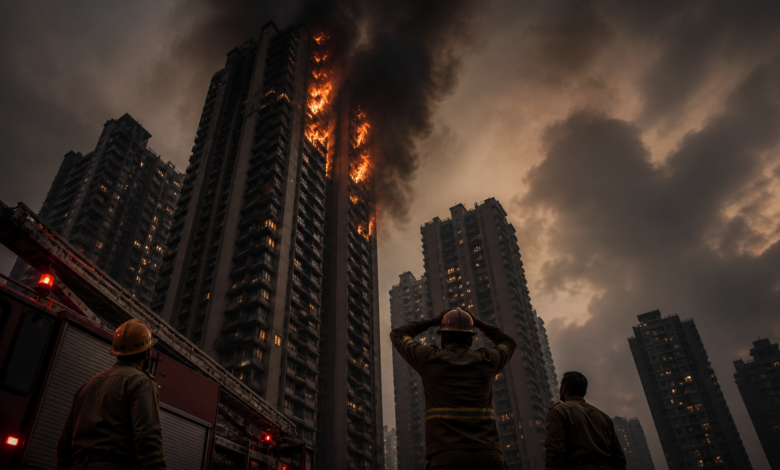
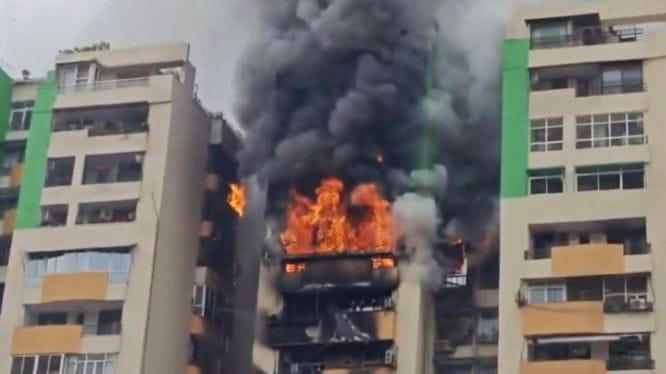
On an otherwise ordinary Wednesday morning in Indirapuram, Ghaziabad, residents of the Gaur Green Avenue housing complex watched helplessly as fire tore through at least eight apartments. Fire tenders arrived — sirens wailing, engines rumbling — but the water pressure from their hoses was too weak to carry water to the upper floors. The ladders they deployed reached only to the fourth floor. Residents in adjacent towers reportedly resorted to garden hoses. The fire department stood roughly 100 metres away, helpless in the most literal sense of the word.
This was not a freak failure. It was a systemic, long-predicted, repeatedly-ignored catastrophe in slow motion — and it is coming to every high-rise tower in the Delhi-NCR region.
“On what basis is the authority giving fire clearances to these tall skyscraper projects expanding across Noida and Ghaziabad?” — Abhishek Kumar, President, NEFOWA
The National Capital Region is among the fastest-growing skylines in Asia. Noida alone has at least 25 completed skyscrapers exceeding 150 metres. Supernova Spira, when complete, will touch 300 metres. Supertech North Eye is expected to reach 255 metres. Cyberthum Towers A and B already stand at over 213 metres each. Across Noida and Greater Noida, there are over 4,000 high-rise buildings. Ghaziabad has over 400 high-rises. Gurugram is home to Trump Tower at roughly 200 metres and Raheja Revanta at 56 floors.
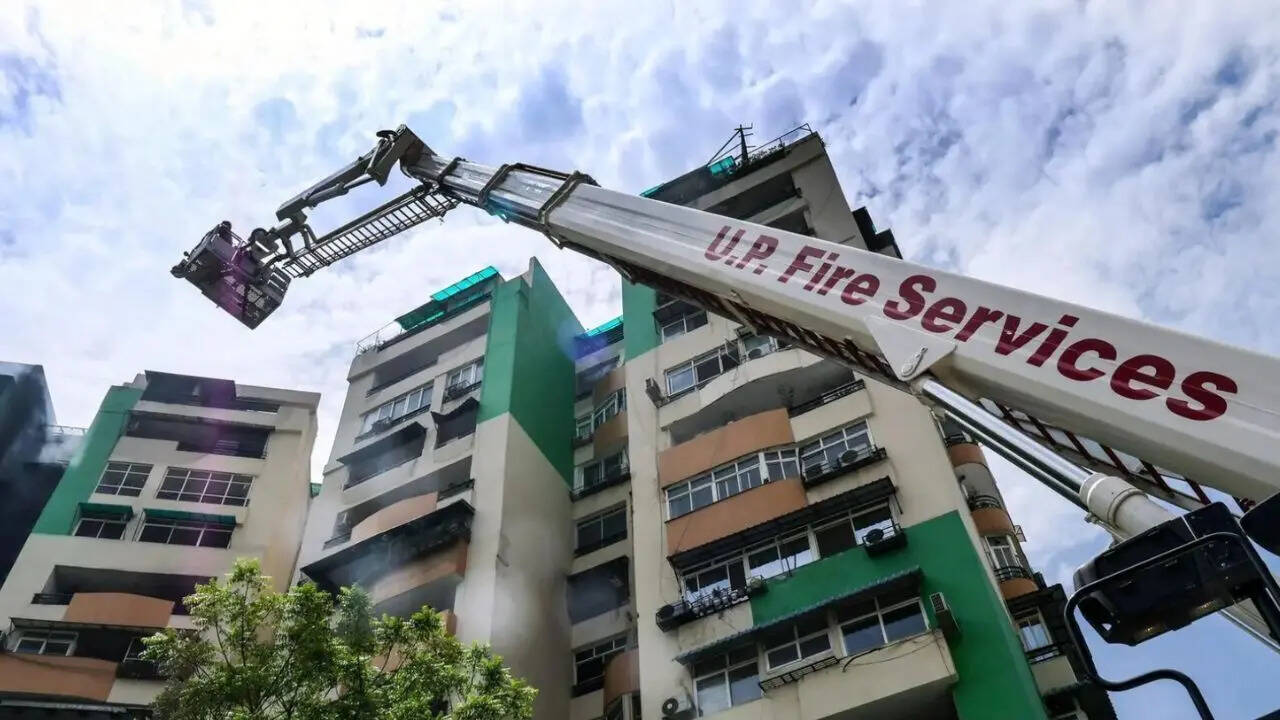
Now here is the other number — the one that should make every resident of these towers profoundly uncomfortable: the tallest firefighting ladder in the entire Delhi-NCR region reaches only 42 metres. That is roughly the 14th floor. Ghaziabad, where residential towers in Indirapuram, Vaishali, and Raj Nagar Extension rise up to 40 floors, has fire department equipment that can reach only the fourth floor. Gurugram’s single hydraulic platform — capable of reaching 42 metres — has been out of service since 2022. Three years. Defunct. Gathering dust.
If you live above the 15th floor in Delhi-NCR — in a city that has approved and celebrated and marketed towers of 30, 40, 50, even 70 floors — no fire engine can reach you. No ladder can touch you. You are, in the most chilling sense of the phrase, on your own.
The Arithmetic of Disaster: How Heights and Hoses Simply Don’t Add Up
There is a grim mathematics to fire safety in high-rise buildings that planners and approving authorities appear to have deliberately refused to confront. A standard floor in a residential high-rise is approximately 3 metres high. The tallest firefighting ladder in Noida — 42 metres — can therefore reach, at best, the 14th floor. The overwhelming majority of residential floors in NCR’s high-rises sit above this threshold. Anyone living on the 20th floor of an apartment in Sector 150, Noida, or on the 35th floor of a Gurugram tower, is in a zone where external firefighting equipment literally cannot reach them.
In Ghaziabad, the situation is dramatically worse. The fire department’s primary workhorse is an extension ladder of 35 to 45 feet — roughly 12 to 14 metres. That is barely enough to access the fourth floor. In a city where residential towers in Indirapuram, Vaishali, and Raj Nagar Extension routinely rise to 40 floors, this is not a gap. It is an abyss.
Compare this to what other Indian cities are doing. Maharashtra has announced plans to procure ladders exceeding 104 metres — a national record set by Chennai. Even Nagpur, a tier-two city whose tallest building is a modest 25 floors, received its first 70-metre hydraulic platform last year. The entire NCR, with hundreds of towers above 50 metres and dozens exceeding 150 metres, does not possess a single ladder that stretches beyond 42 metres. Not one.
The standard official response to this crisis is a rehearsed deflection: high-rise buildings are mandated under fire safety norms to be self-sufficient. They must be equipped with sprinkler systems, floor-level hydrants, pressurised staircases, and refuge areas. This is, on paper, a reasonable framework. But it rests on two assumptions that are both routinely violated in NCR’s housing ecosystem. First, that these internal systems are properly installed. Second, that they are properly maintained.
The reality, as fire departments and residents’ associations both acknowledge, is that maintenance of fire safety equipment in NCR’s residential towers is largely self-regulated — enforced through periodic inspections that are, at best, inconsistent. When internal systems fail, there is no external safety net. The ladder trucks that were supposed to be that net reach only the 14th floor.
Who Gave These Buildings Permission to Exist? The Accountability Maze
This is perhaps the most damning question that emerges from the Gaur Green Avenue fire — and it is one that NCR’s multiple, overlapping authorities have shown a remarkable collective talent for avoiding. On what basis were fire clearances granted to towers of 30, 40, and 50 floors when the fire department lacked the equipment to service even the 15th floor? Who signed off on the No Objection Certificates? Who inspected these buildings? And why are those permissions not being urgently revisited?

Under Indian law and the National Building Code of India (NBC), any residential building exceeding 15 metres in height is mandatorily required to obtain a Fire No Objection Certificate (NOC) from the relevant state fire authority. The process is meant to be a two-stage exercise: a provisional clearance is issued at the plan-approval stage, and a final Fire NOC is issued only after on-site inspection confirms that all mandated firefighting systems — sprinklers, wet risers, hydrants, staircase pressurisation, smoke detectors, refuge areas — are in place and functional. Without a final Fire NOC, an Occupancy Certificate cannot legally be issued, and residents cannot legally occupy the building.
This is the law as written. The law as practised is something else entirely. Across NCR, there is a systemic pattern of buildings receiving occupancy certificates despite incomplete fire safety infrastructure, of NOCs being issued after cursory inspections, and of renewal inspections being delayed or conducted without rigour. The result is a sprawling ecosystem of technically-certified-but-actually-unsafe towers.
The approving authorities are multiple and their responsibilities are diffuse — which is precisely why accountability is so easy to evade. In Uttar Pradesh, for Noida and Greater Noida, fire NOCs for high-rises are issued by the state’s fire department after scrutiny by the Chief Fire Officer. The Noida Authority and Greater Noida Industrial Development Authority (GNIDA) are responsible for building plan approvals. In Ghaziabad, the Ghaziabad Development Authority (GDA) performs this function. In Gurugram, it is the Haryana Fire Services and the Haryana Real Estate Regulatory Authority (HRERA), in coordination with the Municipal Corporation of Gurugram (MCG).
What this labyrinthine multi-agency structure achieves, in practice, is a diffusion of responsibility so complete that when towers burn and ladders cannot reach, no single authority needs to answer for it. The fire department will say the developer was responsible for internal systems. The developer will point to the NOC. The NOC-issuing authority will note that inspections were conducted. The residents — charred possessions in hand, stranded above the 14th floor — are left to absorb the cost of this collective evasion.
Who signed the NOC? Who inspected the building? Why are those permissions not being urgently revisited? In NCR’s accountability maze, no one ever has to answer.
The Bureau of Indian Standards did acknowledge this danger in March 2025, introducing a revised draft National Building Code — NBC 2025 — with significantly stricter fire safety mandates for high-rise buildings. The new draft makes addressable fire detection systems mandatory in all residential buildings above 15 metres, requires IoT-enabled alarms that automatically alert emergency services, and recommends mid-level gravity-fed water tanks for buildings exceeding 45 metres. These are meaningful improvements. But they are proposals, not yet law, and they do nothing for the thousands of towers already built and occupied under the older, weaker framework.
The Infrastructure Deficit: Years of Neglect, Not Days of Oversight
The firefighting infrastructure crisis in NCR is not a recent development. It is the accumulated consequence of years of deliberate under-investment in public safety infrastructure, even as real estate development — and the revenues, permissions, and political patronage it generates — was enthusiastically encouraged.
Noida and Greater Noida, with over 4,000 high-rise buildings across their sectors and villages, are serviced by just 9 fire stations and 28 fire engines. International fire safety norms prescribe a fire station every 5 kilometres, with a fire tender staffed by at least six firefighters — including the driver — expected to reach any emergency within that radius within a prescribed response time. Nine stations across the sprawling Noida-Greater Noida urban agglomeration is strikingly inadequate by any international benchmark.
Ghaziabad, with over 400 high-rises, has 5 fire stations and 22 fire engines — against an acknowledged requirement of 30. The Ghaziabad chief fire officer, Rahul Pal, confirmed that the process to acquire two hydraulic platforms capable of reaching 101 metres is underway — suggesting that the authority already knows what equipment is needed and has known it for some time. The question is why it has taken a major residential fire to move this procurement forward.
Gurugram’s case is particularly egregious. The Haryana Fire Services has exactly one hydraulic platform in its entire Gurugram fleet. It can reach 42 metres. It has been non-functional since 2022. Three years have passed. A senior Gurugram fire official, when questioned after the Indirapuram fire, acknowledged that demands for a replacement have been raised repeatedly through “meetings after meetings with government officials” — and that a meeting was held yet again on the day of the fire to discuss procurement. The city that houses Trump Tower and Raheja Revanta has been operating, for three years, with exactly zero functional high-rise firefighting equipment.
Even where equipment exists, access is a compounding problem. At Gaur Green Avenue, fire tenders were reportedly blocked by vehicles parked in emergency access lanes — a near-universal problem in NCR’s dense residential complexes. Approach roads that were part of building-plan approvals are routinely narrowed or blocked by parked cars, makeshift shops, or construction material. The NBC’s requirement that high-rise buildings maintain clear motorable access-ways with a minimum width capable of supporting fire vehicles weighing up to 45 tonnes is, in most NCR complexes, honoured primarily in the breach.
The Human Cost of Regulatory Failure
Abstract statistics about ladder heights and equipment deficits only acquire their full weight when placed alongside the human cost of inaction. The Gaur Green Avenue fire gutted at least eight apartments in a 447-flat complex. Residents of adjacent buildings — ordinary people with no firefighting training — resorted to garden hoses in a desperate attempt to assist. The image of civilians wielding garden hoses while professional fire tenders stood 100 metres away, unable to reach the flames, is not a metaphor. It is a precise and literal description of what happens when equipment budgets lag decades behind construction approvals.
The morning after the fire, two people — a policewoman seeking a drill at a nearby income tax office, and a housing society resident asking for a building drill — walked into the Ghaziabad fire department. The chief fire officer was in a meeting with the district magistrate. A senior official heard them out. He could not commit to a time for the drills. He asked them to send an email. The policewoman noted that their last drill had been in 2024. The fire official acknowledged the pressure they were under. The conversation ended without resolution. This is the texture of institutional unpreparedness — not dramatic negligence, but the quiet, grinding inadequacy of systems that have normalised their own failure.
Abhishek Kumar, president of NEFOWA, a residents’ association representing Greater Noida West, articulated the anxiety of hundreds of thousands of high-rise residents across NCR when he asked: “There is so much vertical growth in the city, and we live in the farthest corner of it. To know that there isn’t sufficient equipment to douse flames is truly questionable.” KK Jain, secretary general of FONRWA, the Federation of Noida Residents Welfare Associations, was blunter: “The fire department must be fully equipped to handle emergencies. With so many high-rise buildings, even a minor incident can turn deadly if not managed in time.”
“To know that there isn’t sufficient equipment to douse flames is truly questionable.” — Abhishek Kumar, President, NEFOWA
These are not fringe voices. They represent the lived experience of hundreds of thousands of middle-class families who purchased homes in NCR’s high-rise towers, paid premium prices for what were marketed as safe, modern residences, and are now confronting the possibility that the regulatory apparatus that was supposed to guarantee their safety has been, at best, negligent, and at worst, complicit in a slow-motion scandal.
What Are the Authorities Doing? An Audit of Official Responses
To be fair there are signals that at least some authorities are now moving. Noida’s fire chief Pradeep Kumar has stated that a hydraulic platform of 102 metres is being procured, and that the city is exploring the feasibility of firefighting drones and turntable ladders. He described Noida as being “on the path to make our fire services the best in the country” — a statement that invites both cautious optimism and considerable scepticism, given the decades of under-investment it implicitly acknowledges.
The UP government has, according to the fire chief, allotted significant funds for upgrading Noida’s fire services. Ghaziabad’s fire chief has similarly confirmed that the process for acquiring two 101-metre hydraulic platforms is underway. Three additional fire stations have been approved in the Noida-Greater Noida region — two near the upcoming Noida International Airport in Jewar and one in Dadri — though these additions still appear insufficient against the scale of the region’s high-rise density.
But these announcements raise as many questions as they answer. If 102-metre platforms are being procured now, why were they not procured five years ago, when Noida’s skyline was already clearly exceeding the reach of existing equipment? Why did it require a major residential fire, with eight apartments gutted, to accelerate these purchases?
Why does the state of Haryana — which has presided over Gurugram’s transformation into one of India’s most commercially significant cities — allow its sole hydraulic platform to remain non-functional for three years without emergency replacement? These are questions of political will, not budgetary impossibility. The revenues generated by the real estate sector in NCR — in stamp duties, development charges, and builder fees — are enormous. The decision to not invest a fraction of those revenues in firefighting equipment is a choice.
The broader regulatory architecture also demands urgent examination. Fire NOCs in NCR, as in much of India, are not tracked in real-time, publicly accessible databases. Residents of a housing society typically have no way to independently verify whether their building’s Fire NOC is current, whether the last inspection was conducted with rigour, or whether the deficiencies noted in a previous inspection have been rectified. This opacity serves the interests of developers, approving authorities, and maintenance-averse housing societies — and no one else.
A Framework Built on a Dangerous Fiction
The foundational premise of fire safety regulation for high-rises in India rests on the assumption that internal systems, sprinklers, hydrants, pressurised staircases are the primary line of defence, and that external firefighting equipment is a secondary, supplementary resource. This assumption would be defensible if internal systems were reliably installed, maintained, and functional. The evidence from NCR suggests they often are not.
Maintenance of fire safety equipment in NCR’s residential towers is self-regulated, enforced through periodic inspections that both fire departments and resident associations acknowledge are inconsistent. Sprinkler systems in many older high-rises are poorly maintained or partially non-functional. Floor-level hydrants frequently have insufficient water pressure because overhead tanks and booster pumps are not maintained. Emergency staircases in numerous complexes are used for storage, reducing their evacuation utility. Refuge areas are sometimes converted to informal usage by residents or building staff.
When these internal systems fail — as they did, apparently, at Gaur Green Avenue — residents are left in a building that is legally certified as fire-safe, structurally designed to be self-sufficient in emergencies, and practically unable to either control the fire internally or access external help above the 14th floor. The regulatory framework, in other words, has built a system that fails at both levels simultaneously: internal safety is inadequately enforced, and the external backup is inadequate. This is not an unfortunate coincidence. It is the predictable consequence of a regulatory culture that prioritises approvals over accountability.
There is also a deeply uncomfortable question about the role of developers in this ecosystem. Buildings are marketed with glossy brochures that emphasise views from the 30th floor, sky lounges, rooftop gardens, and the status of elevation. Fire safety systems — the wet risers, the refuge areas, the sprinkler maintenance contracts — are rarely featured in the marketing. Developers who cut corners on fire safety infrastructure during construction face regulatory consequences that are, historically, modest and inconsistently applied. The asymmetry between the consequences of under-investing in fire safety and the commercial rewards of building higher, faster, and with more floors than the equipment around them can manage, is a textbook case of misaligned incentives.
What Must Change: A Public Interest Prescription
The systemic nature of this failure demands systemic remedies — not emergency press conferences, not pro-forma procurement announcements, and certainly not the tired bureaucratic suggestion to residents that they should ‘ensure their society maintains fire safety equipment.’
First and most urgently, every authority in Delhi-NCR that has issued Fire NOCs for buildings above 14 floors must immediately conduct an audit of whether the internal fire safety systems in those buildings are functional. This audit must be conducted by independent inspectors, not the same departments that originally issued the NOCs, and the results must be made publicly accessible. Residents have a right to know whether the sprinklers in their building work.
Second, the procurement of firefighting equipment appropriate for the actual heights of NCR’s buildings must be treated as an emergency expenditure, not a budget line item subject to multi-year deliberation. The revenues flowing into state coffers from NCR’s real estate sector are staggering. The political will to spend a fraction of those revenues on firefighting equipment that matches the skylines those revenues helped create has been, until now, conspicuously absent.
Third, the question of who is responsible when high-rise fire safety fails must be answered clearly, publicly, and with legal teeth. The current accountability maze — where developers, fire departments, development authorities, and municipal bodies can collectively shrug while eight apartments burn — is not a system. It is the absence of a system, dressed in the language of one.
Fourth, all new building approvals for structures above the currently serviceable height must be contingent on demonstrated firefighting capability — not assumed internal system adequacy. An authority that cannot service the 15th floor has no business approving a 50-floor tower. This should be a simple, bright-line rule. It is not, currently, the rule anywhere in NCR.
Finally, the NBC 2025 draft’s recommendations for smarter, IoT-integrated fire detection and automatic emergency-service notification must be fast-tracked into mandatory law, with clear timelines for retrofitting existing buildings and hard compliance deadlines for new constructions. The technology exists. The building code revision exists, in draft. What is missing, again, is political will.
Conclusion: The Skyline Grew. The Safety Net Did Not.
There is a brutal simplicity to the predicament facing residents of Delhi-NCR’s high-rise towers. The skyline grew — aggressively, profitably, with great fanfare and glossy advertisements and politicians cutting ribbons at project launches. The safety net did not grow with it. The ladder trucks are where they were a decade ago. The hydraulic platforms are non-functional or absent. The fire stations are fewer than international norms prescribe. The inspection regimes are inconsistent. And the regulatory architecture that was supposed to ensure all of this worked has, for the most part, looked the other way because the looking-away was lucrative.
The Gaur Green Avenue fire was a warning. It was not the first warning — there have been fires in NCR high-rises before, each one prompting the same cycle of official statements, assurances of procurement, and eventual institutional amnesia. The question is whether this time is different, or whether residents of the 20th, 30th, and 40th floors of NCR’s gleaming towers are expected to absorb the consequences of a failure of governance they had no hand in creating.
Until the procurement happens, until the audits are completed, until the accountability is established — the answer to the question in this article’s headline is, shamefully, yes. If you live above the 15th floor in Delhi-NCR, and your home catches fire, you will care for yourself.
The skyline grew. The safety net did not. And the authorities who approved each new tower have yet to answer for the gap between them.