Analysing GIVA: Revenue Surge to 518 Crore, Store Expansion Plans, And Consumer Feedback Patterns


GIVA, the Bengaluru-based omnichannel jewellery brand founded in 2019 by Ishendra Agarwal, Nikita Prasad and Sachin Shetty (with Aditya Labroo later elevated), has emerged as one of India’s faster-growing players in the accessible fine jewellery segment. It began with 925 sterling silver pieces positioned for everyday wear by younger consumers and has since expanded into 14K and 18K gold as well as lab-grown diamonds. The brand operates through its website, app, physical stores, and select shop-in-shop formats. By early 2026 it had moved well beyond pure D2C into a dense offline network while continuing to raise capital and launch premium formats.
This analysis examines the company’s FY25 financial performance, the February 2026 extended Series C funding of approximately $12 million, aggressive store expansion targets, the launch of the premium VEDA format in Bangalore, and the parallel pattern of consumer-level complaints around product durability and service. The picture that emerges is of a high-growth brand investing heavily in scale while still operating at a loss and managing the typical strains of rapid retail and order-volume expansion.
Giva’s FY25 Financial Performance: Strong Top-Line Growth, Widening Losses
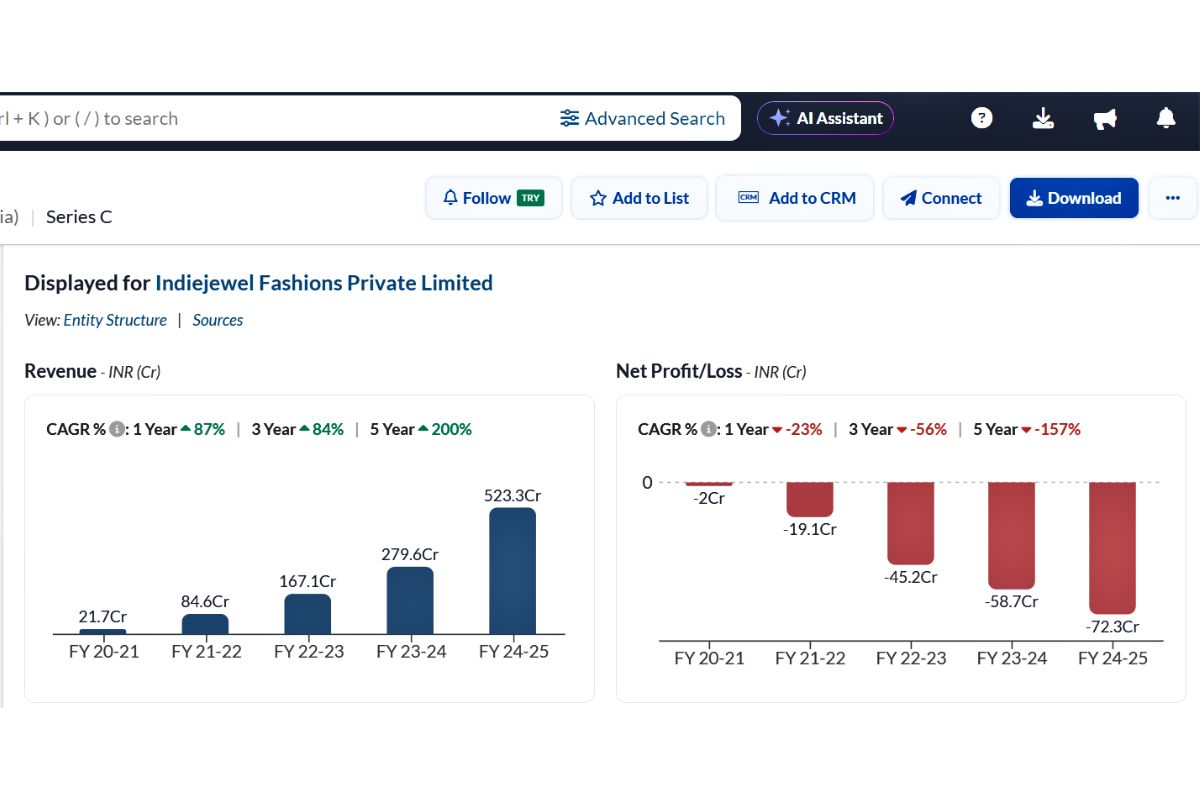
According to filings and contemporaneous reporting based on Registrar of Companies data, GIVA’s operating revenue rose sharply in the financial year ended March 2025. Revenue from operations reached ₹518 crore, an increase of approximately 89–90% from ₹273.6 crore in FY24. Total income, including other income of about ₹5.3 crore (primarily bank interest and investment-related gains), stood at ₹523.3 crore.
Despite the topline expansion, the consolidated net loss widened. The loss rose 23% to ₹72.3 crore from ₹58.7 crore in the prior year. Total expenditure increased 76% to roughly ₹595–596 crore. The largest cost head was materials, which nearly doubled (up about 97%) to ₹226–227 crore and accounted for roughly 38% of overall expenses. This rise reflected higher procurement volumes needed to support both online demand and the growing store network, as well as the shift into higher-value gold and lab-grown diamond categories. Inventory levels also more than doubled to around ₹100 crore.
Employee benefit expenses climbed approximately 82–84% to ₹91.1 crore, consistent with headcount growth required for retail operations, fulfilment and support functions. Marketing spend rose 52–55% (reported figures ranging ₹121.5 crore to ₹135 crore depending on exact classification), a typical D2C pattern of continued brand investment even as offline presence expands. Rental and lease costs more than doubled (up about 134–135%) to ₹47 crore, directly tracking the rapid addition of physical stores. Other costs such as finance charges and depreciation remained smaller relative to the major operating heads.
Operational ratios showed modest improvement in efficiency metrics even as absolute losses grew. Reports indicated EBITDA margin around –10.8% and ROCE around –21.5%, better than the prior year on a relative basis. Cash reserves declined from higher levels in the previous year to approximately ₹37 crore by March 2025, reflecting the capital intensity of expansion. Lab-grown diamonds reportedly contributed around 20% of revenue (approximately ₹100 crore) in FY25, signalling early traction in a higher-margin adjacent category. International expansion began with a Sri Lanka store that generated about ₹10.7 crore.
The financial profile is characteristic of a growth-stage consumer brand prioritising market share and physical density over near-term profitability. Revenue nearly doubled while costs rose at a slower but still substantial pace, producing larger absolute losses. Management and investor commentary around the same period pointed to an expected FY26 revenue range of ₹800–850 crore, implying continued strong growth if expansion and category mix execute as planned.
Continued Fundraising: Extended Series C of ~$12 Million in February 2026
In February 2026 GIVA moved to raise an additional ₹110 crore (approximately $12 million) as an extension of its Series C. The round was led by HPV CC1 Ltd with participation from existing backer Premji Invest (via PI Opportunities Fund II), Kenro Capital, and Titan Capital (via Winners Fund). Regulatory filings indicated issuance of roughly 94 lakh Series C1 compulsorily convertible preference shares at ₹117 each. HPV CC1 was to contribute the largest share (around ₹74 crore), with the others providing the balance.
This followed a larger Series C of ₹530 crore (about $61.5 million) closed in June 2025 and led by Creaegis, with participation from Premji Invest, Epiq Capital and Edelweiss Discovery Fund. Cumulative funding across rounds has been reported in the $130–160 million-plus range from a mix of venture and growth investors including A91 Partners, Sixth Sense, India Quotient, Aditya Birla Ventures and others. Valuation estimates around the extension placed the company in the ₹4,000–4,900 crore range depending on the exact terms and secondary components.
Proceeds from the extension were earmarked for operational expenses, hiring, marketing and general corporate purposes—consistent with supporting the ongoing store rollout and working-capital needs of a larger inventory and fulfilment footprint. The ability to raise follow-on capital relatively quickly after a substantial Series C indicates continued institutional confidence in the growth trajectory, even while losses remain elevated. At the same time, the need for additional capital so soon after a large raise underscores the cash intensity of simultaneous online scaling, offline densification, and category expansion into gold and lab-grown diamonds.
Aggressive Store Expansion and the VEDA Premium Format
By late 2025 GIVA was operating approximately 280 stores across roughly 48 cities, with notable density in Bengaluru, Delhi-NCR and selected Tier-2 markets (multiple stores in cities such as Indore, Lucknow and Jaipur). Management stated a target of 340 stores by March 2026 (adding around 150 outlets in the fiscal year) and a longer-term ambition of 800–1,000 stores over three years. The strategy shifted toward tighter geographic density—aiming for a store every 2–3 km in key markets rather than the earlier wider radius—while continuing to push into Tier-2 locations where offline conversion and brand visibility are strong.
This expansion is capital- and operationally intensive. Rental costs more than doubled in FY25 precisely because of the store build-out. Higher inventory, staffing and local marketing follow. The brand has also experimented with formats such as quick-commerce delivery from stores in select pincodes (“GIVA Go”). Channel mix has moved toward a roughly even online-offline split, reducing pure digital customer-acquisition concentration but increasing fixed-cost leverage.
In March–April 2026 the company launched VEDA, a premium flagship format in Bangalore (HSR Layout). Positioned as an experiential destination rather than a standard retail outlet, VEDA emphasises private consultation rooms, curated collections spanning silver (Kundan, pearl, temple styles), gold (everyday to occasion and Polki), and lab-grown diamonds, made-to-order capability (12–14 day timelines), ethical sourcing claims, and a 0% gold deduction policy on exchanges. The format targets higher-average-order-value, milestone and occasion purchases and represents an attempt to move up the value chain beyond the core accessible silver and lighter gold offerings. A related brand extension, Heer by GIVA (gold and lab-grown diamonds), has also opened offline presence.
The expansion logic is clear: physical stores build trust for jewellery purchases, lower digital CAC over time, enable try-on and higher conversion on gold and diamond pieces, and create billboard-like brand presence. The risk is equally clear—execution complexity, working-capital lock-up in inventory, and the challenge of maintaining consistent product quality and service standards across a rapidly multiplying footprint.
But, every coin has two sides, as so is the case with Giva. On one handm we could see growth in revenue, sales, funding, strategic decisions; and on the other hand, lies a pool of consumer complaints, that seems like a typical fast-scaling D2C brand which is running under strain from rapid growth.
Alongside the growth metrics runs a steady stream of consumer feedback on platforms such as MouthShut, Voxya, Reddit and social media. Recurring themes centre on product durability and after-sales experience.
On the product side, multiple reviewers report gold plating or colour finishes fading, tarnishing or turning black within weeks to a month of light or moderate use. Some describe items arriving damaged, broken or thinner/flimsier than expected from product imagery. While GIVA is a legitimately registered brand selling certified 925 sterling silver (independent guides confirm this), the complaints focus less on the base metal being counterfeit and more on plating durability, finishing quality and longevity under everyday wear conditions. Higher-value orders in the ₹17,000–₹20,000 range have occasionally featured in escalation stories involving non-delivery or delayed resolution.
On the service side, complaint aggregators show patterns of slow or unresponsive customer support, difficulty processing refunds or replacements, and cases of orders cancelled or not delivered after payment. One tracked dataset on Voxya showed a resolution rate around 54% (13 of 24 logged complaints resolved at the time of sampling)—a small sample from a single platform and not a regulatory statistic, yet directionally consistent with broader anecdotal reports. Warranty and re-plating processes have drawn criticism for delays, incomplete resolutions or policies that customers perceive as unfavourable once the return window closes.
These issues are not unique to GIVA; they appear frequently among fast-scaling D2C and omnichannel consumer brands during periods of aggressive store and volume growth. Defect rates and support-ticket volumes often rise faster than support-team capacity and quality-control systems can fully absorb. Jewellery, particularly plated and fashion-adjacent pieces intended for frequent wear, is especially sensitive to finishing consistency and customer expectations around longevity. The brand’s lifetime re-plating or warranty claims exist, but execution consistency across a large store and order network remains a reported friction point.
Synthesis and Outlook
GIVA’s FY25 numbers demonstrate robust demand: nearly doubling revenue while building a meaningful offline presence and diversifying into higher-value categories. The February 2026 extension of Series C capital, coming months after a large prior raise, provides runway for the stated store targets of 340 by March 2026 and the multi-year push toward 800–1,000 outlets. The VEDA launch signals an intentional move up-market into experiential, higher-ticket retail. Recognition of the founding team and continued investor participation (including from established names such as Premji Invest and Titan Capital) reflect confidence in the structural shift toward organised, design-led, everyday and accessible fine jewellery in India.
At the same time, the widening absolute losses, heavy cost inflation in materials, people, marketing and rent, and the volume of durability and service complaints illustrate the classic tension of rapid scale. Unit economics and customer lifetime value will ultimately depend on whether quality control, plating durability, fulfilment reliability and support responsiveness improve in parallel with store count and order volume. Competitors such as CaratLane (now fully under Titan) and BlueStone (public and recently profitable in some quarters) operate in overlapping spaces with different channel and category emphases; GIVA’s path will be judged by its ability to convert growth into sustainable margins while protecting brand trust.
In short, GIVA is executing a high-velocity expansion playbook funded by successive rounds of institutional capital. The financial trajectory shows clear demand and operational leverage potential, yet the absolute loss profile and consumer feedback patterns indicate that the next phase of growth will need to balance speed with consistency in product performance and post-purchase experience. How effectively the company closes that gap will determine whether the current momentum translates into durable profitability and market leadership in the accessible and premium fine-jewellery segments.