Noida International Airport And Dwarka Expressway- How The Real Estate Gang Is Harnessing The Power Of Two Projects In Delhi NCR Region?

Runway to Realty: How Noida International Airport and Dwarka Expressway Are Rewriting the Rules of Delhi NCR Real Estate
There is a particular moment in the life of any great city when infrastructure stops being a matter of convenience and becomes a matter of destiny. Delhi NCR is living through exactly such a moment — not quietly, not gradually, but with the roaring velocity of a market that has finally found its twin engines. Those engines are the Noida International Airport at Jewar and the Dwarka Expressway in Gurugram, and together they are not simply upgrading the region’s connectivity map. They are reordering its economic geography, reshaping its social aspirations, and fundamentally — irrevocably — transforming the fortunes of every square foot of land that falls within their gravitational pull.
This is not a story about real estate in the conventional sense. It is a story about what happens when infrastructure vision, state ambition, private capital, and a deeply aspiration-driven middle class collide at exactly the same point in history. The numbers, as we shall see, are extraordinary. But the meaning behind those numbers is even more so.
Setting the Stage: Why Delhi NCR Needed These Two Projects
To understand the magnitude of what is happening, you first need to understand the problem these projects were built to solve. Delhi NCR, for all its economic weight, had long suffered from a peculiar geographic imbalance. The west of the NCR, dominated by Gurugram and its corridor toward IGI Airport, had captured the lion’s share of corporate investment, luxury real estate, and premium infrastructure. The east and south-east, encompassing Noida, Greater Noida, and the Yamuna Expressway belt, remained perennially undervalued, frequently stigmatised by the homebuyer crisis of the 2012–2018 period, and dismissed by institutional investors as a high-risk, low-return geography.
The Dwarka Expressway, on the other hand, addressed a different but equally pressing pain point — the legendary congestion of NH-48, the old Delhi-Gurugram highway that served as the primary artery for millions of daily commuters. As noted in a detailed analysis of the corridor’s growth, the expressway is also known as the Northern Peripheral Road (NPR) and stretches 29 kilometres, connecting Dwarka in Delhi to NH-48 near Gurugram. For years, the expressway project was stuck in legal battles, land disputes, and bureaucratic delays. Its long-pending completion had become something of a dark joke in the NCR real estate community. But when it finally became fully operational, the joke turned into a gold rush.
These two projects, then, did not emerge from thin air. They were structural responses to structural problems. And that is precisely why their impact on real estate has been so profound and so durable — not speculative hype, but demand anchored in genuine economic logic.
The Noida International Airport: Asia’s Biggest Gamble That Is Paying Off
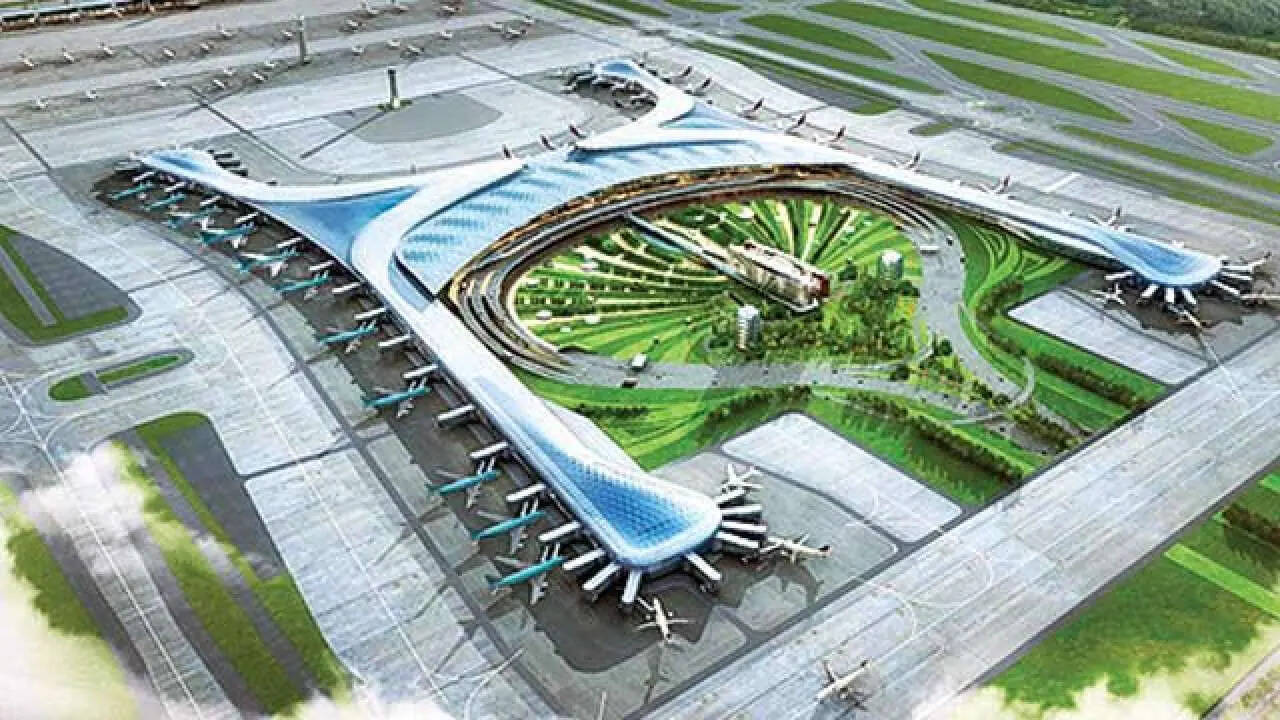
The Noida International Airport at Jewar is not merely a large infrastructure project. It is India’s most ambitious greenfield aviation undertaking in a generation, and its numbers demand to be read carefully. Developed in partnership between Zurich Airport International and the Yamuna Expressway Industrial Development Authority (YEIDA), the airport holds the distinction of being the first airport in India to attract 100 percent Foreign Direct Investment (FDI) in the aviation sector — a symbolic milestone that signals global confidence in India’s regulatory environment and long-term growth story.
The first phase, which cost approximately ₹10,050 crore, was inaugurated in late March 2026. In its final configuration, across four phases spanning decades — the airport is projected to handle 225 million passengers annually, positioning it to be among Asia’s largest airports. The airport sits on approximately 5,000 acres of land, a footprint that alone tells you something profound about the planners’ ambitions for the surrounding ecosystem.
What makes Jewar particularly remarkable from a real estate perspective is the aerotropolis model at its core. This is not just an airport with some shopping and hotels. The YEIDA masterplan envisions Jewar as the nucleus of an entire economic city. It encompasses a Fintech City spanning 3,500 hectares, an International Film City in Sector 21 — which has already shot its first production — industrial parks and logistics corridors that integrate with the Eastern Peripheral Expressway and the Delhi-Mumbai Industrial Corridor, SEZs designed to attract semiconductor, electronics, and data-centre investments, and residential sectors planned to house the workforce of this emerging aerotropolis.
YEIDA has projected that the combined industrial and economic zones will generate 1 million jobs by 2027 — a figure that, if even half-realised, will generate residential demand of enormous proportions. The aerotropolis as an urban planning concept compares Jewar to global models. The land acquisition story at Jewar is itself a landmark. Not a single court case or farmer protest has been recorded against the land acquisition process — an astonishing achievement in a country where infrastructure land acquisition has historically been the single biggest cause of project delays. This conflict-free model has been cited nationally as a benchmark for future greenfield projects.
What Jewar Has Done to Property Prices: The Data Tells a Staggering Story
The market’s response to Jewar has been swift, sustained, and in several micro-markets, quite breathtaking in scale. A comprehensive report by Square Yards, titled “Runway to Realty: How Noida International Airport is Reshaping Realty,” provides the most granular picture of what has unfolded along the Yamuna Expressway corridor between 2020 and 2025. Residential apartment prices along the Yamuna Expressway have nearly tripled in five years. Plot values have risen by an average of 1.5 times, with select micro-markets witnessing up to 5x appreciation — a level of return that would make most equity investors pause and reconsider their asset allocation.
Looking specifically at the data points, Noida’s average residential prices reached ₹14,946 per sq ft in 2024, representing a 152 percent increase since 2019. The Yamuna Expressway itself reached ₹6,600 per sq ft in 2024, up 98 percent over the same period. Land prices in the Jewar micro-market specifically tell an equally compelling story. Colliers India estimates that values in the immediate vicinity of the airport have risen by approximately 40 percent in the last five years, moving from ₹5,000 per sq ft in 2020 to ₹7,000 per sq ft by 2024.
The projection for 2030 stands at ₹10,482 per sq ft — an increase of nearly 50 percent from current levels if realised. For plotted land, the Square Yards report estimates further appreciation of 28 percent over the next two years, while apartment values are projected to rise by 22 percent in the same window. Even the government’s own land allocation schemes are reflecting this investor fever. In 2024, YEIDA’s schemes for 821 residential plots and 1,200 flats attracted 91,380 applications — an oversubscription rate that underscores the depth of demand in a market that was considered peripheral just a decade ago.
The investment implications of all this connectivity infrastructure are direct and calculable. A 31.42-km Greenfield corridor connecting the Delhi-Mumbai Expressway to Jewar Airport, with an investment of ₹3,630.77 crore, has already been approved by the Union Cabinet and will be built under the Hybrid Annuity Mode (HAM) public-private partnership framework.
A Ghaziabad-Jewar Rapid Rail Transit System corridor, expected to be completed by 2031, and a pod taxi network of 14.5 km connecting the airport to Noida Film City through 12 stations are in various stages of planning or execution. A metro link from Noida Sector 148 on the Aqua Line to the airport has completed its Detailed Project Report (DPR), though physical construction has not yet commenced. Every one of these connectivity threads is a price escalator for the properties that sit along its path.
The Builder Cohort Responds: Who Is Betting Big on the Jewar Belt
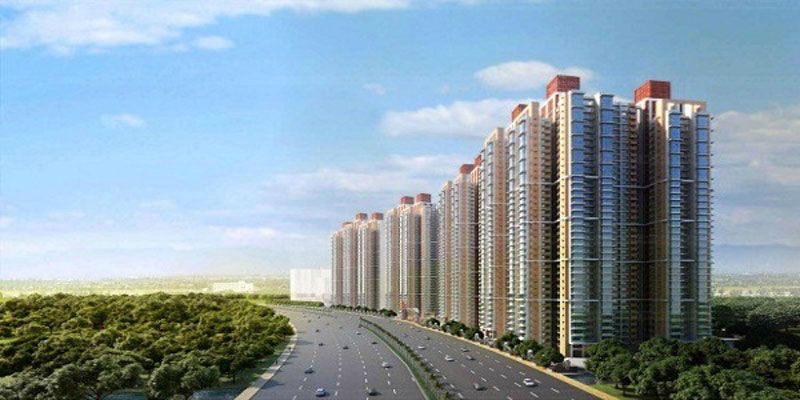
The builder community’s response to the Jewar opportunity has been instructive. Renowned builders like ATS, ACE Group, and Gaursons are aggressively positioning projects along the Yamuna Expressway corridor, particularly in Sector 22D — the first residential sector after the airport. Other significant players include Arihant Group, Eldeco, Bhutani Infra, SKA, and Supertech, along with newer entrants from other cities sensing the opportunity.
Gaursons has already delivered Gaur Yamuna City, an integrated township spanning approximately 250 acres in Sector 19, and is now launching a new premium project in Sector 22D on 11.8 acres with a 75,000 sq ft clubhouse designed by Hafeez Contractor, with a Thailand-based firm handling landscaping. Based on current market trends, this project is in its pre-launch phase with prices starting at approximately ₹7,999 per sq ft.
ACE Group has positioned multiple products along the corridor — from studio apartments in Sector 22A targeting investors at ₹77 lakh onwards, to the premium 3 and 4 BHK ACE Terra in Sector 22D. Eldeco is entering this belt with a high-rise project on a 20,000 sq metre parcel.Bhutani Infra is developing mixed-use commercial assets targeting corporate clients expected post-airport operations. Supertech and Orion are repositioning acquired land parcels as premium residential communities. Sector 22D, the first residential sector on the Yamuna Expressway belt after the airport terminal, has become the hottest address in this corridor. Properties in prime sectors like 22D and 27 have appreciated by up to 30 percent in just three years.
What is commercially savvy about the builder strategy along Jewar is the deliberate use of 30:70 payment structures — where buyers pay 30 percent upfront and the remaining 70 percent only at possession — reducing the financial burden during construction and making under-construction inventory accessible to a wider buyer pool. This is intelligent demand management designed to fill inventory pipelines while the airport-led appreciation story builds toward its real crescendo in the 2026–2030 window.
On the cultural economy front, the Noida International Film City is now operational, with producer Boney Kapoor confirming that Mom 2, the sequel to the 2017 film, is now shooting at the facility — making it the first film to begin production there. This cultural anchor matters more than it might appear: film cities generate large-scale, sustained employment across creative, technical, and support services, and the residential demand they create is less cyclical than corporate or logistics employment.
Dwarka Expressway: The 29-Kilometre Corridor That Became Delhi NCR’s Price Champion
If Jewar is the emerging giant of the east, Dwarka Expressway is the established titan of the west — and its performance data in 2024–2025 rewrote every benchmark for price appreciation in Indian residential real estate.
To understand what Dwarka Expressway achieved, consider this single number: a 58 percent year-on-year surge in housing prices in Q4 2024. This was not just the highest appreciation rate on any expressway in Delhi NCR — it was the highest rate of property price appreciation recorded in any major residential micro-market across the entire country. The CREDAI-Colliers-Liases Foras report that captured this data also revealed that Delhi NCR as a whole recorded 31 percent YoY growth in the same period, the highest among India’s top eight cities (Delhi-NCR, Mumbai, Chennai, Bengaluru, Hyderabad, Kolkata, Pune and Ahmedabad), with Dwarka Expressway as the primary driver of that regional performance.
The longer-term trajectory is equally compelling. Dwarka Expressway property prices doubled from ₹9,434 per sq ft in 2020 to ₹18,668 per sq ft by 2024 — a doubling within four years in a corridor that was once dismissed as over-leveraged and under-delivered. Looking at a slightly broader two-year window, the price surge in Gurugram’s residential markets has registered a 67 percent jump from ₹9,718 to ₹16,186 per sq ft.
The key micro-markets that led this surge were Sectors 108, 113, and 104, which functioned as frontrunners in both primary sales and capital appreciation. More broadly, key growth sectors 113, 106, 103, 111, and 37D contributed over 74 percent of new supply in the four-year window from 2020 to 2024. Luxury residences — including 4BHK apartments priced between ₹4.8 crore and ₹8.6 crore — are now seeing strong absorption in a market that barely had a luxury segment a decade ago.
The Anatomy of Dwarka Expressway’s Price Surge: What Actually Caused It?
Five distinct forces converged along Dwarka Expressway to produce what may be remembered as the most significant residential real estate appreciation story in Delhi NCR’s post-2010 history.
The first and most foundational was infrastructure readiness. The full operationalisation of the expressway — including the completion of underpasses, flyovers, service lanes, and cloverleaf junctions — fundamentally changed the commute experience.
The second factor was connectivity multiplication. The expressway offers direct access to IGI Airport, the Diplomatic Enclave, and Cyber City. The additional metro link underway — connecting Millennium City Centre to Dwarka Expressway with 27 stations — and a 5.3-km link road connecting Manesar to the expressway are further extensions of this network.
The third force was the luxury-segment surge. Delhi NCR’s market shifted decisively upmarket between 2022 and 2025. Luxury and ultra-luxury supply captured 82 percent of new launches in NCR during Q2 2025. More broadly, the share of luxury supply in NCR’s new launches climbed from 24 percent in 2023 to 59 percent in 2024. Dwarka Expressway was the epicentre of this shift, with DLF, M3M, Godrej, Tata Housing, Sobha, and Hero Homes all establishing premium project pipelines along the corridor.
The fourth driver was spillover from saturation in central Gurugram. As Golf Course Road and DLF Cyber City became priced out of reach, Dwarka Expressway emerged as a natural alternative. The fifth and perhaps most underappreciated force was the Global City project — a state-backed initiative that envisions a world-class business district along the expressway. Its inclusion of international business parks, convention centres, and diplomatic-grade infrastructure is what transforms Dwarka Expressway from a residential corridor into a complete economic ecosystem.
The Builder Strategy on Dwarka Expressway: A Masterclass in Timing
The builder cohort’s approach to Dwarka Expressway tells a story of timing that is almost cinematically perfect in retrospect. Developers who had invested in land parcels along this corridor in the 2015–2019 period — when the expressway was still mired in delays — found themselves sitting on assets that had doubled or tripled in value. As Saurab Saharan, Group MD of HCBS Developments, noted in 2025, “The surrounding sectors of Dwarka Expressway are quickly becoming hubs for buyers and investors who want great connectivity and modern infrastructure. Builders are seeing huge potential.”

As Rajjath Goel, MD of MRG Group, stated, “What was once just an emerging corridor is now a prime destination for high-end buyers and investors. The region has witnessed a sharp appreciation in property values, making it one of the most profitable destinations for premium housing.”
The institutional capital dimension confirms this. A Colliers India report from Q1 2025 revealed that institutional investments in Indian real estate rose 31 percent in January to March 2025 to USD 1.3 billion, with domestic investments accounting for 60 percent of total inflows. Brookfield India REIT announced investment in commercial assets in Gurgaon — and institutional capital is forensic in its analysis of long-term value creation, and its preference for the Dwarka Expressway corridor suggests the appreciation story still has significant runway ahead.
Over 41,000 residential units are expected to be delivered across Gurgaon’s growth corridors by 2027, of which approximately 25,000 will be along Dwarka Expressway. Delhi NCR also recorded retail leasing of 0.5 million sq ft in Q3 2025, with Gurgaon contributing 68 percent of that total — further evidence of commercial momentum along this corridor.
The Two Corridors, One Market: How Jewar and Dwarka Expressway Are Reshaping Delhi NCR Together
Together, Jewar and Dwarka Expressway are creating what urban economists call a polycentric growth model — where a metropolitan region has multiple economic centres connected by world-class infrastructure, rather than a single dominant CBD surrounded by dormant periphery. The statistical evidence for this combined effect is visible in the unsold inventory data. NCR’s unsold residential inventory dropped 51 percent from 1,73,117 units in Q1 2020 to 84,500 units by Q1 2025. Noida specifically witnessed a 72 percent decline in unsold stock — the sharpest inventory reduction of any major micro-market in the country.
Delhi NCR led luxury home launches in H1 2024, accounting for 26 percent of 23,500 units launched nationally at prices above ₹5 crore. The combined effect of both projects has created a virtuous cycle: better infrastructure attracts more corporate investment, which generates employment, which fuels housing demand, which enables more infrastructure investment.
Regarding the broader NCR office market, Noida’s sectors 62, 63, 132, and 137 host major corporations including Barclays, Infosys, and Samsung, and recorded a 27 percent office leasing surge in Q1 2025.
The Risks That the Hype Tends to Obscure
This piece would be dishonest if it did not acknowledge the risks embedded in this enthusiasm. Every exceptional real estate story carries within it the seeds of the next crisis, and the Delhi NCR market’s history — including the builder fraud cases involving AVJ Developers, Amrapali, Jaypee Infratech, and Unitech that left thousands of homebuyers stranded — demands that any bullish narrative be tempered with structural caution.
The first and most critical risk is delivery. The builder cohort that is currently marketing aggressively along both corridors includes a wide spectrum of participants — from genuinely credible, well-capitalised developers with proven delivery track records to smaller, under-capitalised entities that are riding the wave without the financial engineering to sustain construction through market cycles. RERA registration is necessary but not sufficient as a protection mechanism.
The second risk is connectivity lag. While Jewar Airport is now inaugurated, the metro connectivity to the airport — which is what will truly democratise access and unlock mass-market demand — is still in the DPR stage. As honestly noted by analysts, “At launch in mid-2026, the expressway remains the primary and only practical access route” to the airport.
The third risk is pricing exuberance. When a single corridor records 58 percent price appreciation in one year, as Dwarka Expressway did in Q4 2024, the question of sustainability is legitimate. Gurugram’s average property prices at ₹16,000 to ₹18,000 per sq ft are now approaching the levels of established luxury corridors in Mumbai. The bandwidth for further appreciation without a proportional increase in rental yields and end-user affordability is structurally limited.
An Opinionated Conclusion: Infrastructure as the Only Honest Compass in Indian Real Estate
Having absorbed all of this data, one conclusion stands inescapably clear: in the Indian real estate market of 2026, the only reliable investment compass is infrastructure — specifically, government-backed, nationally strategic, phased infrastructure with no realistic chance of political reversal.
Noida International Airport and Dwarka Expressway both qualify emphatically on this criterion. The airport is an asset of national strategic importance backed by sovereign-level political commitment, international FDI, and a master authority (YEIDA) that has demonstrated rare execution capability. The Dwarka Expressway is now a physical reality that cannot be un-built. Both have been integrated into national planning frameworks — the Delhi-Mumbai Industrial Corridor, Bharatmala, Smart Cities Mission — that ensure continued government investment regardless of which political formation is in power.
The builder cohort has read this map correctly. Their aggressive land banking and project launches along both corridors are not irrational exuberance — they are rational responses to an infrastructure investment cycle that has, for the first time in Delhi NCR’s post-liberalisation history, made the east of the NCR as investable as the west. The money flowing into Greater Noida, Yamuna Expressway, and Jewar is not speculative hot money looking for a quick exit. It is long-duration capital making a decades-long bet on the aerotropolis model.
The Indian real estate market is projected to touch USD 1 trillion by 2030. Delhi NCR, powered by these two infrastructure anchors, will account for a disproportionate share of that number. Whether you are a small investor looking at a ₹70 lakh studio on Yamuna Expressway or an institutional fund evaluating a ₹2,000 crore commercial asset on Dwarka Expressway, you are essentially making the same fundamental wager: that Delhi NCR’s infrastructure story, which has been thirty years in the making, is now finally delivering on its original promise.
That is not a bet against history. It is a bet with it.