The RBI’s Failure To Monitor Yes Bank Has Finally Been Called Out By The Supreme Court. The ₹8,415 Crore Bond Write-Off Has Been Overturned, But For Investors Who Lost Their Savings, It May Be Little Consolation.
The Supreme Court has overturned Yes Bank’s ₹8,415-crore bond write-off and questioned the RBI’s role. But if the RBI was monitoring Yes Bank, identifying problems and overseeing its rescue, why did the situation reach this point, and why did the consequences fall on investors?

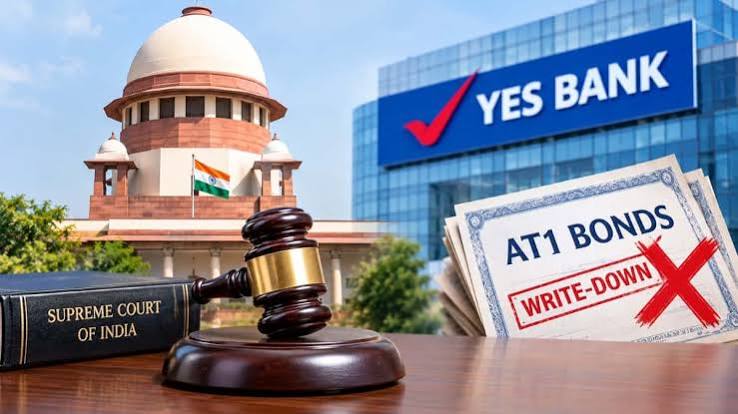
The Supreme Court has overturned Yes Bank’s ₹8,415-crore write-off of Additional Tier 1 (AT1) bonds, reopening a dispute that began during the bank’s emergency rescue in March 2020.
But the judgment is about more than money that investors lost. It raises uncomfortable questions about how Yes Bank was monitored before its crisis, how the rescue was implemented, and why the regulator responsible for supervising the banking system has come under judicial scrutiny.
The court’s observations about the Reserve Bank of India (RBI) are particularly significant. The Supreme Court questioned the RBI’s role in allowing Yes Bank’s problems to reach such a critical point, describing it as a “mere bystander” when the bank was allegedly carrying on business clandestinely.
The ruling also challenges the legal basis on which the bank’s administrator extinguished the AT1 bonds. The write-off was part of the emergency measures taken to restructure Yes Bank, but the final reconstruction scheme did not contain the provision that appeared in the draft. That distinction became central to the legal battle.
For investors whose bonds were written down to zero, the decision is a major legal development. But a court ruling overturning the write-off is not the same as money already being returned to every investor.
And that leaves us with a bigger question.
If the bank’s financial deterioration had become so severe, why did the supervisory system fail to prevent the crisis from reaching this point – and why were investors made to bear the consequences of a rescue decision that the Supreme Court has now rejected?
How Yes Bank Went From a Rising Lender to a Government-Backed Rescue
To understand why the Supreme Court’s judgment matters, it is necessary to return to the years before Yes Bank’s March 2020 crisis.
Yes Bank had built itself into one of India’s prominent private-sector lenders, but its rapid expansion was followed by growing concerns about asset quality, bad loans and the reliability of its reported financial position. As the bank’s problems deepened, confidence weakened and its ability to raise fresh capital became increasingly difficult. By early 2020, the situation had deteriorated to a point where an ordinary turnaround was no longer enough.
‘The RBI stepped in to prevent the crisis from spreading. In March 2020, it imposed a moratorium on Yes Bank, superseded the bank’s board and appointed an administrator. The moratorium restricted withdrawals, while a reconstruction plan was prepared to restore the lender’s financial stability. State Bank of India agreed to take a significant stake, with other investors also participating in the effort to recapitalise the bank.
The rescue was intended to stabilise the bank and protect the wider financial system. But the plan also raised a difficult question: how should the losses be distributed between shareholders, bondholders and the investors being brought in to save the lender?
The treatment of Yes Bank’s AT1 bonds became one of the most contentious parts of that exercise. On March 14, 2020, ₹8,415 crore worth of these bonds were written off, wiping out the investments of affected bondholders. While the bank and the authorities defended the measure as part of the reconstruction, bondholders challenged its legality.
The Bombay High Court ruled in their favour in January 2023, and Yes Bank, the RBI and the Union government appealed. On October 15, 2026, the Supreme Court dismissed those appeals, upholding the decision against the write-off.
The crucial point is that the rescue itself and the legality of the bond write-off are two different issues. The Supreme Court was not deciding whether Yes Bank needed rescuing. It was examining whether the administrator had the legal authority to take away the bondholders’ investments under the reconstruction scheme that actually came into force.
That distinction brings us to the central question of this story: if Yes Bank’s financial condition had deteriorated so badly that an emergency rescue became necessary, what had the regulator been doing while the crisis was developing – and why did the subsequent rescue produce a decision that could not withstand judicial scrutiny?

What Are AT1 Bonds, And Why Were ₹8,415 Crore Written Off?
To understand the dispute, it helps to understand what Yes Bank’s AT1 bonds were and why their write-off became such a contentious issue.
Additional Tier 1 (AT1) bonds are a form of bank capital designed to absorb losses when a lender comes under severe financial stress. Unlike ordinary bonds, they are perpetual instruments, meaning they do not have a fixed maturity date. They can offer investors attractive interest payments, but they also carry substantial risks, including the possibility of losing their investment if specified conditions are triggered.
Yes Bank issued ₹3,000 crore worth of these bonds in December 2016 and another ₹5,415 crore in October 2017, taking the total to ₹8,415 crore. When the bank was restructured in March 2020, its administrator wrote off the entire amount, extinguishing the bondholders’ investments. The action was defended as part of the effort to rescue the troubled lender and restore its financial stability.
But the legal dispute turned on a crucial detail. The draft reconstruction scheme contained a provision permitting the permanent write-off of the AT1 bonds. That clause was omitted from the final scheme notified by the government on March 13, 2020. Nevertheless, the administrator proceeded with the write-off the following day.
The bondholders challenged the decision, arguing that the administrator had no authority to extinguish their investments after the final scheme had come into force. The Bombay High Court agreed with them in January 2023. Yes Bank, the RBI and the Union government appealed, arguing against the decision to invalidate the write-off.
The Supreme Court has now upheld the High Court’s ruling. It held that the administrator could not exercise powers that were not available to him under the final reconstruction scheme and the applicable regulatory framework. It also clarified that the issue was not simply whether AT1 bonds could be written down during a banking crisis, but whether this particular write-off had been carried out lawfully.
That distinction is fundamental. AT1 bonds are designed to absorb losses, but that does not give a bank or its administrator unlimited authority to extinguish them in any manner they choose. The conditions governing the instruments and the applicable rules still matter.
For the bondholders, the judgment is a significant victory. The court also said that annual coupon payments must continue in accordance with the bonds’ information memoranda. But the broader implications extend beyond repayment. The ruling raises questions about how the rescue was executed, why the final scheme’s wording was disregarded and what role the RBI played in overseeing the process.
And that is where the judgment becomes particularly uncomfortable for India’s banking regulator.
Why The Supreme Court Said The RBI Was A “Mere Bystander”
]The most consequential part of the Supreme Court’s judgment may not be the ₹8,415-crore write-off itself. It is the court’s criticism of the RBI, the institution responsible for supervising banks and safeguarding the stability of India’s financial system.
The court observed that the RBI had effectively remained a “mere bystander” while Yes Bank’s Common Equity Tier 1 (CET1) capital ratio fell to an astonishingly low 0.6% by the end of 2019. CET1 is a measure of a bank’s highest-quality capital relative to its risk-weighted assets. It acts as a crucial buffer against losses. For context, the applicable minimum CET1 requirement cited in the reporting was 7.375%. Yes Bank’s reported ratio was therefore far below that threshold.
This was not simply a case of a bank suddenly running into trouble without any warning. The court noted that material irregularities in Yes Bank’s functioning had been identified much earlier and that criminal prosecution had been initiated against bank personnel. Its criticism raises a difficult question: if serious problems had already been detected, how did the bank’s financial position deteriorate to such an extent before emergency intervention became necessary?
The RBI’s role matters because banking supervision is not limited to stepping in after a lender has reached a crisis. Regulators are expected to identify financial weaknesses, demand corrective action and use their statutory powers when a bank’s capital position and conduct raise serious concerns. The judgment puts the spotlight on the gap between identifying problems and ensuring that they are addressed before the situation becomes critical.
The court’s criticism, however, went beyond the bank’s deteriorating capital position. It also questioned the handling of the AT1 bonds during the reconstruction process.
The draft scheme had included a provision permitting the permanent write-off of the bonds, but the clause was absent from the final scheme notified on March 13, 2020.
The administrator nevertheless wrote down the bonds the next day. The Supreme Court questioned whether the RBI, the administrator, Yes Bank and the government understood who possessed the authority to take that action and whether they were aware that the final scheme had omitted the provision. It found the handling of the bonds questionable and held that the administrator could not assume powers that had not been conferred on him.
This is where the ruling exposes two connected problems.
—The first concerns the supervision of Yes Bank before its rescue.
—The second concerns the legality of the measures adopted during that rescue.
The court’s reasoning makes clear that the need to stabilise a bank does not permit authorities to disregard the rules governing how that objective must be achieved.
The RBI’s intervention in March 2020 was intended to contain the crisis and protect the wider banking system. But that intervention does not, by itself, answer the questions about what happened before it or how the bondholders were treated afterwards.
The court’s position on investors was particularly pointed. It said that making them bear the consequences of administrative lapses would be “highly unfair.” It also questioned Yes Bank’s practice of actively offering high-risk AT1 bonds to individual investors, despite the applicable regulatory framework contemplating that such instruments should be offered to institutional investors.
The distinction is important: investors may take risks when they purchase financial instruments, but they should not have their investments extinguished through a process that violates the governing rules.
The Investors Who Lost Their Savings And The Questions Over Mis-Selling
The Supreme Court’s ruling has brought renewed attention to a question that goes beyond the legality of the ₹8,415-crore write-off: why were ordinary individual investors exposed to a financial instrument that was supposed to serve as a bank’s loss-absorbing capital?
AT1 bonds are not conventional fixed deposits. They are high-risk securities that can absorb losses when a bank faces severe financial stress. Their higher returns come with the possibility of losing the investment.
Under the RBI’s regulatory framework, these instruments were intended for institutional investors, including mutual funds and insurance companies, rather than being actively marketed to individual investors.
Yet the Supreme Court found that Yes Bank had not merely permitted individuals to acquire these bonds. It had actively offered them to individual investors in violation of the applicable regulatory framework. The judgment referred to an email dated December 28, 2016, apparently sent by a Yes Bank senior manager in Chennai offering the bonds for sale to individual investors.
The court also noted that the bonds offered directly by the bank to individuals fell outside the scope of the relevant SEBI regulations, even as it acknowledged regulatory action against a wealth management firm and the bank’s former managing director over sales facilitated through market platforms.
The distinction matters because the risk associated with an investment and the manner in which it is sold are two different questions. A financial product can carry genuine risks, but that does not excuse a bank from complying with the rules governing who may be offered the product and how those risks are communicated.
The court’s criticism was pointed. It said closer scrutiny should have been exercised before individual investors were drawn into such high-risk securities. It also questioned why investors should be made to bear the consequences of administrative lapses when the authorities and the bank were responsible for ensuring that the reconstruction followed the applicable rules.
For bondholders, the ruling offers substantial legal relief after more than six years of litigation. The Supreme Court has also directed that annual coupon payments remain unaffected and continue in accordance with the bonds’ information memoranda. However, the precise financial outcome for individual holders still depends on the implementation of the judgment and the terms governing their bonds.
The larger concern is about trust. Investors rely on banks and financial intermediaries not only to offer products but also to comply with the rules governing their sale. If high-risk instruments intended for institutional investors reach individuals through a bank’s own sales channels, the question is not simply whether those investors understood the risk. It is also whether the safeguards designed to protect them were followed in the first place.
Why The Supreme Court Rejected The Bond Write-Off
The Supreme Court’s decision rests on a specific legal distinction: the authorities’ power to reconstruct Yes Bank did not give the bank’s administrator unlimited power to write off the AT1 bonds after the final reconstruction scheme had taken effect.
The sequence of events was central to the ruling. A draft reconstruction scheme contained a provision for permanently writing down the bonds. But when the Union government notified the final scheme on March 13, 2020, that provision was absent.
The administrator nevertheless wrote off the entire ₹8,415 crore on March 14, relying on the RBI’s Master Circular on Basel III Capital Regulations.
The court examined the argument that the administrator retained the authority to write down the bonds until the reconstruction process was fully completed. It rejected that interpretation. Under the applicable provisions, the relevant action had to take place before reconstitution – meaning before the scheme took effect, rather than at any point during the years in which its obligations continued to be implemented.
The judgment also addressed the division of authority between the administrator and the RBI. The administrator had been appointed to take the place of Yes Bank’s board and manage the bank under the powers conferred by law. But that appointment did not transfer every regulatory power of the RBI to the administrator.
The court distinguished between the loss-absorption trigger at which the bank could decide whether to write down or convert its AT1 instruments, subject to their terms, and the point of non-viability, for which the applicable framework assigned a specific role to the RBI. The court held that the administrator could not assume a power that had not been granted to him.
It also noted that the government had consciously omitted the write-off clause from the final reconstruction scheme after objections had been raised by investors. The administrator’s subsequent decision effectively reinstated a provision that had not survived into the final version.
The Supreme Court therefore dismissed the appeals filed by Yes Bank, the RBI and the Union government, upholding the Bombay High Court’s decision to quash the write-off.
This is an important distinction for the wider banking system. The judgment does not say that AT1 bonds can never be written down or that such instruments cannot absorb losses during a bank crisis. It says that loss-absorption powers must be exercised in accordance with the applicable rules, contractual terms and reconstruction scheme.
The implications are consequently twofold. Yes Bank must now deal with the financial consequences of the ruling, while the RBI faces questions about both its supervisory role before the crisis and the regulatory framework under which the bond write-off was carried out.
The authorities had a legitimate objective in trying to stabilise a failing bank. But the Supreme Court’s decision makes clear that the urgency of a rescue cannot substitute for legal authority. The next question is what the ruling means for Yes Bank’s capital, its shareholders and the mutual funds that continue to hold these bonds.
Yes Bank’s Capital Takes A Hit As Investors React To The Verdict
The Supreme Court’s decision has created a new financial challenge for Yes Bank. The bank has survived its 2020 crisis and subsequently rebuilt its business, but the ruling over the AT1 bonds has reopened a liability that the reconstruction had treated as extinguished.
The immediate concern is the effect on the bank’s capital position. AT1 bonds form part of a lender’s additional capital buffer. With the write-off overturned, Yes Bank must account for the consequences of restoring the bondholders’ claims, subject to the judgment and the applicable terms.
Analysts have estimated that the impact could reduce the bank’s Common Equity Tier 1 ratio by roughly 230–300 basis points, potentially taking it to around 11–11.5% from approximately 14% at the end of June 2026. These are estimates, not confirmed final post-judgment figures, and the precise effect will depend on how the liability and related accounting treatment are implemented.
The stock market reacted sharply. Yes Bank shares fell 14.53% to ₹18.12 on October 15, reflecting investor concerns about the financial implications of the judgment. The decline also illustrates how a legal ruling can change expectations about a bank’s capital, future earnings and ability to absorb further losses. However, a fall in the share price does not, by itself, establish that the bank is heading towards another collapse.
The distinction matters because Yes Bank’s present position is different from the emergency conditions it faced in 2020. The current issue is the financial cost of a court ruling against the way its bonds were written off, rather than a new finding that the bank is insolvent.
The bank now faces the task of complying with the judgment while reassuring investors that it can manage the consequences without compromising its ability to lend or meet regulatory capital requirements. For shareholders, the concern is whether the additional liability will affect profitability, future capital needs and the bank’s longer-term recovery.
For the banking sector, the case raises another question: how should banks balance the need for instruments that absorb losses against the legal and regulatory protections owed to investors who purchase them?
The reaction from mutual funds shows that the consequences are not confined to Yes Bank itself.
Kotak Mahindra Asset Management Company suspended fresh subscriptions in two debt schemes — Kotak Medium Term Fund and Kotak Credit Risk Fund — because both held Yes Bank AT1 bonds that had been valued at zero since the 2020 write-off. The suspension was a precautionary measure taken before the Supreme Court delivered its judgment. After the ruling restored the bonds, Kotak said it was reviewing the judgment and would determine its next course of action.
This matters because the ruling changes the valuation of assets held by these funds, potentially affecting their net asset values and the interests of existing and incoming investors. The suspension was intended to protect unitholders while the implications were assessed, not to suggest that the funds themselves had failed.
There is also a more measured assessment from S&P Global Ratings. In its October 16 report, Reuters said S&P did not expect the judgment to affect Yes Bank’s credit ratings, although it anticipated a negative impact on earnings. S&P expects the bank to remain adequately capitalised, with the reinstatement of the bonds largely offsetting the impact on common equity in its assessment.
That provides an important counterpoint to the immediate share-price reaction. Yes Bank faces a significant financial and legal setback, but the ruling does not automatically mean the bank is heading towards another collapse. The immediate challenge is to account for the liability, manage the effect on earnings and capital, and demonstrate that it can meet its obligations while maintaining regulatory buffers.
The larger issue, however, extends beyond one bank’s balance sheet. The ruling has raised questions about how a financial institution can write off billions of rupees in investor holdings under a rescue scheme, only for the legal basis of that action to be rejected years later. It also puts the spotlight on how regulators, administrators and banks interpret their powers during an emergency.
The Last Bit, The Write-Off Has Been Overturned. But Who Will Answer for the Failure?
The Supreme Court’s ruling is a victory for Yes Bank’s AT1 bondholders, but it also exposes a larger problem with the way India’s banking system handles institutional failure.
The bank’s rescue in 2020 was intended to restore stability and prevent a wider crisis. The RBI stepped in, a reconstruction scheme was implemented and new investors were brought in. Yet the court has now ruled that the administrator’s decision to write off ₹8,415 crore in bonds was impermissible under the final scheme.
The institution responsible for supervising banks has also faced pointed judicial criticism over its role as Yes Bank’s financial position deteriorated. These are not minor procedural questions. They go to the heart of regulatory accountability.
—If serious irregularities were identified before the crisis, what action followed?
—If the bank’s capital ratio had fallen to 0.6%, why did the situation reach the point of emergency reconstruction?
—And if the final scheme did not authorise the write-off, how was the decision implemented in the first place?
The RBI’s intervention helped stabilise Yes Bank, and the judgment should not erase that part of the story. But the fact that a rescue was necessary does not remove the need to examine the failures that preceded it or the legality of the decisions taken during it.
For investors, the next step is equally important. The ruling restores their legal claims, but they still need the judgment to translate into the financial relief they have sought for more than six years. A court victory is significant; the actual recovery of money is what ultimately matters to those who lost their investments.
The case also carries a warning for the wider financial system. AT1 bonds are designed to absorb losses, but their use must follow the rules governing them.
Banks must comply with restrictions on how such instruments are sold, administrators must act within their legal authority, and regulators must be able to explain how their oversight functions when a lender’s condition deteriorates.
The Supreme Court has now addressed the legality of Yes Bank’s bond write-off. The harder question remains: will the episode also lead to accountability for the regulatory and administrative failures that allowed the crisis to unfold as it did?