Raheja Revanta And HRERA’s Crackdown: When Regulator Schooled The Builder!
First, Understand What Raheja Revanta Actually Was — Because the Gap Between the Promise and the Reality Is Everything

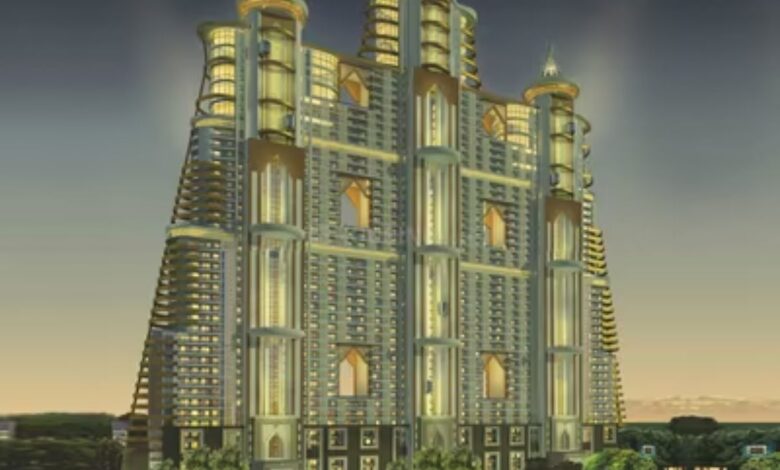
To understand why the HRERA action of April 2023 was as sweeping as it was, you first need to understand what Raheja Revanta was sold as — because the distance between the marketing and the reality is the core of the entire scandal.
Revanta was presented as a marvellous residential project by Raheja, spread over 18.72 acres of prime land in Sector 78, Gurugram, marketed as one of the tallest towers in Haryana. It was located near the intersection of the Northern Peripheral Road, Southern Peripheral Road, and NH8. Most strikingly, the project was described as being constructed by Arabtec, the firm that built the Burj Khalifa in Dubai, with structural engineering provided by Thornton Tomasetti. The project comprised Surya Towers and Tapas Townhouses.
The Surya Tower was described as the tallest luxurious residential tower of Haryana at Ground plus 58 storeys, while the architectural structure and engineering was executed by Thornton Tomasetti — the structural engineers of the Kingdom Tower in Saudi Arabia. The whole construction system was described as being carried out by PERI, a German technology known for quality construction. The project promised a grand skybridge, India’s highest infinity swimming pool, and a clubhouse on the 46th floor.
Raheja Revanta Sector 78 has three towers with 61 floors each, spread over 18.72 acres. Apartment options ranged from 1 BHK to 6 BHK, with sizes between 1,186 and 3,533 square feet, and prices starting from Rs 1.04 crore onwards.
This was not a modest affordable housing project. It was positioned as a luxury skyscraper — the kind of development that families saved for over years and decades, paying not just for a flat but for a statement of arrival. Buyers paid Rs 1 crore to Rs 5 crore per flat. And they paid early, heavily, and in good faith.
The Timeline of Betrayal by Raheja Revanta: 2011 to 2023
The Raheja Revanta project was launched in 2011. Despite homebuyers paying over 95% of the total amount since 2011, the project remained incomplete in 2023. That is twelve years between launch and the HRERA action — twelve years during which buyers made their payments, watched their deadlines pass, filed complaints, attended meetings with builders, and were repeatedly reassured that the project was nearly ready.

Buyers entered into agreements for sale with the builder as early as June 2, 2012. As per the contractual clause 4.2 of the agreement for sale, homebuyers were supposed to receive possession of their respective flats by December 2, 2016. The total sales consideration for individual flats ranged from approximately Rs 89 lakh to Rs 91 lakh, and buyers had paid substantially — in several documented cases, they had paid more than the total sale price due to additional demands raised by Raheja Developers via formal demand letters. Despite paying these substantial amounts, the builder failed to provide possession of the flats.
The contractual possession date of December 2016 came and went. Then 2017. Then 2018. Then 2019. Then the COVID-19 pandemic gave the developer an additional buffer — a six-month extension on licences was granted to developers across Haryana to account for pandemic disruptions. Even with that extension factored in, the licence for Raheja Revanta expired on January 31, 2023.
The homebuyers raised concerns that the licence for Raheja Revanta, launched by Raheja Developers Limited in 2011, had expired on January 31, 2023, even after the additional six months’ extension provided due to COVID-19-related delays. However, Raheja Developers Limited had not taken any steps to apply for a renewal of the licence from Haryana RERA.
This is a fact that deserves to sit with you for a moment. The developer whose project’s licence had expired — expired because the project had not been completed in all the time since 2011 — had not even applied for a renewal. It is difficult to interpret this as anything other than a signal that the developer either could not or did not intend to see the project through in any conventional regulatory sense.
The Revanta Gurgaon Flat Buyers Association: How Buyers Organised
The Revanta Gurgaon Flat Buyers Association (RGFBA) is a society registered under the Haryana Registration and Regulation of Societies Act, 2012, formed specifically to represent and work for the buyers of the Raheja Revanta project in Sector 78, Gurugram. The association’s stated aims include updating members on project progress, bridging the trust gap between the developer and the buyers, representing members at appropriate government, quasi-government, judicial, statutory, and other relevant authorities, and ensuring adherence of the developer to the terms of the RERA licence — including quarterly detailed updates of the project with construction status photographs and fund collection details.
This association became the primary vehicle through which homebuyers escalated their complaints to HRERA. The buyers’ complaints — formally documented and filed with the regulatory authority — covered two core allegations: first, that the developer was harassing homebuyers, and second, that funds collected from buyers had been diverted rather than deployed for construction.
The Revanta Gurgaon Flat Buyers Association raised concerns in February 2023, highlighting how their hard-earned money had been diverted to other projects, and despite the developer promising possession in four years, they still had not received it. The project had promised 962 flats, and complainants had sought a structural, forensic, and architectural audit.
The February 2023 complaint was a formal escalation — buyers presenting to HRERA a documented case of fund diversion, structural concerns, and the developer’s failure to honour its possession commitment. The three-pronged audit demand (structural, forensic, and architectural) tells you exactly what the buyers were worried about: not just whether the money had been spent, but whether the construction that had been done was sound, whether the funds were traceable, and whether the architectural promises of the project had even been kept structurally.
What Buyers Had Experienced Before February 2023: The 2022 Protest
The February 2023 HRERA complaint did not emerge from nowhere. Buyers had already been through years of failed assurances, and by December 2022, they had taken to the streets.
The buyers of the Raheja Revanta project in Sector 78, waiting for possession for five years, staged a protest outside the office of Raheja Developers on Sohna Road in December 2022. Builder Nayan Raheja reached the site and tried reassuring the protesters with folded hands. It was later decided that a meeting between buyers and builders would be held every three months.
The buyers alleged that even after giving 90 per cent money for the flat, they were being misled. The police also reached the spot. Arjun, president of the Revanta Gurgaon Flat Buyers Association, said the flats were sold in the name of the tallest project in Delhi, NCR, and Haryana. The buyers bought the flats for Rs 1 to Rs 5 crore.
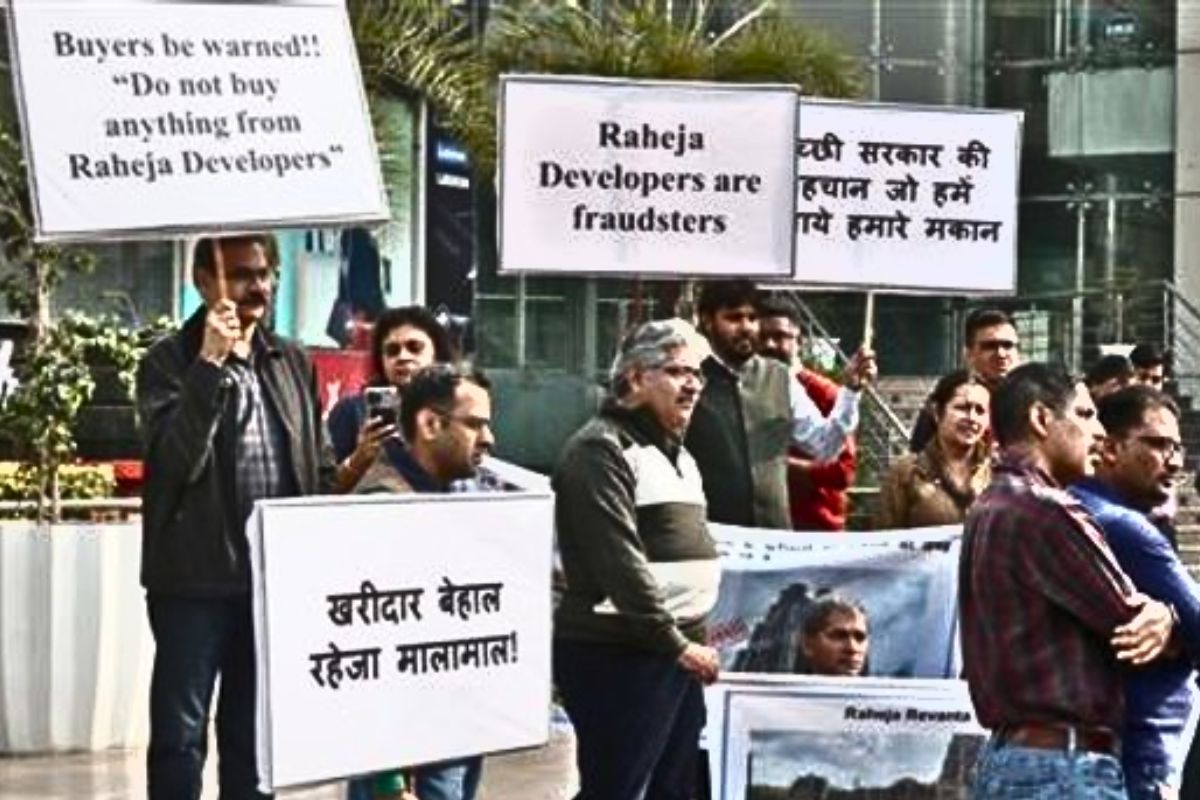
A protester named Arun Kumar stated that the project licence had expired on May 31, 2021, following which HRERA had ordered the builder to refund the money of 65 buyers, but the builder did not comply with the order.
This last detail is critical and often overlooked. Even before the sweeping April 2023 action, HRERA had already ordered Raheja Developers to refund the money of 65 buyers who had sought exit from the project, and Raheja had refused to comply. A regulatory authority had already issued a formal refund order. Raheja simply did not pay. This non-compliance with HRERA’s earlier refund order is the direct institutional context in which the April 2023 ban and forensic audit order must be understood. The regulator did not act in April 2023 because of a single complaint — it acted because Raheja had already demonstrated that it would not comply with the regulator’s previous directions.
The HRERA Order of April 2, 2023: Every Element Unpacked
Taking a stern stance on the alleged harassment of homebuyers by Raheja Developers for the past seven years, the Haryana Real Estate Regulatory Authority banned the sale and purchase of any unit in Raheja Revanta, a project pending in Sector 78, Gurugram. It also ordered a forensic audit of the project and froze all unsold inventory and bank accounts related to the project.
The HRERA order of April 2, 2023 was a multi-pronged action, and each element carried distinct legal and commercial significance. Understanding what each measure actually means in practice is essential to appreciating how severe this intervention was.
The ban on sales and purchases meant that Raheja Developers could no longer sell any of the unsold units in the Revanta project to new buyers. This was a direct commercial choke — the developer could not raise new funds from the project by bringing in fresh buyers. This is particularly significant because in stalled real estate projects in India, developers frequently use fresh buyer collections to fund ongoing construction or to service their other financial obligations, even when the project’s original funding has been misused. The HRERA ban cut off this avenue entirely.
The freezing of unsold inventory reinforced the sales ban by creating a legal encumbrance on those units — they could not be transferred, sold, or encumbered without HRERA’s specific authorisation.
The Haryana Real Estate Regulatory Authority directed the freezing of all unsold inventory and bank accounts associated with the Raheja Revanta project. The freezing of bank accounts associated with the project was arguably the most consequential element. By freezing the project’s bank accounts, HRERA ensured that whatever money remained in those accounts could not be moved out — not to another project, not to a related entity, not to personal accounts of the promoters. This was a direct response to the buyers’ core allegation of fund diversion, and it was designed to prevent any further diversion of whatever liquidity remained in the project’s financial ecosystem.
The forensic audit order was the investigative mechanism — the tool by which HRERA sought to answer the question that buyers had been asking for years: where exactly did the money go? A forensic audit is not the same as a regular financial audit. It specifically examines financial records to trace the flow of funds, identify anomalies, detect potential fraud or misappropriation, and reconstruct the financial history of a project in a way that can be used as evidence in legal proceedings. The buyers had explicitly requested a structural, forensic, and architectural audit — HRERA’s decision to order the forensic audit specifically suggests that the authority found the fund diversion allegation credible enough to warrant a dedicated investigative accounting exercise.
The Developer’s Defence: What Raheja Said in Response
Raheja Developers did not stay silent. The company offered a defence that it has consistently repeated across every subsequent regulatory and legal proceeding, and it is worth examining its elements carefully and honestly — because some of them contain partial truth, even as the overall picture remains deeply troubling.
According to Raheja Developers, they had spent the entire amount received on the project. External services like water supply, sewerage, rainwater, and masterplan road had not been laid due to the government’s failure to acquire the sector road. The developer also disclosed that they had paid over Rs 51 crore as External Development Charges and Internal Development Charges more than a decade ago.
Raheja Developers blamed the government for not providing the requisite infrastructure necessary for the completion and handover of the project. The developer claimed that they could not deliver the “tallest skyscraper of Haryana“, which it said was almost ready, without essential services like power, water, sewer lines, and roads. According to the developer, they could not put the lives of over thousands families in danger of fire and health hazards.
The EDC/IDC argument — that the developer paid the government’s charges for external infrastructure over a decade ago and the government failed to deliver the roads, water lines, and sewerage — is a real phenomenon in Gurugram’s urban planning failure. Sector 78 genuinely suffered from inadequate government infrastructure for years, and this is not entirely a fabrication.
However, there are two problems with the defence as offered. First, other developers in similarly infrastructure-starved sectors of Gurugram managed to obtain occupancy certificates and deliver projects. Second, the buyers’ core allegation was not just that the project was delayed — it was that the funds collected from them had been diverted to other uses, which is a separate and more serious charge that the infrastructure defence does not address.
Consumer reviews of Raheja Revanta on public platforms capture what this looked like from the ground: many customers expressed frustration over delayed completion, with some waiting more than 10 years. Users complained about poor communication from management regarding project status updates. Multiple reviewers accused Raheja Developers of fraud and cheating, mentioning instances of money being siphoned off and a lack of accountability.

The Raheja Revanta story is, in its essentials, the story of Indian real estate’s regulatory failure in microcosm. A project launched with extraordinary ambition in 2011, backed by the builders of the Burj Khalifa and the structural engineers of the Kingdom Tower, promised to thousands of middle and upper-middle class families across Delhi-NCR. Possession promised for 2016. A licence that expired in 2023, unrewarded, unenforced, and unapplied-for. A buyers’ association that organised, protested, complained, and fought. An HRERA that finally moved — imposing a sales ban, freezing accounts, ordering forensic scrutiny, and raising the question: where exactly did all that money go?