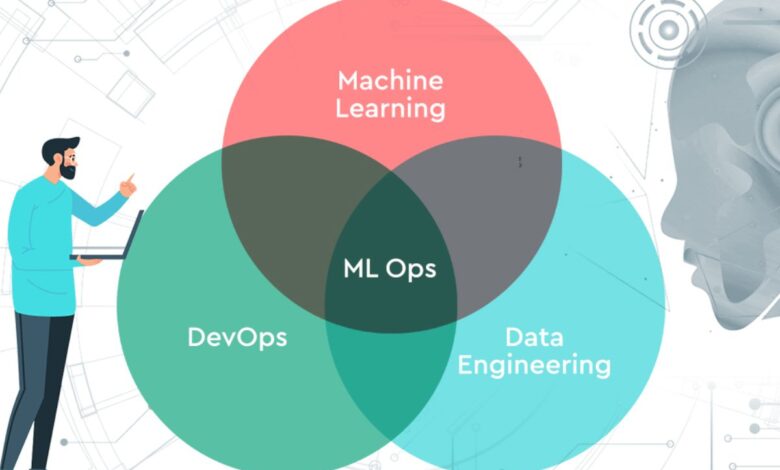
From Prototypes to Production: Why Machine Learning Ops Has Become India’s AI Bottleneck
India’s AI ambitions have arrived at a critical juncture. The country’s data science talent pool — one of the largest in the world — is producing models at extraordinary speed. But the hard, unglamorous discipline of keeping those models working reliably once they leave a data scientist’s laptop and enter the complexity of real production environments is where most AI programmes falter. In 2025, more than 78% of large enterprises worldwide actively deploy machine learning models in production environments, compared to less than 35% in 2020 — and with that rapid acceleration has come the urgent recognition that MLOps is no longer optional infrastructure, it is the discipline that determines whether AI delivers business value or dies in a proof-of-concept folder.
The MLOps market is experiencing explosive growth, with valuations reaching $1.7 billion in 2024 and projected to reach $129 billion by 2034 — a compound annual growth rate of 43% that reflects just how urgently enterprises need the ability to build, deploy, monitor, and govern machine learning systems at scale. Companies implementing proper MLOps report 40% cost reductions in ML lifecycle management and 97% improvements in model performance.
Asia-Pacific is the fastest-growing MLOps region, holding nearly 24% of the global market and recording annual adoption growth above 34% in 2025 — with India among the leading drivers alongside China, Japan, and South Korea. For Indian enterprises in BFSI, healthcare, manufacturing, and e-commerce that are scaling their AI operations in 2026, the following ten platforms represent the most capable, currently active choices available.
1. AWS SageMaker
Best For: AWS-native enterprises, large-scale model deployment, and teams needing the broadest compute selection available
AWS SageMaker dominates the enterprise MLOps landscape with its comprehensive suite of tools designed for every stage of the machine learning lifecycle. The platform excels at bridging data science and production operations through an integrated development environment that reduces deployment friction while maintaining enterprise-grade security and compliance features. SageMaker offers unmatched compute options from tiny instances to massive distributed clusters, a feature store that saves time rather than creating more work, and built-in experiment tracking.
A new “Model Cards” feature introduced in March 2025 dramatically improved handoffs between data science and operations teams. For Indian enterprises in fintech, e-commerce, and media streaming that have standardised on AWS infrastructure, SageMaker is the natural MLOps foundation — eliminating integration overhead while providing production-grade reliability that self-hosted alternatives require significant engineering effort to match. Typical mid-sized team expenditure runs between $1,000 and $7,000 per month depending on compute intensity.
2. Google Vertex AI
Best For: Google Cloud users, GenAI and LLM workflows, and teams prioritising automated ML pipelines
Vertex AI trains and serves models using Vertex AI training and prediction, supporting custom code, multiple ML frameworks, and optimised infrastructure, while automating and managing the ML lifecycle with built-in MLOps tools such as pipelines, model registry, feature store, and model monitoring. Google expanded enterprise MLOps governance and cross-platform ML orchestration significantly in 2025, and Vertex AI’s Gemini model integration has made it particularly compelling for Indian teams building applications that combine traditional ML pipelines with generative AI capabilities in the same operational framework.
Vertex AI follows a pay-as-you-go pricing model, charging based on resources used including training time, prediction requests, compute, storage, and generative AI token usage. For Indian AI startups and global capability centres on Google Cloud, Vertex AI’s unified approach to both classical and generative AI operations is one of the strongest architecture choices available in 2026.

3. Azure Machine Learning
Best For: Microsoft-stack organisations, regulated industries, and teams prioritising responsible AI governance
Azure Machine Learning features a drag-and-drop pipeline builder enabling citizen data scientists to create sophisticated workflows without deep coding expertise, native CI/CD pipeline integration with Azure DevOps and GitHub Actions, a Responsible AI Dashboard with model explainability and fairness assessment tools, and Azure Arc for consistent model deployment across on-premises, edge, and multi-cloud environments.
Microsoft expanded automated CI/CD for ML models and multi-cloud deployment options significantly in 2025, making Azure ML increasingly attractive even for organisations that are not exclusively on Azure infrastructure. For Indian enterprises in BFSI, pharmaceuticals, and government AI projects where regulatory scrutiny of model decisions is real and growing, the Responsible AI Dashboard’s explainability and bias detection capabilities are not optional features — they are operational necessities.
4. Databricks Mosaic AI
Best For: Data-intensive organisations, lakehouse architecture teams, and compound AI system builders
Building on their strong data processing foundation, Databricks has created an MLOps environment that naturally extends their lakehouse architecture, offering unified analytics and ML that eliminates data transfer headaches, feature engineering leveraging Spark, and collaborative notebooks that have evolved into true development environments. The January 2025 release added advanced explainability tools that help teams understand model decisions.
Databricks expanded lakehouse-driven MLOps automation substantially in 2025, and its Unity Catalog governance layer is now considered one of the most comprehensive data and ML governance tools available in any platform. For Indian telecom, retail, and manufacturing enterprises managing petabytes of operational data, Databricks’ principle — that compute should move to data rather than the other way around — has profound cost and latency implications that make it the architecturally superior choice for data-heavy AI programmes.
5. MLflow
Best For: Open-source flexibility seekers, experiment tracking, and teams building cloud-agnostic ML pipelines
MLflow remains one of the most widely used open-source platforms for tracking and managing ML experiments in 2026, offering flexibility as its primary advantage alongside experiment tracking, model registry, and deployment capabilities. MLflow provides a collaborative environment for data science teams, automated ML training workflows, tools to deploy and manage models in production, model version tracking, CI/CD integration for automatic deployment, continuous monitoring, and cost and performance optimisation.
MLflow’s dominance in India’s research institutions, AI startups, and cost-conscious engineering teams is built on a simple value proposition: it is free, it is deeply interoperable with every major cloud and framework, and it handles the experiment tracking and model registry functions that every ML team needs without creating vendor dependency. Used as a foundation layer — with cloud infrastructure for training and deployment sitting on top — it remains the most widely adopted component in Indian ML engineering stacks.
6. Weights & Biases (W&B)
Best For: Deep learning teams, research organisations, and companies with complex multi-run model evaluation needs
What started as a tool for experiment tracking has blossomed into a full-featured MLOps platform with particular strengths in team collaboration, offering visualisation tools that actually help debug models, team spaces that facilitate knowledge sharing without forcing rigid workflows, and artifact management that prevents confusion over model versions. Project templates introduced in Q1 2025 give teams a running start with best practices baked in.

Team plans start at $1,000 per month for 10 users. Weights & Biases has achieved deep adoption among India’s computer vision, NLP, and large model fine-tuning community because the depth of its training run visualisation — covering gradient distributions, hyperparameter sensitivity, and cross-run comparisons — genuinely accelerates debugging in ways that logs and spreadsheets cannot replicate. For Indian AI labs, academic groups, and product companies building image understanding or language understanding systems, W&B remains the experiment management standard.
7. Kubeflow
Best For: Kubernetes-native teams, hybrid cloud deployments, and portable ML pipeline orchestration
Kubeflow is among the leading open-source MLOps platforms with a focus on production-grade ML pipelines designed for deployment from the ground up, building workflows that are intended for production rather than just exploration. Kubeflow’s architecture — which represents ML workflows as directed acyclic graphs executing on Kubernetes — is particularly well-suited for Indian enterprises that have made Kubernetes a strategic infrastructure standard and want their ML pipelines to benefit from the same container orchestration capabilities that govern their application infrastructure.
Its pipeline abstraction is powerful enough for genuinely complex, multi-model AI systems, and recent GUI improvements in early 2025 have made it meaningfully more accessible to team members without deep Kubernetes expertise. For Indian IT services companies building ML platforms for global clients, Kubeflow’s portability across cloud providers is a strategic asset.
8. Dataiku
Best For: Cross-functional AI teams, business-analyst participation in ML projects, and low-code MLOps
Dataiku enhanced automated governance and low-code MLOps capabilities substantially in 2025, and it is consistently recognised for collaborative AI development that bridges technical and non-technical team members. MLOps platforms allow users to manage and monitor machine learning models as they are integrated into business applications, and the collaborative dimension — enabling data scientists, ML engineers, and operations teams to work efficiently together — is one of the most critical differentiating features among platforms.
Dataiku’s particular value for India’s enterprise AI programmes is that it closes the gap between the data science team and the business stakeholders who actually understand the problem being solved — a gap that is responsible for a surprising proportion of failed AI projects in Indian organisations where technical teams and business teams operate in separate silos. For Indian banks, insurers, and large manufacturers deploying ML at scale with cross-functional teams, Dataiku’s unified environment for both technical and non-technical users significantly accelerates time-to-production.
9. ClearML
Best For: Cost-conscious teams, self-hosted deployments, data sovereignty requirements, and open-source-preferred organisations
ClearML launched enhanced distributed training orchestration tools in 2025, adding meaningfully to a platform that was already one of the most complete open-source MLOps solutions available. ClearML covers experiment tracking, model versioning, dataset management, pipeline orchestration, and hyperparameter optimisation in a single coherent system — a breadth that competing open-source tools typically only achieve through integration of multiple separate projects. ClearML integrates with ML libraries including Keras, Fastai, HuggingFace, PyTorch, and others, with a central dashboard that is highly regarded for ML experiments. For Indian enterprises in regulated sectors, defence-adjacent AI projects, and government AI initiatives where data cannot leave on-premises infrastructure, ClearML’s self-hosted deployment option is not merely convenient — it is the only compliant choice among full-featured MLOps platforms.
10. Neptune.ai
Best For: Research-intensive teams, metadata management depth, and organisations with complex model comparison requirements
Neptune.ai is listed among the top MLOps tools for 2026 alongside MLflow and W&B, with a specialisation in experiment tracking and metadata management that goes deeper than most competing tools. Neptune.ai’s particular strength is the granularity with which it captures and organises every artefact from an ML experiment — not just metrics and parameters, but hardware utilisation, console output, source code snapshots, and custom objects — in a queryable, shareable interface. For Indian AI research organisations, pharmaceutical companies running drug discovery ML programmes, and fintech teams that need to produce detailed audit trails of model development decisions for regulatory purposes, Neptune.ai’s metadata depth provides a level of reproducibility and traceability that lighter experiment tracking tools cannot sustain at scale.
How to Think About Platform Selection in the Indian Context
The most important insight for Indian organisations evaluating these platforms is that the right choice is determined primarily by three factors that have nothing to do with feature comparison matrices.
The first is your existing cloud infrastructure. Enterprise teams with existing cloud investments should prioritise MLOps platforms that integrate natively with their current environment, because the hidden costs of cross-cloud data movement, re-authentication, and security perimeter bridging are substantial and are frequently underestimated in initial platform evaluations.
The second is your team’s composition. A platform that requires deep Kubernetes expertise will underperform in an organisation where most ML practitioners are data scientists rather than ML engineers. A platform designed for cross-functional collaboration will be wasted if the organisation has not yet created the governance structures that allow business users to participate meaningfully in model development.
The third is your regulatory environment. In 2026, the primary bottleneck is not building a prototype but proving it is safe for production — modern MLOps platforms automate the evaluation of hallucinations, toxicity, and bias, allowing enterprises to move from demo to trusted client-facing application in weeks rather than months. For Indian enterprises in BFSI, healthcare, and public services where AI decisions affect people’s financial lives and health outcomes, the governance and explainability capabilities of the chosen platform are as commercially important as its training and deployment performance.
Before fully committing to any platform, it is strongly recommended to run a proof of concept on a real project — testing the tool on actual workloads, because the differences between platforms are only fully realised in production conditions, not in feature comparison documents. The Indian AI teams that are extracting the most value from their MLOps infrastructure in 2026 are the ones that made deliberate, context-aware platform choices rather than defaulting to the most marketed option — and that discipline is itself a form of technical leadership that compounds in value with every model pushed to production.