The Strategic Shift That Changed What Managed IT Actually Means
India’s IT services sector has always been a global force — but for most of its history, the direction of that force was outward, with Indian companies managing IT infrastructure for enterprises in the United States, Europe, and Australia. In 2026, that dynamic has meaningfully bifurcated: Indian businesses are now among the most active consumers of managed IT services in the world, driving a domestic market whose scale and sophistication is growing at a pace that demands serious attention.
By 2025, the global managed services market had grown to USD 377.5 billion, and the GVR Report suggests it could rise to USD 731.1 billion by 2030 — with India among the fastest-growing demand markets within that global figure, driven by digital transformation programmes across BFSI, manufacturing, healthcare, and government.
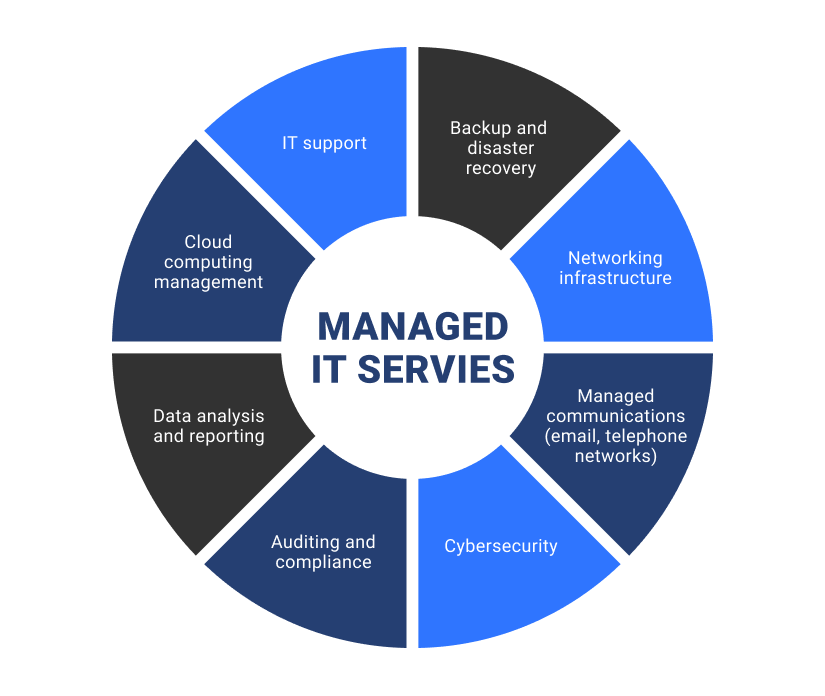
The nature of what managed IT service providers are expected to deliver has also transformed fundamentally. Enterprises, startups, and SMBs now expect Managed IT Service Providers to deliver 24/7 service desk operations, cloud optimisation, cybersecurity, automation, governance, and continuous improvement — managed IT services are no longer about fixing issues after they occur, but preventing incidents through proactive monitoring, predictive analytics, and automation. MSPs can save organisations up to 20% of initial costs, with top providers focusing on developing technology to address staffing needs, creating technical infrastructures, cloud services, and IoT capabilities while enhancing security for sensitive data managed in the cloud.
The ten providers below represent the most credible, comprehensive, and currently active managed IT service providers available to Indian and global enterprises in 2026.
1. Tata Consultancy Services (TCS)
Headquarters: Mumbai, Maharashtra | Best For: Large global enterprises, Fortune 500 companies, and complex multi-geography IT management
TCS is one of India’s largest IT services firms, delivering managed IT services, cloud solutions, and IT infrastructure management to global enterprises. The company generated $30.2 billion in revenue in 2025, reflecting its industry leadership. TCS emphasises innovative IT strategies, proactive monitoring, and digital transformation, helping clients optimise operations, improve security, and scale IT efficiently across industries.
TCS provides comprehensive IT infrastructure management services to Fortune 500 companies, with services spanning hybrid cloud, AI-driven operations, and cybersecurity, and is a trusted brand with global reach best suited for large enterprises requiring complex IT management. For enterprises whose IT environments span multiple geographies, technologies, and regulatory frameworks simultaneously, TCS’s scale, institutional knowledge, and global delivery network represent a combination that few competitors can match across the full breadth of managed IT service categories.
2. Infosys
Headquarters: Bengaluru, Karnataka | Best For: Digital-first IT transformation, next-generation infrastructure management, and cloud migration
Infosys offers next-generation infrastructure management through its Infosys Cobalt platform, known for digital transformation expertise and enterprise IT support, with a strong focus on digital-first IT infrastructure transformation. The Infosys Cobalt platform is particularly significant because it represents a coherent architectural philosophy rather than a collection of individual services — it provides a cloud-first foundation for managed services that integrates security, automation, and analytics into a single managed environment. For Indian enterprises embarking on large-scale digital transformation programmes — migrating from legacy on-premises infrastructure to hybrid or cloud-native architectures — Infosys’s combination of transformation expertise and ongoing managed services capability means a single partner can manage both the migration journey and the steady-state operation that follows.
3. Wipro
Headquarters: Bengaluru, Karnataka | Best For: Large enterprise infrastructure environments, automation-led IT management, and cloud and cybersecurity integration
Wipro is a prominent Indian IT services provider offering managed IT services, cloud solutions, and IT infrastructure management for businesses worldwide, reporting a gross revenue of $2,608.9 million in 2025. Focusing on digital transformation and proactive IT strategies, Wipro helps clients optimise operations, enhance security, and scale IT efficiently with innovative and reliable solutions. Wipro delivers infrastructure services through its Cloud and Infrastructure Services division, combining automation, cloud, and cybersecurity, with deep expertise in managing large enterprise infrastructure environments.
A client testimony captured in available records reflects Wipro’s operational value precisely: “Wipro has been instrumental in strengthening our global IT operations, enabling stability, efficiency, and cost control through structured delivery and technical expertise.” That combination of stability and structured delivery is the core proposition Wipro consistently delivers for enterprises managing complex, globally distributed IT environments.
4. HCLTech
Headquarters: Noida, Uttar Pradesh | Best For: Next-generation enterprise IT infrastructure, AI-blended operations, and large-scale managed security
HCLTech is a leading Indian IT services company offering managed IT services, cloud solutions, and IT infrastructure management for enterprises globally, reporting $13.8 billion in revenue in 2025. With a focus on digital transformation, proactive IT strategies, and scalable solutions, HCLTech helps clients optimise operations, enhance cybersecurity, and achieve operational excellence across industries.
HCLTech is known for its Next-Gen Enterprise IT Infrastructure Services, blending automation, AI, and cloud capabilities — with a notable client reference stating it helped integrate acquired businesses “not only faster but also better and cheaper.” HCLTech’s AI-blended operations approach is particularly relevant in 2026 because it applies machine learning to infrastructure monitoring, allowing the managed services team to identify anomalies and predict failures before they affect business operations, rather than simply responding after incidents occur.
5. Cognizant
Headquarters: Chennai, Tamil Nadu (US-listed) | Best For: Modern IT infrastructure transformation, cloud adoption, and enterprise cybersecurity
Cognizant provides modern IT infrastructure solutions with a focus on automation, cloud, and cybersecurity, and is recognised for strong IT infrastructure support for enterprises adopting digital transformation. Cognizant’s managed IT services practice has developed particular depth in the regulated industry verticals — healthcare, BFSI, and pharmaceuticals — where compliance requirements are as technically complex as the infrastructure itself. Its cloud advisory capabilities, combined with ongoing managed operations, make it a credible choice for Indian enterprises that need a partner capable of both designing the right cloud architecture and then maintaining it to the standard that regulatory frameworks require.
6. LTIMindtree
Headquarters: Mumbai, Maharashtra | Best For: Scalable digital infrastructure, automation-first IT management, and enterprises seeking agile delivery models
LTIMindtree combines digital-first infrastructure with strong automation and cloud services, and is reliable for enterprises with a focus on scalable digital infrastructure. The merger of L&T Infotech and Mindtree created a provider that combines engineering rigour with product-thinking agility — a combination that manifests in managed IT services as both structured operational governance and the flexibility to adapt quickly to changing business requirements. For Indian enterprises in the mid-to-large category that want the process maturity of a large services firm without the organisational inertia that can make large firms slow to respond, LTIMindtree has positioned itself as a compelling middle path.
7. Zenkins
Headquarters: India | Best For: Startups, SMBs, and mid-size enterprises wanting enterprise-grade managed IT at optimised cost

Zenkins has positioned itself as a strategic Managed IT Services partner for startups, SMBs, and mid-to-large enterprises that want enterprise-grade IT operations without enterprise-level costs. It is known for helping organisations reduce IT operational costs by 20 to 40 percent while improving SLA adherence, response times, and end-user satisfaction, built around operational excellence, transparency, and client-centric delivery.
What makes Zenkins particularly relevant in the India context is that it targets the substantial mid-market segment that is too large for basic IT support but not large enough to justify the overhead of a Tier-1 provider relationship. Its transparent pricing model, ITIL-aligned delivery, and focus on measurable cost optimisation address the most common pain points of growing Indian businesses whose IT needs have outgrown their internal team’s capacity but whose budgets have not yet reached enterprise scale.
8. Simform
Headquarters: Ahmedabad, Gujarat | Best For: Product engineering companies, cloud-native organisations, and businesses needing DevOps and GenAI-integrated managed services
Simform is a premier product engineering services company specialising in Cloud and MACH architectures, DevOps automation, Data Engineering, Generative AI, and Machine Learning to create seamless digital experiences and scalable products, with over 1,000 employees and an average hourly rate of $30 per hour. Simform’s managed services offering is architecturally distinct from traditional infrastructure management — it is built around the DevOps and platform engineering model where managed services extend beyond reactive IT support to include continuous delivery pipelines, infrastructure-as-code management, and AI-augmented operations. For Indian SaaS companies, digital-native enterprises, and global businesses with Indian engineering centres that need their managed IT partner to understand modern software delivery as well as traditional infrastructure, Simform’s positioning is genuinely differentiated.
9. Outsource2India (O2I)
Headquarters: Bengaluru, Karnataka | Best For: Cost-effective IT outsourcing, multilingual support requirements, and organisations needing broad portfolio managed services
Outsource2India has been providing outsourced services since the early 2000s, covering a range of business process services including IT infrastructure and application managed services for clients around the world. Their strength lies in cost-effective delivery and the ability to handle diverse IT tasks including cloud infrastructure management and remote support functions. O2I runs on global standards like ISO/IEC 27001 for security, which helps when clients need consistent service across time zones.
O2I’s global delivery model lets MSPs and enterprises extend coverage without adding local costs, with a layered service model ensuring consistent quality and support availability, especially valuable for companies needing multilingual support or operating across regions. For Indian businesses that need a managed IT partner capable of supporting both domestic operations and international customer-facing IT systems, O2I’s multilingual capability and time-zone-spanning delivery model fill a gap that domestically focused providers cannot address.
10. Accenture India
Headquarters: Mumbai, Maharashtra | Best For: Global best practices, enterprise-scale IT outsourcing, and organisations seeking full-spectrum managed services with strategic consulting integration
Accenture provides full-spectrum IT infrastructure outsourcing services backed by automation, analytics, and cloud expertise, and is considered perfect for enterprises seeking global best practices in IT infrastructure management. Accenture’s managed IT services practice in India is distinguished by its integration of strategic advisory with operational delivery — a combination that is rare and genuinely valuable for enterprises navigating simultaneous pressures of cost optimisation, digital transformation, and regulatory compliance.
Its India delivery centres serve both domestic Indian enterprise clients and global clients whose managed IT operations are delivered from India, giving it a dual-market relevance that few other providers on this list can claim. For organisations that want their managed IT partner to understand the business strategy behind the IT decisions — not simply execute against a service catalogue — Accenture’s consulting-delivery integration is a meaningful differentiator.
How to Choose the Right Managed IT Service Provider in India
The decision between these ten providers should be driven by four factors that operate simultaneously rather than in sequence. The first is organisational scale and complexity — TCS, Infosys, Wipro, HCLTech, and Accenture are architected for large enterprise engagements with global complexity, while Zenkins, Simform, and O2I are better aligned with mid-market, startup, and growth-stage organisations whose needs are sophisticated but not yet at that scale. The second is your dominant technology stack — Simform’s strength in cloud-native and DevOps environments makes it ideal for digital-native organisations, while providers like Cognizant and LTIMindtree are better positioned for hybrid environments mixing legacy and modern infrastructure.
The third factor is industry-specific compliance requirements. Sixty-two percent of MSPs are currently offering specialised services by industry vertical, and an additional 54% are actively working to integrate this sector focus into their skill set — reflecting a market-wide recognition that generic managed IT services are insufficient for organisations with industry-specific compliance and security requirements. For Indian enterprises in BFSI, healthcare, or pharmaceuticals where the IT environment is directly governed by RBI, IRDAI, or CDSCO requirements, selecting a managed IT provider with demonstrable expertise in that specific regulatory framework is not optional.

The fourth factor is the maturity of AI and automation integration in the provider’s delivery model. Agentic AI and RPA are transforming IT operations by enabling proactive monitoring, faster issue resolution, and consistent service quality — and providers that have genuinely integrated these capabilities into their managed services delivery are producing measurably different outcomes from those still relying primarily on human-led reactive support. In 2026, that gap between AI-augmented and conventionally delivered managed IT is wide enough to be a primary evaluation criterion rather than a secondary consideration.