India’s Maritime Innovation Wave: A Sector Whose Moment Has Arrived
India’s relationship with the sea is ancient, but its maritime technology ecosystem is startlingly young — and growing at a pace that reflects both the scale of the opportunity and the seriousness with which Indian entrepreneurs and investors are now approaching it. There are 121 Maritime Tech startups in India, of which 32 are funded and 5 have secured Series A or higher funding, with an average of 8 new companies launched annually over the past decade — and several of the most impactful have been founded by alumni of IIT Madras, IIM Ahmedabad, and IIT Kharagpur.
The context for this growth is significant. India has a coastline stretching over 7,500 kilometres, operates 12 major and over 200 non-major ports, handles more than 95% of its trade volume by sea, and has an ambitious maritime infrastructure agenda under the Sagarmala Programme that is creating new demand for technology across port operations, vessel management, underwater inspection, and maritime surveillance. The Aerospace, Maritime and Defense Tech sector in India saw total funding of more than $1.59 billion over the past decade, with the most funding in 2024 at over $430 million, and $315 million raised in 2025 alone — a 49.35% increase over the same period in 2024, reflecting explosive investor interest in deep-tech maritime and defence innovation.
The ten startups below represent the most technically innovative, currently active, and globally relevant maritime technology companies India has produced as of 2026.
1. Planys Technologies
Headquarters: Chennai, Tamil Nadu | Focus: Underwater robotics, ROV inspection, and AI-powered marine asset monitoring
Planys Technologies is India’s most celebrated maritime robotics company and the undisputed leader in the country’s underwater inspection segment. Planys Technologies is a marine underwater robotics inspection platform whose offerings include remotely operated underwater vehicles and autonomous systems for visual inspection, ultrasonic testing, sonar surveys, and real-time data collection for maritime and infrastructure assets.
It also provides non-destructive testing services, corrosion monitoring, structural health assessment, digital reporting dashboards, and Internet of Underwater Things capabilities for remote monitoring.
The platform uses AI-enabled analytics, laser and sonar defect quantification, high-definition video, ultrasonic thickness gauging, and modular ROV and AUV technology for inspection in hostile or submerged environments.
Founded by IIT Madras alumni, Planys serves ports, offshore oil and gas facilities, naval assets, and dam infrastructure across India and internationally. Its transition from pure inspection services toward a SaaS-enabled monitoring platform — where continuous IoUT data streams from submerged assets feed into persistent digital twin models — positions it as the most technologically ambitious Indian maritime startup in 2026.
2. EyeROV
Headquarters: Kochi, Kerala | Focus: Compact ROVs for underwater inspection, port security, and aquaculture monitoring
EyeROV is a provider of remotely operated vehicles and unmanned systems for underwater inspections, operating in the maritime technology space. What distinguishes EyeROV within India’s ROV ecosystem is its focus on compact, cost-accessible underwater vehicles designed for deployment in conditions where traditional large-frame ROVs are impractical — confined port infrastructure, bridge pylons, aquaculture installations, and coastal surveillance.
The company has developed a range of ROV products that can be operated by trained non-specialists, dramatically lowering the barrier to underwater inspection for port authorities, state fisheries departments, and infrastructure companies that cannot afford the operational cost of deploying specialist marine survey vessels. Its Kerala base gives it close proximity to India’s fishing and coastal infrastructure sectors, which represent large and underserved addressable markets for affordable underwater monitoring technology.
3. Sagar Defence Engineering
Headquarters: Ahmedabad, Gujarat | Focus: Unmanned maritime surface vehicles, autonomous surveillance, and maritime domain awareness
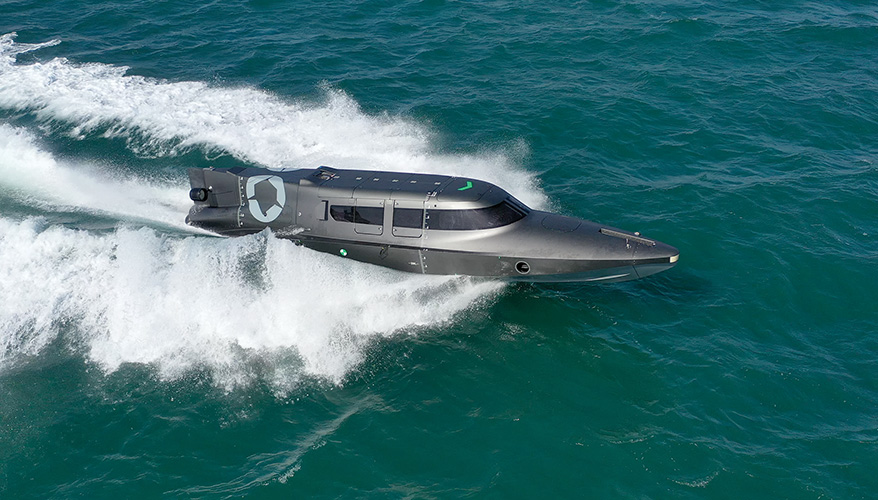
Sagar Defence Engineering manufactures quadcopter drones and unmanned maritime surface vehicles which facilitate real-time data collection in extreme conditions and environments. It employs optical sensors, an automated identification system, and acoustic sensors. Products can be customised according to requirements and feature cloud connectivity and storage, and a built-in collision avoidance system.
Sagar Defence’s USV (Unmanned Surface Vehicle) programme is among the most technically sophisticated in India’s maritime sector, addressing a capability gap that the Indian Navy and Coast Guard have explicitly identified as a priority: persistent surveillance of India’s Exclusive Economic Zone without deploying crewed vessels. The company’s integration of AIS, optical, and acoustic sensor suites into autonomous platforms that can operate continuously in open ocean conditions represents a significant engineering achievement, and its defence and government customer base gives it a revenue visibility that consumer-facing maritime technology startups often lack.
4. PierSight
Headquarters: Bengaluru, Karnataka | Focus: SAR and AIS satellite constellation for maritime surveillance and ocean monitoring
PierSight is an operator of SAR and AIS satellite constellation for maritime surveillance. It offers persistent monitoring solutions providing real-time situational awareness, with technology that excels in all-weather imaging and comprehensive ocean coverage. Data processing is low-latency, enabling actionable insights. Data fusion capabilities combine SAR and AIS data on a single platform, with solutions that address illegal fishing, oil spill detection, and Exclusive Economic Zone protection. PierSight is the most globally ambitious of India’s maritime technology startups — it is building space infrastructure for ocean visibility rather than individual maritime tools.
Synthetic Aperture Radar satellites can detect vessels regardless of weather conditions and regardless of whether the vessel is transmitting its AIS signal, which makes PierSight’s technology uniquely relevant for the most serious maritime security challenges: dark vessel detection, illegal fishing, and sanctions evasion. India’s 2.37 million square kilometre EEZ — one of the largest in the world — represents a domestic use case of extraordinary scale, and the international market for maritime domain awareness is growing rapidly as nations invest in ocean surveillance capabilities.
5. ShipsKart
Headquarters: Delhi | Focus: B2B marketplace for maritime supplies, ship chandlery, and procurement digitisation
ShipsKart is a provider of an online B2B marketplace for maritime services and logistics, with an app-based platform that provides solutions for all maritime needs. It caters to multiple vendors, managers, purchase officers, and captains. The captain of the assigned ship can place orders based on uploaded details like ETA and ETD using the app. ShipsKart addresses one of the maritime industry’s most persistent and least glamorous inefficiencies: the procurement of ship supplies — spare parts, provisions, marine chemicals, safety equipment, and maintenance items — which has historically been managed through fragmented, phone-and-email-based relationships with local chandlers at each port.
By aggregating suppliers into a single procurement platform and giving ship captains and purchasing officers a digital ordering interface, ShipsKart reduces procurement time, improves price transparency, and creates accountability in a supply chain that has traditionally operated with minimal documentation. For India’s fleet operators and port-side buyers, this digitisation of the chandlery process delivers cost savings that accumulate significantly across large vessel portfolios.
6. Solverminds
Headquarters: Chennai, Tamil Nadu | Focus: ERP and analytics solutions for liner container shipping companies
Solverminds is a software and analytics solution company specialising in providing enterprise application and analytical solutions for maritime transport. Solverminds provides tools that allow liner container shipping companies and agencies to plan, execute, control, and monitor their global operations. Solverminds provides ERP solutions, EDI, analytics and tracking, e-commerce enablement, and vehicle and warehouse scheduling services.
Solverminds occupies a specialised but high-value niche in maritime technology: enterprise software for the operational management of container shipping lines, which are among the most logistically complex businesses in the world. Its platform covers vessel scheduling, slot management, freight pricing, documentation, and terminal interface — the full operational lifecycle of a container shipping service. For Indian shipping companies and global liner operators with Indian agency operations, Solverminds provides a domain-specific alternative to generic ERP platforms that lack the maritime operational logic needed to manage dynamic vessel schedules, multi-port rotations, and real-time cargo commitments.
7. Xera Robotics
Headquarters: Chennai, Tamil Nadu | Focus: Underwater inspection robots and electric propulsion systems for maritime applications
Xera Robotics is a manufacturer of underwater inspection robot solutions whose flagship product is the DeepDive ROV, providing a modularly developed advanced underwater robot. It also offers electric propulsion systems for boat owners. Xera Robotics’ modular design philosophy — building ROVs from standardised, interchangeable component sets — addresses one of the most persistent operational challenges in underwater robotics: the cost and delay of repair and reconfiguration when operating in remote maritime environments.
A modular ROV can be field-repaired by swapping a damaged component rather than shipping the entire vehicle to a service centre, which dramatically improves operational availability for port authorities and offshore operators. Its electric propulsion systems for boat owners represent a separate but strategically coherent diversification into the recreational and small commercial vessel market, positioning Xera across both the professional inspection and the broader marine electrification segments.
8. IGO Solutions
Headquarters: Chennai, Tamil Nadu | Focus: AI-enabled port terminal management and port operations digitalisation
IGO Solutions offers AI-enabled solutions for port terminal management, providing solutions for monitoring port operations including port scheduling, document management, terminal business management, finance, billing, and many more. Port terminal management is one of the most data-intensive operational environments in logistics — a major container terminal processes thousands of truck movements, crane lifts, vessel calls, and customs transactions daily, and the margin between an efficient terminal and an inefficient one is directly visible in vessel turnaround times and cargo dwell times.
IGO Solutions’ AI layer, applied to scheduling and resource allocation, addresses the specific bottlenecks — unexpected vessel delays, crane breakdowns, gate congestion — that cause cascading inefficiencies across terminal operations. For India’s rapidly expanding port infrastructure, where terminal capacity is growing faster than the management sophistication to optimise it, IGO’s platform addresses a timing-relevant operational need.
9. Manastu Space (Maritime Applications Division)
Headquarters: Mumbai, Maharashtra | Focus: Green propulsion and satellite-enabled maritime communication solutions
Manastu Space, while primarily known as a green propulsion startup for small satellites, has developed maritime-relevant applications through its satellite communication and positioning technology — particularly for India’s fishing fleet, where thousands of small vessels operate beyond the range of terrestrial communication networks. Its hydrogen peroxide-based propulsion technology, developed as an environmentally benign alternative to conventional satellite propulsion, has potential maritime applications in unmanned surface vehicle propulsion and in the orbital systems that underpin maritime surveillance services. The company’s institutional backing and IIT Bombay founding team reflect the quality of engineering talent that India’s maritime technology ecosystem is now able to attract.
10. C Electric
Headquarters: India | Focus: Electric propulsion systems and marine electrification for commercial and coastal vessels
C Electric is among the most recently funded maritime technology startups in India, having received seed investment in 2025. C Electric addresses the electrification of India’s coastal and inland waterway vessel fleet — a transition that is both environmentally urgent and economically significant given India’s ambitious maritime electrification targets under the Green Shipping programme.
India’s ferry and coastal cargo fleet runs primarily on diesel, and the fuel cost, emission, and maintenance implications of that dependence are substantial for operators of high-frequency services on fixed routes — exactly the duty cycle where electric propulsion’s lower operating cost and simpler drivetrain deliver the most compelling economics. C Electric’s early-stage positioning means it is building toward a market that India’s maritime infrastructure investment is actively creating, giving it a structural tailwind that well-timed marine electrification companies in maturing Western markets are no longer able to access.
What India’s Maritime Tech Ecosystem Reveals About the Next Frontier
The ten companies above collectively cover every major dimension of maritime technology innovation — autonomous surface and underwater vehicles, satellite surveillance, port digitalisation, procurement platforms, enterprise software, and marine electrification. What they share, beyond their industry focus, is a set of structural advantages that make India’s maritime technology ecosystem unusually well-positioned relative to its current scale.
The first advantage is talent. Several of India’s most impactful maritime tech startups have been founded by alumni of IIT Madras, IIM Ahmedabad, and IIT Kharagpur — institutions whose engineering and management education produces founders capable of tackling the hardware, software, and systems integration challenges that maritime technology requires simultaneously.
The second advantage is market proximity. India’s 7,500-kilometre coastline, its 12 major ports, its 1.4 million registered fishermen, and its Sagarmala Programme infrastructure investment pipeline create an enormous domestic test bed that maritime technology startups in landlocked or smaller-coastal nations simply do not have access to. Startups like PierSight, Sagar Defence, and EyeROV can build, test, and validate their products against real operational requirements before they approach international markets — a product development advantage that compounds into competitive depth over time.
The third advantage is government alignment. India’s maritime security priorities, its fishing fleet modernisation agenda, its port efficiency targets, and its green shipping commitments under international agreements collectively create a policy environment that generates both direct procurement demand and regulatory tailwinds for the technologies these startups are building. In a sector as capital-intensive and technically complex as maritime technology, government alignment is not merely helpful — it is often the difference between a startup that can sustain its development timeline and one that cannot.