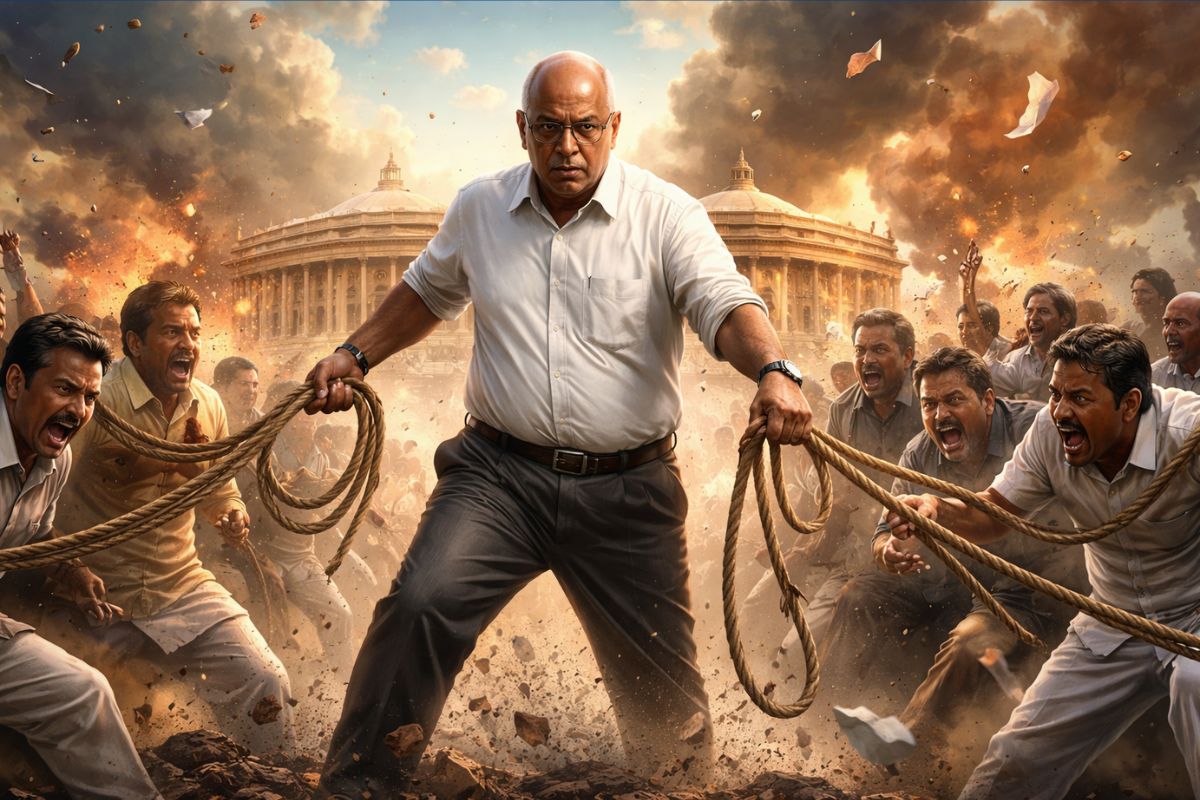
BJP Seal On Election Commission Document: Not Just A Case Of Clerical Error, But A Sign Why India Misses T.N. Seshan

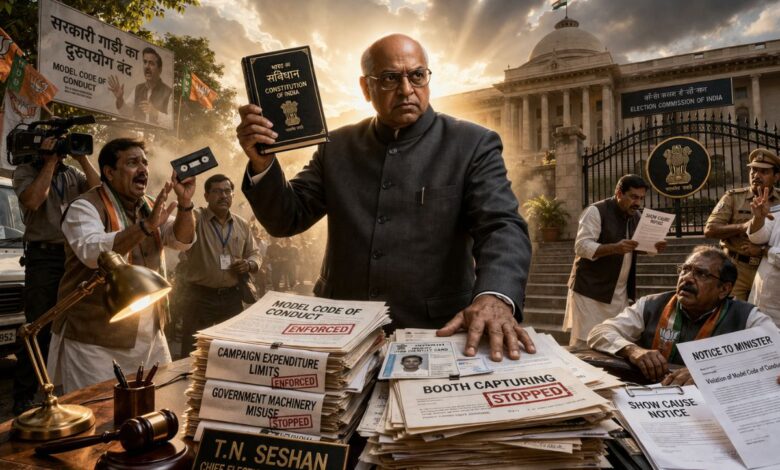
There is a moment that crystallises, with almost comic precision, the distance between what India’s Election Commission once was and what critics argue it has become. In March 2026, documents pertaining to the ECI’s guidelines in Kerala were found to carry the “BJP’s party symbol, on official Election Commission paperwork”. The Commission called it a clerical error. Perhaps it was. In isolation, such administrative oversights happen in any bureaucracy. But nothing in democracy happens entirely in isolation. A symbol is, after all, a symbol.
The Kerala CEO suspended the officer involved, issued an official clarification, and the incident was flagged and corrected on the same day it was distributed. This is, of course a sign of institutional responsiveness; however, it is not enough when viewed alongside a broader pattern of incidents that critics describe as emblematic of institutional opacity!
And the BJP’s lotus appearing on an Election Commission document, at times when 65 lakh names were being deleted from Bihar’s voter rolls (2025), when CCTV footage from polling booths was being ordered destroyed, when 27 unanswered complaints against the Prime Minister had accumulated like unread notifications on a phone that nobody intended to pick up — struck many observers not as an accident of office management, but as an accidental confession.
It is the kind of moment that would have made T.N. Seshan reach for his pen, his notice pad, and probably his contempt.
This is a story about two versions of the same institution. It is, in the deepest sense, a story about what it means for a democracy to have a spine — and what it looks like when that spine softens into something more yielding. To understand the full weight of the BJP-symbol controversy, you must first understand what the Election Commission of India was designed to be, what one extraordinary civil servant made it in the 1990s, and what a series of structural, political, and institutional choices (or chaos) have made it today. This story attempts that understanding, without pretending the picture is simple, without labelling allegations as established facts, and without the false comfort of easy conclusions.
The contrasts that follow are not drawn to be partisan. They are drawn to be honest.
PART ONE: THE INSTITUTION AND ITS ARCHITECTURE — THEN AND NOW
The Design: An Independent Commission for an Imperfect Democracy
Article 324 of the Constitution of India vests in the Election Commission the superintendence, direction, and control of the preparation of electoral rolls and the conduct of all elections to Parliament and to the Legislature of every State. In eight lines of text, the framers of the Constitution created an institution that, on paper, is among the most powerful in the Republic. The Election Commission cannot be easily dismissed by the government. The Chief Election Commissioner has security of tenure comparable to a Supreme Court judge. The institution is answerable, ultimately, to the Constitution, not to whichever government happens to sit in New Delhi.
But all these things are on paper. Always on paper!
The architecture’s central vulnerability has always been the appointment process. Before 2023, the President of India appointed the Chief Election Commissioner and Election Commissioners solely on the recommendation of the Prime Minister. In practical terms, this meant that the government of the day chose the individuals who would supervise its own elections. The circularity of this arrangement was obvious to any observer with a functioning sense of irony: you can hardly expect a fiercely independent umpire when the captain of one of the teams has the authority to appoint the umpire in the first place.
This structural flaw did not produce problems immediately, because for several decades, successive governments appointed individuals of sufficient integrity and professional standing that the independence of the Commission, while never guaranteed, was broadly maintained. What the system needed — as it turned out — was not better constitutional architecture but better human beings. When it got T.N. Seshan, it got both at once.

The Appointment Problem Explodes: 2015–2024
The appointment problem, which had simmered for decades, came to a full boil during the most recent decade of Indian elections. In 2015, advocate Anoop Baranwal filed a public interest litigation challenging the very basis of the executive’s unilateral authority over ECI appointments, arguing that it fundamentally compromised the Commission’s independence. The case dragged through the Supreme Court for eight years — a fact that is itself a commentary on the urgency with which democratic institutions treat reforms that may inconvenience those who run them.
While the case was pending before a Constitution Bench, the government executed what can only be described as a move of breathtaking audacity. In November 2022, Arun Goel’s appointment as Election Commissioner was pushed through with such unusual speed that the Supreme Court itself — the very court hearing the case about how appointment processes were opaque and rushed — questioned the urgency of the appointment on the floor of the courtroom. The irony of a Constitution Bench studying the lack of transparency in EC appointments, while simultaneously watching a new EC being appointed in a manner the Bench found questionable, would have been darkly comic if the stakes were not quite so high.
On March 2, 2023, the Constitution Bench delivered its verdict: the appointment committee would henceforth include the Chief Justice of India, the Prime Minister, and the Leader of the Opposition. It was a carefully constructed safeguard, designed to ensure that no single political interest could monopolise the selection of those who would oversee elections. Civil society celebrated. Democratic reformers exhaled.
The celebration lasted approximately several months.
The government’s response was the Chief Election Commissioner and other Election Commissioners (Appointment, Conditions of Service and Term of Office) Act, 2023, which replaced the Chief Justice on the selection committee with a Union Cabinet Minister. The executive, which the Supreme Court had specifically said should not dominate the appointment process, now held two out of three votes on the very committee designed to limit its dominance. The Supreme Court had installed a lock. Parliament had promptly changed the combination.
Contrast this, for a moment, with T.N. Seshan’s era. Seshan’s appointment in December 1990 came from the then Prime Minister, Chandra Shekhar, who almost certainly did not anticipate that he was handing the keys of the Election Commission to a man who would spend the next six years making the political establishment’s life deeply uncomfortable. Seshan’s independence was not structurally guaranteed. It was personally maintained, through force of character and an almost missionary conviction about what his constitutional role required of him.
When next prime minister P.V. Narasimha Rao who had initially believed Seshan might be a manageable instrument of the executive, found that the new CEC was anything but manageable; Rao’s response was to expand the Commission to three members in 1993, diluting Seshan’s individual authority through the addition of two new Election Commissioners.
Here is the difference, and it is a difference that cuts to the bone of Indian democracy: in Seshan’s time, the government tried to limit the power of an overly independent CEC. In our time, the government has restructured the appointment system itself to reduce the likelihood of ever having an overly independent CEC in the first place. The first is damage control. The second is prophylaxis.
PART TWO: THE MODEL CODE OF CONDUCT — FROM FEARED LAW TO PUNCHLINE
What Seshan Made of It
The Model Code of Conduct, before T.N. Seshan, was precisely what the phrase “gentleman’s agreement” implies: something that gentlemen agreed to observe, and then mostly didn’t, while everyone pretended they were. Political parties submitted to it verbally and ignored it practically. Campaigners used government vehicles, distributed liquor, organised riots near polling stations, and relied on the deep-rooted Indian tradition of nobody really being held accountable for anything.
Seshan decided, unilaterally and without any new legislative authority, that this was going to stop. His method was not to draft new laws — he had none to draft. His method was to enforce the existing ones with a ferocity that no politician had previously considered possible from a civil servant. He deployed videographers to record candidate speeches. He reviewed the footage and issued notices. A sitting governor was effectively forced to resign because he had campaigned for his son, in violation of the MCC.
A minister in Uttar Pradesh was physically pulled off a stage at a rally because the campaign period had just ended and the MCC had kicked in. Seshan cancelled elections in Bihar and Punjab when he concluded that conditions were not conducive to a free and fair vote — a decision of such extraordinary institutional boldness that some politicians called for his impeachment. They failed.
The statistical evidence of what this enforcement produced is not propaganda — it is documented. Booth capturing in Uttar Pradesh fell from 873 incidents in 1991 to 255 in 1993. Polling-day killings in the same state fell from 36 to 3. India Today, in December 1993, documented a near 80 per cent fall in booth capturing and a 90 per cent fall in deaths compared to 1991. The Pioneer newspaper ran an editorial on November 23, 1993, titled, simply, “Thank You, Mr Seshan.”
What the MCC Has Become Under the Present Commission?
The trajectory of the Model Code of Conduct between 2019 and 2025 forms perhaps the most damning factual record available to critics of the current Election Commission, because it is a record not of disputed events, but of documented inaction.
In the 2019 Lok Sabha elections, the volume of MCC complaints against Prime Minister Narendra Modi and BJP chief Amit Shah was unprecedented. When the Supreme Court pressed the Election Commission on why it had not acted on complaints against the Prime Minister and the BJP President for nearly a month, the Commission’s response was extraordinary: the ECI told the court it was “toothless” and “powerless,” that it could issue notices and advisories, and that on repeated violations, it could file complaints.
This is the same institution that, a generation earlier, had told a sitting governor that he had to resign because he had violated the Code. The same institution that had dragged a minister off a stage. Now, when asked why it had not acted against the Prime Minister of India, it was describing itself as toothless.
To borrow a cricket analogy that Seshan, a great lover of order and precision, might have appreciated: the umpire had stopped calling no-balls, and when asked why, had explained that he didn’t really have a good arm anymore.
By the time of the 2024 general elections, the pattern had become systemic. At least 27 complaints had been filed by opposition parties against the Prime Minister for alleged MCC violations, including hate speech, use of armed forces branding in electoral appeals, seeking votes in the name of religion, and the allegedly communal Banswara speech in Rajasthan. A complaint letter signed by over 17,400 citizens explicitly alleged that the speech had violated both the MCC and the Representation of the People Act, 1951, by “aiming at not only appealing to ‘communal feelings’ but also instigating and aggravating hatred.” The Election Commission issued no substantive action in response to any of these 27 complaints.
The international record is equally pointed. A 2024 report by Human Rights Watch found that Prime Minister Modi had made remarks targeting Muslims in 110 of his 173 speeches while the MCC was in force during the Lok Sabha elections. The report noted explicitly that the Election Commission had “failed to take adequate action to respond to these violations.” When the Commission did act, it merely wrote to the parties — no campaigning bans, no candidate disqualifications, no dramatic public consequences.
Meanwhile, the Commission found the energy to issue a show-cause notice to Congress leader Rahul Gandhi in November 2023 over jibes characterising the Prime Minister as a “panauti” and a “pickpocket” — mild political ribbing by any standard, but apparently more urgently in need of investigation than hate speech documented by an international human rights organisation.
Psephologist Sanjay Kumar of the Centre for the Study of Developing Societies did not mince words: “Certainly, from the people’s point of view, the Election Commission is seen to be playing a partial role.” West Bengal Chief Minister Mamata Banerjee, in a remark that had the virtue of being direct if not diplomatic, proposed that the Model Code of Conduct be rechristened the “Modi Code of Conduct.”
This is the most painful contrast in the entire story. Seshan’s MCC was identical in its text to the one that exists today. Not a comma, semicolon, or full stop has been changed, as Mr Seshan would have, himself liked to boast — because he implemented the existing law rather than writing new ones. What has changed is not the law. What has changed is the willingness to enforce it. In Seshan’s time, the MCC was a sword. Today’s critics argue it is a decorative display piece — shown to visitors, polished for photographs, but carefully kept in its scabbard.
PART THREE: VOTER IDENTITY AND ELECTORAL INTEGRITY — THEN AND NOW
Seshan’s EPIC Achievement and the Voter Roll Problem of Today
The Elector’s Photo Identity Card is one of the most tangible democratic objects in the world. Hundreds of millions of Indians carry one. It is the physical embodiment of the democratic right to vote — a document that says, in effect: this person exists, this person is registered, and this person’s vote belongs to them alone.
T.N. Seshan introduced it in 1993, nearly four decades after it had first been proposed by the West Bengal government in 1957. The idea had been shelved and forgotten because it was expensive, logistically challenging, and — the real reason, though nobody said it aloud — because impersonation at the polls was a feature rather than a bug for enough of the political establishment that nobody was in a hurry to eliminate it.
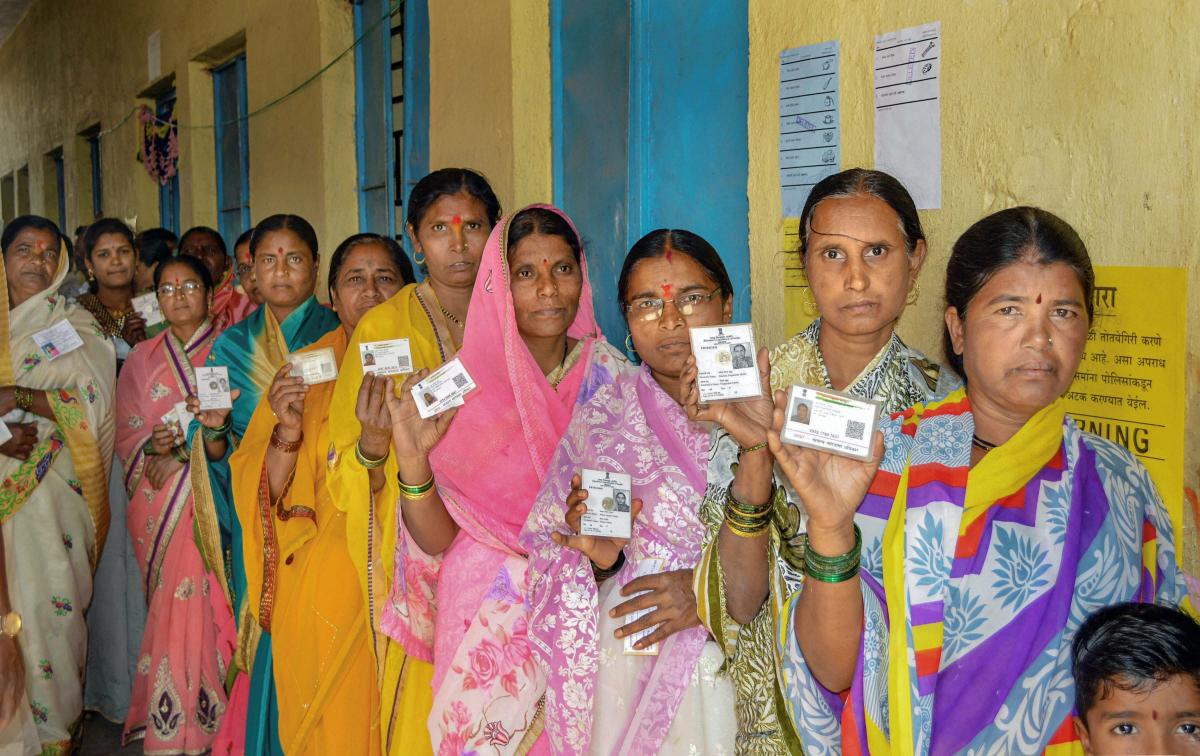
Seshan’s method of forcing the government’s hand was pure Seshan. After 18 months of watching the voter ID programme stall, he announced that he would not hold elections until the cards were issued. The government protested. The Supreme Court intervened, ruling that elections could not be postponed indefinitely because voting was a fundamental right. But the government, faced with the political and constitutional embarrassment of a CEC willing to cancel elections over a voter ID card, eventually moved. By the end of 1996, the programme was underway. Today’s voter ID is the direct and unambiguous legacy of Seshan’s willingness to hold the entire electoral calendar hostage until the government did the right thing.
The tragedy is that the integrity of those voter rolls — the very lists that the EPIC was meant to protect — is now the subject of the most serious allegations of electoral manipulation that India has seen in a generation.
The Maharashtra Surge and the Bihar Deletions
During the Maharashtra Assembly Elections in November 2024, a set of numbers appeared that resisted easy explanation. The Election Commission’s Voter Turnout App recorded a turnout of 58.22 per cent as of 5 pm on polling day, November 20. This translated, arithmetically, to roughly 5.64 crore votes. Five and a half hours later, at 11:53 pm, a new figure was published: 65.02 per cent. This translated to 6.30 crore votes. The difference between the two figures amounted to approximately 65.97 lakh — nearly 66 lakh votes — appearing in the data between 6:14 pm and 11:53 pm on a day when polling had officially closed at 5 pm.
A former Chief Election Commissioner described the variation as “worrying.” In at least 95 constituencies across Maharashtra, a discrepancy was found between the votes recorded in the Commission’s Voter Turnout App and the votes retrieved from EVMs at counting centres. In these 95 constituencies, the strike rate of the BJP and its allies was notably high. The Mahayuti alliance, which had performed poorly in Maharashtra just months earlier in the Lok Sabha elections, swept the assembly polls in a result that surprised almost every poll analyst.
Rahul Gandhi additionally pointed out that in the five months between the Lok Sabha elections in June 2024 and the assembly elections in November 2024, Maharashtra had registered 4.1 lakh new voters — against only 3.1 lakh in the preceding five years. Numbers and their context, as any statistician will tell you, tell very different stories.
Now consider what happened in Bihar in 2025. The Election Commission launched a Special Intensive Revision — an exercise to clean up electoral rolls. What it produced was the largest mass deletion of voter names in any single exercise in recent Indian electoral history: roughly 65 lakh names removed, of which 22 lakh were declared deceased, 7 lakh were duplicates, 36 lakh were listed as “shifted or untraceable,” and 1.2 lakh were still awaiting verification. The declaration of 22 lakh people as dead, in a single administrative exercise, is a number that strains credulity. For context, the entire population of cities like Ranchi or Patna is in this range.
When political parties requested the list of persons whose names had been removed — specifically, a list of those declared dead — the Election Commission declined. When they noted that preliminary drafts of the rolls given to some parties contained a “reason for deletion” column that was mysteriously absent in the publicly available version, the Commission’s response was, at best, opaque. The Supreme Court has since directed the Commission to verify whether such differential lists were distributed and to name recipients.
The documents pertaining to the 2003 SIR exercise, which the Commission cited as precedent, had gone missing from the Commission’s own website. The ECI told journalists that these documents “could not be traced.” Documents establishing the precedent for one of the most significant voter roll operations in recent memory, unavailable, untraceable, gone. In the age of the internet and government e-archives, this is not simply an administrative failing. It is an explanation that asks to be taken on faith from an institution whose credibility is precisely what is under question.
Contrast this with Seshan’s voter roll approach. Seshan launched the EPIC specifically to make it harder to manipulate voter rolls — to anchor each voter’s identity to a photograph that could be checked at the booth. His instinct was transparency and verification. The current Commission’s instinct, critics argue, has been in the opposite direction: less verification, less transparency, and when transparency is demanded, a tendency to respond with institutional authority rather than institutional accountability.
PART FOUR: THE CCTV FOOTAGE AND THE DISAPPEARING EVIDENCE
The Most Indefensible Decision of the Modern ECI
In December 2024, the government, acting on the Election Commission’s advice, amended the Conduct of Election Rules, 1961 to prohibit the public disclosure of CCTV footage from polling booths. Previously, this footage had been available to citizens for a nominal fee. Then, in June 2025, the Commission went further: it directed that all CCTV footage from polling booths be destroyed within 45 days.
The stated rationale was that the footage could be used to spread “misleading narratives” about voter fraud. This is a curious formulation. CCTV footage of what actually happened inside a polling booth is, by definition, evidence. It is the primary mechanism by which allegations of booth-level manipulation — ballot stuffing, coercion of voters, impersonation — could be independently verified or definitively refuted.
An Election Commission that was confident in the integrity of its processes would, one might reasonably expect, be eager for this footage to be available: it would clear the Commission’s name every time an allegation was made. The decision to destroy it, instead, has precisely the opposite effect. It ensures that allegations can never be tested, and that confidence in the electoral process must rest entirely on trust in the very institution whose conduct is being questioned.
This is the logic of a commission that fears scrutiny. T.N. Seshan’s Election Commission invited scrutiny. It sent 1,500 observers to the 1996 general elections — one for every three constituencies. It deployed videographers to record campaign speeches and brought the tapes back for review. It placed election officials under 24-hour monitoring from a central control room. Seshan’s instinct was always to generate more evidence, more documentation, more verification — because he understood that in a democracy, the legitimacy of an election rests not just on the election being fair, but on it being visibly and verifiably fair. These are not the same thing, and Seshan knew the difference.
The current Commission’s decision to order the destruction of the one category of evidence that could most conclusively answer the questions being asked about it represents a philosophical inversion of everything that Seshan stood for. Where Seshan said “here is the evidence — check it,” the current Commission is effectively saying “there will be no evidence — trust us.” In a country of 1.4 billion people, where elections determine the fate of hundreds of millions, “trust us” is not a governance strategy. It is a request.
PART FIVE: ELECTORAL BONDS, FINANCIAL ACCOUNTABILITY, AND THE GHOST OF SECTION 77
Seshan’s Campaign Finance Revolution
One of Seshan’s most under-appreciated achievements was his systematic enforcement of campaign expenditure limits, something so completely ignored before his tenure that it existed in a kind of legal twilight — technically obligatory, practically imaginary. He implemented Section 77 of the Representation of the People Act, 1951, requiring candidates to maintain accounts certified by district election officers. He personally reviewed more than 40,000 expenditure accounts. He banned 1,488 candidates for three years for improper spending disclosures. He disqualified 14,000 candidates for submitting false information. He set up a round-the-clock monitoring operation from the Commission’s headquarters, with one dedicated officer per state.
The underlying principle was simple: in a democracy, the rules of the game must apply equally to everyone, including the rules about how much money can be spent trying to win it. Allowing unlimited or unaccounted campaign spending is a structural advantage for the wealthy and the powerful — it means that the richest candidate or party can simply outspend their opponents into oblivion, and democracy becomes a function of financial muscle rather than popular support. Mr Seshan understood this and acted accordingly.
The Electoral Bond Debacle
The Electoral Bond scheme, introduced by the Modi government in 2017 and struck down as unconstitutional by the Supreme Court in February 2024, represents the most complete demolition of campaign finance transparency in recent Indian history. Bonds were anonymous — donors could not be identified by the public, and recipients could not be traced through normal disclosure mechanisms. An investigation following the Supreme Court order revealed that 33 corporations had donated bonds worth more than their declared profits, raising immediate questions about the source of the funds.
Three-quarters of total donations went to the BJP. Thirty corporate donors purchased electoral bonds after facing investigations by the Enforcement Directorate for money laundering and tax violations — a pattern that Indian media characterised as a possible quid pro quo between donations and investigations being quietly set aside.
What was the Election Commission’s role in this? The Commission had, reportedly, written to the government earlier expressing concerns about the anonymity provisions of the scheme. Those concerns were buried. The government did not disclose the ECI’s objections to Parliament. And the Commission itself did not go public, did not file a petition in the Supreme Court, and did not use whatever moral authority a constitutional body possesses to resist a scheme that, the Supreme Court ultimately found, violated the voters’ right to information and the equality norms of the Constitution.
The contrast with Mr Seshan could not be more starkly drawn. He was willing to cancel elections, defy Prime Ministers, endure impeachment proceedings, and lose cases in the Supreme Court in defence of financial accountability in elections. The current Commission, faced with a scheme that the highest court in the land later found unconstitutional, chose institutional silence. It wrote a private letter and then, apparently, went back to its desk.
PART SIX: GYANESH KUMAR AND THE ERA OF INSTITUTIONAL QUESTIONS
The Appointment That Started Under a Cloud
Gyanesh Kumar became Chief Election Commissioner after serving as an Election Commissioner — appointed in March 2024 under the very process the Supreme Court had earlier flagged as insufficiently transparent. The selection committee that chose him held its meeting on March 15, 2024, and notified the appointment on the same day. The Supreme Court noted, in proceedings related to the appointment, that the two new Election Commissioners were chosen without full details and particulars of candidates being shared with the Leader of the Opposition — a violation of the spirit, if not the strict letter, of the new law.
It is important to be scrupulously fair here: Gyanesh Kumar is a retired IAS officer of the Kerala cadre with a long career in public service. He has not been found guilty of any offence. The concerns about his appointment are structural and procedural — they relate to the process by which he came to hold the office, and to the actions (and inactions) of the institution he now leads, rather than to any personal or professional failing that has been established as a matter of fact.
This distinction matters in a country where the line between allegation and conviction is routinely blurred in public discourse, and the person is kept in jail just on the basis of allegation (take Prabir Purkayashta or Sonam Wangchuk, for example)
What can be said, however, is that the Commission under his watch has presided over a period of extraordinary controversy: the Maharashtra turnout surge, the Bihar SIR, the Mahadevapura fake voter allegations, the CCTV destruction order, and the persistent pattern of asymmetric MCC enforcement. Whether these controversies reflect the Commission’s culpability or merely the political temperature of a polarised democracy is a question that honest observers must leave open. What cannot be left open is that the Commission has not, in response to any of these controversies, produced the kind of fearless, transparent, institution-first response that might have settled the questions.
The Mahadevapura Moment: A Case Study in Institutional Response
In August 2025, Rahul Gandhi presented what he described as the most significant electoral fraud allegation in Indian history — backed, he said, by six months of research. The Mahadevapura Assembly constituency in Karnataka had, he alleged, over 1,00,250 fake voters in its rolls: 11,956 duplicates, 40,009 with invalid addresses, 10,452 bulk registrations, and 4,132 with invalid photographs. Several media organisations that independently investigated the allegations found credible evidence supporting them. The BJP’s lead in Mahadevapura had grown from approximately 44,501 to over 1,14,000 votes between 2023 and 2024 — a more than doubling of the margin — as turnout figures moved in directions that the standard model of organic voter registration growth did not easily explain.
The Election Commission’s response was to demand that Gandhi file the allegations under oath within seven days, with the implicit threat that failure to comply would render the charges “baseless and invalid.” Not: we will investigate. Not: we will audit the rolls. Not: we will publish the data so that independent verification can occur. But: file an affidavit, or the matter is closed.
Political activist and psephologist Yogendra Yadav, who has been a consistent and credible critic of electoral irregularities across party lines, put it plainly: any credible election commission would investigate the charges, fix the list, and punish the guilty. The standard Yadav described is not a demanding one. It is the basic institutional response that accountability requires. It is also, critics argue, precisely what the present Commission has failed to deliver — choosing instead to respond to scrutiny with demands for procedural compliance from the complainant, rather than substantive investigation of the complaint.
Compare this with Mr Seshan’s methodology. When he identified electoral malpractices, his first instinct was to enumerate them — he produced a 150-point catalogue of violations, a 34-page reform booklet, a systematic audit of the problem. His second instinct was to act on what he found. His third instinct was to publish and document the results, so that the public could see what had been done. There was no hiding. There was no “file an affidavit.” There was only: here is the problem, here is what we are going to do about it, and here is the evidence that we did it.
PART SEVEN: THE SURAT NON-ELECTION AND WHAT IT REPRESENTS
An Election Without Voters
In the 2024 Lok Sabha elections, the Surat constituency in Gujarat produced a result that, in any other context, would have been the leading story of the election cycle: the BJP candidate was declared elected without a single vote being cast. Every opposition nomination had been rejected on technical grounds. Every last one. In a constituency that was not a war zone, not a region of extraordinary administrative complexity, but a major commercial city — the first uncontested Lok Sabha election in decades had been produced by the systematic rejection of opposition paperwork.
The returning officer, who functions under the superintendence of the Election Commission, accepted every one of these rejections without the kind of scrutiny that the extraordinary nature of the outcome might have warranted. Civil society groups alleged coordination between the returning officer and the ruling party. The ECI did not, to the public’s knowledge, initiate any independent review of why every single opposition candidate in a major constituency had their papers rejected simultaneously.
Comparing it with past, Mr Seshan had cancelled elections in Bihar when he determined that the conditions for democracy did not exist. The principle was that an election without genuine competition and genuine choice is not an election at all — it is a formality, and formalities do not deserve the democratic dignity of the electoral process. In Surat, every condition for a non-election was met: one candidate, no opposition, zero votes. The Commission found no reason to intervene.
PART EIGHT: THE NUMBERS AND THE NARRATIVE — WHAT THE DATA ACTUALLY SAYS
Mr Seshan’s Measurable Legacy
Institutional legacies are most honestly assessed not through rhetoric but through numbers, and Mr Seshan’s numbers are striking. Booth capturing in Uttar Pradesh fell from 873 incidents in 1991 to 255 in 1993. Polling-day killings in the state fell from 36 to 3 in the same period. For the 1996 general elections, 1,500 observers were deployed, 6,00,000 law enforcement personnel were stationed near polling stations, over 3,00,000 individuals were placed in preventive detention, and 87,000 firearms were seized in Madhya Pradesh alone.
The number of booths requiring repoll fell from 2,614 in 1991 to 1,056 in 1996. Poll-related deaths fell from 272 in 1991 to 213 in 1996, and continued falling to 60 in 1998 and 5 in 1999. The trend was unmistakable, sustained, and independent of which political party was in power — because Mr Seshan was not serving any party.
The Present Commission’s Data Problem
The current Commission’s data problem is the inverse of Seshan’s data legacy: it is a story of numbers that don’t add up being presented as though they do. The Maharashtra 66-lakh vote surge between 6:14 pm and 11:53 pm on a day when polling had closed at 5 pm. The 65 lakh names deleted from Bihar’s rolls, with no publicly available list of the declared dead.
The 5–6 per cent discrepancy between initial and final turnout figures across multiple phases of the 2024 Lok Sabha elections — a discrepancy that, in previous years, would have been published within 24 hours but was now delayed by 11 days. The Association for Democratic Reforms petitioned the Supreme Court for polling-station-wise turnout data to be published within 48 hours of each polling phase. The Supreme Court declined. The Commission denied wrongdoing.
These are not proven acts of fraud. This must be said clearly and repeatedly. The Election Commission has denied every allegation in this space, and none of these matters has been established as electoral manipulation by any court or independent body. But the volume, the pattern, and the timing of the data anomalies — combined with the Commission’s consistent refusal to provide the transparency that would definitively resolve them — constitute a crisis of democratic confidence that the Commission appears unwilling or unable to address.
Mr Seshan understood that in a democracy, the perception of fairness is almost as important as fairness itself. A voter who does not believe their vote will be counted accurately will not vote, will not participate, will not trust the system. He therefore did everything in his power not merely to conduct fair elections but to be seen conducting fair elections — through observers, videographers, public notices, documented results, and a personal willingness to stand in front of any camera and defend every decision he had made. The current Commission’s approach to contested data, delayed publication, opaque methodology, and pointed institutional defensiveness when questioned, produces the opposite effect on public confidence, regardless of what the underlying truth may be.
PART NINE: THE INSTITUTIONAL CULTURE — WHAT Mr SESHAN BUILT AND WHAT HAS BEEN ERODED
The Internal Revolution and What Replaced It
Seshan’s first act of reform was internal: he banned long lunch breaks and the use of EC office time for tennis and library reading. It sounds almost absurd to cite this alongside election cancellations and MCC enforcement — but it was not absurd. It was the foundation. An institution whose staff understood that they were there to work, and that the work mattered, was an institution capable of the kind of sustained, rigorous, high-stakes administrative effort that free and fair elections require.
There is no comparable public record of any internal reform effort at the Election Commission in the period under review. What there is, instead, is a record of institutional behaviour that raises questions about the culture that has developed. The missing 2003 SIR documents — which the Commission told journalists it could not trace. The CCTV footage destruction order, issued on the stated grounds that the footage might be used for “misleading narratives.”
The asymmetric application of the MCC, where 27 complaints against the Prime Minister generate no consequences while a Congress leader’s political jibes earn a show-cause notice. The appointment process under which Gyanesh Kumar and Sukhbir Singh Sandhu were installed as Election Commissioners without the full details being shared with the Leader of the Opposition. These are not the marks of an institution that has applied Seshan’s internal discipline to its own processes.
Shashi Tharoor described Seshan as “a courageous and crusty boss who asserted the Election Commission’s autonomy and authority as no CEC before him had done.” The word “crusty” is doing considerable work in that sentence. Mr Seshan was not easy. He was not amenable. He was not the kind of official you could manage with a quiet conversation over tea in the Prime Minister’s dining room.
He was, in the fullest and most aggravating sense of the term, his own man. He had internalised the constitutional role of the CEC to such a degree that political pressure simply had no purchase on him. Every CEC who has come after him has been measured, however fairly or unfairly, against that standard — and the current Commission, in the view of its critics, falls further short of it than any previous one.
PART TEN: THE QUESTION THAT MUST BE ASKED
Why Does This Matter?
One might ask, and it is a fair question, why any of this matters, if elections are ultimately being held, results are being declared, and governments are being formed. What, precisely, is the harm?
The harm is this: democracy is not merely a counting exercise. It is a system of legitimacy; a mechanism by which the governed give consent to the governors through a process that everyone, including those who lost the election, accepts as fair. The moment that process becomes suspect, when significant portions of the population believe, with or without definitive proof, that the numbers are wrong, the rolls are manipulated, the rules apply differently depending on which party you support, the entire legitimacy of the outcome is compromised.
It does not matter if the Commission is, in fact, perfectly impartial. What matters is that it must be seen to be perfectly impartial. The two things are not the same, and the current Commission, whatever the truth of the underlying allegations, has manifestly failed the second test.
Mr Seshan understood this. He understood it so well that he organised voter awareness campaigns to educate citizens about their rights, because he knew that an informed voter is a protected voter, and a protected voter is the foundation of a legitimate election. He understood that democracy is not a building, it is not a structure that, once built, can be left standing unattended.
It requires constant maintenance, constant vigilance, and constant institutional courage. His most famous remark — “Good government is not an accident” — contains within it the corollary that receives less quotation but carries equal weight: neither is good governance lost by accident. It is lost by negligence, by institutional drift, by the slow, comfortable, unexamined accommodation of those in power.
CONCLUSION: WHAT THE BJP SYMBOL ON AN EC DOCUMENT REALLY MEANS
Let us return, finally, to where we began: a BJP party symbol on an official Election Commission document, dismissed as a clerical error. In isolation, perhaps it is. Symbols appear in unexpected places. Computers copy formatting. Offices make mistakes. Anyone who has spent time in Indian bureaucracy knows that administrative errors of this kind are neither impossible nor, by themselves, sinister.
But symbols are also revealing, not because they are deliberately placed, but because of what they reflect about the context in which they appear. A symbol turns up where it is comfortable, where the surrounding environment makes it feel at home.
The BJP’s lotus on an Election Commission document, in the year 2026, appeared in an environment where the Commission had issued no punitive action against 27 MCC complaints against the Prime Minister, had ordered the destruction of polling booth CCTV footage, had presided over a 66-lakh vote surge in Maharashtra without adequate public explanation, had deleted 65 lakh names from Bihar’s electoral rolls without publishing the list of the declared dead, had responded to the most detailed fake voter allegation in Indian history by asking the complainant to file an affidavit, and had been appointed through a process that the Supreme Court had already flagged as insufficiently transparent.
In that environment, the BJP’s symbol on an EC document is not simply a clerical error. It is an accidental illustration of an uncomfortable proximity. It is the kind of thing that, in Seshan’s time, would have triggered an immediate internal inquiry, a public statement, and a thorough accounting. In our time, it was explained and moved past.
T.N. Seshan served as Chief Election Commissioner for six years, from December 1990 to December 1996. He was appointed by a government that (perhaps) expected him to be manageable and discovered, too late, that he was not. He enforced existing laws. He cancelled elections when elections could not be fair. He disqualified 14,000 candidates and personally reviewed 40,000 expenditure accounts. He introduced the voter ID card by threatening to halt the entire electoral calendar.
He watched a governor resign and a minister step off a stage because he had made clear, through every action of his tenure, that the rules applied to everyone. He was awarded the Ramon Magsaysay Award, Asia’s equivalent of the Nobel for public service, because the world recognised that what he had done — transforming the electoral process of the world’s largest democracy using nothing but existing law and personal conviction — was genuinely extraordinary.
He did not consider himself a hero. “It was not that I introduced a new reform in the system,” he said. That sentence should be engraved at the entrance of the Election Commission of India. It should be the first thing every new Commissioner reads when they take their oath. It is simultaneously the simplest and the most demanding description of democratic public service ever offered by an Indian civil servant: do what the law already says. Nothing more. Nothing less. Without fear. Without favour. Without exception.
India does not need a new Election Commission Act. It does not need new constitutional amendments or new Supreme Court verdicts. It already has all of those things, and the Commission’s conduct during the period under review suggests that laws and verdicts are, by themselves, insufficient guarantors of institutional integrity.
What India needs, and what it had once, and what it is waiting — with dwindling patience — to have again, is not a new law. It is an Election Commissioner with the spine to implement the existing one.
Good government, Mr Seshan reminded us, is not an accident.
Neither, as the last decade has demonstrated at painful length, is its absence.