Public bank, Public Money, Yet Public Do Not Have The Right To Know Who Stole 35000 Crore From Bank Of Baroda?
Taxpayer Money, Private Secrecy: How Indian Banks Turn Massive Defaults Into Accounting Entries and Refuse Accountability

Public Money Demands Public Accountability, Then Why, Indian Banks Prefer Darkness?
Every time a public sector bank writes off thousands of crores in large loans, the money does not disappear into thin air. It is public money. It comes from the deposits of ordinary citizens and, when losses mount, from the taxpayers who ultimately recapitalise these banks. Yet the same institutions that publish the names and photographs of small borrowers in recovery notices and newspaper advertisements refuse, year after year, to disclose the identities of those who defaulted on loans of ₹100 crore and above. This is not prudence. It is a deliberate culture of secrecy that protects the powerful and shields the officials who sanctioned the loans in the first place.
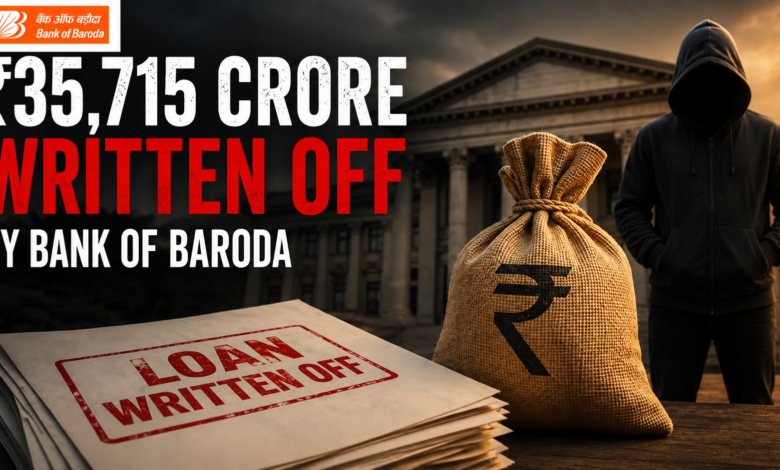
The numbers are staggering. Bank of Baroda alone wrote off ₹35,715 crore in accounts of ₹100 crore and above between FY20-21 and FY25-26. Recovery from these accounts stood at only ₹9,946 crore, which is less than 28 percent. Another ₹7,817 crore was written off as haircuts in NCLT and similar settlements. When activist Vivek Velankar sought the names of these borrowers under the Right to Information Act, the bank refused, citing Section 8(1)(j) of the RTI Act, which is personal information and unwarranted invasion of privacy.
This is not an isolated episode. It is the standard operating procedure across India’s public sector banks.
Historical Anecdores Of The Pattern of Secrecy That Never Breaks
State Bank of India has written off sums running into more than a lakh crore from large defaulters over successive multi-year periods. In one stretch it accepted haircuts of 65 to 67 percent on NCLT settlements amounting to tens of thousands of crores. When pressed, even by its own shareholder, SBI refused to name the borrowers, invoking Section 44 of the SBI Act 1955 and the duty of confidentiality. Earlier, in a rare moment of partial transparency, it had shared a few names. That window closed. The bank retreated into silence.
Canara Bank wrote off approximately ₹1.29 lakh crore linked to big defaulters over an eleven-year span. Names? Refused under the same privacy clause. Punjab National Bank recorded write-offs of ₹31,966 crore in large accounts over a four-year window with recovery of only about 22 percent. Again, names withheld on grounds of commercial confidence and fiduciary relationship.
Central Bank of India wrote off figures in the range of ₹17,000 to ₹21,085 crore from big accounts and recovered as little as 7 to 10 percent. The response to requests for names was the familiar third-party exemption.
Indian Overseas Bank briefly broke ranks around 2020 and disclosed some names — Bhushan Steel & Power, ABG Shipyard, IL&FS Financial Services, Lanco group entities, IVRCL and others — along with the abysmal recovery figures. Then it reversed course. Subsequent RTI replies cited fiduciary relationship and Section 8(1)(e). The moment of accidental transparency was shut down.
Bank of Maharashtra, Union Bank of India, Bank of India, UCO Bank, Indian Bank and the rest follow the same script. Aggregate numbers are sometimes released under parliamentary pressure or persistent RTI applications. The names of the borrowers who actually received and failed to repay the money remain locked away. Government replies in Parliament confirm the scale of overall write-offs running into several lakh crore, yet when Members of Parliament ask for the identities of the large accounts, the answer is confidentiality, RBI Act provisions, or the claim that category-wise name-level data is not maintained in the requested form.
Private sector banks face fewer such public RTI demands because they are not covered by the Act in the same way. The opacity is therefore most glaring precisely where public money and public ownership are involved.
Technical Write-Off: The Accounting Trick That Hides Reality
Banks are careful to insist that a technical or prudential write-off is merely an accounting entry. The borrower remains legally liable. Recovery efforts, they claim, continue. This is technically correct and practically misleading. Once an account is written off, it disappears from the main balance sheet. The pressure to pursue recovery diminishes. The political and media spotlight moves elsewhere. The officials who sanctioned the original loan and the committees that monitored it face no further scrutiny. The public is left with a clean-looking NPA ratio and no idea whose loans were quietly erased.
Recovery rates of 10 to 30 percent from these large written-off accounts are routinely reported. That means for every ₹100 written off, ₹70 to ₹90 is effectively lost to the system — until or unless further recovery materialises years later. When those losses eventually require the government to inject fresh capital into the banks, the bill is paid by the same citizens who are denied the right to know who defaulted.

The Double Standard That Exposes the Rot
Walk into any bank branch or open a newspaper and you will find recovery notices naming ordinary borrowers who defaulted on home loans or small business loans of a few lakhs. Their addresses are published. Their properties are put up for auction. The message is clear: default and you will be publicly shamed.
Contrast this with the treatment of borrowers who took ₹100 crore, ₹500 crore or ₹1,000 crore. Their names are protected as “personal information.” Their privacy is treated as inviolable. The fiduciary relationship between bank and customer is suddenly sacred. This is not equal application of the law. It is class-based secrecy. Small defaulters are made examples. Large defaulters are made invisible.
Activist Vivek Velankar of Sajag Nagrik Manch has spent years exposing this pattern. Through carefully drafted RTI applications and, when necessary, by using his rights as a shareholder, he has forced banks to release the aggregate figures. He has repeatedly asked the obvious question: if a bank has already written off the loan and effectively given up hope of full recovery, why does the identity of the borrower still deserve the highest level of protection? The banks have no coherent answer beyond the ritual invocation of privacy and confidentiality.
The Hidden Story: Who Approved These Loans?
Naming the borrowers is only the first step. The deeper question is who inside the banks allowed these loans to be sanctioned and then failed to prevent or contain the defaults. Large credit decisions are not taken by a single junior officer. They pass through credit committees, risk departments, external valuers, legal teams and, in many cases, board-level oversight. When a loan of several hundred crore turns into a write-off with minimal recovery, the failure is institutional.
Yet the officials and directors who approved these loans face almost no public accountability. There is no routine disclosure of the names of the sanctioning authorities. There is no automatic inquiry into whether due diligence was compromised, whether collateral was over-valued, whether political or corporate influence played a role, or whether monitoring was deliberately lax. The same culture of secrecy that protects the borrower’s name also protects the banker’s decision.
This is where the real systemic risk lies. If the people who take the decisions know that even catastrophic losses will remain anonymous and consequence-free, the incentive structure is broken. Reckless lending becomes rational. The eventual cost is socialised through recapitalisation while the original decision-makers move on to the next posting or the next board.

Public Money, Private Opacity
Public sector banks are not ordinary commercial entities. They are backed by the sovereign. Their deposits are guaranteed, in practice if not always in strict legal form, by the full faith of the government. When they lose money on a massive scale, the government steps in with taxpayer funds. That reality creates a direct public interest in transparency that does not exist in the same degree for purely private institutions.
The consistent refusal to name large written-off borrowers is therefore not a technical compliance issue. It is a political and moral choice. It prioritises the reputation and comfort of powerful borrowers and the officials who dealt with them over the right of citizens to understand how their money was used and lost. It converts what should be a public reckoning into a private accounting adjustment.
The RTI Act was designed to pierce exactly this kind of institutional darkness. Sections 8(1)(j), 8(1)(d) and 8(1)(e) were never intended to create a permanent shield for those who take public money and fail to return it. Banking secrecy laws were meant to protect genuine commercial confidentiality, not to hide the identities of those whose defaults impose costs on the entire system. When these provisions are routinely stretched to cover multi-thousand-crore write-offs, the law is being used against its purpose.
The Cost of Continued Silence
The pattern documented across Bank of Baroda, State Bank of India, Canara Bank, Punjab National Bank, Central Bank of India, Indian Overseas Bank and the rest of the public sector banking system is not accidental. It is the product of a deliberate preference for opacity. Aggregate numbers are released because they can be managed. Names are withheld because they cannot. The officials who approved the loans remain protected because accountability would disrupt careers and relationships.
As long as this system continues, every new round of write-offs will follow the same script. The public will be told that the amounts are large, the recovery is partial, and the identities are confidential. The next recapitalisation will be presented as a necessary support to the banking system. The cycle will repeat.

Public money demands public accountability. When banks that belong, in the final analysis, to the people of India choose secrecy over transparency, they are not protecting the banking system. They are protecting the people and the processes that failed it. The refusal to name the big defaulters and the equal refusal to examine the officials who enabled them is not caution. It is complicity dressed up as confidentiality. Until that changes, the write-offs will continue, the recoveries will remain meagre, and the public will keep paying the price for decisions it is not allowed to scrutinise.