How Did Senior IAS Officers Enable the Siphoning of Hundreds of Crores From Haryana Public Accounts Through Private Banks?
In the shadow of Haryana administrative corridors a pattern of fund movement from eight government departments into selected branches of IDFC First Bank and AU Small Finance Bank has exposed how public money left official records and entered private channels while senior officers received hospitality gold and entertainment. The CBI chargesheet of September 2 2026 named six IAS officers among nineteen accused bringing the total chargesheeted to thirty seven. The bank repaid five hundred eighty three crore in principal and interest yet questions of who authorised the placements who signed the debits and who pocketed the residual benefits continue to demand answers that departmental reconciliations and court proceedings have yet to settle fully. This report examines every documented transaction every named officer and every reported benefit against the backdrop of institutional failure that allowed the discrepancy to grow from a single fifty crore shortfall into a multi hundred crore investigation spanning Haryana and Chandigarh bodies.

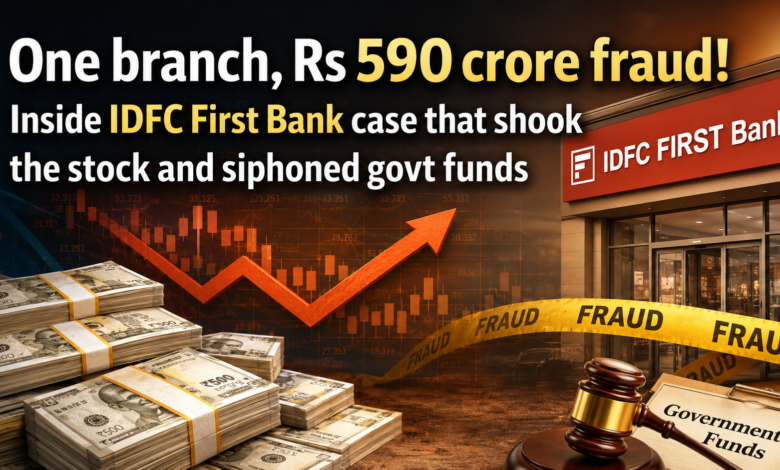
The case first surfaced when the Haryana Development and Panchayats Department noticed that a claimed fifty crore deposit with IDFC First Bank returned only one point two seven crore.
That single mismatch triggered an internal inquiry which uncovered forged signatures transfers to AU Small Finance Bank and further movement into accounts linked to the wife of a relationship manager. The Haryana State Vigilance and Anti Corruption Bureau registered its case on February 23 2026. By April the CBI had taken over after the state government referred the matter under the Delhi Special Police Establishment Act.
Early reporting spoke of five hundred ninety crore. Later chargesheets settled on five hundred four crore for the core Haryana departments while wider figures of six hundred forty five crore and six hundred fifty seven crore appeared once Chandigarh Smart City Limited and CREST accounts were included. The bank itself stated on February 24 2026 that it had paid one hundred percent of the principal and interest claimed by the relevant departments amounting to five hundred eighty three crore while noting that final reconciliation could alter the total.
The statement is available at the Business Standard report of that date and the bank filing summarised in the Economic Times. Yet repayment of principal and interest does not erase the fact that government funds left their intended accounts through instruments the departments could not later verify.
Eight Haryana bodies appear in the September chargesheet. The Development and Panchayats Department the Municipal Corporation Panchkula the Municipal Council Kalka the Haryana School Shiksha Pariyojna Parishad the Haryana Labour Welfare Board the Haryana State Agricultural Marketing Board the Haryana State Pollution Control Board and the Haryana Power Generation Corporation Limited.
Each body manages distinct public functions. Rural development funds education programme money labour welfare allocations agricultural marketing receipts pollution control collections and power generation surpluses all moved into the same narrow set of bank branches.
The Indian Express report of September 3 2026 lists these eight entities and notes that the CBI regards the transfers as part of a single conspiracy executed by public servants in connivance with bank officials. The sheer administrative diversity of the victims raises an immediate interrogative. How did a common banking corridor capture funds from so many independent organisations without simultaneous alarms in multiple finance wings.
The mechanism described in successive chargesheets begins with the placement of surplus funds. Departments routinely park money with empanelled banks. In this instance investigators found accounts opened without the required approvals and deposits placed beyond prescribed limits. For the Haryana State Pollution Control Board the CBI states that funds were sent far in excess of the fifty crore ceiling applicable to a newly empanelled bank. The member secretary Pardeep Kumar prepared comparative rate charts and investment notes.
The chairman Vineet Garg approved six placements between March 2025 and January 2026 that together exceeded two hundred nine crore. The Hindustan Times and The Print reports of July and October 2026 detail the sequence. On one cycle Garg overruled a recommendation that split funds between IndusInd Bank and IDFC First Bank and directed the entire fifty crore to IDFC. The account itself was opened without departmental records of approval. Fixed deposit receipts that departments believed they held did not exist in the bank books.
Instead fraudulent debit notes and forged cheques emptied the balances. The net loss attributed to the Pollution Control Board alone stands at approximately one hundred sixty nine crore the largest single departmental figure in the investigation. That sum is recorded in the CBI statement quoted by India Today on July 1 2026 and by The Hindu on the same day.
Pardeep Kumar was arrested on the day of his retirement. The agency states that he handled the entire investment related work at his level and that his actions had a direct nexus with the fraud. The question that follows is institutional rather than personal. Why did a member secretary prepare rate charts that repeatedly favoured one bank whose quoted rates were not always the highest and why did the approval chain never flag the cumulative exposure.
The same interrogative applies to every department. In the School Shiksha Pariyojna Parishad roughly one hundred eighty two point nine crore moved through one hundred one debit entries according to the Times of India coverage of the second chargesheet. In the Power Generation Corporation fixed deposits of approximately one hundred eight point five crore were liquidated prematurely and fifty crore redirected to an unpanelled branch.
Each of these movements required some combination of signature authority mobile number verification and internal bank clearance. The fact that they occurred across eight organisations suggests either coordinated action or systemic blindness in the control architecture.
The six IAS officers named on September 2 2026 held different posts and are linked to different segments of the trail. Pankaj Agarwal 2000 batch served as chairman of the Haryana State Agricultural Marketing Board and earlier in education administration. The chargesheet attributes to him the facilitation of account openings that exceeded finance department ceilings. In return the investigation records four dance parties organised at Jade Manor Zirakpur on his demand. Seven or eight women dancers were brought from Delhi.
On each occasion currency notes of fifteen to twenty lakh in small denominations were showered on the performers. The Indian Express report of September 30 2026 and The Tribune of September 25 2026 place the total cash showered across the four events between sixty and eighty lakh. Additional expenditure on liquor catering and accommodation was borne in cash by Ribhav Rishi the former IDFC branch manager identified as the principal architect.
Witness statements recovered WhatsApp chats and call detail records form the evidentiary base. The critique is unavoidable. Public funds intended for agricultural marketing and school programmes financed private entertainment whose only documented link to official duty is the concurrent banking decisions that moved those same funds into the private bank.
Vineet Garg 1991 batch chaired the Pollution Control Board. The chargesheet records the delivery of two fifty gram gold coins to his Sector 7A residence roughly four or five days before Diwali 2025. A courier collected the coins from Sawan Jewellers Sector 35 and handed them over in the presence of Rishi and a middleman. Mobile tower data place the four phones at the same location at the relevant time.
The Indian Express of September 30 2026 and The Print of October 3 2026 reproduce the sequence. Garg also approved the six deposits that pushed the bank exposure past the fifty crore limit. The gold coins therefore sit at the intersection of personal benefit and official decision. The weight is one hundred grams. The monetary value depends on the purity and the prevailing rate yet the fact of delivery itself is treated by the agency as undue advantage under the Prevention of Corruption Act.
Mohammad Shayin 2002 batch served as managing director of the Power Generation Corporation. Three restaurant and hotel bills total one lakh sixty seven thousand one hundred one rupees. On January 10 2025 a party for Shayin and his wife at Corbys Hyatt Centric cost fifty eight thousand three hundred ninety nine rupees paid in cash. On November 3 2025 a Koyo restaurant bill of thirty five thousand six hundred twenty nine rupees was settled the same way.
On May 8 2025 a further bill of seventy three thousand seventy three rupees was paid. Hotel staff confirmed to investigators that Rishi took care of the amounts. The Indian Express of September 30 2026 lists the three dates and the amounts. The absolute figures are modest beside five hundred four crore yet the CBI treats them as part of the same pattern of gratification linked to the opening of accounts and the placement of fifty crore deposits. The interrogative is whether any threshold of hospitality becomes criminal once it is paid by a banker whose institution simultaneously receives government funds outside the prescribed process.
Ram Kumar Singh 2012 batch held charge of the Municipal Corporation Panchkula and the Municipal Council Kalka. The chargesheet attributes to him the acceptance of a two point five crore bribe in connection with the diversion of one hundred eighteen point four six crore. A fifty lakh payment on January 11 2026 and a subsequent two crore transfer through hawala channels to his son are recorded. The Tribune of September 2026 and the Indian Express of October 14 2026 describe the hawala leg.
Chandigarh businessman Mohit Goyal was arrested for arranging the cash that reached the son in Delhi the same evening. Between October 2023 and January 2026 firms linked to Rishi transferred fifty nine point five zero crore to Goyal and his entities of which forty five point four five crore returned in cash. The money trail therefore runs from municipal accounts through shell firms into cash and finally into family hands.
The critique must ask how a commissioner of a municipal corporation could authorise or overlook transactions of that scale while the civic body continued to function under the assumption that its balances remained intact.
Saket Kumar 2005 batch served as additional principal secretary to the chief minister and held responsibilities for the Development and Panchayats Department. The chargesheet states that he knew of the fraud in the last week of December 2025 yet moved to close the affected accounts so that the discrepancy could be squared without public disclosure.
The Print report of September 29 2026 quotes the chargesheet language that he sought to bury the matter from within. Twenty five crore from a power utility pension fund was routed into the panchayat accounts under his watch. The interrogative here concerns the moment of discovery. Once an officer of that rank becomes aware of irregular balances what duty of immediate reporting exists and why was the first institutional response an attempt at quiet closure rather than full disclosure to the finance department and the vigilance bureau.
Ribhav Rishi occupies the central banking position. As relationship manager and later branch official at the Sector 32 IDFC First Bank branch he possessed the operational capacity to open accounts alter signatories process debits and coordinate with external parties. The chargesheet describes shell companies named after Hindu deities through which funds were layered before conversion into cash or gold. Jewellers received ninety three point nine nine crore of which only five point eight one crore returned.
Hawala operators in Chandigarh and Delhi moved residual sums. The bank itself acknowledged in its February 24 2026 statement that certain branch employees acted fraudulently in clearing forged instruments potentially in collusion with external parties. The statement is archived in the Business Standard and The Hindu reports of that date. The bank paid the claimed principal and interest yet the criminal investigation continues precisely because repayment does not answer the question of who designed the sequence of forgeries and who received the diverted residue.
The September 2 2026 chargesheet brought the total number of accused to thirty seven. Nineteen were named that day including the six IAS officers three IDFC First Bank officials one AU Small Finance Bank official and nine other government servants. Offences invoked include criminal conspiracy cheating forgery use of false documents criminal breach of trust falsification of accounts and provisions of the Prevention of Corruption Act concerning bribery and criminal misconduct. The Tribune and Hindustan Times of September 3 2026 summarise the charge list.
In October the CBI sought prosecution sanctions against five serving and one former IAS officer. The Indian Express of October 8 2026 names Vineet Garg Pankaj Agarwal Mohammad Shayin Saket Kumar R K Singh and Pardeep Kumar. Sanction is a procedural gate. Until it is granted or refused the trial stage for those officers remains incomplete. The status of each sanction request therefore constitutes an open question that any complete account must track.
The institutional questions outrun the individual ones. Government departments maintain investment manuals that prescribe competitive quotations approved bank lists exposure ceilings dual authorisation and periodic reconciliation. The CBI investigation shows that several of these safeguards were either bypassed or never triggered. Deposit certificates that departments recorded did not match bank books. Authorised signatory lists were altered.
Debit instructions travelled without corresponding government purpose. Internal audit and concurrent bank confirmation failed to surface the shortfalls until a department attempted to close an account and transfer the balance. The initial fifty crore discrepancy became visible only because a routine administrative act collided with an empty account. How many other accounts across other departments remain unreconciled is a question the final government audit must still answer.
The bank repayment of five hundred eighty three crore restored the claimed principal and interest to the departments that raised claims by February 2026. The bank filing and the chief minister statement in the Assembly that nearly five hundred fifty six crore returned within twenty four hours are recorded in the Economic Times and India Today reports of February 24 and 25 2026. Recovery however is not the same as restitution of process.
The criminal investigation continues because the manner of the original diversion the identity of every intermediary and the exchange of personal benefits remain matters for the special court. Gold valued at approximately twenty crore was seized during fifty four searches. Twenty six accused had been arrested by the time of the September chargesheet. Those figures appear in the Illustrated Daily News summary of September 30 2026. The seized gold is not attributed solely to the six IAS officers. Its existence nonetheless demonstrates that diverted funds left the banking system in tangible form.
Related proceedings concerning Chandigarh Smart City Limited and CREST add roughly one hundred fifty three crore to the wider picture producing the six hundred fifty seven crore figure used in some reports. The Indian Express of June 2026 and The Tribune of September 25 2026 distinguish the Haryana core from the Chandigarh extensions.
The same banking corridor and several of the same intermediaries appear yet the legal cases remain separate. An accurate account therefore refuses to add the figures indiscriminately. The five hundred four crore headline belongs to the eight Haryana bodies. The larger numbers describe an expanded investigative canvas.
What remains unresolved is the complete transaction by transaction reconciliation that would explain the movement from five hundred ninety crore in early reporting to five hundred four crore in the September chargesheet and the still higher figures once Chandigarh is included. The final amount recovered after all claims and interest calculations must be confirmed by the departments themselves. The ultimate beneficiaries of every shell company transfer require mapping.
The precise knowledge and intent of each of the six IAS officers must be tested against the documentary and digital record rather than assumed from the mere fact of chargesheeting. Prosecution sanctions must be decided. Court framing of charges and any subsequent trial will determine which elements of the chargesheet survive evidentiary scrutiny. Institutional accountability requires an examination of whether concurrent audit internal control and supervisory review could have detected the pattern earlier and whether those systems have since been redesigned.
The public interest in this case is not limited to the quantum of money. It concerns the integrity of the administrative apparatus that is supposed to protect public funds. When eight departments simultaneously lose control over surplus balances when fixed deposit instruments that exist only on paper become the vehicle for large scale debit when gold coins hotel bills and dance parties appear in the same investigative file as government account statements the question is no longer merely forensic. It is structural.
How many layers of authorisation must fail before such a sequence becomes possible and what confidence can citizens place in the remaining financial controls of the state. The chargesheets and the bank repayment have placed a large volume of material on the public record. The answers to the residual questions will determine whether the episode is treated as an isolated conspiracy or as a warning that the architecture of public financial management itself requires fundamental repair.