From US Fraud Charges To Fresh Global Capital; Every Time Gautam Adani Looks Cornered, The Empire Finds A Way Back
For over three years now, every major controversy surrounding Gautam Adani has arrived with predictions that the empire may finally begin to crack. Yet somehow, the businessman keeps emerging intact. Now, even as reports suggest US fraud charges may soften and global investors line up fresh billions for Adani Airports, the larger question returns once again: why does the Adani story keep surviving storms that appear powerful enough to sink it?


Just months ago, the legal pressure around Gautam Adani appeared to be intensifying dramatically in the United States. Federal prosecutors had accused Adani, his nephew Sagar Adani and other executives of participating in an alleged $265 million bribery scheme linked to solar energy contracts in India, while also misleading international investors about anti-corruption compliance tied to fundraising activities.
The allegations were significant not merely because of the sums involved, but because they threatened to evolve into one of the most consequential international corporate fraud cases involving an Indian billionaire.
Parallel proceedings launched by the US Securities and Exchange Commission (SEC) added further pressure, with regulators alleging that investors had been given false and misleading assurances during a $750 million bond offering by Adani Green Energy that included investments from US investors.
At one stage, the developments appeared capable of reopening many of the same anxieties that surfaced during the Hindenburg crisis – questions around governance, transparency, leverage, regulatory oversight and the sustainability of the Adani empire itself. Critics argued the US case could trigger wider global scrutiny, weaken investor confidence and complicate the group’s future access to international capital markets.
Recent reports, however, indicate that the situation may once again be shifting.
According to reports, the US Justice Department is considering dropping or significantly softening portions of the criminal case against Adani, while parallel SEC proceedings appear to be moving toward settlement. Gautam Adani and Sagar Adani have reportedly agreed to pay a combined $18 million to settle SEC allegations without admitting wrongdoing, with Gautam Adani expected to pay $6 million and Sagar Adani $12 million.
The reported turn in the case has drawn even greater attention because of the legal and political maneuvering surrounding it. Adani reportedly hired a high-powered legal team led by Robert Giuffra Jr., one of US President Donald Trump’s lawyers and co-chairman of Sullivan & Cromwell. During discussions with American authorities, Adani’s legal representatives reportedly argued that prosecutors lacked sufficient jurisdiction and evidence to sustain the case.
Simultaneously, reports also suggested that Adani’s willingness to invest nearly $10 billion into the American economy and potentially create around 15,000 jobs in the United States formed part of the broader discussions surrounding the matter.
The Adani Group has consistently denied all allegations and maintained that the accusations are baseless. Still, the larger significance of the moment lies elsewhere. Once again, a controversy that many believed could fundamentally weaken Gautam Adani’s global standing now appears to be stabilising before it could fully spiral into an existential threat.
Even As Legal Clouds Hover, Global Investors Return To Adani
Almost simultaneously with reports of the US case softening, another development quietly reinforced a pattern that has increasingly come to define the Adani story: global capital keeps returning.
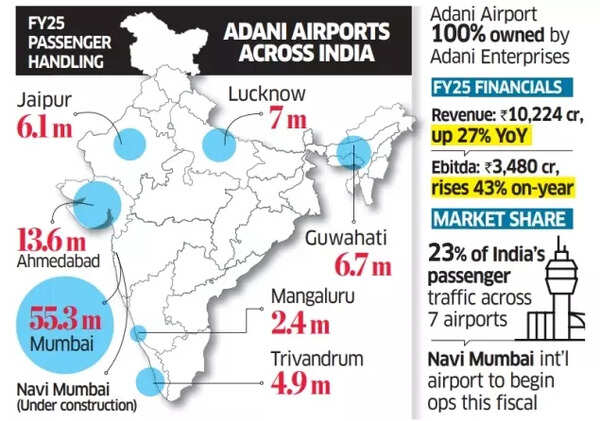
According to recent reports, Singapore’s sovereign wealth giant Temasek and investment firm Alpha Wave Global are exploring an investment of nearly $1.3 billion into Adani Airport Holdings, in a deal that could value the airports business at close to $18 billion.
The timing of the development is difficult to ignore.
At a moment when the Adani Group is still facing questions around governance, political proximity and international scrutiny, some of the world’s largest institutional investors are once again evaluating long-term exposure to the conglomerate’s infrastructure ecosystem. That contradiction sits at the centre of the Gautam Adani story.
If the controversies are truly existential, why does global money repeatedly find its way back to the group?
Part of the answer may lie in the nature of the assets the Adani empire now controls. Airports are not speculative businesses built around hype cycles or short-term market sentiment. They are long-duration strategic infrastructure assets tied directly to economic growth, urbanisation, logistics, trade, tourism and rising consumer mobility. In many ways, they represent the arteries of a rapidly expanding economy.
Over the last decade, the Adani Group has steadily transformed itself from a ports-focused conglomerate into one of India’s most deeply embedded infrastructure empires, spanning airports, transmission networks, renewable energy, logistics, mining, roads and data infrastructure. That scale has made the group increasingly difficult for investors to ignore, even during periods of intense controversy.
This is also not the first time institutional investors have returned after a major crisis.
In the aftermath of the Hindenburg Research report in 2023, many predicted the group would struggle to regain financial credibility. Instead, global investors such as GQG Partners eventually poured billions back into Adani companies, helping stabilise sentiment around the conglomerate. Financing lines gradually reopened, expansion projects resumed and several Adani stocks recovered significant portions of their losses.
Now, with fresh interest emerging around Adani Airports even as the US legal overhang continues to dominate headlines, the same question is resurfacing once again: are investors simply willing to overlook recurring controversies, or do they believe the strategic relevance of the Adani empire ultimately outweighs the risks attached to it?
That distinction matters because it begins to explain why every major storm around Gautam Adani has so far failed to produce the collapse that critics repeatedly predicted.

The Pattern That Makes Gautam Adani Different
Over the last several years, a strange rhythm has emerged around Gautam Adani and the Adani Group. A major controversy erupts, markets panic, political attacks intensify and predictions of collapse begin circulating almost immediately. Then, slowly and often unexpectedly, the group regains its footing once again.
That cycle has repeated itself with remarkable consistency.
Whether it involved accusations of excessive leverage, concerns around opaque offshore entities, allegations of stock manipulation, questions surrounding regulatory oversight, coal pricing controversies, environmental criticism or now the US fraud and bribery case, each episode appeared at one stage capable of fundamentally weakening the Adani empire.
Yet the business ecosystem built around the group continued functioning.
Ports remained operational. Airports expanded. Power and transmission assets kept growing. Renewable energy ambitions stayed intact. International lenders gradually returned, institutional investors selectively re-entered and large infrastructure projects continued moving forward.
That is precisely what makes the Adani story different from an ordinary corporate controversy.
Most business groups facing simultaneous scrutiny across markets, politics, regulation and international legal systems would likely retreat into defensive consolidation mode. The Adani Group, however, has repeatedly behaved as though it is still in expansion mode even while under pressure.
Supporters see this as evidence of execution capability, resilience and strategic positioning. They argue that Adani has built assets deeply connected to India’s long-term infrastructure ambitions and that the market ultimately continues to value those assets regardless of periodic controversies.
Critics interpret the situation very differently. They argue the repeated recoveries reflect the extraordinary political and institutional insulation available to certain large business groups whose economic footprint becomes too important to destabilise. For them, the Adani story increasingly represents the uneasy intersection of corporate concentration, political influence and state-linked capitalism.
Perhaps that is why every controversy surrounding Gautam Adani now triggers reactions far larger than those attached to an ordinary businessman.
The debate is no longer confined to balance sheets, stock prices or legal allegations alone. It has evolved into a broader argument about modern India itself – about how power operates, how capital flows, how institutions respond and how closely business success can become intertwined with political authority.
That larger backdrop is what transformed the Hindenburg episode from a corporate short-seller report into a national political battle. It is also why the latest developments in the United States are being watched so closely, not merely as a legal matter, but as another test of whether the Adani empire can once again emerge intact from a crisis many believed could permanently damage it.
Hindenburg And The Crisis That Nearly Shook India Inc.
The defining rupture in the Adani story arrived in January 2023, when US-based short seller Hindenburg Research accused the Adani Group of stock manipulation, accounting irregularities and the misuse of offshore entities.
The fallout was immediate. Adani Group companies collectively lost tens of billions of dollars in market value as global scrutiny intensified and fears around leverage, governance standards and debt-funded expansion spread through Indian markets. Opposition parties accused Prime Minister Narendra Modi of shielding Gautam Adani, Parliament witnessed repeated disruptions and the Supreme Court eventually asked SEBI to investigate the allegations.
For a brief period, it genuinely appeared as though the Adani empire had entered its most dangerous phase. The group was forced to cancel a major follow-on public offering, international investors grew cautious and analysts questioned whether the conglomerate’s aggressive expansion strategy could continue under sustained pressure.
The collapse many predicted, however, never fully materialised.
The Adani Group denied all allegations and described the report as an attack on India’s growth story. Over time, panic eased, global investors such as GQG Partners poured billions back into Adani companies and financing channels gradually reopened.
The Hindenburg episode was supposed to permanently destabilise Gautam Adani’s rise. Instead, it reinforced another perception altogether – that even after one of the biggest corporate crises India had witnessed in years, the Adani empire still possessed the scale and strategic relevance necessary to survive.

The Political Question That Never Left Adani
Long before the Hindenburg report or the recent US allegations, one question had followed Gautam Adani almost everywhere his empire expanded: how much of the Adani Group’s rise was purely business, and how much of it was tied to political proximity?
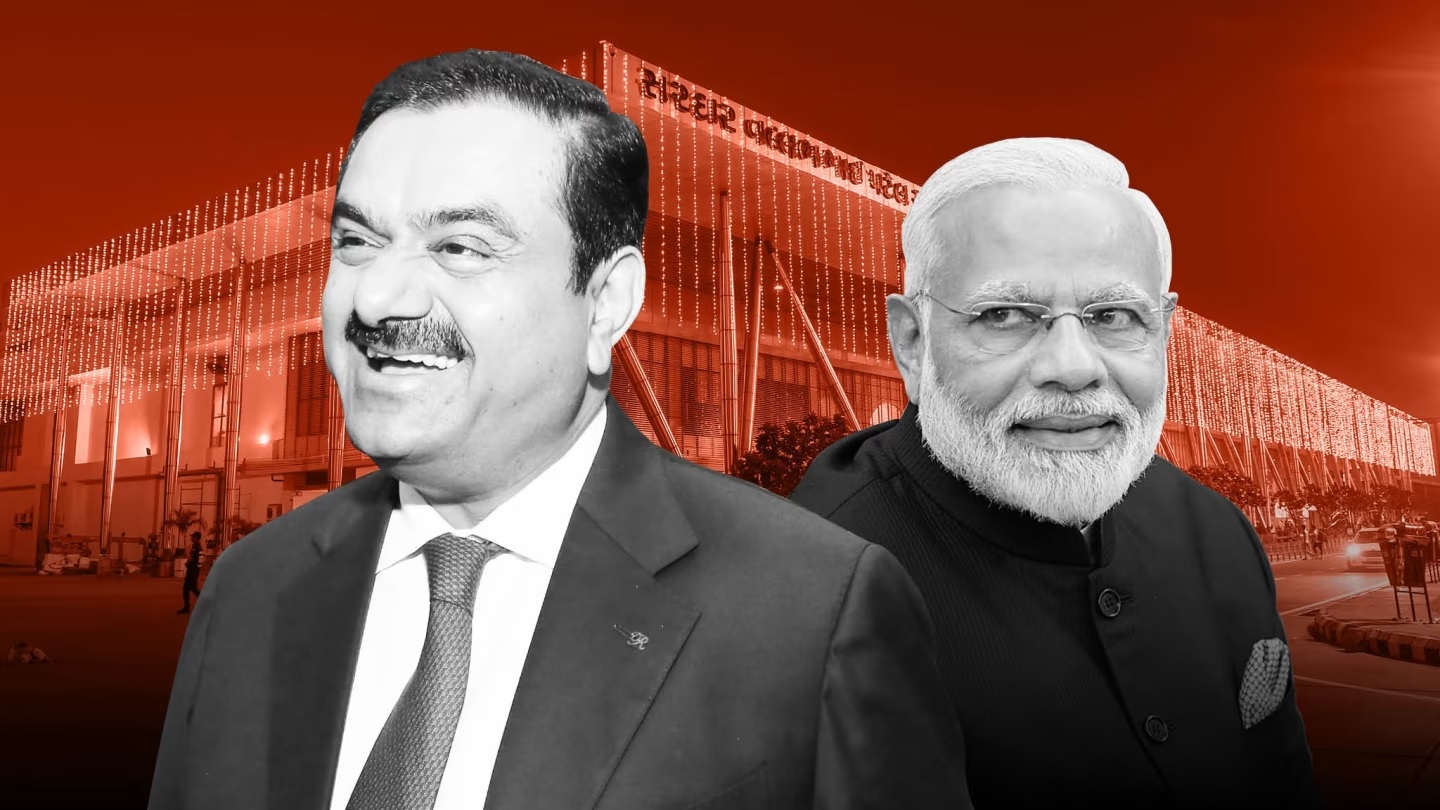
That debate has shadowed the conglomerate for years, particularly because Gautam Adani’s rise to national prominence closely mirrored the political ascent of Narendra Modi from Gujarat Chief Minister to Prime Minister.
Critics have repeatedly pointed to the businessman’s rapid expansion across sectors deeply intertwined with government policy and public assets – ports, airports, mining, transmission, renewable energy, logistics and large-scale infrastructure concessions. Questions surrounding land allocations, airport privatisation, coal contracts and regulatory clearances frequently fuelled accusations that the group benefitted from extraordinary political access.
One of the most symbolic images repeatedly cited by critics dates back to May 2014, when Narendra Modi arrived in Delhi to take oath as Prime Minister after flying aboard an aircraft linked to the Adani Group. Over time, that image came to represent, for many opponents, the perceived closeness between political power and corporate expansion in modern India.
The allegations intensified further after the Hindenburg episode. Opposition parties accused the government of shielding the Adani Group from deeper scrutiny and repeatedly demanded a Joint Parliamentary Committee investigation into the matter. Parliamentary sessions were disrupted for weeks as the Adani controversy evolved into one of the country’s biggest political flashpoints.
Supporters of the Adani Group, however, reject the idea that the conglomerate’s rise can simply be reduced to political favouritism.
They argue that the group entered sectors requiring enormous capital, long gestation periods and operational risk at a time when many others hesitated. Ports, logistics corridors, power infrastructure and renewable energy projects require scale, speed and risk appetite that few Indian conglomerates were willing to undertake aggressively. In that interpretation, Adani’s rise reflects execution capability rather than merely political access.
Another reality complicates the debate further.
Governments across political systems often depend heavily on large infrastructure players capable of executing projects quickly and at scale. As the Adani empire expanded deeper into sectors critical to India’s economic ambitions, the group increasingly became intertwined with the country’s broader infrastructure story itself.
That interdependence is precisely what makes the Adani debate so polarising.
To critics, the group represents the dangers of concentrated corporate power operating too close to political authority. To supporters, it represents aggressive nation-building through infrastructure expansion in sectors where India desperately needs investment and speed.
Either way, the political questions surrounding Gautam Adani never truly disappeared. They simply evolved alongside the empire itself, growing larger every time the group survived another controversy that many believed would permanently weaken it.
Ports, Power, Airports And Why Adani Became Hard To Ignore
Part of the reason every crisis surrounding the Adani Group attracts such enormous attention is simple: the empire today sits across some of the most strategically important sectors of the Indian economy.
What began decades ago as a trading business gradually evolved into a sprawling infrastructure conglomerate with interests spanning ports, logistics, mining, airports, power transmission, renewable energy, gas distribution, data centres, cement and media. Few corporate groups in modern India have expanded across so many interconnected sectors at such speed.
That scale fundamentally changed the nature of the Adani story itself.
When a conglomerate controls ports handling a significant share of India’s cargo movement, operates airports serving millions of passengers, builds transmission lines powering industries and invests heavily into renewable energy ambitions central to India’s future plans, the conversation around it inevitably becomes larger than quarterly profits or stock market volatility.
Supporters of the group often point to this very factor while defending Gautam Adani’s rise. They argue that Adani identified sectors critical to India’s long-term growth well before many rivals and was willing to commit capital aggressively where others remained cautious. Ports, logistics corridors and large-scale infrastructure projects are not glamorous businesses generating instant returns. They demand patient capital, political coordination, land acquisition, regulatory approvals and enormous operational scale.
That ability to execute large projects rapidly became one of the Adani Group’s defining strengths.
Over time, the conglomerate also positioned itself at the centre of India’s renewable energy ambitions. Adani Green Energy emerged as one of the country’s largest renewable players, while the group simultaneously expanded into solar manufacturing, transmission and green hydrogen initiatives. This transformation helped project the image of an empire aligned not merely with India’s present infrastructure requirements, but also with its future energy transition.
The airports business especially symbolised the speed of the group’s expansion. In just a few years, Adani became one of India’s largest private airport operators after acquiring control over multiple major airports, including Mumbai. To supporters, this demonstrated ambition and execution capability. To critics, it intensified concerns about concentration of strategic national assets within one corporate ecosystem.
That is also where the Adani story becomes difficult even for markets to simplify.
Investors may worry about governance controversies, regulatory risks or political backlash, but they also recognise that the group now controls assets deeply embedded within India’s economic machinery. Ports cannot simply disappear overnight. Airports cannot be replaced easily. Transmission networks and logistics corridors remain critical regardless of political cycles or market turbulence.
That strategic embeddedness may ultimately explain why the Adani empire repeatedly survives storms that appear capable of severely damaging it. The deeper the conglomerate expanded into India’s infrastructure backbone, the harder it became for markets, lenders and even governments to entirely disengage from the ecosystem Gautam Adani built.
The Allegations That Refused To Disappear
Even as the Adani Group continued expanding across India’s infrastructure, the controversies surrounding the empire never fully faded away. In many ways, they simply evolved from one form into another.
After the Hindenburg episode, international investigative reports began drawing attention to other areas of concern surrounding the group’s operations and business practices. Among the most widely discussed were allegations linked to coal imports and pricing.
Investigations by the Financial Times and the Organized Crime and Corruption Reporting Project (OCCRP) raised questions over whether certain Adani-linked entities may have imported low-grade coal at inflated prices, potentially increasing costs for power distribution systems and ultimately consumers. Earlier, India’s Directorate of Revenue Intelligence had also reportedly examined allegations involving the over-invoicing of coal and power equipment imports by several Adani companies.
The group has consistently denied wrongdoing and rejected the allegations.
The persistence of such reports, however, kept alive a broader perception problem for Gautam Adani. Even when one controversy appeared to cool down, another emerged from a different direction – governance concerns, offshore structures, environmental issues, land acquisition questions or international investigative scrutiny.
Environmental controversies especially added another sensitive dimension to the debate.
The Adani Group’s expansion into mining and energy projects repeatedly attracted criticism from activists and environmental groups, particularly around forest clearances, land usage and displacement concerns. One of the most debated flashpoints became the Hasdeo Arand forests in Chhattisgarh, where mining activity triggered protests from local communities and environmental campaigners worried about deforestation and ecological damage.
Critics argued that India’s push for industrial and energy expansion was increasingly colliding with ecological concerns and indigenous rights. Supporters countered that large developing economies cannot build critical infrastructure and energy security without difficult trade-offs involving land and natural resources.
The controversies also extended beyond India.
Internationally, the group faced criticism over business dealings in politically sensitive regions, including Myanmar, Israel and Australia with opponents accusing the conglomerate of prioritising commercial expansion over ethical considerations. Such accusations further strengthened the image of the Adani empire as a business group operating at the intersection of geopolitics, infrastructure and state power.
Despite the sheer breadth of allegations over the years, something unusual kept happening: the empire continued expanding.
Projects moved ahead. Capital returned. Expansion plans resumed. New sectors were entered. Strategic assets kept growing.
That recurring survival is precisely what has made Gautam Adani one of the most debated business figures in modern India. The controversies never fully disappear, but neither does the empire built around them.

The Media, The Silence And The Fear Factor
As the controversies surrounding Gautam Adani grew larger, another uncomfortable question slowly began surfacing alongside them: why did much of India’s mainstream media appear far more cautious in scrutinising the Adani empire than international publications or independent investigative platforms?
Critics have repeatedly argued that the media response to the Adani story revealed deeper anxieties about corporate influence, political proximity and the shrinking space for aggressive investigative journalism in India.
Over the years, some of the most detailed reporting around the Adani Group emerged not from large Indian television networks or mainstream business publications, but from international organisations and independent platforms.
Investigations by the Financial Times, OCCRP, the Australian Broadcasting Corporation and Hindenburg Research repeatedly generated global headlines, while sections of India’s larger media ecosystem were accused of either underplaying the controversies or moving on from them unusually quickly.
The criticism intensified after the Hindenburg report.
For weeks, the allegations dominated political discourse, markets and international financial coverage. Yet critics argued that portions of Indian television media framed the issue less as a corporate governance debate and more as an attack on India itself. Supporters of the Adani Group frequently described Hindenburg’s report as an assault on India’s economic rise and investor confidence rather than purely a critique of one conglomerate.
The debate became even more contentious because several journalists and independent media platforms investigating Adani-related issues found themselves locked in prolonged legal battles.
According to Reporters Without Borders (RSF), the Adani Group and its subsidiaries have filed multiple defamation lawsuits against journalists, editors and publications since 2017.
These included cases involving journalists such as Paranjoy Guha Thakurta, Ravi Nair and Abir Dasgupta, along with publications including The Wire, EPW and NewsClick. Critics described many of these actions as SLAPP suits – Strategic Lawsuits Against Public Participation – aimed at exhausting journalists financially and psychologically through prolonged litigation.
The Adani Group has defended its legal actions as legitimate attempts to protect its reputation against false and defamatory reporting.
The larger issue, however, extends beyond individual lawsuits.
The Adani story increasingly became a lens through which broader concerns about institutional independence in India were debated – whether involving regulators, political systems, financial oversight or sections of the media itself. Critics argued that powerful corporate groups with deep economic and political relevance often generate a climate where aggressive scrutiny becomes more difficult, particularly when expensive litigation and reputational pressure enter the picture.
At the same time, the controversies never fully disappeared from public discourse either.
Independent journalists, international media houses, opposition leaders, activists and financial analysts continued probing the group’s rise, business practices and political connections. In that sense, the Adani story also evolved into a test case for how modern democracies negotiate the increasingly blurred boundaries between corporate power, political influence and media independence.
Perhaps that is why the debate around Gautam Adani today extends far beyond balance sheets or infrastructure assets. It now touches something even larger – who gets to question power, how far scrutiny is allowed to travel and whether certain corporate empires eventually become too influential to examine without consequences.
So What Exactly Does Gautam Adani Represent Today?
That question has become increasingly difficult to answer in simple terms.
To supporters, Gautam Adani represents a businessman who understood India’s infrastructure future before most others did. They see a risk-taker who entered sectors requiring enormous capital, long gestation cycles and operational complexity at a scale few Indian conglomerates were willing to attempt. Ports, airports, transmission networks, renewable energy corridors and logistics infrastructure are not businesses built overnight, nor are they sectors where investors enter casually.
From that perspective, the Adani story reflects ambition, execution capability and the emergence of an Indian corporate group with global-scale infrastructure aspirations.
Critics see a very different picture.
For them, the Adani empire increasingly symbolises the concentration of corporate power operating unusually close to political authority. They argue that the group’s extraordinary expansion across strategic sectors, repeated survival through controversies and ability to retain investor confidence despite recurring allegations point toward a system where economic influence and political proximity often become deeply intertwined.
What makes the Adani phenomenon so polarising is that both interpretations contain elements that millions of Indians can recognise simultaneously.
There is little doubt that the group helped reshape India’s infrastructure landscape over the last decade. There is also little doubt that questions around governance, regulatory oversight, transparency and institutional independence continue to shadow the empire.
That duality is precisely what separates Gautam Adani from an ordinary billionaire.
He is no longer viewed merely as a businessman whose success or failure affects shareholders alone. The rise of the Adani Group has increasingly become tied to larger debates around India’s development model itself — how infrastructure is built, who controls strategic assets, how capital flows through political systems and how much influence large conglomerates should ultimately wield in a democracy.
Even the market’s behaviour around the group reflects this contradiction.
Every major controversy surrounding Adani sparks predictions of collapse. Analysts question leverage. Critics demand investigations. International headlines intensify scrutiny. Over time, however, lenders return, investors re-enter and expansion resumes.
That repeated recovery cycle has created an aura around the Adani empire that now borders on something larger than conventional corporate resilience. To some, it signals extraordinary strategic depth. To others, it signals a system reluctant to allow certain business groups to fail.

The Last Bit, Adani Empire That Keeps Escaping Collapse
For years now, every major controversy surrounding Gautam Adani has arrived with predictions that this time the empire may finally crack. The Hindenburg report was supposed to trigger a lasting collapse. Allegations around debt, offshore entities and political proximity were expected to weaken investor confidence permanently. The recent US fraud and bribery case appeared capable of becoming the most damaging global challenge the group had ever faced.
And yet, the story keeps unfolding differently.
Markets panic, scrutiny intensifies and political attacks grow louder, but over time the Adani empire somehow stabilises itself again. Investors return. Financing revives. Expansion resumes. New sectors open up. Strategic assets continue operating at the centre of India’s economic machinery.
That recurring cycle is precisely what has made the Adani story larger than a normal corporate moves. While it reflects the resilience of a businessman who built one of India’s most consequential infrastructure empires and continues to command investor confidence despite relentless attacks. At the same time, it raises difficult questions about concentrated corporate power, political access and the ability of modern institutions to hold influential business groups fully accountable.
Perhaps the real answer lies somewhere in between.
What is certain, however, is that Gautam Adani today represents far more than one billionaire or one conglomerate. His rise, controversies, recoveries and continued expansion have increasingly become intertwined with larger questions about modern India itself – its ambitions, its institutions, its capitalism and the uneasy relationship between economic power and political influence.
The empire has become so deeply embedded in India’s infrastructure and growth story that each crisis no longer tests only Gautam Adani’s resilience, but also the system surrounding him.
For now at least, even after Hindenburg, international scrutiny, political firestorms and US fraud allegations, the conclusion remains remarkably unchanged: every time Gautam Adani looks cornered, the empire still finds a way back.