Rupee Nears 100 Against The Dollar; Why The Rupee’s Relentless Slide Is Becoming A Major Economic Stress Test For India
The Indian rupee is now inching dangerously close to the psychologically critical 100-mark against the U.S. dollar, but this is no longer merely a currency story. Rising oil prices, foreign capital flight, geopolitical instability, and widening external imbalances are rapidly turning the rupee’s slide into one of the biggest economic stress tests India has faced in years.

The Indian rupee’s decline is no longer being viewed as a routine emerging-market fluctuation. What initially appeared to be temporary pressure from global uncertainty is increasingly beginning to resemble a deeper and far more uncomfortable economic stress point for India.
The rupee recently slipped to fresh record lows near 95.8 against the U.S. dollar, making it Asia’s weakest-performing major currency in 2026. Since the conflict in West Asia intensified earlier this year, the rupee has already lost nearly 6% of its value, and the pace of depreciation appears to be accelerating rather than stabilising.
That matters far more than the numbers alone suggest.
Currencies often act as silent report cards of an economy’s vulnerabilities. A weakening currency typically signals that investors are becoming cautious, imports are becoming more expensive, external balances are deteriorating, or global capital is beginning to move elsewhere. In India’s case, all these pressures now appear to be arriving simultaneously.
The immediate trigger behind the rupee’s sharp fall has been the escalation of geopolitical tensions in West Asia. The conflict has sent crude oil prices soaring and disrupted shipping routes around the Strait of Hormuz, one of the world’s most critical oil transit corridors. For India, which imports close to 90 percent of its crude oil requirements, that immediately translates into a rising import bill and greater demand for dollars.
Yet oil alone is not driving the crisis.
Foreign investors have been steadily pulling money out of Indian markets and shifting capital toward safer or faster-growing opportunities elsewhere. Large amounts of global capital are currently flowing into the United States and AI-driven markets such as Taiwan, Japan, and South Korea, where technology-led growth stories are attracting investors aggressively. India, despite its strong domestic consumption story, has struggled to position itself as a direct beneficiary of the global artificial intelligence boom.
That divergence is beginning to show up sharply in currency markets.
Foreign Portfolio Investors have already withdrawn tens of billions of dollars from Indian financial markets this year, creating immense pressure on India’s Balance of Payments. Simply put, more dollars are now leaving the economy than entering it comfortably.
This is precisely why policymakers have begun sounding unusually cautious.
Chief Economic Advisor V. Anantha Nageswaran recently described preventing further rupee depreciation as one of the “central macroeconomic imperatives” for the current fiscal year. Such language is significant. Governments and central banks rarely frame currency management so directly unless concerns inside policymaking circles are becoming serious.
The Reserve Bank of India has intervened repeatedly through dollar sales and liquidity management measures in an attempt to slow the rupee’s fall. However, interventions have only managed to cushion volatility rather than reverse the trend altogether.
And that is where markets begin getting nervous.
Once a currency repeatedly touches record lows, psychology itself starts playing a role. Importers rush to secure dollars before costs rise further. Traders begin increasing speculative positions against the currency. Foreign investors become even more hesitant. The fear of depreciation itself begins accelerating depreciation.
The larger problem is that the rupee’s weakness is now exposing structural vulnerabilities that India has long attempted to manage but never fully eliminate. The economy remains heavily dependent on imported energy, foreign capital inflows, and relatively stable global conditions. When those external pillars weaken simultaneously, the pressure on the rupee becomes extraordinarily difficult to contain.
The worrying part for policymakers is that this no longer appears to be a short-term currency shock. It is increasingly beginning to resemble a deeper test of how resilient India’s economic foundations truly are in a far more volatile global order.
)
Oil: The Energy Trap India Has Never Fully Escaped
Every major rupee crisis in modern India eventually circles back to one uncomfortable reality: the country’s overwhelming dependence on imported energy.
For years, India’s economic rise has been powered by access to relatively affordable global crude oil. Rapid urbanisation, expanding infrastructure, rising automobile ownership, aviation growth, manufacturing expansion, and increasing electricity consumption have all steadily pushed India’s energy requirements higher. The problem, however, is that India still imports nearly 85–90 percent of its crude oil needs, making the economy extraordinarily sensitive to global oil shocks.
That vulnerability is once again returning to the centre of the crisis. The first impact is visible on the import bill itself.
India buys crude oil in dollars. When oil prices rise globally, India requires more dollars to purchase the same quantity of energy imports. At the same time, when the rupee weakens against the dollar, the cost rises even further. This creates a dangerous double blow: expensive oil and an expensive dollar arriving together.
The consequences ripple rapidly through the broader economy.
Higher crude prices widen India’s current account deficit, weaken the Balance of Payments position, increase inflationary pressures, strain government finances, and put further downward pressure on the rupee itself. This is precisely why oil prices and the rupee often move in a vicious cycle during periods of external stress.
Economists estimate that every 10-dollar increase in crude oil prices can significantly widen India’s current account deficit while also adding pressure on retail inflation. Fuel becomes costlier, transportation expenses rise, freight charges increase, and industries dependent on petroleum-linked inputs begin facing margin pressure. Eventually, these costs filter down to consumers through higher prices across sectors ranging from aviation and logistics to FMCG products and food distribution.
The pressure becomes even more dangerous when governments attempt to shield consumers artificially from the full impact of rising crude prices.
India’s public sector oil marketing companies have reportedly been absorbing large losses by keeping petrol and diesel prices lower than market-linked levels despite the global crude surge. While such measures may temporarily ease inflation and public anger, they create pressure elsewhere through rising fiscal strain and weakened corporate balance sheets.
The Modi government now finds itself confronting an uncomfortable policy dilemma. Allow fuel prices to rise sharply and inflation could surge while consumer sentiment weakens. Continue suppressing prices and fiscal pressures could worsen substantially. Neither option comes without economic pain.
What makes the current situation particularly worrying is that India has faced this vulnerability repeatedly over decades despite years of discussion around energy diversification and strategic resilience.
While the govt has spoken about reducing oil dependence through renewable energy expansion, ethanol blending, electric mobility, domestic production incentives, and strategic petroleum reserves. While progress has undoubtedly been made in certain areas, the broader structural reality remains largely unchanged: India’s economic engine still runs heavily on imported crude.
And that creates a permanent vulnerability whenever geopolitical tensions erupt globally.
India today aspires to become a global manufacturing hub, a major economic power, and eventually a developed nation. Yet one geopolitical flare-up thousands of kilometres away can still destabilise its currency, pressure its inflation outlook, strain its external balances, and unsettle financial markets within weeks.
That is why the current rupee crisis is not merely exposing a currency problem. It is exposing how deeply India’s growth story remains tied to forces beyond its direct control.
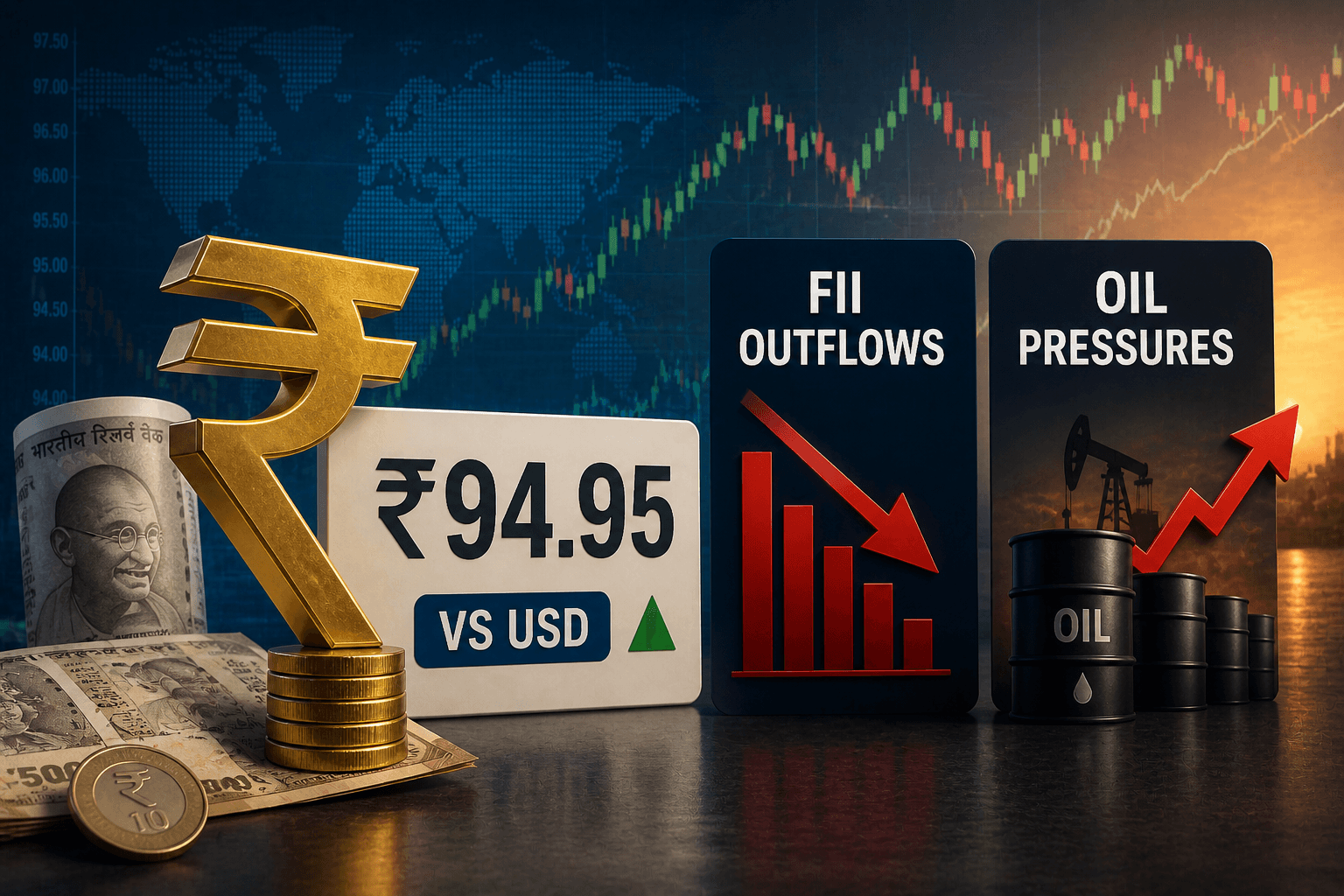
Why Global Capital Is Suddenly Turning Cautious On India
The pressure on the rupee is not being driven by oil prices alone. Another equally significant problem has quietly been building in the background – the steady withdrawal of foreign capital from Indian financial markets.
For an economy like India, foreign investment plays a critical role in maintaining external stability. Dollars flowing into equities, bonds, startups, infrastructure, and businesses help finance the country’s trade deficit and support the rupee. When those flows begin slowing or reversing, pressure on the currency intensifies rapidly.
That is precisely what India is witnessing today.
Foreign Portfolio Investors have already pulled billions of dollars out of Indian markets this year as global uncertainty rises and investors shift capital toward markets perceived to be safer or more attractive. The exodus has accelerated amid rising geopolitical tensions, elevated oil prices, and growing fears of prolonged global instability.
However, the outflows are not merely about risk aversion. A major global capital rotation is currently underway, and India increasingly appears to be on the weaker side of it.
Over the last two years, enormous investor enthusiasm has poured into markets closely linked to the global artificial intelligence boom. Capital has aggressively moved toward the United States and technology-heavy Asian economies such as Taiwan, South Korea, and Japan, where semiconductor companies, AI infrastructure firms, and advanced manufacturing ecosystems are driving strong earnings growth and market momentum.
- India, despite its scale and long-term growth story, has not emerged as a direct AI beneficiary in the eyes of global investors. This is becoming an increasingly uncomfortable reality for Indian markets.
- The country continues to command relatively high market valuations compared to several other emerging economies, yet earnings growth has slowed and corporate profitability in many sectors remains under pressure. From the perspective of foreign investors, India today offers expensive valuations without the same level of AI-driven upside visible elsewhere.
That combination is proving difficult to ignore.
- There are also growing concerns surrounding the future of India’s services-driven export model itself. Analysts globally have begun questioning whether advancements in artificial intelligence could eventually disrupt portions of India’s IT and outsourcing industry, long considered one of the country’s strongest dollar-generating sectors.
Even the perception of such risks can alter capital flows significantly.
- At the same time, Foreign Direct Investment inflows into India have remained weaker than expected despite government efforts to position the country as an alternative manufacturing destination amid global supply-chain diversification. While companies are diversifying beyond China, large-scale manufacturing migration into India has happened far more slowly than policymakers had hoped.
The outcome is a widening imbalance.
India requires substantial foreign capital inflows to comfortably finance its current account deficit and maintain currency stability. When portfolio money exits while fresh investment inflows remain muted, the burden on the rupee intensifies considerably.
The situation gradually becomes cyclical.
As the rupee weakens, foreign investors become more cautious since currency depreciation erodes their returns further when converted back into dollars. That leads to additional selling pressure, which weakens the rupee even more. Gradually, the cycle begins feeding on itself.
The situation also exposes a broader truth about global finance.
Emerging markets often benefit enormously during periods of abundant global liquidity and investor optimism. However, when uncertainty rises, capital tends to retreat quickly toward safer and more dominant financial systems, particularly the United States. India, despite its strong domestic consumption base and growth ambitions, is not insulated from that reality.
In fact, the current outflows are revealing how dependent India still remains on external investor confidence to maintain macroeconomic stability.
That dependency becomes particularly dangerous when several global shocks arrive together – geopolitical conflict, rising oil prices, slowing trade, expensive valuations, and shifting technological leadership. Under such conditions, currencies like the rupee often become the first visible pressure point in a much larger economic adjustment.
Is India Sitting On Delayed Inflation Pain?
At first glance, India’s inflation numbers may not appear alarming enough to justify the growing anxiety surrounding the rupee and the broader economy. Retail inflation has remained relatively contained in recent months, giving policymakers some breathing space and allowing the Reserve Bank of India to avoid aggressive monetary tightening so far.
Yet beneath those headline numbers, economists increasingly believe inflationary pressures are quietly building across the system. And the worrying part is that much of the actual pain may simply be delayed rather than avoided.
A weakening rupee almost always creates imported inflation for an economy like India. Since the country depends heavily on imported crude oil, natural gas, chemicals, fertilisers, edible oils, electronics, and industrial components, any sharp depreciation in the currency immediately raises the cost of bringing these goods into the country.
Initially, businesses often absorb a portion of those costs to protect demand and avoid hurting consumers abruptly. However, such absorption can only continue for a limited period before companies eventually begin passing the burden onward.
That process now appears to be underway.
Rising global crude prices are already increasing transportation and logistics costs across sectors. Aviation turbine fuel prices have surged. Commercial LPG prices are climbing. Freight-linked expenses are rising steadily. Industries dependent on imported raw materials are facing growing margin pressure, while FMCG companies are beginning to grapple with higher packaging and distribution costs.
These pressures may not have fully reflected in headline inflation yet, but economists warn that the pass-through effect is gradually intensifying.
The danger with imported inflation is that it spreads silently across the economy.
A costlier rupee does not only affect fuel stations. It eventually impacts food transportation, airline tickets, manufacturing costs, fertilizers, medicines, consumer appliances, construction inputs, and even small everyday household products. Once businesses across sectors start adjusting prices simultaneously, inflation becomes much harder to contain.
This is precisely where the current situation becomes uncomfortable for policymakers.
The Reserve Bank of India faces a difficult balancing act. Raise interest rates aggressively to contain inflation and support the rupee, and economic growth could slow sharply at a time when global uncertainty is already hurting demand. Delay tightening too long, however, and inflationary expectations may begin becoming entrenched within the economy.
Markets are already beginning to price in the possibility that the RBI may eventually be forced into a more hawkish stance if the rupee continues weakening and crude prices remain elevated.
The government, too, faces mounting pressure.
So far, authorities have attempted to shield consumers from the full impact of rising global energy prices by keeping petrol and diesel prices relatively controlled. However, such measures merely shift the burden elsewhere. Public sector oil marketing companies have reportedly absorbed massive losses by selling fuel below market-linked prices, creating growing fiscal and corporate stress.
Eventually, somebody pays the price.
Adding to the risks are domestic uncertainties that could worsen inflationary pressures further in the coming months. Concerns around harsh summer conditions, erratic rainfall patterns, and the possibility of El Niño-linked monsoon disruptions have revived fears about food inflation, one of the most politically sensitive aspects of the Indian economy.
The recent hike in import duties on gold and silver may also contribute marginally to inflation while attempting to reduce non-essential imports and conserve foreign exchange reserves.
The broader concern is that India may currently be experiencing what some economists describe as “deceptive comfort” on inflation.
Headline numbers may still appear manageable for now, but the underlying cost pressures building beneath the surface are becoming increasingly difficult to ignore. If oil prices remain elevated, the rupee continues weakening, and supply-side disruptions persist globally, inflation could re-emerge far more aggressively than policymakers currently hope.
And if that happens, the economic stress surrounding the rupee may quickly begin spilling into the daily lives of ordinary Indians through rising prices, weaker purchasing power, and slowing consumption.

Modi Government’s Toughest Balancing Act Yet?
The falling rupee is no longer merely testing financial markets and central banks. It is now beginning to evolve into a major political and economic challenge for the Modi government itself.
That is because every option available to policymakers comes with significant economic costs and political consequences.
Over the last few years, the Indian government has carefully attempted to maintain a delicate balance between sustaining economic growth, controlling inflation, preserving fiscal discipline, and protecting consumers from global shocks. The current crisis, however, is putting all those objectives under simultaneous pressure.
The most immediate challenge is fuel prices.
Despite the sharp rise in global crude oil prices over recent months, petrol and diesel prices in India have not risen proportionately. This has helped prevent a sudden inflation shock for consumers and has protected household spending to some extent. However, keeping retail fuel prices artificially stable during periods of elevated crude prices comes at a steep cost.
Public sector oil marketing companies are reportedly absorbing enormous losses by selling fuel below market-linked levels. The longer global oil prices remain elevated, the larger the financial strain on these companies becomes. Eventually, either fuel prices must rise, fiscal support must increase, or corporate balance sheets begin deteriorating sharply.
None of those choices are politically easy.
Fuel inflation carries enormous political sensitivity in India because it directly impacts transportation costs, food prices, logistics, and household budgets. Any sharp increase in petrol and diesel prices quickly filters across the broader economy and often shapes public sentiment far beyond macroeconomic discussions.
This is precisely why governments globally, including India’s, often attempt to delay the full pass-through of oil shocks for as long as possible.
Yet delaying the pain does not eliminate it.
The Modi government has already started signaling growing concern over the country’s external financial pressures. Prime Minister Narendra Modi recently urged citizens to adopt more restrained consumption behaviour, including reducing non-essential imports, limiting unnecessary foreign travel, reviving work-from-home wherever possible, and prioritising local goods. Such appeals strongly resemble the kind of conservation-focused messaging governments typically deploy during periods of external sector stress.
Markets noticed immediately.
Several economists and analysts interpreted the messaging as an indication that policymakers are becoming increasingly uncomfortable with the pressure building on India’s foreign exchange reserves, fiscal position, and currency stability.
The recent decision to sharply raise import duties on gold and silver also reflects this growing anxiety. Gold imports place significant pressure on India’s external balances because the country imports large quantities of precious metals despite producing very little domestically. By making gold imports more expensive, the government hopes to reduce dollar outflows and ease pressure on the current account deficit.
However, these measures alone are unlikely to resolve the deeper structural issues driving the rupee’s weakness.
The larger dilemma facing policymakers is that India’s growth ambitions themselves require substantial imports, infrastructure spending, energy consumption, and foreign capital inflows. Attempting to suppress imports aggressively or tighten liquidity too sharply could weaken growth momentum precisely when the global economy is already slowing.
This leaves the government and the Reserve Bank of India walking an increasingly narrow policy tightrope.
If authorities prioritise growth and avoid aggressive tightening, inflation and currency pressures could worsen further. If they focus too heavily on defending the rupee through tighter monetary conditions and fiscal restraint, economic activity could slow meaningfully, hurting employment, consumption, and investment sentiment.
There is also the political dimension that cannot be ignored.
The Modi government has consistently projected India as one of the world’s fastest-growing major economies and an emerging global powerhouse capable of attracting investment, manufacturing, and strategic influence. A persistently weakening rupee, rising inflation, and visible external stress complicate that image significantly, particularly at a time when global investors are already becoming more selective toward emerging markets.
This is what makes the current situation particularly sensitive.
The government is no longer simply managing a currency problem. It is attempting to preserve confidence in India’s broader economic story while facing a global environment that is becoming increasingly unstable, fragmented, and unforgiving toward vulnerable economies.

Could The Rupee Actually Touch 100?
Until recently, the idea of the Indian rupee touching 100 against the U.S. dollar was often dismissed as an extreme or distant possibility. That perception is now beginning to change rapidly.
As the rupee slides deeper into record territory and external pressures continue mounting, several economists, strategists, and market participants have openly started discussing the possibility of a three-digit dollar exchange rate if crude oil prices remain elevated and foreign capital outflows continue.
The fact that such conversations are now happening seriously is itself significant.
Currency levels often carry psychological importance beyond pure economics. A move from 95 to 96 may not appear dramatic mathematically, but crossing the 100-mark would represent a symbolic moment for both markets and public perception. It would reinforce the sense that India’s external vulnerabilities are intensifying and that policymakers are struggling to fully contain the pressure.
That psychological impact matters enormously in financial markets.
Once confidence around a currency weakens sharply, importers, investors, and businesses begin changing behaviour defensively. Companies rush to hedge foreign currency exposure. Importers increase dollar purchases before the rupee weakens further. Foreign investors become more cautious about fresh investments. These reactions themselves can accelerate pressure on the currency.
The economic consequences of a sharply weaker rupee would also be widespread.
India imports a substantial portion of its energy needs, industrial inputs, electronics, chemicals, and machinery. A weaker rupee immediately raises the cost of all these imports, increasing pressure on inflation, corporate margins, and household spending.
Several sectors of the economy would come under particularly severe strain.
Aviation companies would face higher fuel costs and more expensive aircraft-related payments, most of which are dollar-linked. Oil marketing companies would confront larger losses if fuel prices remain politically controlled despite rising import costs. Automobile manufacturers dependent on imported components could face margin compression, while consumer durable companies dealing in electronics and appliances may be forced to increase prices significantly.
Highly leveraged firms with foreign currency liabilities would also face rising repayment burdens as the rupee weakens further against the dollar.
Financial markets themselves could become increasingly volatile under such conditions.
Foreign institutional investors often turn more cautious during periods of sharp currency depreciation since falling exchange rates reduce their effective returns when converted back into dollars. If investors begin fearing prolonged external instability, capital outflows could intensify further, creating additional pressure on both equity markets and the rupee.
At the same time, not every sector loses during periods of currency weakness.
Export-oriented industries typically benefit because their dollar revenues become more valuable when converted into rupees. India’s pharmaceutical sector could emerge as one of the relative beneficiaries given its strong export exposure and relatively inelastic global demand. Textiles and selected manufacturing exporters may also gain competitiveness internationally from a weaker currency.
The IT services sector could theoretically benefit from rupee depreciation as well due to its large dollar earnings. However, growing global concerns surrounding AI disruption within outsourcing and software services continue clouding the sector’s long-term outlook.
The larger challenge for policymakers is that defending psychologically important currency levels often becomes expensive and difficult.
The Reserve Bank of India can intervene aggressively through dollar sales, liquidity tightening, or other monetary measures to reduce volatility. Yet markets also understand that central banks cannot permanently resist structural external pressures indefinitely without broader improvements in trade balances, capital inflows, or energy prices.
This is why the debate around the rupee touching 100 is ultimately not just about a number.
It is about what such a move would reveal regarding India’s external resilience, dependence on imported energy, vulnerability to global capital shifts, and ability to withstand prolonged geopolitical and economic turbulence.
And perhaps most importantly, it would force India to confront an uncomfortable question: how long can a rapidly growing economy sustain global ambitions while remaining so heavily exposed to forces largely beyond its control?
Why Every Global Crisis Eventually Hits The Rupee
The current pressure on the rupee may have been triggered by geopolitical conflict and rising oil prices, but the deeper problem runs far beyond any single crisis. What the present situation is exposing is a structural vulnerability that has repeatedly surfaced across decades whenever the global environment turns unstable.
India remains deeply dependent on external factors it cannot fully control.
That dependence sits at the core of nearly every major rupee crisis the country has faced.
The Indian economy today is undoubtedly far larger, more diversified, and more resilient than it was during earlier periods of external stress. Foreign exchange reserves are significantly stronger, banking institutions are better regulated, and India possesses one of the world’s largest domestic consumption markets. Yet despite these strengths, the broader architecture of the economy still carries several structural weaknesses that make the rupee highly vulnerable during global disruptions.
The first and perhaps most important vulnerability is energy dependence. Very few large economies remain as exposed to imported energy volatility as India.
The second major vulnerability lies in India’s trade structure itself.
Unlike export-driven economies such as China, South Korea, or several Southeast Asian manufacturing hubs, India consistently runs large trade deficits. The country imports substantially more goods than it exports, particularly in sectors such as energy, electronics, gold, industrial machinery, and advanced technology components.
This creates a persistent dependence on foreign capital inflows to finance the gap.
As long as global investors remain optimistic and capital flows freely into Indian markets, the system remains manageable. However, the moment global risk appetite weakens or investors begin shifting money elsewhere, pressure rapidly begins building on the rupee.
That dependence on external capital is becoming increasingly risky in a changing global environment.
For nearly two decades, India benefited enormously from a world characterised by relatively cheap global liquidity, expanding trade flows, stable geopolitical conditions, and abundant foreign investment into emerging markets. Today, that world is changing rapidly.
Globalisation itself is fragmenting.
Trade wars, geopolitical rivalries, sanctions, supply-chain disruptions, and technology bifurcation are steadily reshaping international economic relationships. Countries are increasingly prioritising strategic security over pure economic efficiency. Capital flows are becoming more selective. Investors are rewarding economies positioned around advanced technologies such as artificial intelligence, semiconductors, and high-end manufacturing.
India is still attempting to reposition itself within this shifting global order.
While the government has aggressively promoted manufacturing initiatives such as “Make in India” and production-linked incentive schemes, the country continues struggling with structural bottlenecks involving logistics, manufacturing scale, energy dependence, labour productivity, judicial delays, and infrastructure gaps in critical sectors.
As a result, India has not yet developed the kind of export dominance that could provide a stronger natural cushion for the rupee during global turbulence. This is precisely why external shocks tend to hit the Indian currency disproportionately hard.
Whenever global oil prices rise, foreign investors pull back, or geopolitical tensions intensify, India’s vulnerabilities become exposed almost immediately through the rupee. In many ways, the currency acts like an early warning system for broader macroeconomic stress building underneath the economy.
There is also an uncomfortable irony emerging here.
India today is widely projected as one of the world’s future economic superpowers, with ambitions spanning manufacturing, digital infrastructure, defence, technology, and global supply chains. Yet despite that promise, the economy can still be significantly destabilised by a distant geopolitical conflict or a spike in crude oil prices.
That contradiction shows the gap between economic aspiration and structural preparedness.
The larger question therefore is not simply whether the rupee stabilises in the coming months. The more important question is whether India can fundamentally reduce the structural imbalances that repeatedly leave its economy vulnerable whenever the global environment becomes volatile.
Until those deeper vulnerabilities are addressed, every major global crisis may continue finding its way back to the same pressure point – the Indian rupee.
Is RBI Running Out Of Easy Options?
As pressure on the rupee intensifies, attention is increasingly shifting toward the Reserve Bank of India and the question policymakers everywhere eventually face during currency stress: how long can a central bank defend a weakening currency before the costs begin outweighing the benefits?
So far, the RBI has moved aggressively to prevent disorderly movements in the rupee.
The central bank has reportedly intervened repeatedly in currency markets through dollar sales, liquidity management measures, and the use of state-run banks to smooth volatility. These interventions are designed to prevent panic, reduce speculative attacks, and signal that authorities remain in control of the situation.
To some extent, the strategy has worked.
The rupee’s decline, while sharp, has still been relatively orderly compared to full-scale currency crises witnessed historically in several emerging markets. India’s substantial foreign exchange reserves continue giving the RBI significant firepower to absorb volatility and reassure markets that the country retains enough buffers to manage external pressures.
Yet the broader challenge is becoming increasingly difficult to ignore.
Central bank intervention can slow depreciation temporarily, but it cannot permanently reverse a currency trend if the underlying macroeconomic pressures remain unresolved. If oil prices stay elevated, foreign investors continue withdrawing capital, and the Balance of Payments remains under strain, defending the rupee eventually becomes an expensive exercise in buying time.
That is precisely the dilemma now confronting the RBI.
Every dollar sold by the central bank to support the currency gradually reduces foreign exchange reserves. While India’s reserves remain relatively strong compared to many developing economies, markets closely monitor the pace at which those reserves are being deployed. If investors begin believing reserves are being depleted too aggressively without stabilising the currency meaningfully, confidence itself can weaken further.
And confidence is often the most important weapon central banks possess during currency stress.
The RBI also faces another difficult challenge: inflation.
A weakening rupee increases imported inflation, particularly through energy and industrial input costs. Under normal circumstances, central banks often respond to persistent inflationary pressure by raising interest rates. Higher rates can help support the currency by attracting capital inflows and slowing domestic demand.
However, the current situation is far more complicated.
India is already witnessing slowing global demand, weaker exports, and fragile external conditions. Aggressive rate hikes could weaken growth momentum, hurt borrowing activity, pressure corporate profitability, and reduce investment at a time when the economy is already dealing with multiple external shocks simultaneously.
This leaves the RBI walking an exceptionally narrow policy path.
Tighten policy too aggressively and growth could suffer. Remain too accommodative and inflationary pressures alongside currency weakness could worsen further.
Markets are therefore beginning to speculate that the RBI may increasingly rely on alternative measures beyond conventional interest-rate tightening.
Economists have floated several possible options, including incentivising foreign investments into sovereign bonds, encouraging state-run banks to raise foreign currency borrowings, attracting higher non-resident Indian deposits through special schemes, and deploying targeted liquidity measures to stabilise external financing conditions.
Some of these measures were used successfully during earlier periods of currency pressure, including the 2013 “taper tantrum” episode when India faced sharp capital outflows following U.S. Federal Reserve tightening fears.
However, the challenge today may be more structural than cyclical.
The current pressure on the rupee is not being driven by one temporary financial shock alone. It is emerging from a combination of geopolitical instability, expensive energy, global capital realignment, weak external balances, and changing patterns in international trade and investment flows.
Monetary tools can cushion volatility against such pressures, but they cannot fully eliminate the deeper imbalances causing the stress in the first place.
This is why the RBI’s role is gradually shifting from trying to “defend” a particular currency level toward ensuring that market confidence itself does not deteriorate uncontrollably.
And that distinction matters enormously.
Central banks rarely win prolonged battles against economic realities indefinitely. At best, they buy economies time – time for oil prices to cool, capital flows to stabilise, exports to recover, or governments to implement deeper structural adjustments.
The uncomfortable question now is whether India will use that time to strengthen its external resilience, or whether the rupee’s current slide is merely foreshadowing larger economic pressures still waiting ahead.
)
The Last Bit,
The Indian rupee’s fall toward the 100-mark against the U.S. dollar is ultimately about far more than currency markets, oil prices, or short-term investor panic. It is increasingly becoming a reflection of a global economic order that is turning more fragmented, volatile, and unforgiving toward vulnerable economies.
For nearly two decades, countries like India benefited from an era shaped by globalisation, abundant liquidity, relatively stable geopolitics, and expanding trade flows. Cheap energy, easy capital, and rising investor appetite for emerging markets helped fuel rapid economic expansion across much of the developing world.
That environment is now changing fundamentally.
The world economy today is increasingly being shaped by geopolitical conflicts, trade fragmentation, technology rivalries, supply-chain disruptions, energy insecurity, and aggressive competition for global capital. Investors are becoming more selective, capital is concentrating around advanced technology ecosystems, and energy shocks are once again destabilising major economies.
In such an environment, underlying weaknesses become impossible to hide for long.
India still remains one of the world’s fastest-growing major economies, possesses substantial foreign exchange reserves, has a large domestic market, and continues attracting long-term strategic interest from global businesses. Compared to many emerging economies, India’s macroeconomic foundations remain considerably stronger.
Yet strong foundations alone may no longer be sufficient in a world undergoing profound economic and geopolitical shifts.
The real challenge before India now is not merely stabilising the rupee over the next few months. The larger challenge is whether the country can build an economic structure less vulnerable to external shocks altogether – one driven by stronger manufacturing competitiveness, deeper technological leadership, greater energy security, more resilient exports, and reduced dependence on volatile foreign capital.
That transition will not happen quickly. But the current rupee crisis may ultimately serve as a warning that the old assumptions underpinning India’s growth story are beginning to face serious strain in a changing global order. And perhaps that is the most important takeaway from the rupee’s slide.
The question is no longer whether the currency briefly recovers from record lows. The real question is whether India can evolve fast enough economically to ensure that every global crisis no longer pushes the rupee and the broader economy back toward the edge of instability.