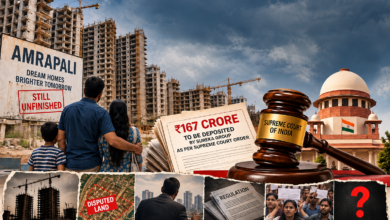
The Builder-Bank-Bureaucrat Nexus: How AVJ Developers And India’s Real Estate Cartel Turned Homebuyers’ Dreams Into A Multi-Decade Fraud Machine?
From Proxy Buyers to Politician Patrons: How India's Real Estate Builders, Bankers, and Bureaucrats Built an Empire on Stolen Homes


HOW INDIA’S BUILDERS MADE FRAUD A BUSINESS MODEL — A TWENTY-YEAR CHRONICLE
The Dream That Was Sold — And Stolen
There is a particular cruelty in real estate fraud that sets it apart from every other kind of financial crime. When a stock goes down, you lose money. When a bank fails, you lose savings. But when a builder defrauds you, he takes your home — the one thing that most working-class and middle-class Indian families spend their entire productive lives saving for. He takes thirty years of EMIs already paid, the savings of two generations, and the last hope of a roof over your head in old age.
This is not an accident. It is, by now, an industry practice, aka a trend!
India’s residential real estate sector is valued at over $300 billion and generated sales worth approximately ₹5.68 lakh crore in 2024 alone, according to ANAROCK Research data. In the top seven Indian cities, roughly 4,59,650 housing units were sold in 2024. Yet beneath this shimmering surface lies a deeply rotting underbelly. As of July 2024, a staggering 5,08,202 housing units across 1,981 projects in 44 cities remained completely stalled, i.e., homes that were paid for but never delivered. That is a 9 per cent increase from 2018, when the figure stood at 4,65,555 stalled units.
These are not just statistics. Each of these half-a-million units represents a family — a husband who took an extra job, a wife who postponed her surgery, a couple who deferred their child’s education — all to pay the EMI on a flat that would never come.
Let’s Start With The Anatomy of a Builder Fraud: How the Trick/Tactic/Trend Works?
The model is ingeniously simple, which is part of why it has survived and thrived for over two decades. A builder acquires land, often through political connections that ease regulatory approvals at throwaway rates. He launches a housing project with glossy brochures, scale models, and a sales office staffed with persuasive agents. Homebuyers book flats by paying a token amount, and then banks step in to disburse home loans — often the full cost of the flat — directly to the builder under a “subvention scheme.” Under this arrangement, the builder promises to pay the interest (pre-EMI) on the loan until the flat is handed over. The buyer pays nothing till possession.
This is where the trap snaps shut. The builder collects the full loan amount from the bank, uses it, often to repay older debts, fund other projects, or simply siphon off; and then defaults on the pre-EMI payments to the bank. The bank, having already disbursed the loan, now turns to the homebuyer and demands payment.
The homebuyer, who was told they would not pay a rupee until they got their flat, is suddenly liable for EMIs on a home that exists only on paper. The Supreme Court of India, which has been monitoring real estate frauds since at least 2017, specifically flagged this subvention scheme as a tool of mass deception when it directed the CBI in April 2024 to investigate 24 projects in Noida, Greater Noida, and the Yamuna Expressway region.
What Is RERA Doing? The Law That Arrived Too Late for Too Many!
The Real Estate (Regulation and Development) Act, 2016, universally known as RERA, was supposed to be the answer. It mandated that builders register every project, maintain a dedicated escrow account into which 70 per cent of the collected funds must be deposited and used only for that project’s construction, and deliver homes on time or face penalties. In theory, RERA was revolutionary. In practice, it arrived a full decade too late for hundreds of thousands of homebuyers already trapped in unfinished projects. And even for post-RERA buyers, enforcement has been patchy at best and non-existent in many states.
Here, We Got A New Name In The Roster of Shame: AVJ Developers
The AVJ Developers case, which is the recent name in this list, is not even the largest or most egregious real estate fraud India has ever produced. It is merely the most recent to receive a CBI chargesheet. The roster of builders who have broken India’s homebuyers is long and largely still free.
CASE STUDY 1: Jaypee Infratech — The Grand Collapse That Swallowed 30,000 Families
When the National Company Law Tribunal (NCLT) Allahabad ordered the initiation of Corporate Insolvency Resolution Process (CIRP) against Jaypee Infratech Limited (JIL) on August 9, 2017, approximately 25,000 homebuyers hoped that the legal process would be their saviour. Nearly nine years later, most of them are still waiting.
Jaypee Infratech was part of the Jaiprakash Associates group, a behemoth that once counted expressways, cement plants, and five-star hotels among its assets. In Noida and the Yamuna Expressway region — the very same geography as AVJ Developers — Jaypee had sold flats to over 30,000 families in projects like Wishtown, Aman, Kensington, and Krescent Homes. Buyers booked as far back as 2010, paying in full or taking home loans, with possession promised in three to five years. The years came and went. Construction slowed, then stopped. The company’s debts ballooned. When the CIRP was initiated, it emerged that JIL owed its financial creditors approximately ₹9,800 crore, while thousands of homebuyer claims added further to the liability mountain.
The Insolvency and Bankruptcy Code (IBC) mandates a CIRP completion within 330 days. JIL’s CIRP entered its ninth year on August 9, 2025. The Supreme Court intervened repeatedly, at one point in November 2019 directing the IRP to complete the process in 90 days. That deadline passed like so many others. The Committee of Creditors initially voted for NBCC (India)’s resolution plan; NBCC promised to complete the stuck projects in three to four years. The NCLT approved the plan with modifications; NBCC challenged those modifications in the Supreme Court. Eventually Suraksha Group received the green light from the NCLAT to acquire JIL and complete around 20,000 units, a development finally reported in late 2024.
Though the company survived, the human cost was staggering. Rashmi Singhal bought a flat in Wishtown Krescent Homes in 2010. For over a decade and a half she has been paying rent and EMIs simultaneously — two homes’ worth of money for zero homes delivered. “The flat’s structure is exposed to the elements. It’s aging,” her co-buyer Tejendra Khanna noted. “Our flats’ value is depreciating while the banks get land whose value keeps appreciating.” The cruelest irony: the very land Jaypee used as collateral with banks has appreciated dramatically over fifteen years. The banks will be made whole. The ordinary homebuyer may not.
What Jaypee reveals is a structural truth: the IBC, much like RERA before it, was designed without adequately accounting for the asymmetry of power between a homebuyer and a financial creditor. In the Jaypee case, financial creditors were placed ahead of homebuyers in the resolution priority until the 2018 amendment that finally gave homebuyers a seat at the table in the Committee of Creditors. But even that seat, as events show, does not guarantee delivery.
The CBI has also filed a chargesheet against Jaypee Infratech Ltd as part of the Supreme Court–directed investigation of 50 builder-related cases, confirming that the collapse was not merely financial mismanagement but allegedly involved criminal conspiracy and misuse of funds. The ED also arrested Manoj Gaur (Jaypee Group) in Money Laundering Case linked to Jaypee Group, based on complaints filed
by homebuyers of Jaypee Wishtown and Jaypee Greens projects, alleging criminal conspiracy, cheating, and criminal breach of trust against the company and its promoters.

CASE STUDY 2: Amrapali Group — When 46,000 Families Were Left in the Lurch
The Amrapali Group story is perhaps one of the most emotionally devastating chapter in India’s real estate fraud history. Founded by Anil Kumar Sharma, a man who served as a vice-president of CREDAI, the industry association meant to represent responsible builders. Amrapali developed dozens of housing projects in Greater Noida and Noida, selling flats to roughly 46,000 homebuyers.
Amrapali collected money from buyers in one project and diverted it to fund land acquisition or construction in another, in a Ponzi-like cycle that could only be sustained as long as new buyers kept coming. When the music stopped around 2016–17, the entire structure collapsed. Buyers who had paid in full, sometimes ₹50 lakh, sometimes ₹1 crore, found construction frozen, buildings half-finished, and the company unable to even pay its workers.
The Supreme Court took direct cognizance of the matter in 2018 and what emerged from the court-ordered forensic audit was breathtaking in its brazenness. Amrapali’s directors had diverted thousands of crores meant for project construction to fund personal luxuries, foreign accounts, and related-party transactions. Anil Kumar Sharma and two other directors were arrested by the ED. NBCC was directed by the Supreme Court to complete all stuck Amrapali projects, with the Court itself effectively acting as the project regulator — an unprecedented judicial intervention in Indian corporate history.
As of mid-2024, NBCC had completed some units and was working through the backlog, but tens of thousands of families were still waiting. The forensic audit commissioned by the Supreme Court revealed that ₹3,000 crore had been diverted from the escrow accounts of various Amrapali projects; this is the money that homebuyers had paid, money that was supposed to build their homes, gone into a labyrinth of 89 subsidiary companies, shell entities, and offshore transactions.
The Amrapali case establishes a key pattern that repeats in AVJ, Jaypee, and dozens of others: the use of multiple corporate entities, inter-company loans, and accounting complexity to disguise fraud as business operations. A single housing project generates revenues from homebuyers, loans from banks, and sometimes grants from government schemes — and a sophisticated builder can route all three streams into a single extraction machine while the auditors, regulators, and banks look the other way.
CASE STUDY 3: Raheja Developers — Gurugram’s Glittering Fraud
The year is 2011. Gurugram is booming. Glass towers are rising from the dusty flatlands of Haryana at a pace that feels almost cinematic. Into this gold rush stepped Raheja Developers, launching upscale residential projects with names like Raheja Shilas, Raheja Navodaya, and Raheja Revanta, selling units at premium prices to an aspirational middle class eager to plant a flag in India’s millennium city. What followed over the next twelve years was a systematic pattern of delays, diversions, and defaults that culminated in not one but two Enforcement Directorate raids and a ₹1,113 crore asset seizure.
Raheja Developers, under its promoter Navin M Raheja, collected money from thousands of homebuyers across multiple projects. Construction proceeded slowly on many projects, while on others it stopped entirely. Buyers who had taken home loans found themselves paying EMIs for flats still under construction, or not under construction at all. RERA complaints piled up. Consumer forum cases followed. And then the ED came knocking, twice.
The ED’s investigation revealed what homebuyers had long suspected: money collected from project buyers was allegedly not staying within those projects’ escrow accounts as mandated. The ₹1,113 crore attachment represents the investigative agency’s estimate of the proceeds of crime — a figure that gives you a sense of the scale of the alleged diversion. Meanwhile, buyers who paid ₹60 lakh, ₹80 lakh, or ₹1.2 crore for flats in 2012 or 2013 are in 2026 still fighting in courts, still paying rent and EMIs simultaneously, their life savings locked into half-finished concrete shells.
The Raheja case illustrates another recurring theme: the astonishing impunity with which builders operate even after regulatory action begins. The first ED raid triggered media headlines, legal battles, and firm statements from the company. Life went on. The second raid came year later. Life went on again. Homebuyers, exhausted and financially depleted, found themselves facing an adversary that had both more resources and more time than they did. Perhaps, Raheja Developers is not an outlier. It is a template.
CASE STUDY 4: BPTP — The Hooda-Era Miracle That Left Buyers Stranded
BPTP Limited is, by many accounts, the most remarkable story of builder-politician symbiosis in independent northern India’s real estate history. In 2004, BPTP under Kabul Chawla was an obscure construction firm. By 2014, it had amassed a land bank exceeding 2,500 acres and Chawla had moved to a property on Delhi’s ultra-elite Amrita Shergill Marg, valued at approximately ₹300 crore. What happened in between has everything to do with the nine years that Bhupinder Singh Hooda governed Haryana.

BPTP under Kabul Chawla received Change of Land Use (CLU) licences for 1,635 acres under the Hooda regime — the single highest allocation to any builder in the state during that period. In the 23 years before Hooda came to power, successive Haryana Chief Ministers cumulatively granted CLU licences for just 8,550 acres. Hooda’s government transformed this calculus entirely.
The beneficiaries of this political alchemy developed dozens of projects, Park Serene, Amstoria, Discovery Park, and sold units to tens of thousands of homebuyers. Many of these projects, particularly in Faridabad and the Gurugram periphery, experienced delays, construction stoppages, and quality failures. Buyers who had taken loans found themselves stranded. BPTP disputes clogged Haryana RERA’s complaint boards for years.
The most disturbing postscript: Kabul Chawla has been living in New York for the past fifteen years. His passport has not been revoked. No effective extradition proceedings are on record. That an individual with such legal exposure can continue to operate internationally, unreachable to Indian law, is not administrative oversight.
Now, let’s focus on the recent case- THE FULL ANATOMY OF AVJ DEVELOPERS’ FRAUD: FROM GREATER NOIDA TO THE SUPREME COURT
The Company Behind the Fraud: Who Is AVJ Developers?
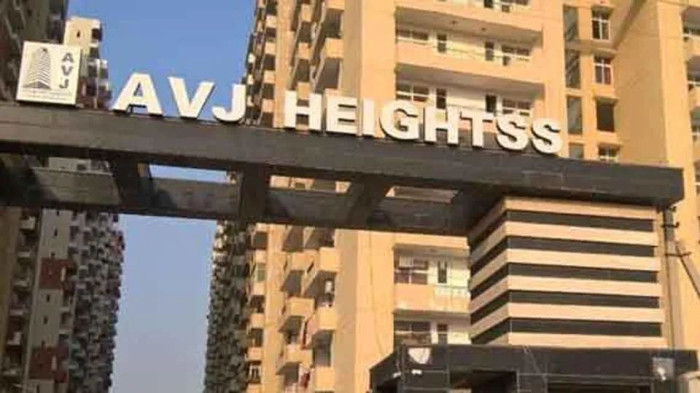
AVJ Developers (India) Pvt. Ltd. is a Greater Noida–based real estate developer that built and marketed AVJ Heights, a residential project located at Plot No. 12, Sector Zeta I, Greater Noida, Uttar Pradesh. Spread over 12 acres, AVJ Heights comprised 1,800 premium housing units — 1 BHK, 2 BHK, 3 BHK, and 4 BHK apartments ranging from 600 sq. ft. to 2,400 sq. ft. in size. The 3 BHK units were priced between ₹51.3 lakh and ₹60.8 lakh, targeting the aspirational middle class of Delhi-NCR who could neither afford the luxury towers of Central Gurugram nor the overcrowded tenements of inner Noida.
The company marketed AVJ Heights aggressively. For a middle-class family in Greater Noida, a 3 BHK flat at ₹55 lakh — financed via a bank loan under a subvention scheme where the builder paid the pre-EMI — felt like a genuinely achievable dream. Hundreds of families signed agreements, paid their bookings, and took out loans. Banks, specifically Bank of India, ICICI Bank, and UCO Bank, disbursed housing loans to these buyers, routing the funds to AVJ Developers. Then the construction stopped.
The Corporate Rot: No MCA Filings Since 2015
One of the most telling early indicators of AVJ Developers’ breakdown was a detail that most homebuyers would not have known to check: the company stopped filing its annual returns and financial statements with the Ministry of Corporate Affairs (MCA) from 2015 onwards. In other words, for nearly a decade before the CBI chargesheet of May 2026, this company had been operating in a regulatory black hole — a company with hundreds of crores in homebuyer funds, bank loans, and outstanding obligations, invisible to the corporate regulatory system.
This detail matters enormously. A company that stops filing with MCA has, in effect, declared its own administrative insolvency. It has no audited accounts, no transparency in fund flow, no way for buyers, regulators, or courts to track where the money went. And yet banks continued disbursing loans to it. Homebuyers continued paying. The state machinery continued to look the other way.
The CIRP: Insolvency That Goes Nowhere
The formal acknowledgment of AVJ Developers’ collapse came on October 22, 2019, when the Corporate Insolvency Resolution Process (CIRP) was publicly announced under the Insolvency and Bankruptcy Code, 2016. A Resolution Professional, Mr. Vivek Kumar (IP Registration No. IBBI/IPA-002/IP-N00008/2016-17/10008), was appointed to manage the company’s affairs, business, and assets. That was over six and a half years ago.
The Claims List on the IBBI portal was last updated as recently as August 2, 2025, indicating that the process is still technically alive. An Expression of Interest (EOI) for a resolution plan has been issued. Yet the plan remains unapproved — a fact that has now drawn the direct attention of the Supreme Court of India in what may become a landmark judgment on insolvency delays.
Here is the timeline of failure: The Committee of Creditors (CoC) comprising AVJ’s financial creditors approved a resolution plan on July 4, 2024. An application seeking NCLT’s approval of this plan was filed on July 12, 2024. As of May 2026, nearly two years later, the NCLT Principal Bench, New Delhi has not yet adjudicated this approval application. Hundreds of homebuyers sit in limbo, unable to move forward, unable to recover their money, unable to get their flats.
The Supreme Court, hearing Civil Appeal No. 3811/2023 / Diary No. 6520/2023 (AVJ Heights Apartment Owners Association v. IIFL Finance Limited), expressed its displeasure in unambiguous terms. A Bench of Justice J.B. Pardiwala and Justice K.V. Viswanathan stated: “We take a very serious note of the matter that the plan as approved by the CoC is awaiting approval of the adjudicating authority past almost two years.” The Court directed the NCLT and the IBBI to place on record detailed nationwide data on all pending applications seeking approval of resolution plans — a direction that goes far beyond AVJ and indicts the systemic failure of India’s insolvency infrastructure.
The IIFL Controversy: A ₹85 Crore Claim and Allegations of Fraud
Buried within the insolvency proceedings is a dispute that adds another layer of scandal to AVJ’s story. On January 24, 2020, the Resolution Professional rejected a claim of approximately ₹85 crore submitted by IIFL Finance Limited, on the ground that this claim could not be verified from AVJ’s own records. IIFL challenged this rejection before the NCLT, which ruled in IIFL’s favour. The NCLAT upheld the NCLT’s decision by order dated January 2, 2023.
But then, in July 2024, an arbitral tribunal issued an award dated July 3, 2024, that cast serious doubt on the very validity of IIFL’s claim, finding that the underlying loan documents had been “vitiated by fraud.” The Apartment Owners Association and a suspended director of AVJ then appealed to the Supreme Court, contending that IIFL’s ₹85 crore claim was “sham and bogus.” That arbitral award is now under challenge before the Delhi High Court under Section 34 of the Arbitration and Conciliation Act.
The CBI Chargesheet: May 6, 2026 — The Most Recent Explosive Development
On May 6, 2026, the Central Bureau of Investigation filed a chargesheet that has made national headlines across every major Indian media outlet. The chargesheet names AVJ Developers (India) Pvt. Ltd., AVJ Developers Pvt. Ltd., Kesar Builders Pvt. Ltd. (identified as a sister concern used for routing funds), their directors, officials from Bank of India, ICICI Bank, and UCO Bank, as well as private individuals who acted as proxy or fictitious homebuyers.
The charges filed include criminal conspiracy under the Indian Penal Code, cheating, criminal breach of trust, forgery for the purpose of cheating, use of forged documents, and criminal misconduct by public servants under the Prevention of Corruption Act. This is not a civil dispute about delivery delays. This is a criminal conspiracy allegation, that public servants (bank officials) abused their official positions to facilitate the illegal activities of the builders, and that private individuals masqueraded as homebuyers to obtain loans that were then funnelled back to benefit the builder companies.
The CBI’s investigation revealed a multi-layered scheme. The builder companies allegedly lured genuine homebuyers and investors with false assurances to secure financial gains. Simultaneously, proxy or fictitious “homebuyers” — private individuals acting on behalf of the builder — submitted fraudulent loan applications to banks. The banks disbursed housing loans based on these applications. The money went to AVJ and Kesar Builders, not to build homes, but allegedly to benefit the builder group financially. The bank officials named in the chargesheet are accused of facilitating this by abusing their positions, looking the other way, approving dubious applications, or actively assisting in the misrepresentation.
The Broader CBI Mandate: AVJ Is One of 50 Cases
Context is critical here. The AVJ chargesheet did not emerge from a standalone investigation. It is part of an enormous, Supreme Court–directed operation. The CBI is currently investigating approximately 50 cases against various builders and unknown officials of financial institutions. Chargesheets have already been filed in three other cases: Rudra Buildwell Constructions Pvt. Ltd., Dream Procon Pvt. Ltd., and Jaypee Infratech Ltd. In April 2026, the CBI expanded its crackdown by registering 22 fresh cases and conducting searches at 77 locations across eight states and Union Territories, seizing documents and digital evidence linked to suspected financial irregularities.
AVJ Heights was specifically identified as one of 24 real estate projects under CBI investigation in the Noida, Greater Noida, and Yamuna Expressway region, alongside Earthcon Universal, Rudra Buildwell, Geotech, Morpheus Group, Future World, and Bulland Group. The specific investigation focuses on alleged financial irregularities linked to the housing loan subvention scheme — the same mechanism described earlier in this article — which the Supreme Court identified as a vehicle for systematic homebuyer and bank fraud. This is not a failed project. This is an allegedly engineered failure — a criminal enterprise dressed in construction branding.
THE CONSORTIUM — HOW BUILDERS, BANKS, BUREAUCRATS, AND POLITICIANS BUILT A FRAUD MACHINE
Section 3.1: The Builder-Bank Nexus — India’s Most Profitable Criminal Partnership
To understand why builders like AVJ Developers could allegedly operate as described above, you must first understand the specific financial architecture that enabled them. The relationship between a builder and a bank in India is not merely transactional. In the worst cases, it is symbiotic in a way that is deeply corrupt — and the names in the AVJ chargesheet give us a rare window into its mechanics.
Bank of India, ICICI Bank, and UCO Bank are not obscure institutions. Bank of India is a public sector bank with a history going back to 1906. UCO Bank is another public sector heavyweight. ICICI Bank is India’s largest private sector bank by many metrics. These are not fly-by-night lenders. Their presence in the CBI chargesheet, with officials accused of abusing their official positions to facilitate builder fraud, tells us something profound: the builder-bank nexus is not confined to shady co-operative lenders. It reaches into the mainstream banking system.
How does this nexus operate? At the level of the housing project, the builder approaches banks for two types of credit: a construction loan (to fund the actual building activity) and home loans to buyers (which are disbursed to the builder under the subvention scheme). For the construction loan, the builder pledges the land and the future receivables of the project as collateral. For the home loans, the individual buyer is the borrower, but the money goes directly to the builder.
The nexus is created when a bank official facilitates the disbursal of home loans to proxy or fictitious buyers — individuals who have no genuine intention of occupying or owning the flat, but who are used to extract loan money from the bank on behalf of the builder. In the AVJ case, the CBI specifically found that some private individuals acted as proxy homebuyers, misrepresenting facts before financial institutions to obtain housing loans, which were then used to benefit the builder companies. Bank officials who approved these loans without adequate due diligence — or worse, with full knowledge of the fraud — are now chargesheeted under the Prevention of Corruption Act.
The subvention scheme investigation adds a further dimension. Under this scheme, the bank disburses the full loan to the builder from day one. The builder pays the pre-EMI until possession. When the builder defaults on the pre-EMI — as AVJ and scores of other builders did — the bank’s first instinct is often not to declare the project a fraud and protect the homebuyer, but to restructure the builder’s debt, give him more time, and continue the relationship.
Why? Because if the builder is declared NPA (Non-Performing Asset), the bank’s own balance sheet takes a hit, and bank officials face accountability. It is often easier for a bank official to quietly roll over the debt, hope the builder recovers, and keep the NPAs off the books — at the cost of the homebuyer, who is left without their flat and without their money.
The CBI’s 50-case mandate, at its core, is an investigation into this banking complicity — the question of how much of the builder fraud could have happened without the active or passive participation of bank officials who were supposed to be guardians of public funds.
Section 3.2: The H-Gang — How Politics Made the Fraud Systemic
If the builder-bank nexus is the engine of homebuyer fraud, the builder-bureaucrat-politician nexus is the fuel that powers it. Nowhere is this more chillingly documented than in the Manesar Land Scam in Haryana — a case that reveals how an entire state machinery can be weaponised for the benefit of private real estate interests.
The “H-Gang” — a term used in investigative circles to describe the nexus of politicians, bureaucrats, and private builders allegedly facilitated by former Haryana Chief Minister Bhupinder Singh Hooda — came to national attention through the Manesar Land Scam. The mechanics of this scam deserve to be spelled out in detail, because they are a masterclass in how political power converts into builder profit at the direct expense of ordinary citizens.
In August 2004, the Hooda government issued a notification to acquire 912 acres of land across the villages of Manesar, Lakhnaula, and Naurangpur, purportedly for the development of an Industrial Model Township (IMT). The moment this acquisition notification was published, it had a predictable effect on farmers: terrified of being compulsorily acquired at government-determined compensation rates, they began selling their land to whoever offered cash.
Private builders — including ABWIL Group under Atul Bansal and several others — swooped in, buying approximately 400 acres at rates of ₹20 to ₹25 lakh per acre, when the actual market value was approximately ₹4 crore per acre. The total of 400 acres was purchased for approximately ₹100 crore, against a market value of approximately ₹1,600 crore — a windfall of ₹1,500 crore extracted from farmers through the combination of governmental threat and builder opportunism.
Then came the second act of the scam. On August 24, 2007, the Director of Industries passed an order releasing this very land from the acquisition process — in violation of government policy, and in favour of the builders rather than the original landowners. In other words: the government first threatened to acquire the land (forcing farmers to sell cheap), then abandoned the acquisition after the builders had bought it (allowing them to retain the land at far below market value), and then proceeded to grant Change of Land Use permissions that allowed this agricultural land to be developed as real estate and sold to unsuspecting homebuyers at market prices.
According to the CBI, which registered this case on September 15, 2015 and subsequently chargesheeted former Chief Minister Bhupinder Singh Hooda along with 34 others, the “acquisition process was withdrawn with fraudulent intentions after the land was purchased by the private builders in active connivance with state functionaries.” The Supreme Court, on March 13, 2018, cancelled the entire illegal acquisition and grant of land to the builders.
A 2022 report submitted to the Supreme Court described an “unholy nexus between Hooda, his associates, and builders” in which the entire administrative machinery of Haryana was bent to serve builder interests rather than citizens. This machinery had multiple moving parts: the revenue department that processed CLU applications with unusual speed, the town planning authorities that approved layouts without proper scrutiny, the police that looked the other way when farmers complained of coercion, and the bank officials who disbursed loans on projects built on fraudulently acquired land.
The direct correlation between the Manesar scam and the builder-bank nexus exposed by AVJ Developers is more than atmospheric. It is structural. The Manesar scam shows how politically connected builders acquire land at artificially depressed prices through government complicity. They then use this land to launch housing projects, collect homebuyer funds and bank loans, and when the project collapses — as so many did — the homebuyer is left with nothing while the builder has already extracted his profit, the banker has restructured his exposure, and the politician has received his consideration in the form of campaign donations, property allocations, or simply the knowledge that his own family members benefited from CLU grants.
Bhupinder Singh Hooda himself has faced an avalanche of legal consequences. The CBI has registered multiple cases against him, including the Gurugram-Manesar IMT land scam, the Panchkula Industrial plot allotment scam, the AJL-National Herald Panchkula land grab case, the Sonepat-Kharkhoda IMT land scam, the Garhi Sampla Uddar Gagan land scam, and the Haryana Forestry scam. He has been formally chargesheeted in the Manesar-Gurugram land scam.
The CBI Special Court rejected his plea to avoid framing of charges in September 2025. The Punjab and Haryana High Court dismissed his subsequent appeal in November 2025. He then obtained a stay from the Supreme Court in November 2025 — the judicial process still grinding on twenty-one years after the original land grab.
This is the architecture of impunity. The fraud is committed swiftly. The investigations take years. The trials take decades. The politician appeals, the builder absconds, the bank official retires, and the homebuyer grows old.
CONCLUSION: AN OPINION IN THE PUBLIC INTEREST
What does the CBI chargesheet against AVJ Developers tell us? On one level, it tells us about one developer, one project, and approximately 1,800 families in Greater Noida. On another, deeper level, it tells us everything about how India’s real estate sector has been run for the better part of three decades.
The players are always the same: a builder with political connections, a bank with corruptible officials, a bureaucrat with discretionary powers, and a politician with an appetite for consideration. The victim is always the same: a middle-class family that believed in the dream of owning a home. Greater Noida alone has 74,645 stalled housing units across 167 projects. Across India, the number crosses half a million.
The CBI’s 50-case mandate is the most significant real estate enforcement action in independent India’s history. But enforcement, by itself, is not enough. Chargesheets take years to become convictions. Convictions, even when they come, rarely restore the stolen money or the stolen years. What India needs, urgently, is not just more criminal cases but a structural dismantling of the conditions that produce these crimes: the unaccountable discretion of land-use authorities, the opacity of builder finances, the lack of real-time escrow monitoring by banks, and the political funding ecosystem that converts real estate approvals into campaign finance.
Until that happens, the next AVJ Developers is already selling flats somewhere in Greater Noida, Gurugram, or Bengaluru. The brochures are glossy. The scale model is impressive. The bank loan is already approved. And somewhere, a family is signing a booking form, believing in a dream that an entire system is already conspiring to take from them.