Who Killed Nirbhay? Unfolding India’s Deadly Borewell Negligence Crisis That No Government Has Fixed
19 Hours, One Dead Child, Zero Answers: Why India's Borewell Deaths Keep Repeating Since Prince Kumar's 2006 Rescue

A four-year-old is dead. A 19-hour rescue failed. And the system that let this happen has been “warned” since 2010.
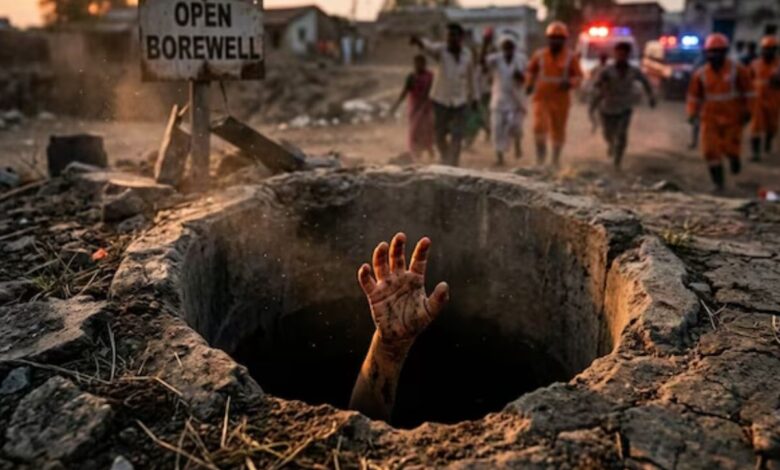
Nirbhay was 4 years old. He liked playing near the fields of Dhanaura village in Ambala, Haryana, the way millions of rural Indian children do every single day. On Tuesday morning, at around 6 AM, he slipped into an open borewell, a narrow, 200-foot throat of concrete and mud that no one had bothered to cover.
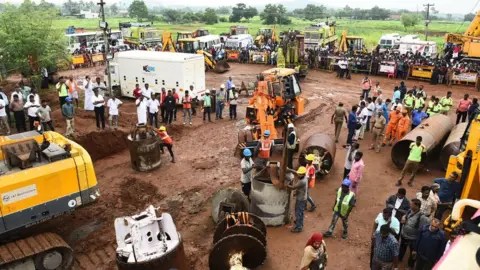
By the time doctors at City Hospital pronounced him “brought dead” nearly 19 hours later, the Indian Army had been mobilised. The NDRF had dug a parallel shaft. The SDRF, the fire department, the police, and the district administration had all converged on a single field to save one small boy who should never have been in danger in the first place.
He did not survive the wait. He survived the fall, barely, only to be defeated by rising water, loose soil, relentless rain, and a rescue apparatus that, once again, arrived after the emergency had already become a tragedy. This is not a story about bad luck. This is a story about a country that has known the exact fix to this exact problem for sixteen years and has simply refused to apply it.
A Child Falling Into An Open Borewell Is Not A New Incident In ‘Naya Bharat’, But An Old Script From ‘The Republic Of India’…
If the Ambala tragedy feels like you’ve read it before, that’s because you have. Almost word for word.
- In 2006, five-year-old Prince Kumar fell into a borewell in Kurukshetra, barely 60 kilometres from where Nirbhay just died, in a rescue that became India’s first televised borewell catastrophe. Prince survived. The nation cheered. But…nobody sealed the wells.
- In 2019, two-year-old Fatehveer Singh was trapped for over 100 hours in a Punjab borewell. He died. The state government, in a fit of reactive guilt, ordered the closure of over 40 open borewells in Punjab alone, proving, retroactively, that the danger had been sitting in plain sight the entire time. Although, it took the state government to sacrifice an innocent life to get so attentive!
- Also in 2019, two-year-old Sujith Wilson was trapped for more than 80 hours in Tamil Nadu’s Tiruchirappalli district. Rescuers only recovered parts of his decomposed body. A court, hearing a plea on the state’s failure to enforce Supreme Court norms, reportedly asked officials whether they needed a corpse before acting.
- That same year, in 2019, four-year-old Seema died trapped at 260 feet in a borewell in Jodhpur, Rajasthan. Another child, also named Seema, died in Uttar Pradesh’s Farrukhabad after the rescue dig was abandoned mid-operation because it was cracking the foundations of neighbouring homes.
- In December 2024, five-year-old Aryan died in Rajasthan’s Dausa district after a 57-hour rescue operation for a fall into a 150-foot borewell. Following this ‘systematic murder of the innocent child’, the NHRC took suo moto cognisance of the incident, yet, it could not save Nirbhay in 2026!
Here is what should terrify every Indian parent: India does not even properly count these deaths.
- The National Disaster Response Force has stated that more than 40 children died after falling into borewells just between 2009 and 2019, and that roughly 70 percent of borewell rescue operations fail. Seven out of ten. Not a marginal risk. A coin flip stacked against a toddler.
- NDRF officials have separately said such incidents occur at a frequency of five to six a month in parts of the country.
- The National Crime Records Bureau did not even maintain a dedicated category for borewell deaths until after 2014, as before that, dead children were folded anonymously into the generic bucket of “accidental deaths.” A four-year-old’s death, erased into a spreadsheet footnote.
- According to NCRB-linked reporting, roughly 281 people died falling into borewells across India in a recent four-year stretch alone.
- Government Home Ministry data once showed child deaths from falls into pits and manholes climbing steadily, from 175 in 2010, to 192 in 2011, to 194 in 2012, in the very years immediately following the Supreme Court’s supposedly landmark 2010 intervention.
- India currently has an estimated 27 million borewells, the largest groundwater extraction infrastructure on the planet, and there is no national database tracking which of them are abandoned, unsealed, or unsafe, because water remains a state subject and states have simply not bothered to build one.
Read that last figure again. Twenty-seven million holes drilled into Indian soil, and not a single central authority can tell you, in real time, how many of them are sitting open like landmines in a farmer’s field. Since, under the Indian Constitution, water is a state subject, hence, individual state governments are responsible for managing, legislating, and tracking their own groundwater resources rather than the central government. Consequently, tracking is highly fragmented and ofcourse, till date, not done.
Borewells and potholes have been documented to kill and injure people at a scale that dwarfs terror-related casualties in the same period, yet one gets national security budgets, war rooms, and daily briefings, and the other gets a press release after a child’s funeral.
The Guidelines Exist. But Only The Guidelines Exist, And They are Never Followed, Till The Next Innocent Sacrifice By The System takes place…
This is not a regulatory vacuum. This is not a case of Indian law failing to anticipate the problem. It is worse than that.
On 11 February 2010, the Supreme Court of India, acting on its own cognisance under a bench led by then-Chief Justice K.G. Balakrishnan, issued a detailed, specific, enforceable set of directions in Writ Petition (C) No. 36 of 2009. Among them:
- Landowners must give written, 15-day advance notice to the District Magistrate or equivalent authority before drilling any borewell.
- Every drilling agency, government or private, must be registered with the district administration.
- A signboard must be erected at the site listing the drilling agency and landowner’s details.
- Barbed-wire fencing must surround the site during construction.
- A cement platform must be built around the well casing.
- Once a borewell is no longer needed, it must be capped with a welded steel plate, and abandoned wells must be filled to ground level.
Every single one of these measures, applied with even moderate diligence, would have made it structurally impossible for a four-year-old to vanish into a 200-foot pipe in a field near Ambala. None of it happened. Not for Fatehveer. Not for Sujith. Not for Seema. Not for Aryan. Not for Nirbhay. 16 years of a binding Supreme Court order, and the compliance mechanism amounts to: wait for a child to die, seal that one specific well, issue a statement, and move on until the next village, the next field, the next name.

Who, Exactly, Is Accountable For Killing The Innocent Souls?
This is the question that should be screamed in every district collectorate in this country, and it is the question that is never seriously answered. Ask who dug the borewell that swallowed Nirbhay without a permit. Ask who was supposed to inspect it. Ask which official was responsible for verifying that Dhanaura’s agricultural borewells complied with a 2010 court order. Ask whether a single show-cause notice, a single suspension, a single prosecution has ever followed one of these deaths.
You will get silence, or you will get the same tired administrative shrug experts have described for over a decade, which just hides behind the statement that- borewells are dug by private individuals, so there’s “no one to blame,” the “landowner is the victim too,” “there’s a lack of awareness.” This framing is not an explanation. It is an alibi manufactured by the very system that was legally obligated to prevent this and didn’t.
A Supreme Court order is not a suggestion. When district magistrates fail to enforce mandatory registration, when panchayats fail to fence open wells, when state groundwater boards fail to maintain even a basic list of abandoned borewells, that is not bad luck; that is a chain of individual administrative failures, repeated in state after state, year after year, until it becomes structural.
Rescue heroics cannot substitute for prevention. Sending the Army, the NDRF, and the SDRF to dig a parallel shaft for 19 hours is commendable bravery under horrific conditions, but it is also an admission of catastrophic failure upstream. You do not need Army engineers digging tunnels in the rain if the well had been capped with a steel plate the way the law has demanded since 2010.
The Emotional Cost the Statistics Cannot Capture
Somewhere in Dhanaura tonight, there is a mother who watched her son sink slowly into rising water for nineteen hours while the country’s most capable rescue agencies fought soil, rain, and time, and lost. There is a father who heard “brought dead” instead of hearing his son’s voice. There is a family that will now spend the coming days at a mortuary and a post-mortem table instead of celebrating a fifth birthday that will never come.
This is not abstract policy failure. This is a child who suffocated or drowned, alone, in the dark, in a hole that existed only because someone, somewhere in a chain of landowners, drillers, and inspectors, decided that a legally mandated steel cap, a fence, or a filled shaft was not worth the trouble.
Multiply Nirbhay by Fatehveer, by Sujith, by both Seemas, by Aryan, by the anonymous scores folded into NCRB’s “accidental death” category before anyone even bothered counting them separately. Every one of those names represents a family sentenced to the same nineteen hours of helpless hope, followed by the same devastating silence. None of this is radical. All of it was already ordered in 2010. The only missing ingredient, for 16 years running, has been the political and administrative will to actually do it.
A Question for Every Official Who Signs Off on “Business as Usual”
Nirbhay did not die because India lacks laws, engineers, disaster response forces, or judicial foresight. He died because the machinery meant to enforce all of that was, once again, absent exactly where and when it mattered. It was the same what happened with the techie engineer few months ago in Noida, where he died because the road to Noida was left broken, unattended, and no alert sign was placed in the dark, so that the commuters could go aware.

The next tragedy is not a matter of “if.” Given the pattern of the last two decades, it is a matter of which village, which month, and which family’s turn it is next, unless someone in power finally treats a Supreme Court order like the law of the land rather than a piece of paper to be remembered only in grief.
India owes Nirbhay’s family more than condolences and a sealed borewell. It owes them, and every family that has stood at the edge of one of these pits, an honest reckoning with why a preventable death keeps repeating itself as a national ritual.