Why Judges Have Rescued Themselves From HDFC Case?
Ten Judges, One Case, No Answers: Inside the Bombay High Court's Unprecedented Recusal Cascade in the HDFC CEO Bribery FIR

What the Bombay High Court’s Unprecedented Recusal Cascade in the HDFC CEO Case Tells Us About Justice, Power, and Institutional Opacity?
India’s constitutional democracy rests on the premise that every citizen, regardless of power, wealth, or institutional standing, can obtain a timely, fair hearing before an impartial court. That premise was put to a test of extraordinary public significance in June and July of 2025, when a case involving India’s most powerful private sector banker and one of Mumbai’s most storied charitable trusts arrived at the Bombay High Court.
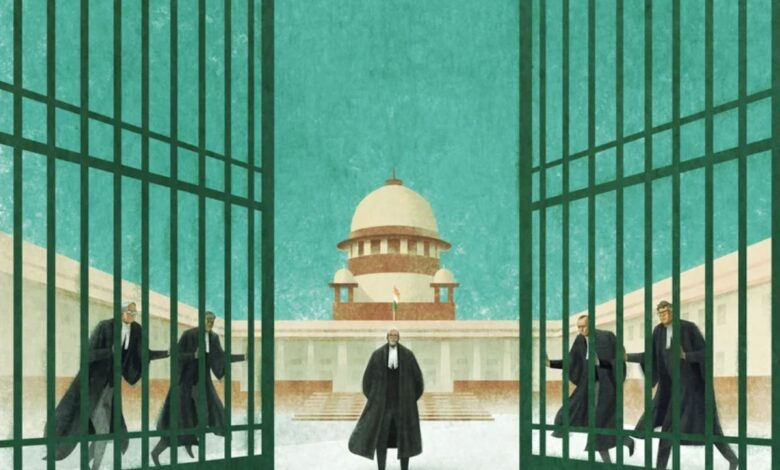
What followed was more than a hearing! What followed was a judicial disappearing act, one bench after another stepping aside, citing reasons that ranged from transparent and principled to opaque and unexplained, until the accumulated recusals became one of the most extraordinary administrative crises in the Bombay High Court’s modern history.
The case is the petition filed by Sashidhar Jagdishan, Managing Director and CEO of HDFC Bank, seeking to quash a First Information Report registered against him on the complaint of the Lilavati Kirtilal Mehta Medical Trust. The FIR, registered at Bandra Police Station on May 30, 2025, following an order of the Bandra Magistrate Court under Section 175(3) of the Bharatiya Nagarik Suraksha Sanhita, alleges that Jagdishan accepted a bribe of ₹2.05 crore from members of the Chetan Mehta Group in exchange for providing financial and strategic advice that helped them retain control over the Trust’s governance — a charge HDFC Bank has called “malicious, false and defamatory.”
When Jagdishan moved the High Court, what happened next was not less than shocking! At least ten judges recused themselves from hearing the plea. The full list: Justices Rajesh Patil, Sarang Kotwal, Revati Mohite Dere, G.S. Kulkarni, Arif Doctor, B.P. Colabawalla, M.M. Sathaye, R.I. Chagla, Sharmila Deshmukh, Jitendra Jain, and Gautam Ankhad.
Beyond these formal recusals, an administrative order by Chief Justice Alok Aradhe had already pre-listed six other judges as unavailable for Lilavati-related matters. The Bombay High Court, one of India’s most consequential judicial institutions, was functionally unable to constitute a bench for a single criminal quashing petition. That more than procedure, but can be called as an institutional paralysis.
The Anatomy of Each Recusal: Where Principle Ends and Opacity Begins
Judicial recusal is not inherently sinister. The doctrine of nemo judex in re sua, which says no one shall be a judge in their own cause, is among the oldest and most important principles in common law jurisprudence. Its purpose is unimpeachable, which is to ensure that justice is not merely done, but visibly seen to be done, without contamination by personal interest. The problem arises not when individual recusals occur, but when they accumulate into a pattern that denies access to justice entirely and when the reasons given are so vague as to make scrutiny impossible.
The first bench to encounter the case was the division bench of Justices A.S. Gadkari and Rajesh Patil, which normally holds the assignment for FIR-quashing petitions in the High Court. Justice Patil stepped away on June 18, 2025, citing what was recorded as “personal difficulty.” The phrase “personal difficulty” is among the least informative justifications available to a judge.
It conceals more than it reveals. Notably, Justice Gadkari himself did not recuse, instead, on the record, he observed that his colleague “does not take up matters relating to HDFC.” That observation is significant. It suggests that Justice Patil’s recusal from HDFC-related matters was not a fresh decision taken in response to this specific case, but a pre-existing standing policy, the one whose origins were never publicly explained and whose rationale is entirely absent from the court record.
The second recusal came from Justice Sarang Kotwal, assigned alongside Justice Shyam Chandak. Justice Kotwal stepped aside without providing any stated reason on record. No financial interest was disclosed. No prior association was named. The court record is simply silent. Justice Kotwal’s recusal is, from a transparency standpoint, the quite troubling of the sequence; because a recusal without any stated reason, from a judge assigned to hear a matter of significant public importance, offers the public no basis whatsoever for evaluating whether the recusal was appropriate or whether it reflected something else entirely.
The third formal recusal, involving the bench of Justices Mahesh Sonak and Jitendra Jain, was the most transparent. Justice Jain voluntarily disclosed that he held shares in HDFC Bank and initially, neither side objected. The matter was ordered listed for the following day.
It was only when Trust counsel advocate Niteen Pradhan raised an objection on June 26 that the bench withdrew, with Justice Jain asking pointedly; “Is it because me holding shares… Did I not disclose this yesterday itself?” The Jain recusal, whatever its procedural outcome, represents the gold standard of judicial transparency in this case. It is the one moment in the entire cascade where the public was told, in precise terms, exactly why a judge was stepping away. It stands in sharp contrast to the opaque “personal difficulty” and unexplained silence that surrounded the others.
Justice Gautam Ankhad then became the fourth formal recusal. The remaining judges, Justices Revati Mohite Dere, G.S. Kulkarni, Arif Doctor, B.P. Colabawalla, M.M. Sathaye, R.I. Chagla, and Sharmila Deshmukh, are reported to have cited prior associations with the Lilavati Trust as their reason for non-participation. This explanation, taken at face value, is plausible. Lilavati Hospital is not merely a medical institution, but it is a civic institution, used by judges, lawyers, their families, and much of Mumbai’s professional class for decades. Many of the city’s senior legal professionals have genuine prior relationships with it as patients, as donors, or through institutional connections. Prior association with a party is a recognised and legitimate ground for recusal.
/squirrels/media/media_files/2025/08/26/1000532227-2025-08-26-21-29-08.jpg)
The Trust’s allegations were not merely financial, but they included the claim that Jagdishan and his family had received free and unbilled medical treatment at Lilavati Hospital, and that ₹48 crore in deposits and investments had been placed with HDFC Bank since 2022, allegedly without proper approvals.
If many of the recusing judges were also in some relationship with Lilavati Hospital, as patients, well-wishers, or recipients of its services, then the recusal pattern becomes simultaneously more administratively understandable and more democratically uncomfortable. It is understandable because each individual recusal may be genuinely appropriate. It is uncomfortable because the accumulation of those individually appropriate recusals produces an outcome that is collectively unjust. A CEO of India’s largest private bank cannot get his petition heard, and a complainant trust’s allegations cannot be tested in open court.
The Pre-Listed Exclusion: A Judicial Map of Elimination
Perhaps the most extraordinary element of this entire episode is what emerged when Jagdishan’s legal team, led by Senior Advocate Amit Desai approached the Chief Justice to report the impasse. According to a lawyer connected to the proceedings, Jagdishan’s legal team provided the Chief Justice with a list of judges who had already recused from Lilavati-related matters in previous cases, thereby informing the court of which benches would be unavailable. Chief Justice Alok Aradhe had already issued an administrative order listing names of judges who had, for various reasons over the years, recused from Lilavati-related matters and should therefore not be assigned those cases in future.
This creates a deeply unusual constitutional condition where the administrative apparatus of the Bombay High Court had, in effect, pre-mapped which judges could not hear cases involving this institution, and yet even the judges outside that pre-mapped zone continued to recuse one by one. The result seemed to be a judicial map of elimination, not of bench-shopping in the pejorative sense, but of a court that had progressively exhausted its available benches for a case of significant public importance. This is not a normal administrative situation in any jurisdiction that calls itself a rule-of-law democracy.
Andy Mukherjee, a Bloomberg Opinion columnist gave voice to this absurdity with a remark whose levity masked a serious constitutional point: “The Collegium should introduce a new criterion for appointing judges in Bombay: select only those who haven’t worked with Lilavati.” Stripped of its irony, that statement identifies a genuine structural problem, that when a single institution’s social reach is so extensive that it creates conflicts of interest for a significant portion of a High Court’s bench, the system has no clean mechanism to address the resulting denial of judicial access.
Facing this impasse, Jagdishan escalated to the Supreme Court. Senior Advocate Mukul Rohatgi appeared before a bench of Justices M.M. Sundresh and K. Vinod Chandran, describing the situation plainly: “A frivolous FIR has been filed against the MD and the bank by the trustees of Lilavati Hospital, who are in a dispute with another set of trustees. The bank needs to recover money from them. To build pressure, they have filed this FIR against the MD through a magistrate.
The Supreme Court declined to entertain the petition, observing that the matter was already listed tentatively for July 14 in the High Court, and directing Jagdishan to return if that hearing did not materialise. The Supreme Court’s restrained response of neither endorsing the recusals nor questioning them, possibly left the structural problem entirely unaddressed.
India’s Documented History of Recusal Cascades: The Pattern Behind the Pattern
The HDFC case does not exist in isolation. Across India’s judicial history, there is a documented pattern where mass or successive recusals have intersected with matters of significant political, institutional, or financial power, and where the outcomes have ranged from principled impartiality protection to functional institutional cover.
Sanjiv Chaturvedi: The Record That Should Not Exist
The closest structural parallel to the HDFC case in Indian judicial history is the case of Sanjiv Chaturvedi, a Ramon Magsaysay Award-winning Indian Forest Service officer whose anti-corruption work generated a series of legal proceedings in which fifteen judges ultimately recused from hearing his cases.
These included two Supreme Court judges, then-Justice Ranjan Gogoi in 2013 and then-Justice U.U. Lalit in 2016, both of whom recused from a petition seeking CBI investigation into the alleged corruption of then-Haryana Chief Minister Bhupinder Singh Hooda, without citing specific reasons. Three High Court judges, eight Central Administrative Tribunal members including a Chairman, and two lower court judges followed over the subsequent decade, many without stating any reason whatsoever on record.
The significance of Chaturvedi’s case is not merely statistical, but it is substantive. Chaturvedi was not a fraudster seeking to escape justice. He was a whistleblower exposing documented corruption. Each recusal effectively delayed the hearing of that exposure. Each year without a hearing was, functionally, a year of continued impunity for the officials he had identified. The Chaturvedi case established a principle that the HDFC case now illustrates from a different angle; where mass judicial recusal, regardless of individual legitimacy, can function as systemic delay, and this systemic delay, in matters of financial and institutional accountability, almost always favours the powerful over the powerless.

The Judge Loya Case: When Recusal Signalled Bench-Fixing Anxiety
In 2018, four of India’s most senior Supreme Court judges, Justices Ranjan Gogoi, J. Chelameswar, Madan Lokur, and Kurian Joseph took the unprecedented step of holding a press conference to warn the public that sensitive cases were being assigned to particular benches in ways that raised concerns about judicial impartiality.
When pressed on whether their concern specifically related to the petition seeking an independent inquiry into the death of CBI Special Judge B.H. Loya, who had been presiding over the Sohrabuddin Sheikh fake encounter case involving politically significant accused, Justice Gogoi confirmed, “Yes.” Justice Arun Mishra, before whom the Loya petition had been placed, subsequently recused. A fresh bench was constituted under the CJI and ultimately dismissed the petitions. No independent inquiry into Loya’s death was ever conducted.
The Loya case matters for understanding the HDFC recusal because it reveals that recusal can function not only as a personal declaration of conflict but as a political and institutional signal, which is a way of communicating, without words, that a particular case carries sensitivities that specific judges prefer not to be publicly associated with. The Bombay High Court’s silence on the precise reasons for most of its recusals in the HDFC case invites, without proving a similar reading.
Justice C.S. Karnan: When a Judge Accused the Judiciary Itself
In 2017, Calcutta High Court Justice C.S. Karnan publicly alleged corruption against 33 sitting and retired Supreme Court and High Court judges. The judicial system’s response was to initiate contempt proceedings against him, in which every judge he had named was obviously unable to participate without creating a fresh conflict of interest, generating a recusal cascade within the contempt proceedings themselves. Karnan was ultimately sentenced to six months in prison. His underlying allegations were never formally investigated. Whether his specific claims were accurate remains publicly unresolved. What is resolved is that the system has no mechanism for an insider judicial accusation of corruption that does not simultaneously generate recusal paralysis in any proceeding that follows.
The NCLAT Recusal Under Alleged Judicial Pressure: A 2025 Alarm
On August 13, 2025, a judicial member of the National Company Law Appellate Tribunal recused himself from a dispute between KLSR Infratech Ltd and AS Met Corp Pvt Ltd, not because of a financial interest or prior association, but because he alleged that he was facing “undue pressure from one of the most revered members of the higher judiciary” to influence the outcome in favour of a particular party. The alleged influential judicial figure was never publicly identified. No investigation followed. The recusal stood as an isolated act of individual courage where a judge protecting himself from pressure he could not publicly name, and the systemic question his act raised simply dissolved into institutional silence.
The Constitutional Stakes: What This Cascade Actually Reveals
The doctrinal underpinning of judicial recusal, enshrined in the Supreme Court’s own jurisprudence in cases like P.K. Ghosh v. J.G. Rajput, is precise: “If there be a reasonable basis for a litigant to expect that his matter should not be heard by a particular judge and there is an alternative, it is appropriate that the learned judge should recuse himself so that people do not doubt the process.”
The critical phrase is “if there is an alternative.” The Bombay High Court’s HDFC recusal cascade is a case study in what happens when the doctrine is invoked so many times, by so many judges, that the alternative disappears, and the doctrine, designed to protect access to impartial justice, ends up denying access to any justice at all.
India has over 50 million cases pending in courts as of 2024. The systemic causes of that backlog are well-documented, vacancies, infrastructure, procedural inefficiency. But the Bombay High Court’s inability to constitute a single bench for a high-profile FIR-quashing petition, not because of backlog but because of the progressive elimination of available judges through recusal, represents a different and in some ways more troubling failure mode. It is a failure not of capacity but of institutional structure, where a structure in which the social interconnections between Mumbai’s elite professional class, its premier hospital, its largest private bank, and its judiciary have created a web of conflicts of interest so dense that the system cannot navigate it without becoming paralysed.

What makes this case constitutionally significant is that both parties are harmed by the paralysis. Jagdishan cannot obtain a timely hearing of his petition to quash a case he describes as baseless and retaliatory. The Lilavati Trust cannot obtain a timely judicial determination of whether the FIR it has filed is legitimate. And the Indian public, which is the ultimate stakeholder in whether India’s largest private bank is governed with integrity, cannot obtain the judicial transparency that a functioning FIR-quashing hearing would produce: a court record in which both sides’ arguments are tested, weighed, and publicly documented.
What can be said with complete confidence is this: a judicial system that responds to a complex, high-stakes matter by silently stepping away, ten times, without adequate explanation, until no bench remains has failed the elementary standard of democratic accountability.
The doctrine of recusal exists to ensure that justice is impartial. When it is invoked so repeatedly that justice becomes inaccessible, it has been turned against its own purpose. And when the pattern of its invocation, which in this case, is ten judges, one bank, one hospital, one city’s elite professional network, matches so precisely the geography of power in that city, the public has not only the right but the democratic duty to ask whether recusal has been stretched from a shield into a shelter.