CBI Files 9th Charge-Sheet In Builders–Banks Fraud Nexus: Homebuyers’ Agony Grows
How India's Real Estate Dream Became a Nightmare for Thousands of Middle-Class Families — and Why the Supreme Court Had to Step In


Imagine saving for a decade. You scrimp on holidays, cut back on dining out, postpone your children’s school fees to put every extra rupee into a fixed deposit. Finally, you have enough for a down payment on a flat; a 2BHK in Noida or Ghaziabad that you’ve been dreaming about since your wedding day. The builder promises possession in 3 years. The bank assures you the project is verified. You sign on the dotted line and go home happy, telling your parents that the family finally has something concrete, something real.
Fast Forward To Today. 5 years later, you are still paying EMIs. But the flat? It doesn’t exist.
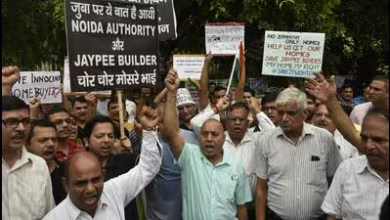
This is not a hypothetical story. This is the lived reality of hundreds of thousands of Indian homebuyers, particularly across the National Capital Region, who fell into one of the most audacious frauds in the country’s real estate history; a scheme so brazen that it took a Supreme Court order to drag it into the light. In May 2026, the Central Bureau of Investigation filed its 9th charge-sheet as part of an ongoing probe into what the Supreme Court itself described as an “unholy collusion” between property developers and bank officials. The case is about greed, systemic failure, institutional capture, and the quiet, devastating suffering of ordinary Indian families who simply wanted a home.
This investigation did not begin overnight. It has been building since April 2025, when the Supreme Court, alarmed by a wave of petitions from over 1,200 defrauded homebuyers, directed the CBI to probe a nexus between developers and banks operating across the NCR and other major cities. Several charge-sheets had already been filed in the months leading up to this one, naming builders, bank officials and proxy buyers in projects across Noida, Ghaziabad, Greater Noida and beyond. The 9th charge-sheet is both a milestone and a reminder, that a signal that the investigation is widening even as the wound it seeks to heal remains raw.
Background: The Subvention Scheme — A Dream That Was Also a Trap
To understand how this fraud worked, you need to understand a product that the real estate industry marketed with tremendous success in the years before the 2016 Real Estate (Regulation and Development) Act — the interest subvention scheme.
On paper, it sounded like a gift. A developer would approach a bank. The bank would disburse a housing loan to a buyer. But instead of the buyer paying EMIs right away, the builder would promise to pay the EMIs on the buyer’s behalf until possession of the flat was handed over. The buyer could simply sit back, wait for the keys, and only start repayments once they were living in their new home. For a middle-class family stretched thin, this was irresistible. No EMI burden for three years? Sign us up.
But, there is a CATCH! The problem was structural; and some would argue deliberately designed to exploit. Under this arrangement, banks were disbursing up to 70–80% of the entire loan amount to the builder upfront, long before any significant construction had taken place. The Reserve Bank of India had issued guidelines as far back as 2013 specifying that home loans should be disbursed in stages, linked directly to verified construction milestones. These norms were not an obscure technicality. They existed precisely to prevent what happened next.
What happened next was that builders pocketed enormous sums of money, sometimes across multiple projects simultaneously. They used funds earmarked for one project to shore up another, or simply diverted money into other ventures, land purchases, or the pockets of promoters. When construction inevitably stalled or stopped altogether, builders also stopped paying the EMIs they had promised. Banks, legally speaking, could then go after the original buyer, who had no flat and no remedy except court. The buyer was stuck paying off a loan for something that did not exist, while the developer was either in insolvency proceedings, or living comfortably somewhere else.
The Supreme Court, receiving petitions from homebuyers numbering in the thousands by mid-2025, did not mince words. It flagged an “unholy nexus” between developers and bank officials and ordered the CBI to conduct a thorough probe. One bench went so far as to say that “delay or prolonging investigation will only add to homebuyers’ agony.” That line could have been written by any one of the families living in rented apartments, paying EMIs on flats they will never see.
Between January and May 2026, the CBI filed charge-sheets at a steady pace. The first through seventh were filed covering projects in Noida, Greater Noida and Ghaziabad. Then came the 8th (Logix City Developers, Noida, May 12, 2026), and the 9th (Manju J Homes, Ghaziabad, May 20, 2026).
Throughout this period, the Supreme Court has held repeated status hearings. CBI affidavits have been filed. Additional Solicitor General Aishwarya Bhati has represented the government before the bench. At one point in March 2026, Chief Justice Surya Kant’s bench pulled up the CBI for the pace of investigations, making clear that the court would not allow the agency “to disappoint millions of homebuyers.” That public rebuke, rare in tone and pointed in intent, underscores how personally invested the judiciary has become in this matter.
Systemic Causes: Why These Frauds Flourished in Plain Sight
The builders-banks nexus did not spring up overnight, nor did it succeed in a vacuum. It grew in the fertile soil of regulatory gaps, financing loopholes, opaque land records and an environment where political patronage and institutional capture had become part of doing business in Indian real estate. To prevent future frauds, we must understand each of these fault lines.
Regulatory Blind Spots Before RERA
Before the Real Estate (Regulation and Development) Act came into force in 2016, there was no centralised oversight of private real estate developers in India. Projects were approved by state-level bodies, local development authorities and municipal corporations, which were a patchwork of agencies with overlapping and often contradictory jurisdictions. Builders could register a project, collect money and run construction at whatever pace suited their financial interests, with minimal accountability to buyers.
Even after RERA was enacted, its reach was limited. Projects that had already been launched before May 2016 were largely outside its ambit. Many developers simply refused to register with state RERA authorities, or exploited definitional loopholes to avoid compliance. Enforcement varied wildly from state to state, like Uttar Pradesh RERA and Maharashtra RERA had very different capacities and willingness to act.
Financial Engineering and the Subvention Loophole
The subvention scheme was, as we’ve seen, the central vehicle for fraud. But it was not the only one. Non-Banking Financial Companies (NBFCs) and housing finance companies, some of which were entirely outside RBI’s direct oversight, provided project financing to developers under even more opaque conditions. Builders could access multiple lines of credit, from commercial banks, housing finance firms and NBFCs, creating a web of financial relationships that was extraordinarily difficult to untangle after the fact.
RBI’s 2013 master circular on housing finance explicitly prohibited banks from disbursing more than a stipulated percentage of loan amounts before corresponding construction milestones were verified. Yet the CBI’s investigations found that banks had routinely disbursed 70–80% of loan funds in violation of these norms. The question, and this is a damning one, is whether this was innocent incompetence or deliberate collusion.
Escrow Accounts: Mandated, Then Ignored
RERA mandates that developers deposit 70% of all amounts received from buyers into a designated escrow account, which can only be withdrawn in proportion to construction progress as certified by an engineer, architect and chartered accountant. This was specifically designed to prevent fund diversion. Yet as the CBI’s charge-sheets have revealed, many developers simply did not comply. Money collected from homebuyers was spent on other projects, on land acquisition, or never accounted for at all.
Land Title Chaos
India’s land records are among the most complex and disputed in the world. Titles are murky, encumbrances go unregistered and due diligence by both buyers and banks is frequently cursory. In the Rudra Buildwell case, the CBI found that the same flat had been sold to two different buyers, with the earlier sale deliberately concealed from the second buyer and from the bank. The second buyer took a loan, started paying EMIs and had no idea that the flat already “belonged” to someone else on paper.
This kind of double-selling is not unique to Rudra. It has been reported across multiple NCR projects and is a predictable consequence of a land registry system that does not provide real-time, publicly accessible information about encumbrances and prior sales.
Political and Administrative Capture
Investigators have long noted a “builders-bureaucrat-politician” nexus that makes large developers virtually untouchable at the local level. Project approvals, environmental clearances and building permissions, which are the lifeblood of any real estate venture, can be expedited or blocked by local officials and politicians. In an environment where developers need continuous bureaucratic cooperation, the temptation to cultivate these relationships through financial means is immense. This also means that whistle-blowing, whether by local officials, rival developers or aggrieved buyers, is dangerous.
Finally, there is a cultural dimension that enabled this fraud at scale. In India, homeownership is not merely a financial decision. It is a social and emotional milestone — a marker of stability, respectability and achievement. For many families, buying a flat is the single largest financial commitment of their lives, and it is one they approach with a mixture of hope and anxiety rather than hard-nosed due diligence. Many buyers do not hire independent lawyers to verify titles. Many do not read the fine print of their agreements. Many take the builder’s assurances at face value, because to doubt them feels like doubting the dream itself.
Builders and bank marketers exploited this trust systematically.
Case Studies: The Faces Behind the Fraud
Numbers tell part of the story. The individual cases tell the rest.
Rudra Buildwell Constructions, Noida
Rudra’s project in Sector 16, Noida, was launched in 2012–13 with promises of modern apartments at affordable prices. Buyers paid substantial sums — many taking out loans of ₹30–40 lakh — and were assured of possession within a few years. The CBI registered a case in July 2024 and filed its charge-sheet in January 2026.
What investigators found was extraordinary even by the standards of this scandal. Rudra had sold 672 flats, with many sold more than once. In one documented instance, a buyer paid ₹9.45 lakh as a down payment and took a bank loan of ₹35 lakh under the subvention scheme. The CBI found that the flat he had purchased had already been sold to another buyer in 2017 — a fact concealed not just from this buyer but from the bank. The earlier buyer’s loan remained active. The new buyer had no idea. Both were paying for the same flat.
The human cost is staggering. Families like that of complainant Nupur Chaurasia lost life savings and took on debt for a flat they will never own. They have spent years in courts, missing work, paying lawyers, watching their savings erode. The SC ordered trial courts to take cognisance of this case in January 2026, but justice remains distant.
AVJ Developers and Kesar Builders, Ghaziabad
The CBI’s charge-sheet, filed on May 6, 2026, targeted AVJ Developers (India) Private Limited and its sister concern Kesar Builders, along with officials from Bank of India, ICICI Bank and UCO Bank. The modus operandi here was particularly audacious: under-sales to proxy buyers.
Builders allegedly recruited stand-in or dummy buyers — individuals who would apply for home loans they had no intention of actually using to buy a flat. Banks would disburse loans to these proxy buyers. The money would flow to the builder. The proxy buyer would receive a small cut. The real homebuyer, who had separately paid a booking amount, would be told everything was on track. Meanwhile, the funds had been diverted entirely.
Bank officials named in the charge-sheet are accused of knowingly facilitating this arrangement — relaxing documentation requirements, ignoring background checks and giving what the CBI describes as “undue pecuniary advantage” to the builder group. Scores of buyers in Greater Noida and Ghaziabad remain stranded, having paid EMIs for five or more years without receiving possession.
Logix City Developers, Noida
The 8th charge-sheet, filed May 12, 2026, targeted Logix City Developers Private Limited along with officials from ICICI Bank and HDFC Bank. Logix was a reasonably well-known name in the NCR real estate landscape, which made its alleged fraud all the more shocking to its buyers.
The CBI alleges massive homebuyer cheating through systematic loan diversion. Buyers were shown show-flats and marketing materials that suggested a premium, well-managed project. What they got was a builder that allegedly siphoned off loan funds and bank officials who colluded to breach disbursement norms. Over a hundred Noida investors are affected, many now facing loan defaults on top of the loss of their property. As one housing activist put it with devastating simplicity: “They were shown glittering show-flats but ended up empty-handed.”
Manju J Homes India Ltd, Ghaziabad
The 9th charge-sheet, filed May 20, 2026, named Manju J Homes India Limited and officials of the State Bank of India. The case involves what investigators describe as the under-ascertainment of project costs and fraudulent loan utilisation — essentially, the builder presented inflated or fraudulent cost estimates to secure larger loans, and bank officials approved these without adequate scrutiny.
Buyers in Manju J’s township projects in Ghaziabad are now pursuing refunds through courts. One homebuyer described paying EMIs for a flat that was nowhere near completion years after the promised possession date. “The bank keeps calling me about the loan,” she said. “Nobody calls me about the flat.”
The Human Toll: What It Costs to Be Defrauded
You might think that a financial fraud of this scale would trigger outrage proportional to its size. It has, but the outrage has been slow, dispersed and often private. Because the victims of this scandal are not stock traders or institutional investors. They are teachers, government employees, small businesspeople, nurses and engineers. People who took one calculated risk and lost everything on it.
The financial losses are staggering. In the Supertech cases alone, loans of approximately ₹5,000 crore are under scrutiny. Across all the NCR cases the CBI is probing, aggregate losses to buyers and banks run into thousands of crores. But the rupee figures do not capture what it means to lose a home.

Many buyers made down payments amounting to 10–20% of a flat’s cost — amounts that often represented the entirety of a family’s savings, painstakingly accumulated over years. Then they took loans for the balance. Then they paid EMIs on those loans. Then the builder stopped paying EMIs. Then banks came after them. Some families have been paying double — the EMI on the fraudulent loan plus rent on the flat they still need to actually live in.
Consumer forums have documented cases of senior citizens who invested retirement savings in these projects. NRIs who sent remittances home to secure a flat for parents. Young couples who delayed having children because they were servicing a loan for a home that never came. There are documented cases of psychological breakdown and, in the most tragic instances, suicide.
The Supreme Court itself, reviewing these petitions, used language that is unusually emotive for a legal document. Buyers were described as being “held to ransom” by a system that should have protected them. That phrase — held to ransom — is precisely right.
Regulatory and Enforcement Failures: Who Was Supposed to Stop This?
The builders-banks fraud did not occur in the absence of regulation. It occurred despite regulation — or more precisely, it occurred because regulation was fragmented, poorly enforced, and easily circumvented by actors with the right connections.
The RBI had the tools. Its 2013 master circular on housing finance clearly specified construction-linked disbursement norms. The circular was explicit: banks could not disburse the bulk of a home loan without verifying that corresponding construction milestones had been achieved. Yet in case after case, that is precisely what happened. The RBI’s enforcement focus tends to be systemic — it monitors bank balance sheets, capital adequacy ratios and liquidity metrics — rather than granular. The question of whether a particular loan in a particular project violated disbursal norms was simply not on the radar of routine supervisory inspection.
RERA, when it came, was a genuine step forward. But its limitations were built into its architecture. Projects already underway when it came into force in 2016 were largely outside its scope, which meant that the bulk of the projects now under CBI investigation — all launched in the 2012–2015 period — were operating in a regulatory vacuum. Moreover, even for newer projects, RERA’s enforcement teeth are at the state level, and states vary enormously in how seriously they take their RERA obligations. In states where builders are politically influential, RERA enforcement has often been toothful on paper and toothless in practice.
The Ministry of Housing and Urban Affairs frames national policy but does not directly regulate private builders. Local development authorities like the Noida Authority and Delhi Development Authority control land and approve projects but do not monitor how builders handle the financial aspects of those projects. Consumer courts are overwhelmed and slow. The result is a systemic vacuum at the exact point where it matters most: the moment when a builder, having collected funds, decides whether to build or to disappear.
Why Did It Take So Long? The SC and the CBI’s Slow March
A question that many homebuyers have asked, with increasing bitterness, is this: the Supreme Court ordered an investigation in April 2025. It is now mid-2026. Why are only 9 charge-sheets filed?
The honest answer involves several layers of complexity. First, the sheer scale of the investigation is staggering. The CBI was directed to look into more than 50 cases across multiple states, involving builders, bank officials, proxy buyers and intermediaries whose financial trails often cross multiple jurisdictions. Forensic accounting alone, tracing where loan funds actually went, across multiple accounts, companies and sometimes years, takes enormous time.
Second, prosecuting public servants, including bank officers employed by nationalised banks, requires prior sanction under the Prevention of Corruption Act. Every bank official named in a charge-sheet requires specific sanction from the relevant authority before the CBI can formally prosecute. This process is legal, deliberate and slow.
Third, the CBI itself is not a large agency. It has finite investigative capacity, and the builder-bank cases represent only a fraction of its workload at any given time. Coordinating with Enforcement Directorate investigations (which track money-laundering angles), state Economic Offences Wings and banking regulators adds further procedural complexity.
At a March 2026 hearing, the SC bench monitoring these cases expressed clear displeasure at the pace, with comments that the court “will not wait indefinitely” for progress. Amicus curiae Rajiv Jain has reportedly flagged evidentiary gaps and coordination failures in internal reports. These are not gentle nudges — they are judicial pressure of a kind that rarely ends well for the party being pressed.
Bank Culpability: Public Servants Who Forgot Their Duty
Among the most disturbing threads running through the CBI charge-sheets is the naming of senior officials from some of India’s most prominent banks — State Bank of India, ICICI Bank, HDFC Bank, Bank of India and UCO Bank. These are institutions that millions of Indians trust with their savings, their transactions and their financial lives. The accusation that their officials knowingly colluded with fraudulent builders demands serious reckoning.
The allegations follow a pattern. Bank officials are accused of approving loans to unverified buyers, including proxy or dummy purchasers. They are accused of relaxing documentation norms, not asking for the kind of income proof, title verification and project completion records that standard lending requires. They are accused of giving what the CBI describes as “pecuniary advantage” to builder groups — and investigators are clear that this phrase is a euphemism for bribery or illicit financial gain.
The banking sector’s internal controls, which includes credit committees, loan appraisal processes, legal vetting of property titles, clearly failed in these cases. Whether they failed because of individual corruption, systemic pressure to grow loan books, or a combination of both is something the courts will have to determine. What is already clear from the charge-sheets is that these were not isolated errors of judgment. The pattern across multiple banks and multiple projects suggests something more organised and more deliberate.
For homebuyers, the irony is cruel. The very institution they trusted to safeguard their financial interest — by verifying the builder, the project and the title before disbursing the loan — was, in some cases, the institution facilitating the fraud.
Economic and Market Implications: What the Scandal Means for Indian Real Estate
The immediate suffering of defrauded homebuyers is profound. But the builders-banks scandal also carries broader implications for Indian real estate and the financial sector.
Trust is the bedrock of any housing market. Buyers commit enormous sums over long time horizons — sometimes 20-year loan tenures — based on confidence that the legal, financial and regulatory systems will protect them. When that confidence is shattered at scale, the consequences ripple outward. In the NCR market, already struggling with massive unsold inventory before this scandal became public, the fear of being defrauded has made many potential buyers extremely cautious about investing in under-construction properties. Developers, including honest ones who have done nothing wrong — find buyers demanding ready-possession flats, or simply sitting on the sidelines.
For banks, the scandal is creating pressure to tighten lending norms in real estate. Post-scandal, banks are far more reluctant to sanction subvention-style loans, which means developers lose a powerful marketing tool. Developers who relied on advance loan disbursements to fund early construction costs now face tighter credit and must demonstrate more robust equity before banks will engage.
At a macro level, the housing sector’s Non-Performing Asset burden remains a concern. Loans disbursed to proxy buyers who never intended to repay, and loans to real buyers on stalled or defunct projects, have contributed to NPA portfolios that put pressure on bank balance sheets. In an economy where the banking sector’s health is closely tied to the ability of businesses to access credit, this is not a trivial concern.
The silver lining, if there is one, is that this scandal may accelerate the formalisation of real estate finance in India. The push toward REITs, greater transparency in project financing, and mandatory escrow monitoring are all likely to gather momentum as the policy response to these cases matures. India’s real estate sector, which has long operated in the shadows, may be forced into the light.
Reforms and Recommendations: What Must Change Now
The builders-banks fraud is a systemic failure. It cannot be fixed by arrest alone. Every charge-sheet is a necessary step — but without structural reform, the conditions that created this scandal will simply generate a new version of it in a decade.
- Closing the Subvention Loophole Permanently
The RBI should issue an explicit, enforceable ban on banks disbursing housing loans under subvention schemes without independent, third-party verification of construction milestones. This is not a new idea — the 2013 circular pointed in this direction. What is needed now is clarity, mandatory compliance checks and severe penalties for violations.
- Strengthening RERA’s Reach and Teeth
RERA needs to be retroactively applied — through specific legislative amendment — to cover projects launched before 2016 but still under construction. The escrow mandate must be enforced through automated, bank-linked systems where withdrawals can only occur after certified milestone verification. State RERA authorities need dedicated legal wings to pursue criminal referrals, not just administrative penalties.
- Mandatory Title Insurance
One of the simplest protective measures for homebuyers is title insurance, which protects against undisclosed encumbrances, prior claims and fraudulent prior sales. Countries like the United States make title insurance a standard part of any real estate transaction. In India, it remains rare. Making title insurance mandatory for all new project sales above a threshold value would shift some risk from buyer to insurer, and insurers would then have strong incentives to demand rigorous title verification.
- Faster Prosecution of Bank Officials
The requirement of prior sanction to prosecute bank officials under the Prevention of Corruption Act has been a significant bottleneck. When the Supreme Court has specifically ordered a CBI probe, Parliament should consider enabling a provision that either streamlines the sanction process or grants it automatically in court-directed investigations. The current situation — where months pass waiting for sanctioning authority decisions — is untenable when thousands of families are waiting for justice.
- Specialized Fast-Track Courts
The Supreme Court has already noted that special CBI courts are needed to handle these cases. The government should expand this mandate — establishing dedicated housing fraud benches, equipped with forensic accounting capacity, that can move these cases to trial and verdict within a defined timeframe. Justice delayed is not only justice denied; it is a signal to future fraudsters that the system can be outlasted.
- A Public Developer Registry Linked to Financial Records
Every real estate developer should be required to maintain a publicly accessible registry entry that includes their project registrations, escrow account balances, construction milestone certifications and loan disbursement records. Linking this to PAN and Aadhaar, and making it accessible to any potential buyer through RERA portals, would give buyers the ability to verify a developer’s track record before committing their savings. The information already exists in silos — what is needed is integration and transparency.
- Buyer Awareness and Legal Aid
Finally, there is a need to invest in homebuyer education. Consumer protection organisations, RERA authorities and banks should be mandated to provide clear, simple information to buyers about their rights before any home loan is sanctioned. Legal aid clinics — attached to RERA offices or district consumer forums — can help buyers who cannot afford lawyers navigate the system.
Conclusion: Each Charge-Sheet Is a Step — But Justice Needs More Than Steps
The CBI’s 9th charge-sheet in the builders-banks fraud nexus is a milestone. It means that builders, bankers, proxy buyers are being held formally accountable before a court of law. It means that the Supreme Court’s intervention has not been symbolic. It means that institutions, however slowly, are moving.
But let us not be naive about what 9 charge-sheets mean to the family still paying EMIs on a flat that does not exist. For them, justice is not a charge-sheet. Justice is a refund, or a flat, or at the very least the end of the monthly deduction from an account that is nearly empty. That justice is still far away for most of the victims in this case.

India’s real estate sector has enormous potential. A growing, urbanising population, a housing shortage in the hundreds of millions and a rising middle class with genuine aspirations for homeownership — these are the ingredients of a thriving housing market. But that market can only function if trust is restored. And trust can only be restored when it is clear that fraud has consequences, that regulators function, and that buyers are protected. The 9th charge-sheet is not the end. It is, we must hope, closer to the beginning.