Healthcare & Pharma To Add 2–2.5 Million Jobs By 2030 But Is India Building A Global Powerhouse Or Just A Larger Low-Cost Engine?
India’s healthcare and pharmaceutical sector is staring at what looks like a defining decade. A new report suggests the industry could generate 2 to 2.5 million jobs by 2030, driven by rising demand, expanding infrastructure, and a deeper integration of technology. On the surface, it feels like a breakthrough moment. But beneath the optimism lies a far more important question - what exactly is India building: a global powerhouse, or just a larger low-cost engine?


The numbers are hard to ignore. India’s healthcare and pharmaceutical ecosystem is expected to enter a capability-led growth phase, with hiring accelerating across hospitals, pharmaceuticals, diagnostics, life sciences, telemedicine, clinical research, and even home and elder care.
This is not just about scale anymore. The nature of jobs itself is changing.
Demand is rising for specialised roles – advanced R&D, regulatory functions, and tech-integrated healthcare delivery. Diagnostics, preventive healthcare, and telemedicine alone are expected to push a 20–25% increase in distributed and remote care roles, particularly across Tier II and Tier III markets. Meanwhile, hiring in high-skill segments like research and regulatory affairs could see a 25–30% jump.
Geographically too, the story is evolving. While metros like Bengaluru, Hyderabad, Mumbai, Chennai, and Delhi-NCR continue to dominate, there is a visible shift toward cities such as Pune, Ahmedabad, and Coimbatore, as healthcare infrastructure and manufacturing expand beyond traditional hubs.
There is also a global angle emerging. India is increasingly being positioned as a supplier of healthcare talent to the world, with overseas demand for professionals expected to rise by 25–30% across regions like the Middle East, Southeast Asia, and developed markets.
Add to this the sector’s growing economic footprint – projected to expand from 3.3% of GDP in 2022 to nearly 5% by 2030 – and the direction begins to look like a clear success story in the making.
The Fine Print – Growth Comes With a Catch
But buried within the same report is a detail that deserves far more attention than it is getting.
—-Nearly 30–35% of the workforce will need reskilling.
This is not a small adjustment. It is a structural warning.
Even as millions of jobs are expected to be created, employers are already struggling with a dual problem – shortages in core healthcare roles and a widening gap in specialised capabilities. Thus, the industry is not just looking for more people; it is looking for different people.
The shift toward complex generics, biologics, and tech-enabled healthcare means that traditional skill sets are rapidly becoming inadequate. The demand is moving toward hybrid roles – professionals who can operate at the intersection of clinical knowledge, data, regulation, and technology.
In simple terms, India is not short of manpower. It is short of the kind of expertise this next phase demands. And that changes the nature of the opportunity entirely.

What This Growth Actually Signals
The hiring boom is not happening in isolation. It is a reflection of something far bigger underway within the industry.
For years, India’s pharmaceutical strength rested on scale – large volumes of low-cost generic medicines, efficient manufacturing, and a steady pipeline of exports. That model worked. It earned India the label of the “pharmacy of the world” and made it indispensable to global healthcare systems.
But the nature of demand is now changing.
The increasing need for roles in advanced R&D, regulatory affairs, and specialised therapies points to a shift toward complex generics, biologics, and innovation-led products. These are not areas where scale alone is enough. They demand precision, compliance, and deep technical expertise.
At the same time, healthcare delivery itself is evolving. Telemedicine, digital diagnostics, and AI-assisted clinical processes are blurring the lines between medicine and technology. The rise of hybrid roles – part clinician, part technologist – is a direct outcome of this transition.
What the job numbers are really signalling, then, is not just expansion. It is upgradation.
India is slowly being pulled into a more sophisticated layer of the global healthcare and pharmaceutical ecosystem—one where value is determined not by how much you produce, but by how complex, reliable, and innovative that production is.
And that brings us to a crucial point.
If this transition succeeds, India moves up the value chain.
If it doesn’t, the country risks being stuck in a familiar position – doing more work, but not necessarily capturing more value.
India’s Pharma Story – Strong, But Not Complete
To understand what this means, it is important to recognise just how strong India’s position already is.
India is the largest supplier of generic medicines globally, accounting for roughly 20% of global demand. It has over 10,000 manufacturing facilities, more than 3,000 pharmaceutical companies, and the highest number of US-FDA-compliant plants outside the United States.
Its reach is vast. Indian medicines are exported to nearly 200 countries, supplying close to 50% of Africa’s generics demand and around 40% of generics consumed in the United States. By volume, India ranks among the top exporters globally, a sharp rise from its position just a few years ago.
The numbers at home are equally compelling. The domestic pharmaceutical market, currently valued at around $55 billion, is expected to more than double by 2030. Exports already account for about 6% of India’s total merchandise trade, reinforcing the sector’s importance to the broader economy.
This is not a weak foundation. It is a formidable one. Yet, it comes with a limitation that is often overlooked. India’s dominance is built on volume, not value.
Despite its scale, the country still accounts for only about 3% of global pharmaceutical exports by value, ranking significantly lower when compared to its position in terms of volume. In other words, India produces a large share of the world’s medicines, but captures a much smaller share of the money those medicines generate.
And that gap is where the real story lies.

The Contradiction – Big Workforce, Small Value Capture
This is where the story begins to shift from celebration to scrutiny.
India’s pharmaceutical sector employs millions, exports to the world, and is now preparing to add another 2–2.5 million jobs. But the uncomfortable question remains – who is capturing the real value of this growth?
Because scale, by itself, does not guarantee strength.
India’s dominance in generics has been built on cost efficiency. It produces high-quality medicines at low prices, making it indispensable to global supply chains. But that same strength has also locked the industry into a low-margin game, where pricing power is limited and competition is relentless.
The result is a structural imbalance.
India does the heavy lifting—manufacturing, supplying, scaling—while a disproportionate share of profits sits with companies and markets that control innovation, patents, and high-value therapies. The gap between what India produces and what it earns continues to persist.
And this is where the jobs story becomes more complex.
If the sector continues to expand without moving up the value chain, India risks creating millions of additional jobs that are productive, but not necessarily profitable at a national level. A larger workforce does not automatically translate into greater economic power if the underlying model remains unchanged.
In other words, India could end up doing more of what it already does well – just at a bigger scale – without fundamentally changing its position in the global hierarchy. That is not transformation. That is expansion without elevation.
The Global Shift Driving This Hiring Boom
The surge in hiring is not just being driven by domestic demand. It is being shaped by a rapidly changing global environment.
The pandemic exposed the fragility of global supply chains, forcing countries to rethink their dependence on single sources. This has triggered a broader push toward supply chain diversification, with many global players looking to reduce reliance on China.
India, with its cost advantage and manufacturing base, stands to benefit from this shift; the much-discussed China+1 strategy.
At the same time, regulatory frameworks across the US, Europe, and other major markets are becoming more stringent. Quality, compliance, and transparency are no longer negotiable. This is pushing companies to invest more heavily in specialised roles – regulatory experts, quality assurance professionals, and advanced research talent.
Then there is the shift in science itself.
The future of pharmaceuticals lies increasingly in biologics, biosimilars, specialty drugs, and personalised medicine – areas that demand deeper R&D capabilities and longer development cycles, but also offer significantly higher returns.
Overlay this with the rise of digital health and AI, and the industry begins to look very different from the one India dominated over the past two decades. The hiring boom, therefore, is not just about growth. It is a response to a world that is becoming more complex, more regulated, and far more demanding.
And that leads to a critical realisation. India is not just being given an opportunity. It is being forced to evolve.

What’s Holding India Back
For all the optimism, India’s pharmaceutical story is still carrying structural weaknesses that cannot be ignored.
Despite being a global supplier of medicines, India continues to rely heavily on China for critical raw materials, particularly APIs and intermediates. This is not just a supply chain issue – it is a strategic vulnerability. Any disruption upstream immediately exposes the limits of India’s so-called self-reliance.
Then comes R&D.
While Indian companies have increased spending, it still falls short of what is required to compete in high-value segments like biologics, novel therapies, and advanced drug discovery. Innovation remains selective, not systemic. For a country aiming to move up the value chain, that is a serious constraint.
Regulation and infrastructure add another layer of friction.
Approval timelines remain inconsistent, processes can be cumbersome, and infrastructure – from logistics to dedicated pharma parks – still lacks the scale and efficiency seen in global leaders. These are not headline issues, but they quietly determine competitiveness.
And then there is perception.
India has made significant progress in quality standards, but it still battles a lingering global image problem – that of being a low-cost producer first, and an innovation-driven player second. In high-value markets, perception often shapes access as much as capability does.
Finally, execution.
Policies exist – PLI schemes, incentives, export push strategies – but the gap between intent and implementation continues to slow momentum. In an industry where development cycles are long and global competition is intense, delays are not neutral – they are costly.
Put together, these are not isolated challenges. They form a pattern.
India is trying to transition into a high-value pharmaceutical hub while still being anchored to a system designed for scale and cost efficiency. And transitions like that do not happen automatically.
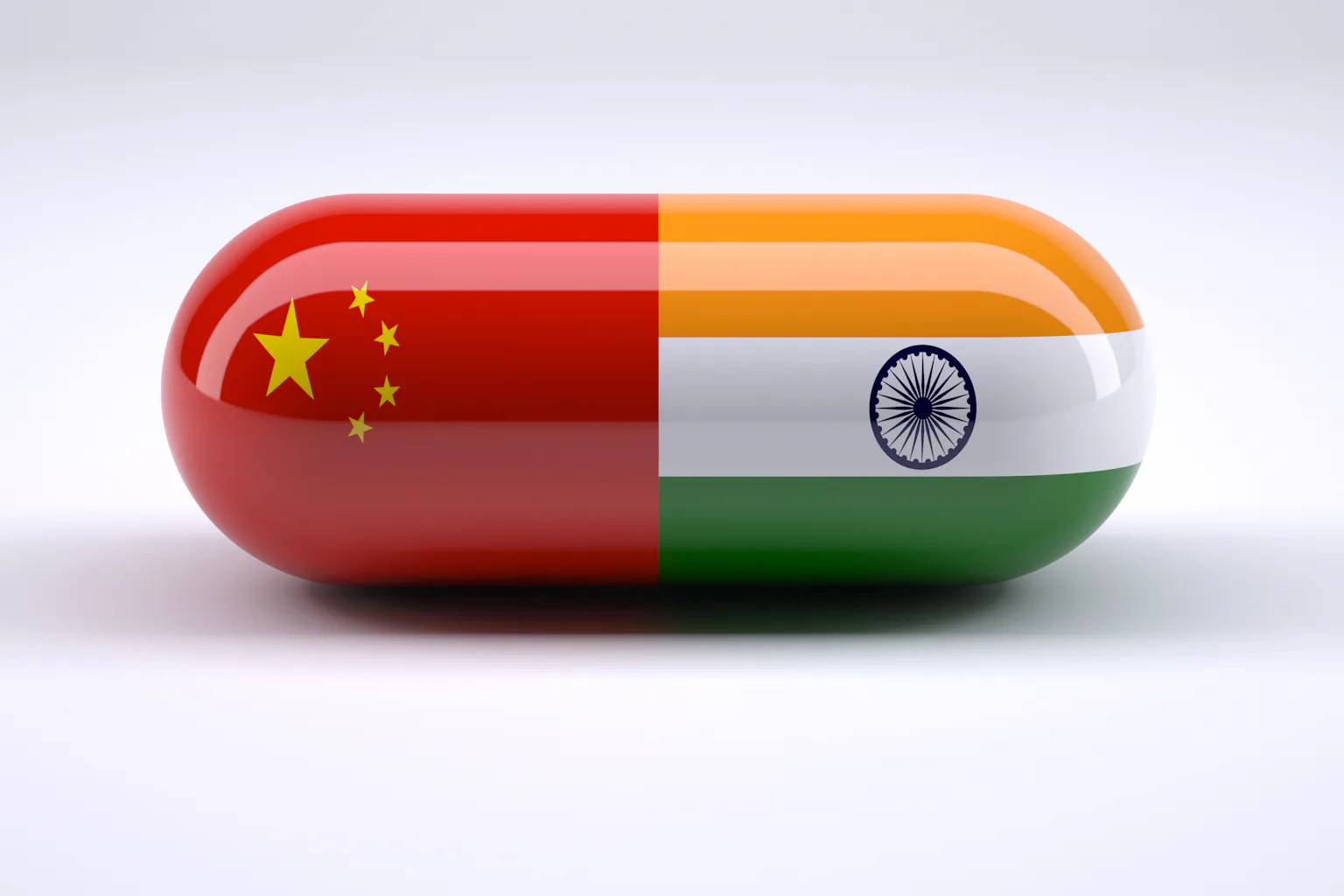
The China Comparison – A Mirror India Cannot Ignore
If there is one comparison that makes this contrast clearer, it is China.
Over the past few decades, China did not just participate in the global pharmaceutical supply chain – it restructured itself to dominate it. Through coordinated policy, large-scale industrial zones, aggressive infrastructure building, and consistent support for exports, it created an ecosystem that moved from low-cost manufacturing to strategic control over key segments like APIs.
More importantly, China aligned its long-term vision with execution.
It invested heavily in R&D, built self-sufficiency in critical inputs, and steadily upgraded its capabilities toward more complex and high-value products. Regulatory reforms were not reactive; they were part of a broader strategy to integrate with global standards and build credibility.
India, in contrast, has moved forward but in a far more fragmented way.
There have been successes, no doubt. But the approach has often been incremental rather than coordinated. Infrastructure comes up in parts, policy support arrives in phases, and industry efforts remain uneven.
The result is a gap – not in potential, but in pace. And in a global market that is evolving rapidly, pace matters.
The Last Bit – Real Question
At first glance, the headline is hard to argue with. 2 to 2.5 million new jobs in healthcare and pharmaceuticals by 2030 is not just growth – it signals scale, demand, and opportunity.
But numbers, on their own, can be misleading. Because this is not just about how many jobs India creates. It is about what kind of economy those jobs are building.
If the current trajectory holds, India will continue to expand its role as a critical supplier to the world – manufacturing more, exporting more, employing more. But unless this growth is matched by a decisive shift toward innovation, complex therapies, and high-value research, the country risks reinforcing the very model it now needs to outgrow.
A larger workforce does not automatically translate into greater influence.
A bigger industry does not guarantee a stronger position. The real test lies elsewhere.
Will India use this moment to move beyond being the world’s most reliable low-cost producer? Or will it simply become a more efficient, more expansive version of the same system?
Because in the end, the question is not whether India will power the future of global healthcare. It already does. The question is whether it will own a meaningful part of that future or continue to build it for someone else.