The Strait of Hormuz Is Not The Crisis. It Is A Rehearsal, Says Vivian Balakrishnan. The Future Of US–China Confrontation, Is The World Watching The Wrong War?
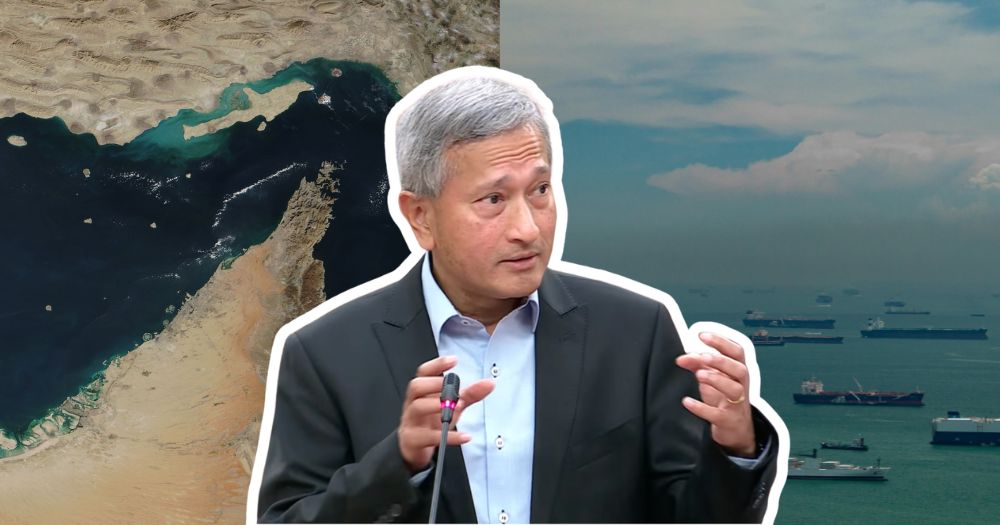
At a time when global attention is fixed on rising tensions in the Middle East, a remark by Vivian Balakrishnan cuts through the noise with unusual clarity. He described the crisis in the Strait of Hormuz not as the main event, but as a “dry run” - a precursor to something far more consequential. The implication is difficult to ignore. What the world is witnessing today may not be the conflict that defines this decade, but a preview of the one that will. And if that is true, then the real story is not unfolding in the Gulf, but gathering momentum elsewhere.

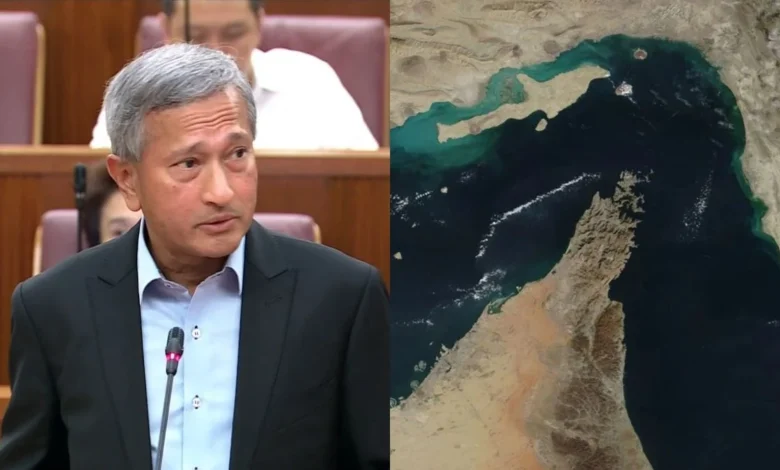
The Strait of Hormuz has long been one of the most critical arteries of the global economy, but the events of 2026 have demonstrated just how fragile that artery truly is.
As tensions escalated, oil prices surged past $120 per barrel, reflecting not just immediate supply fears but the deeper anxiety of systemic disruption. Nearly 20 percent of the world’s oil flows through this narrow passage, and even the suggestion of instability was enough to send shockwaves across markets.
Yet, focusing on oil alone understates the scale of the disruption. The ripple effects were immediate and widespread. Fertilizer supplies tightened, industrial gases such as helium faced constraints, and aluminium markets showed signs of stress. What appeared at first to be an energy crisis quickly revealed itself as something far broader—a multi-sector disturbance with global implications.
Equally significant was the transformation of shipping dynamics. What had once been a predictable commercial route became a contested corridor. The presence of naval escorts, the threat of mines, and the increasing use of drones altered the calculus of maritime trade. Transit through the region was no longer routine; it became a strategic risk.
This is the first lesson the current crisis offers. In an interconnected global economy, chokepoints do not merely disrupt supply – they expose the vulnerability of entire systems. A single point of pressure, if applied effectively, can cascade across industries, geographies, and markets with remarkable speed.
And that is precisely why the Strait of Hormuz matters – not just for what it is, but for what it reveals.
The “Dry Run” – When a Crisis Becomes a Simulation
To describe a live geopolitical crisis as a “dry run” is to assign it a very specific meaning. It suggests not just disruption, but observation. Not just conflict, but calibration.
That is what Vivian Balakrishnan was pointing to.
Because what is unfolding around the Strait of Hormuz is not happening in isolation. It is being watched closely – by governments, militaries, corporations, and markets alike. Every escalation, every response, every hesitation is offering data.
The question is: data about what?
First, it is testing how quickly global supply chains can absorb a shock. The initial disruptions revealed just how tightly wound and interdependent modern systems have become. A disturbance in one narrow passage did not stay contained; it travelled across sectors with little resistance.
Second, it is revealing how states respond under pressure. The deployment of naval escorts, the signalling by major powers, the restraint shown in avoiding direct confrontation—all of these are not just reactions. They are templates. They show how far countries are willing to go, and just as importantly, where they choose to stop.
Third, it is exposing the limits of economic resilience. Markets reacted sharply, but more telling was the underlying uncertainty. Pricing mechanisms struggled not because of immediate shortages alone, but because of the fear of sustained disruption. In other words, the system is not just sensitive—it is anticipatory, and therefore volatile.
Finally, and perhaps most importantly, it is mapping political alignment. Countries are not declaring positions outright, but their actions – diplomatic, military, economic – are beginning to outline preferences. Who supports stability, who signals deterrence, who remains cautious – these distinctions matter, and they are being noted.
Seen this way, the current crisis is doing more than unsettling markets. It is quietly answering a far larger question: If a bigger conflict were to unfold, how would the world behave?
That is what makes this a “dry run.” Not because it mirrors a future conflict perfectly, but because it reveals the patterns that such a conflict would follow.
And those patterns do not point back to the Middle East. They point elsewhere.
The Shift in Theatre – From the Gulf to the Indo-Pacific
If the current crisis is a rehearsal, then the obvious question follows: where is the main stage?
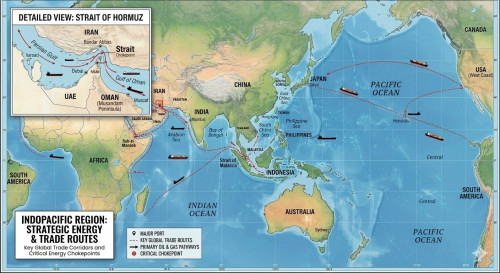
The answer lies not in the Middle East, but across a stretch of water far more consequential to the modern global economy—the Indo-Pacific. The critical corridors here are the South China Sea, the Taiwan Strait, and the Strait of Malacca. Together, they form the backbone of global trade, carrying everything from raw materials to finished goods at a scale that far exceeds any single route elsewhere.
This is where the comparison with Hormuz becomes essential.
The Strait of Hormuz is vital because it channels energy. Disrupt it, and oil markets react instantly.
But the Indo-Pacific is different. It does not merely move resources—it sustains production itself. It connects manufacturing hubs, supply chains, and consumer markets in a continuous flow. Interrupt that system, and the consequences extend well beyond commodities.
This is why Balakrishnan’s warning carries weight. A disruption in Hormuz creates shock. A disruption in the Indo-Pacific risks paralysis.
Consider the scale. A significant portion of global trade – by some estimates nearly half – passes through these waters. China’s role as the world’s largest exporter, combined with the dense manufacturing networks across East and Southeast Asia, means that these routes are not optional. They are foundational.
In such an environment, the nature of disruption changes. It is no longer about rising prices alone. It becomes about stalled production lines, delayed shipments, and broken supply chains. The system does not simply adjust – it begins to strain.
What emerges, then, is a clear shift in perspective. The Middle East remains strategically important, but it is no longer the centre of economic gravity. That centre has moved eastward, to a region where trade is not just a component of growth – it is the mechanism through which the global economy functions.
And if that mechanism is disrupted, the impact will not be contained. It will be systemic.
From Disruption to Paralysis – When Trade Stops Flowing
The lesson from the Strait of Hormuz is straightforward: disrupt a chokepoint, and markets react. Prices rise, volatility increases, and governments scramble to stabilise supply. But that logic only holds when the disruption is limited to a single resource – primarily energy.
Extend that same logic to the Indo-Pacific, and the scale changes dramatically.
A disruption across the South China Sea, the Taiwan Strait, or the Strait of Malacca would not simply tighten supply—it would interrupt the movement of goods across entire industries simultaneously. These are not specialised routes; they are the central highways of global commerce.
The difference is not just quantitative, but structural.
In Hormuz, roughly a fifth of global oil supply is at stake. In the Indo-Pacific, the exposure is far broader. A significant share of global trade – ranging from intermediate components to finished products – passes through these waters.
Manufacturing networks depend on continuous, predictable movement. Even short disruptions can stall production cycles that operate on tight timelines.
What follows is not a gradual adjustment, but a chain reaction.
Factories slow down as inputs fail to arrive. Inventories begin to thin. Delivery schedules become unreliable. Businesses that rely on just-in-time systems find themselves with no buffer. What begins as a maritime disruption quickly translates into a production slowdown across continents.
At that point, the issue is no longer confined to logistics. It becomes economic.
Because modern globalisation is built on flow—of goods, capital, and information. Interrupt that flow at scale, and the system does not simply become more expensive. It begins to seize.
This is where the comparison with Hormuz reaches its limit.
Hormuz demonstrates disruption. The Indo-Pacific, under stress, would demonstrate paralysis. And that is a far more difficult condition to manage.
When Prices Stop Rising and Goods Stop Arriving
If the early effects of the Strait of Hormuz disruption were felt through prices, the next phase of a larger conflict would be felt through absence.
This is where the distinction becomes critical.
In most crises, the first instinct is to measure impact through inflation – how much more expensive oil becomes, how sharply commodities react, how quickly markets adjust. But inflation, by its nature, assumes availability. It assumes that goods exist, even if at higher prices.
A prolonged disruption across the Indo-Pacific would challenge that assumption.
The global electronics ecosystem offers the clearest example. Manufacturing is deeply concentrated across China and East Asia, with critical semiconductor dependencies linked to Taiwan. Interrupt shipping routes or restrict access, and the effect is immediate – not just on consumer devices, but on industries ranging from automobiles to defence systems.
The same applies to pharmaceuticals, where supply chains depend heavily on Asian inputs. A break in that chain does not simply increase costs; it creates shortages that ripple through healthcare systems.
Add to that the strategic importance of rare earth materials – essential for energy, technology, and military applications – and the picture becomes more complex. These are not easily substitutable resources. Their disruption cannot be quickly offset.
Then there is the less visible but equally decisive factor: shipping itself.
Maritime trade does not function without insurance, predictable routes, and manageable risk. In a high-conflict environment, insurance premiums do not merely rise – they can become prohibitive. Coverage may be withdrawn altogether for certain routes. Shipping companies, faced with uncertainty, begin to reroute or suspend operations. What appears on paper as an available pathway becomes, in practice, inaccessible.
At that point, the system crosses a threshold.
The question is no longer how expensive goods have become. It is whether they can be delivered at all.
This is the shift from inflation to scarcity – a transition that is far more disruptive because it cannot be easily managed through monetary or policy tools. Prices can be adjusted. Supply gaps cannot be filled overnight. And once scarcity takes hold, the effects move beyond economics into stability itself.

War Without Missiles – Control Before Confrontation
One of the more revealing aspects of the current crisis is not what has happened, but how it has happened.
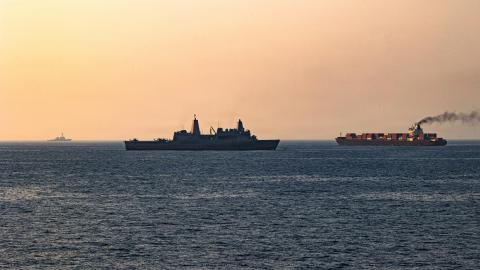
Despite heightened tensions, there has been no immediate slide into full-scale military confrontation. Instead, the response has taken a different form – measured, indirect, and focused on control. Naval deployments have increased. Commercial vessels are being escorted. Access to critical routes is being monitored, and at times, restricted.
This is not restraint in the traditional sense. It is strategy.
Modern conflict, particularly between major powers, is unlikely to begin with overt escalation. The costs are too high, the consequences too unpredictable. Instead, it begins with shaping the environment – establishing presence, influencing movement, and gradually tightening pressure points.
The Strait of Hormuz is offering a glimpse of that approach. Control over passage, rather than outright closure, has become the central lever. It allows for escalation without declaration, disruption without immediate retaliation. But transposed to the Indo-Pacific, this model becomes even more significant.
The Taiwan Strait and surrounding waters could, in a future confrontation, see similar patterns emerge. Restrictions on movement, selective enforcement, and the strategic use of presence could shape trade flows without triggering direct conflict in its early stages. At the same time, countermeasures – whether through allied naval coordination or route diversification – would begin to take form.
What emerges is a form of contest that is neither peace nor war in the conventional sense. It operates in a grey zone, where economic and military tools overlap. In such a scenario, escalation is gradual. Each move tests limits without immediately crossing them. But the cumulative effect is clear: pressure builds, options narrow, and systems begin to strain.
This is why the idea of conflict needs to be reconsidered. It may not arrive as a sudden rupture. It may unfold as a series of controlled constraints—each one manageable in isolation, but collectively transformative.
In that sense, war does not begin with missiles. It begins with the ability to decide who moves, and who does not.
The Fragmentation of Globalisation
If control over trade routes becomes a tool of pressure, the next logical shift is in how the global economy organises itself in response.
Because globalisation, as it exists today, is built on openness – on the assumption that goods, capital, and supply chains can move across borders with relative predictability. That assumption begins to weaken the moment access becomes conditional.
Even in the current environment, there are early signs of this shift. Countries are responding cautiously, calibrating their positions rather than committing fully. Economic ties are being weighed against strategic risks. Partnerships are becoming more selective, less automatic.
In a full-scale confrontation between the United States and China, this balancing act would become far more pronounced.
What emerges is not a collapse of global trade, but a reconfiguration.
Two broad economic spheres begin to take shape. One anchored around the United States and its allies, built on existing security partnerships and financial systems.
The other centred on China, supported by its manufacturing base, regional influence, and alternative trade arrangements. Between them lies a third category – countries that attempt to navigate both systems without being fully absorbed by either.
This is where the position articulated by Vivian Balakrishnan becomes significant. The idea of remaining engaged with both sides while avoiding alignment is not just diplomatic language; it is a strategy for survival in a divided system.
But such a strategy is not without limits.
As pressures intensify, neutrality becomes harder to maintain. Trade decisions begin to carry political weight. Supply chains are reshaped not just by efficiency, but by alignment. Access to markets, technology, and capital may increasingly depend on where a country is positioned within this emerging structure.
The result is a world that continues to trade, but no longer freely. Flows persist, but along narrower, more controlled pathways. This is the transformation that often goes understated.
Globalisation does not end under stress.
It fragments – into parallel systems that coexist, compete, and occasionally collide.
And once that fragmentation sets in, reversing it becomes significantly more difficult than maintaining it ever was.
Why Asia Changes the Equation
For decades, the Middle East has occupied a central place in geopolitical thinking, largely because of its role in global energy supply. Disruptions in the region have historically translated into immediate economic consequences, reinforcing its importance.
But the global economy has evolved.
Today, the centre of gravity lies in Asia—not just as a transit zone, but as the engine of production, supply chains, and consumption. From electronics and machinery to pharmaceuticals and consumer goods, a significant portion of global output is concentrated across this region.
This distinction is critical.
A disruption in the Middle East primarily affects supply—most notably energy. The system absorbs the shock through price adjustments, strategic reserves, and alternative sourcing where possible. The impact is significant, but it remains, to an extent, manageable.
A disruption in Asia operates differently.
Here, the issue is not just the movement of goods, but their creation. Factories, assembly lines, and component networks form tightly integrated ecosystems. Interruptions do not simply delay delivery; they halt production itself. And when production halts, the effects cascade outward – into trade, employment, and economic stability.
This is why a potential conflict centred in the Indo-Pacific carries a different order of risk. It is not about a single commodity or sector. It is about the functioning of the global economic system as a whole.
Balakrishnan’s warning reflects this shift. The Pacific is not just another playground – it is where the structural foundations of the modern economy are located. And when those foundations are tested, the consequences extend far beyond regional boundaries.
They become global, immediate, and difficult to contain.
What the Hormuz Crisis Has Already Proven
By now, the outlines of the argument are clear. The events surrounding the Strait of Hormuz are not an isolated disruption. They are a demonstration – one that has already revealed several underlying realities of the modern global system.
The first is the power of chokepoints. In a highly interconnected economy, control over a narrow passage can have disproportionate effects. It does not require widespread conflict to generate global consequences; targeted disruption is sufficient.
The second is the reach of economic impact. What begins as a regional issue does not remain confined. Supply chains extend across borders, industries depend on shared inputs, and markets react to both present conditions and future expectations. The result is a spread of disruption that is both rapid and far-reaching.
The third is the nature of escalation. Conflict does not necessarily begin with direct confrontation. It can emerge gradually, through measures that fall short of open warfare but still exert significant pressure—on trade, movement, and access.
Taken together, these lessons form a framework.
They show how modern crises unfold, how systems respond, and where vulnerabilities lie. More importantly, they provide a basis for understanding what a larger confrontation might look like – not in abstract terms, but in practical, observable patterns.

The Last Bit, From Crisis to Systemic Shock
The significance of Balakrishnan’s remark lies in its ability to connect these patterns to a larger possibility.
If the Strait of Hormuz represents a crisis, then it is one that the global system, for now, is attempting to absorb. Markets adjust, governments respond, and trade, though strained, continues to function.
But extend the same dynamics to a confrontation between the United States and China, centred in the Indo-Pacific, and the scale shifts.
The disruption becomes broader, the interdependencies deeper, and the pathways to resolution more complex. What is manageable in one region may not be in another. What is temporary in one context may become structural in another.
In such a scenario, the impact is unlikely to be confined to volatility or short-term adjustment. It would affect production, trade flows, and economic alignment simultaneously.
This is where the distinction becomes unavoidable.
A crisis tests the system. A systemic shock reshapes it. And that is the possibility embedded within the current moment.
The events in the Gulf are not insignificant. But they may not be the defining challenge ahead. They may, instead, be the indication of how the next, far larger disruption will unfold.
If the Strait of Hormuz is a crisis, a US–China confrontation would not be one. It would be a systemic shock to the global economic order itself.