Indian IT Lost Rs 1.35 Lakh Crore In A Day. Why Accenture’s Warning Has Sent Indian IT Into Panic Mode, Is AI Making Traditional Outsourcing Obsolete?
Accenture's guidance cut may have erased Rs 1.35 lakh crore from Indian IT stocks in a single trading session, but the market's reaction reflects something deeper. Investors are no longer worried about a temporary slowdown. They are beginning to question whether the industry's traditional growth model still works in an AI-driven world.


The Rs 1.35 lakh crore wipeout in Indian IT stocks may appear excessive for what was essentially a modest guidance cut from Accenture. But markets are rarely reacting to a single event. More often, they are reacting to what that event confirms.
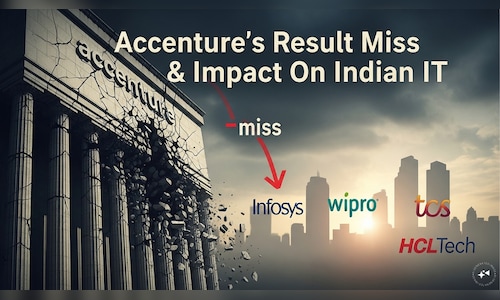
Accenture‘s decision to lower the upper end of its FY26 revenue growth guidance from 5% to 4% was not merely a revision of numbers. It was an acknowledgment that the demand environment remains weaker than many had hoped. More importantly, it challenged the belief that technology spending was finally on the verge of a meaningful recovery.
The warning travelled quickly from Wall Street to Dalal Street.
Infosys plunged more than 8%, while TCS, HCL Tech, Tech Mahindra and several other IT majors suffered sharp losses. The Nifty IT index slumped 6%, extending what has already been a painful year for one of India’s most celebrated sectors.
For investors, the concern was not Accenture’s quarterly performance. Revenue still grew, earnings remained healthy and bookings did not collapse. The real concern lay in the message hidden beneath the headline numbers. Enterprise clients across major markets continue to delay discretionary technology spending, consulting demand remains subdued and decision-making cycles are becoming longer rather than shorter.
That matters because Indian IT companies remain deeply dependent on the same global clients that Accenture serves. When the world’s largest consulting and technology services company signals caution, investors assume the rest of the industry is likely facing similar challenges.
Yet the market’s violent reaction suggests something deeper than worries about a weak quarter or even a weak year. Investors are beginning to ask whether the problem facing Indian IT is cyclical, or whether the industry is entering a far more profound transition. Accenture’s guidance cut merely brought those fears to the surface.
The Recovery That Never Arrived
For much of the past two years, the Indian IT industry has been selling investors a familiar promise: the slowdown was temporary, budgets would eventually return, and discretionary technology spending would recover once economic uncertainty faded.
That recovery has remained frustratingly elusive.
Accenture’s latest numbers reinforced a trend that has become increasingly difficult to ignore. While companies continue to spend on essential technology infrastructure, they remain reluctant to commit large sums to consulting-led transformation projects. Businesses are scrutinizing every technology dollar, delaying non-essential initiatives and stretching decision-making timelines far beyond historical norms.
The reasons are not difficult to identify. Higher interest rates, geopolitical conflicts, slowing growth in major economies and persistent uncertainty over future demand have forced corporate executives into preservation mode. In such an environment, ambitious digital transformation projects often become easy candidates for postponement.
For Indian IT companies, this matters because discretionary spending has traditionally been one of the sector’s most profitable growth engines. Large consulting engagements often opened the door to years of implementation, maintenance and support work. When consulting pipelines weaken, the impact eventually spreads across the broader technology services ecosystem.
The problem is particularly evident in sectors such as manufacturing, automotive and retail, where companies continue to face volatile demand conditions. Even where technology investments are proceeding, clients are increasingly demanding faster returns, clearer business outcomes and lower implementation costs.
As a result, many Indian IT firms find themselves trapped between rising expectations and slowing demand. Investors have spent several quarters waiting for a meaningful rebound in spending patterns. Instead, every earnings season seems to bring another reminder that clients remain cautious and budgets remain tightly controlled.
The uncomfortable reality is that the industry’s biggest challenge is no longer a temporary slowdown. It is the possibility that the spending environment has fundamentally changed. If clients have permanently become more selective about technology investments, then the growth assumptions that once justified premium valuations may need to be reconsidered.

AI Is Not Just Creating Opportunities. It Is Eliminating Work
For years, every major technological shift has ultimately benefited the IT services industry. Cloud computing created migration projects. Digital transformation generated consulting mandates. Cybersecurity opened new revenue streams. The assumption was simple: new technology meant new business.
Artificial intelligence is different.
Unlike previous technology waves, AI is not merely creating fresh opportunities. It is also reducing the amount of human effort required to perform existing work. Tasks that once demanded teams of programmers, testers, analysts and support engineers can now be completed significantly faster with the assistance of AI-powered tools.
The implications for traditional outsourcing are profound.
The Indian IT industry’s growth story has historically been built on scale. Companies hired thousands of engineers, deployed them across client projects and generated revenue through billable hours. The larger the workforce, the larger the potential revenue base. AI threatens to disrupt that equation by increasing productivity while simultaneously reducing the need for manpower.
This challenge is already becoming visible. Enterprises are increasingly asking service providers not just how they can implement AI, but how AI can lower project costs and reduce headcount requirements. In other words, clients want the benefits of technology without paying for large armies of consultants and engineers.
To be clear, AI is not eliminating the need for IT services. Businesses still require cloud migration, data modernization, cybersecurity, integration and governance expertise. However, the nature of that demand is changing rapidly.
Clients are no longer willing to pay for repetitive work that can be automated. They increasingly expect service providers to deliver more output with fewer people.
That creates a difficult balancing act for traditional IT companies. On one hand, they must aggressively adopt AI to remain competitive. On the other, every productivity gain achieved through AI potentially reduces the volume of work on which their existing business models were built.
Infosys, TCS, Wipro and their peers are investing heavily in AI platforms, partnerships and capabilities. Yet investors remain uncertain whether these initiatives will generate enough new revenue to offset the potential erosion of traditional services income. The concern is not that AI will destroy the industry. It is that AI may compress revenues and margins before new business models have fully emerged.
For decades, technology created more work than it eliminated. The question now confronting Indian IT is whether artificial intelligence will reverse that relationship. If it does, the industry may be entering the most significant transition in its history.

The Outsourcing Playbook Is Being Rewritten
If artificial intelligence is changing how work is performed, it is also changing who performs that work.
The technology services industry, for decades, operated on a relatively predictable model. Companies won consulting contracts, deployed large teams, managed implementation, provided ongoing support and generated recurring revenue from long-term client relationships. Scale was the competitive advantage, and the firms with the largest talent pools often enjoyed the strongest market positions.
That model is now facing its most serious challenge yet.
The emergence of AI-native companies is creating a new template for technology services, one that relies less on manpower and more on platforms, automation and specialized expertise. Instead of assembling thousands of consultants for large-scale deployments, these firms aim to deliver solutions through AI-powered systems that require significantly smaller teams.
This shift helps explain why some analysts believe the next generation of industry leaders may not resemble the outsourcing giants that dominated the previous era. New entrants are building businesses around proprietary AI tools, automated workflows and platform-based delivery models rather than traditional labour-intensive execution.
The implications extend beyond competition. They strike at the heart of how value is created within the industry. Traditional IT services companies have historically benefited from expanding workforces and long-duration contracts. AI-native firms, by contrast, seek to generate greater output with fewer people and shorter deployment cycles.
This does not mean established players are destined to lose. Companies such as Infosys, TCS and HCLTech possess deep client relationships, global delivery networks and decades of institutional expertise. Those advantages cannot be replicated overnight. However, history offers little comfort to industries facing technological disruption. Market leadership in one era does not automatically guarantee dominance in the next.
To their credit, Indian IT firms are already adapting. Investments in AI platforms, acquisitions, partnerships and automation capabilities reflect an understanding that the old playbook cannot be relied upon indefinitely. Yet adaptation is rarely painless. New business models often emerge long before old revenue streams disappear, creating years of uncertainty and competitive pressure.
That uncertainty is precisely what investors are struggling to price today. The challenge is no longer determining whether AI will transform the technology services industry. The challenge is identifying who will benefit most from that transformation and who will bear the cost of it.
The outsourcing industry is not disappearing. But the rules that governed its growth for the last three decades are being rewritten, and the winners of the next chapter may look very different from the winners of the last one.
)
Why The Market May Not Be Done Repricing Indian IT Yet
The sharp correction in IT stocks has inevitably sparked a familiar debate: has the selloff gone too far?
Many investors would argue that a sector that has already lost nearly a third of its value this year should begin to look attractive. Yet markets rarely value companies based on where they have traded in the past. They value them based on expectations of future growth. And that is precisely where the uncertainty lies.
Brokerages such as Jefferies have warned that Accenture’s revised outlook could trigger another round of earnings estimate cuts for Indian IT companies. If revenue growth continues to slow and clients remain cautious on discretionary spending, analysts may be forced to revisit assumptions that still appear optimistic in parts of the market.
The valuation question becomes even more important when viewed against global peers. Despite the recent correction, several Indian IT companies continue to command significant valuation premiums compared to international technology services firms. Investors have historically been willing to pay those premiums because Indian companies consistently delivered superior growth, strong margins and predictable cash flows.
Today, each of those assumptions is facing scrutiny.
Growth is slowing. Margins are under pressure from wage inflation and competitive pricing. At the same time, artificial intelligence is creating uncertainty around future revenue models. When the visibility on earnings becomes less certain, investors typically become less willing to pay premium multiples.
This is why the recent selloff may be less about quarterly earnings and more about a reassessment of long-term expectations. The market is attempting to determine what Indian IT companies should be worth in a world where growth is slower, competition is intensifying and AI is reshaping the economics of technology services.
That process can be painful. History shows that valuation resets rarely happen in a single move. Instead, they unfold gradually as investors adjust their assumptions to new realities. Every earnings downgrade, every delayed project and every sign of weakening demand adds another layer of pressure.
None of this means that Indian IT has suddenly become a poor industry. The sector remains highly profitable, globally competitive and financially strong. However, investors are increasingly demanding proof that future growth can justify yesterday’s valuations.
The market’s message is becoming clear. The question is no longer whether Indian IT companies can survive the current slowdown. The question is whether they can grow fast enough in an AI-driven world to deserve the premium valuations they once enjoyed almost unquestioningly.
The Last Bit, Can Indian IT Reinvent Itself Once Again?
Predictions about the decline of Indian IT are hardly new. Over the past three decades, the industry has repeatedly faced moments that appeared existential at the time. The Y2K opportunity eventually faded. The Global Financial Crisis disrupted technology spending. Cloud computing threatened traditional infrastructure services. Digital transformation altered delivery models and client expectations.
Yet each time, the sector adapted.
That history is worth remembering amid the current pessimism. While artificial intelligence undoubtedly presents new risks, it also creates opportunities. Companies around the world still need help modernising legacy systems, managing complex cloud environments, securing data, integrating AI into business processes and navigating an increasingly complicated technology landscape.
In fact, the AI revolution itself may become a significant source of future demand. Enterprises may understand the promise of artificial intelligence, but many still lack the expertise required to deploy these technologies at scale. This creates an opening for technology services firms that can position themselves as trusted implementation and transformation partners.
The challenge is that this transition will not happen overnight. The revenue generated from AI-related projects remains relatively small compared to the vast streams of income produced by traditional outsourcing and managed services contracts. There is likely to be a period where old businesses slow faster than new businesses grow.
That transition phase could prove uncomfortable for both companies and investors. Firms may have to rethink workforce structures, invest aggressively in reskilling employees, pursue acquisitions and develop entirely new service offerings. Margins could come under pressure and growth may remain uneven as the industry adjusts to a fundamentally different environment.
The strongest players, however, possess advantages that should not be underestimated. Deep client relationships, global delivery capabilities, strong balance sheets and decades of operational experience provide a foundation that newer competitors often lack. The question is not whether Indian IT companies have the resources to adapt. The question is whether they can adapt quickly enough.
Ultimately, the market’s brutal reaction to Accenture’s warning reflects more than concerns about a weak quarter or a cautious outlook. It reflects a growing realization that Indian IT is confronting two challenges simultaneously: a cyclical slowdown in technology spending and a structural transformation driven by artificial intelligence.
The first challenge will eventually pass. The second is likely to define the industry’s future.
And that is why investors are no longer merely watching quarterly earnings. They are watching for evidence that the business model which made Indian IT one of the country’s greatest corporate success stories can evolve once again for a radically different technological era.