Bhavish Aggarwal, Ola Electric, And The World Of Scams.
The Number That Didn't Add Up: Inside Ola Electric's Disclosure Crisis and What It Reveals About India's Startup Ecosystem

In recent months, social media posts, circulating from Delhi to Karnataka, Tamil Nadu to Madhya Pradesh, have described electric scooters bearing valid registration plates being offered to fresh buyers at discounts of up to 50%, marketed as new and unused. These posts are anecdotal. They have not been independently verified by this publication, no regulator has confirmed their specifics, and Ola Electric has not been asked to respond to these particular claims as reported.
They are included here not as evidence of wrongdoing, but because the question they raise, that how does a vehicle that has already been registered to a buyer end up being resold as new stock?
According to multiple reports citing people familiar with the matter, the Securities and Exchange Board of India issued a show-cause notice to Ola Electric and its founder, Bhavish Aggarwal, on April 10, alleging that the company may have disseminated false and misleading information about its sales, deliveries, and service-network expansion. These are the disclosures that, per SEBI’s own observations, coincided with measurable movements in the company’s share price. Ola Electric and Aggarwal filed a settlement application less than two weeks later, on April 23, seeking to resolve the matter “without admission or denial” of the underlying allegations.
Why there is the gap between what Ola Electric told investors and what its own internal records, its statutory auditor, and government registration data appear to show- ans it is large enough, and recurring enough, to raise a question that extends well beyond one company: has India’s startup ecosystem normalized treating investor disclosure as a marketing function rather than a legally accountable one?
And if a SEBI settlement, closed “without admission or denial,” with no return of the wealth lost by two million retail shareholders, is the most serious consequence that results, what does that tell every other founder watching how this plays out?
Question 1: How a “Sold” Vehicle Is Supposed to Work in India?
To understand why discrepancies between reported sales and registration data matter, it helps to understand how vehicle sales are actually supposed to flow in India, step by step. When a two-wheeler company like Ola Electric reports a “sale,” that term can legitimately mean several different things depending on the stage of the transaction:
A dealer invoice (the company shipping a vehicle from its factory or warehouse to a dealer or store, which books revenue for the manufacturer in some accounting treatments but does not mean a customer has bought anything yet); a confirmed customer order or booking (a customer has paid a deposit or placed an order, but no vehicle has changed hands); and final retail delivery, which in India is formally completed through registration on the government’s VAHAN portal, the Ministry of Road Transport and Highways’ centralized vehicle registration database at which point the vehicle receives its number plate and legal ownership transfers to the named buyer.
Ola Electric has told stock exchanges that it recognizes revenue specifically at the point of delivery, after registration is completed, which is a fact the company has stated directly in regulatory filings responding to scrutiny of its sales figures. This matters enormously, because it means that for Ola Electric’s own accounting policy, “sold” and “registered” should, in principle, refer to roughly the same population of vehicles, give or take normal administrative lag of a few days to a couple of weeks for paperwork processing.
A persistent, large gap between a company’s announced sales figure and the number of vehicles actually appearing in VAHAN registration data in the same period is not, by itself, proof of wrongdoing. Legitimate explanations exist like regional delays in registration processing, batch uploading of VAHAN data that lags real-world registration by days, definitional differences between what a company calls a “sale” (which might include confirmed, paid bookings awaiting delivery) versus a completed registration, and genuine seasonal mismatches between when orders are taken and when vehicles are physically delivered.
But a sufficiently large, sufficiently repeated gap, particularly one that a company itself later concedes reflects a difference between “orders” and “deliveries” without having clearly disclosed that distinction to the market in real time, starts to look less like noise and more like a disclosure problem. That is precisely the distinction SEBI’s investigation appears to have focused on.
Question 2: What “Channel Stuffing” Actually Means, and Why Investors Watch for It
Channel stuffing is a well-documented and, unfortunately, well-precedented form of revenue manipulation in which a manufacturer ships more product into its distribution channel to dealers, retailers, warehouses, than the channel can realistically sell through to end customers, books the shipment as revenue, and effectively borrows future-quarter sales to make the current quarter look stronger than it is. It is not always illegal on its own; aggressive but disclosed channel loading is a normal part of competitive sales strategy. It becomes a securities-law problem when it is not disclosed, when it is used specifically to manufacture a misleading impression of demand, or when revenue is recognized in violation of applicable accounting standards.
The pattern has a long history in corporate accounting scandals. Sunbeam Corporation, under CEO Al Dunlap in the late 1990s, was found to have used “bill and hold” arrangements and aggressive channel stuffing to inflate reported sales, ultimately triggering an SEC investigation and a restatement of its financials. Bristol-Myers Squibb agreed to pay a $150 million SEC settlement in 2004 over channel-stuffing practices in which the company pressured wholesalers to buy more pharmaceutical inventory than needed to hit earnings targets, a practice the company itself referred to internally as “trade loading.”
Symbol Technologies similarly faced SEC and criminal charges in the early 2000s tied to channel stuffing, false revenue recognition, and other accounting irregularities, ultimately resulting in a $37 million SEC settlement and criminal convictions of several executives. Valeant Pharmaceuticals, in a more recent and more complex case, faced scrutiny over its relationship with the specialty pharmacy Philidor, where investigators examined whether its distribution arrangements were used to inflate apparent product sell-through.
The common thread across these cases is instructive: in each one, what eventually surfaced was not a single smoking-gun document, but a persistent, hard-to-explain gap between a headline sales number and an independently verifiable, harder-to-manipulate secondary data source — wholesaler inventory levels, pharmacy fill data, or in Ola Electric’s case, government vehicle registration records. Investors and forensic analysts learn to watch for exactly this kind of gap, because management has far more control over how it characterizes “sales” in a press release than it does over a centralized, government-administered registration database that exists entirely outside the company’s control.
Ola Electric’s Sales Story, Chronologically
Ola Electric listed on Indian exchanges in August 2024 at an issue price of ₹76 per share, riding genuine enthusiasm for India’s electric two-wheeler growth story and the company’s position as the segment’s reigning leader — a position it had held for three consecutive years, from CY2022 through CY2024, according to industry data compiled by Autocar Professional.
That leadership position did not survive 2025. According to retail sales data tracked through the VAHAN portal and compiled by industry publications, Ola Electric’s market share fell from over 40% in late 2024 to roughly 11.5% by October 2025, and its full-year CY2025 registrations fell 51% year-on-year, dropping the company to fourth place in the annual e-2W rankings behind TVS Motor (which finished the year as market leader with nearly 299,000 units sold), Bajaj Auto, and Ather Energy.
By November 2025, Ola had fallen further still, to fifth place behind Hero MotoCorp’s Vida brand, selling just 8,400 units that month against TVS’s 30,309 — a 71% year-on-year decline for Ola in a month where the overall e-2W market grew only modestly. Year-end CY2025 figures put Ola’s market share at roughly 16%, down from over 33% the prior year, according to one industry analysis — a decline that occurred even as the overall electric two-wheeler market grew to a record 1.28 million units sold.
It was against this backdrop of genuine, verifiable commercial decline that the disclosures now under SEBI’s scrutiny were made. On December 25, 2024, in the middle of this slide, Ola Electric announced it had crossed 3,200 “co-located” outlets (stores combining sales and service functions) under an expansion initiative the company branded Project Vistaar.
SEBI’s own subsequent data-gathering, according to multiple reports citing the regulator’s findings, showed only 452 such outlets actually operational as of February 19, 2025 — compared with 429 outlets at the time of the company’s IPO five months earlier. That arithmetic, if SEBI’s figures are accurate, implies the network grew by just 23 outlets in the period during which the company was publicly claiming an expansion into the thousands.
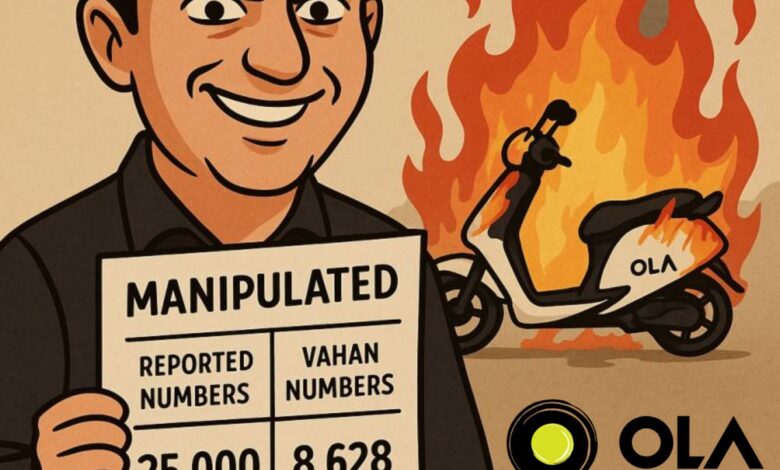
In February 2025, Ola Electric announced it had sold more than 25,000 electric two-wheelers that month, claiming over 28% market share. SEBI’s investigation reportedly found that VAHAN registration data for the same month showed only 5,341 actual vehicle registrations, with revenue recognized by the company on just 2,848 units — and that the 25,000-plus figure represented confirmed customer orders rather than completed sales, a distinction SEBI has alleged was not made sufficiently clear to the market at the time.
An earlier Business Standard report, citing slightly different figures, put the VAHAN registration number for that month at approximately 8,600, a discrepancy in secondary reporting worth flagging plainly, since it illustrates that even verified-sounding figures can vary by source and require care before being treated as settled fact. SEBI also reportedly found that of the orders Ola had touted, a substantial share were not as solid as represented: advance payments accounted for around 68% of total order value rather than the roughly 90% figure the company had suggested, and 3,333 of the February orders were later cancelled — including 2,560 by April 2025 — without, SEBI alleges, a corrective disclosure being issued to the exchanges at the time.
The VAHAN Gap, Examined on Its Own Terms
It is worth pausing on the VAHAN gap specifically, because it is the single most concrete, hardest-to-dispute data point in this entire story — precisely because VAHAN is not a number Ola Electric produces or controls. It is a government-administered registration system, and a registration entry requires a physical vehicle, a buyer’s documentation, and a completed transaction. Unlike a company’s self-reported “sales” or “orders” figure, it is structurally resistant to the kind of definitional flexibility that gives a company room to characterize ambiguous figures favourably.
This is precisely why the gap matters as a forensic signal even where individual reported figures differ slightly across sources. Whether the February 2025 VAHAN figure was 5,341 (the number reportedly identified in SEBI’s investigation) or roughly 8,600 (the number cited in earlier Business Standard reporting), both figures sit dramatically below the 25,000-plus units the company publicly announced that month. A gap of that magnitude, recurring as a pattern rather than a one-off anomaly, is the kind of signal that — per the channel-stuffing precedents discussed above — typically draws exactly the regulatory attention it appears to have drawn here.
It is equally important to state what this gap does not, by itself, prove. Ola Electric’s own explanation, that the larger figure reflected customer bookings rather than completed, registered deliveries, is not an inherently implausible accounting position; many consumer companies do report bookings or pre-orders as a forward indicator of demand.
The dispute, as SEBI has reportedly framed it, is not that the company tracked bookings internally, but that it allegedly failed to clearly and consistently disclose to the market that the headline figure represented bookings rather than completed sales, and allegedly shifted its terminology between “registrations” and “orders” across different disclosures without flagging the change — a pattern that, if accurate, would matter a great deal to any investor trying to model the company’s actual run-rate of cash-generating deliveries.
What the Auditor Actually Said?
Separately from the SEBI probe, and this distinction matters, because these are two different regulatory and professional processes examining related but not identical questions, Ola Electric’s statutory auditor, BSR & Co. LLP, raised its own concerns in the company’s FY25 (year ended March 31, 2025) annual report.
The auditor identified what it formally termed a “material weakness” in internal controls at Ola Electric Technologies Private Limited, the wholly owned subsidiary that the company has stated accounted for nearly 99% of Ola Electric Mobility’s consolidated revenue in FY25. Specifically, BSR stated that the subsidiary “did not have an appropriate internal control system for physical verification of raw material and finished goods located at its stores and state distribution centres,” and that this deficiency “could potentially result in material misstatements” in the company’s reported inventory, cost of materials consumed, and related account balances.
Reported figures for the value of inventory affected by this verification gap have varied slightly across outlets — figures of ₹362 crore and ₹367 crore have both appeared in reporting on the same underlying disclosure, likely reflecting different reference dates or rounding within the audit report itself, and this article does not treat either figure as more authoritative than the other without access to the primary document’s precise wording.
It is essential to be precise about what “material weakness” and “unable to physically verify” mean in accounting terms, because these phrases are frequently misunderstood or overstated in public discussion. A material weakness in internal controls is a finding about process, but it means the company’s systems and procedures were not adequate to reliably confirm that the inventory recorded in its books actually existed, in the stated quantity and condition, at the locations claimed.
It is not, on its own, a finding that the inventory did not exist, that fraud occurred, or that the company’s financial statements were false. Indeed, BSR’s own report reportedly stated that, except for the effects of the described material weakness, the company maintained adequate internal financial controls “in all material respects” and that those controls were “operating effectively” as of March 31, 2025 — a far more measured conclusion than “the company cannot account for its inventory.”
That said, the auditor’s report also flagged something considerably harder to wave away as a mere process gap: discrepancies between inventory figures the company reported in its own books and the figures it separately reported to lending banks for the same reporting periods. For the quarter ended December 2024, the company’s books showed inventory of ₹367 crore, while its return filed with Bank of Baroda for the identical period showed ₹341 crore.
For the quarter ended September 2024, the company reported ₹320 crore in inventory to Bank of Baroda but ₹361 crore to Yes Bank for the same quarter. A similar discrepancy was flagged in customer dues outstanding — ₹1,187 crore in the company’s books versus ₹1,221 crore reported to Bank of Baroda for the December 2024 quarter. The auditor’s report also disclosed a separate, smaller matter: a suspected employee fraud at the subsidiary involving an amount exceeding ₹1 crore.
Ola Electric responded to these disclosures by stating, in an exchange filing, that the observation related to “an isolated case” of inventory verification at the subsidiary, attributable to a temporary realignment of inventory processes under an internal initiative it called “Project Lakshya” during the fourth quarter of FY25, and that there was no financial impact or actual misplacement of inventory. The company maintained that its auditors issued a clean opinion on both its standalone and consolidated financial statements overall.
What should an investor reasonably take from this section, holding both sides fairly? The auditor’s findings establish, on the documentary record, that Ola Electric’s internal systems produced materially different inventory and receivables figures for the same reporting periods depending on which external party — its own books, Bank of Baroda, or Yes Bank — was being told. That is a verified fact, not an allegation. Whether that reflects a one-off, temporary process disruption with no financial consequence, as the company has stated, or a more systemic weakness in financial controls during the very period when SEBI was separately examining the company’s sales disclosures, is a fair question that the public record, as it stands, does not fully resolve.
Project Vistaar, in Full
Project Vistaar deserves its own careful chronology, because it sits at the center of SEBI’s most quantitatively stark finding. The initiative was publicly framed by the company, including in statements attributed to Bhavish Aggarwal such as claims that “all stores have service capacity too” and references to a “4,000 Ola stores & service centres” network, as a major retail and service expansion designed to address mounting customer complaints about after-sales service — complaints that had already drawn attention from India’s Central Consumer Protection Authority and several state transport departments.
On December 2, 2024, ahead of the formal December 25 announcement, Ola’s shares reportedly rose 8.45% intraday alongside a spike in trading volume, a market reaction SEBI has pointed to as evidence that the expansion narrative was, in fact, material to investors and capable of moving the stock — a key threshold for whether a disclosure falls under securities-law disclosure obligations in the first place.
The verified numbers, as reported through SEBI’s reviewed data, are stark: 429 outlets at IPO (August 2024), a claim of over 3,200 outlets by December 25, 2024, and an actual count of 452 outlets as of February 19, 2025 — implying, per SEBI’s own arithmetic as reported, a net addition of just 23 outlets in the period when the company was publicly describing an expansion into the thousands.
This is not a rounding discrepancy or a difference in counting methodology between two similar figures; it is an order-of-magnitude gap between a publicly announced figure and the regulator’s own subsequently gathered data, and it is the single allegation in this entire dossier that is hardest to explain away as a definitional or timing nuance.
What SEBI’s investigation reportedly examined was not whether Ola Electric had an ambitious expansion plan — companies are entitled to discuss plans and targets — but whether the company represented a plan as an achieved fact to the market, in a way that influenced trading activity, without adequate basis for the specific numbers used. That distinction — aspiration versus accomplishment — is the crux of nearly every disclosure-fraud allegation in securities law, in India and elsewhere, and it is the frame through which the rest of this section, and indeed this entire article, should be read.
Did Investors Receive Misleading Information? The Legal Framework
India’s disclosure regime for listed companies rests primarily on the SEBI (Listing Obligations and Disclosure Requirements) Regulations, 2015, which require listed entities to promptly disclose any information that is “material” — meaning information that a reasonable investor would consider important in making an investment decision, or that is likely to have a bearing on the company’s share price.
Separately, the SEBI Act, 1992, and the Prohibition of Fraudulent and Unfair Trade Practices (PFUTP) Regulations prohibit the dissemination of information that is false or misleading and that is likely to induce the sale or purchase of securities, regardless of whether the disseminator personally profited from the misinformation. The Companies Act, 2013, separately imposes obligations on directors and officers regarding the accuracy of statements made in connection with a company’s affairs, with personal liability attaching in cases of demonstrated knowing misstatement.
According to reporting on the matter, SEBI’s investigation into Ola Electric specifically examined disclosures made between the company’s market debut in August 2024 and May 2025, citing potential breaches of both the PFUTP Regulations and the LODR Regulations — meaning the regulator’s concern spans both the “was this information false or misleading” question and the separate “was this material information disclosed properly and promptly” question.
Why do figures like store counts, sales volumes, and order quality matter so much under this framework? Because for a pre-profitability growth company like Ola Electric — one still posting substantial net losses years after its IPO — these operational metrics are often the primary basis on which investors, particularly retail investors without access to sophisticated internal modelling, can assess whether the business is actually scaling toward sustainability.
A store count or a monthly sales figure is not a peripheral detail for a company like this; for many retail buyers, it functions as a proxy for the entire investment thesis. If those proxies are inflated or insufficiently caveated, the harm to investor decision-making is arguably more severe, not less, than it would be for a mature, profitable company where investors have many other reliable metrics to fall back on.

If SEBI’s allegations were to be fully established through adjudication — which, given the settlement route the company has pursued, will likely not happen — the legal consequences under Indian securities law can include monetary penalties, disgorgement of any wrongful gains, debarment from the securities markets for specified periods, and, in cases involving demonstrated fraudulent intent, referral for criminal prosecution under the SEBI Act. None of those outcomes is determined or established by the facts as currently public; they represent the range of consequences the relevant statutes provide for, not a prediction of what will happen here.
The Settlement Route, and What It Actually Resolves
Ola Electric and Bhavish Aggarwal’s decision to seek settlement with SEBI is, procedurally, unremarkable — settlement is a well-established, legally sanctioned mechanism under SEBI’s Settlement Proceedings Regulations, and a large share of SEBI enforcement matters, across the Indian listed-company universe, conclude this way rather than through full adjudication.
It is important to be precise about what a settlement does and does not mean. A settlement application filed “without admission or denial” means exactly what it says: the company is not conceding that the underlying allegations are true, but it is also not contesting them through a full hearing process. SEBI evaluates the application, may impose a settlement amount and other terms (such as enhanced disclosure undertakings or strengthened internal controls), and if both sides agree, the proceeding is closed.
Crucially, a settlement is not equivalent to an acquittal, which would require an adjudicating officer or tribunal to actively find that the allegations were not established on the merits. It is closer to a negotiated resolution that allows both the regulator and the regulated entity to avoid the cost, delay, and public exposure of a full administrative hearing — a logic not unlike settlement practice in many enforcement contexts globally, including, for instance, the U.S. Securities and Exchange Commission’s long-standing and frequently criticized practice of allowing companies to settle “without admitting or denying” wrongdoing.
Companies generally choose settlement for straightforward reasons: it caps financial and reputational exposure, avoids the multi-year timeline of contested SEBI proceedings and potential appeals to the Securities Appellate Tribunal, and allows the company to present the matter publicly as closed and behind it — exactly the framing Ola Electric has reportedly sought in describing its wish to resolve the matter “amicably.”
The fair question is whether settlement, as currently structured, adequately protects the retail investors who were on the other side of the disclosures in question. A settlement payment, even a substantial one, flows to SEBI’s investor protection and education fund rather than directly compensating the specific shareholders who bought stock at prices the regulator itself has suggested may have been influenced by the disputed disclosures.
For a retail investor who bought shares near Project Vistaar’s announcement at prices around ₹89 and has watched the stock trade in the ₹40s through much of 2026 — a decline of more than 50% — a settlement that closes the regulatory matter without admission, without restitution, and without a public finding of fact does very little to address the actual harm experienced. This is not a criticism unique to Ola Electric’s case; it is a structural critique of how India’s settlement mechanism interacts with retail-heavy shareholder bases more broadly, and it deserves more scrutiny than it has received in coverage that has largely focused on the settlement as a neutral procedural footnote.
Two Million Retail Investors, and an Asymmetry Worth Naming
Ola Electric’s IPO in August 2024 attracted enormous retail participation, reflecting genuine public enthusiasm for India’s electric vehicle growth story and the broader cultural visibility of the Ola brand built over a decade as a ride-hailing company before its EV pivot. As of the company’s most recent public shareholding disclosures, public shareholders — the category that includes retail investors alongside other non-promoter, non-institutional holders — held approximately 49.6% of the company, against promoter holding of roughly 34.6% and combined foreign and domestic institutional holding of around 11%, as of March 2026 filings.
The share price trajectory since listing has been, by any measure, brutal for investors who bought near the IPO or during the subsequent run-up. The stock listed at ₹76, climbed in its early months of trading, but has since fallen to trade in the ₹40s through most of 2026, touching an all-time low of ₹22.25 along the way — a peak-to-trough decline exceeding 70%, and a decline from the IPO price itself of roughly 45%, even after a partial recovery from the lows.

A Qualified Institutional Placement completed in June 2026, priced at a floor of ₹37.74 per share, further diluted existing shareholders, including the retail base, at a price well below the IPO level, compounding the unrealized losses already sitting in millions of retail portfolios.
This matters for a reason that goes beyond sympathy for any individual investor’s losses: disclosure quality affects retail and institutional investors asymmetrically. Institutional investors typically have access to private company interactions, sell-side analyst scrutiny, and sophisticated alternative-data tools — including, ironically, the kind of VAHAN registration tracking that ultimately surfaced the gaps at the center of this story — that allow them to cross-check a company’s public claims in close to real time.
Retail investors overwhelmingly do not have these tools. They rely, almost by necessity, on the company’s own disclosures, news coverage of those disclosures, and broad market sentiment. When a disclosure later turns out to have been materially inflated, institutional investors are structurally better positioned to have hedged, sold early, or never bought in based on independent verification; retail investors disproportionately bear the downside. This asymmetry is precisely why disclosure regulation exists in the first place, and it is precisely why a settlement that closes a case without restitution sits uneasily against the scale of retail exposure involved here.
Where Did the Inventory Actually Go? An Honest Accounting of What We Don’t Know
Ola Electric’s auditor found it could not adequately verify the physical existence of inventory worth several hundred crore rupees at the company’s stores and distribution centers, attributing this to an internal-control weakness rather than to a specific finding of missing goods. Separately, SEBI’s investigation has examined a large gap between announced store counts and verified store counts, and between announced sales figures and VAHAN registration data, in overlapping time periods.
Separately still, unverified social media accounts have described already-registered scooters being resold at steep discounts in multiple states — an anecdotal pattern that, if true, would be structurally consistent with (though not proof of) some combination of returned inventory, cancelled-order vehicles being re-marketed, or genuine clearance sales of overstocked units, none of which would necessarily constitute wrongdoing on their own.
What is not known, on the current public record: whether the inventory verification gap identified by the auditor is connected in any way to the store-count or sales-figure discrepancies identified by SEBI — these may be entirely unrelated control issues that happened to surface in the same fiscal year, or they may share a common root cause; whether any specific volume of vehicles was registered without a genuine, willing end customer behind the registration; and whether the discounted-scooter social media pattern, if accurate, reflects a systemic practice or a series of unconnected, legitimate dealer-level clearance events.
The honest position, and the one this article takes deliberately, is that these are exactly the unanswered questions that a full SEBI adjudication — as opposed to a settlement closed without admission or denial — would ordinarily be expected to resolve through document discovery, forensic accounting, and testimony. Their absence from the public record is not, on its own, evidence of concealment; complex financial investigations frequently end without every question publicly answered, settlement or not. But it is worth stating plainly that the settlement route, by design, forecloses the kind of fact-finding process that might otherwise have answered the very question this section is titled after.
The Startup Culture Problem, Beyond Ola
It would be a mistake, and, frankly, a more comfortable but less honest conclusion to treat everything in this article as a story unique to one company and one famous founder. The pattern of growth-at-any-cost storytelling, in which vanity metrics substitute for verified fundamentals and aggressive public narrative substitutes for disciplined disclosure, has recurred across India’s startup ecosystem with enough frequency to suggest something structural rather than incidental.
The broader dynamic is not difficult to diagnose, even if it is difficult to fix. Venture-backed startups are built, almost by design, on a continuous narrative of acceleration — each funding round, each public announcement, each press cycle exists in service of justifying the next valuation step-up. Founders who built consumer-facing brands often become inseparable from those brands in the public imagination, creating a dynamic in which scrutiny of the company can feel, to media and investors alike, like scrutiny of a revered individual — a dynamic that several Indian business commentators have argued dampens the kind of skeptical, adversarial coverage that mature public companies in other markets routinely receive.
Indian financial media, while increasingly sophisticated and willing to pursue stories like this one, still operates within a startup ecosystem deeply intertwined with the same venture capital relationships, founder networks, and growth narratives that any rigorous, independent coverage must be willing to question — a structural tension that deserves more open acknowledgment across the industry than it typically receives, without this article alleging any specific instance of suppressed coverage it cannot verify.
The quarterly and IPO-cycle pressure compounds this further. Once a startup transitions from private VC funding rounds, where growth narratives are negotiated privately between sophisticated parties, to public markets, the same storytelling instincts that served the company well in private fundraising suddenly collide with a legal disclosure regime built for a different kind of accountability entirely.
A pitch deck projection that would draw, at most, hard questions from a venture partner becomes, once repeated to public markets as an achieved fact, a potential securities-law violation. Ola Electric’s case is illustrative precisely because it shows a company apparently continuing to communicate in the register of private-market storytelling — ambitious, narrative-forward, light on caveats — well after it had become subject to the public-market disclosure regime that simply does not tolerate that register in the same way.
Other governance episodes across India’s listed-startup landscape — disputes over founder conduct, board independence questions, and revenue-recognition controversies at various consumer technology companies in recent years — suggest this is not an isolated phenomenon, even where the specific facts differ meaningfully from company to company and should not be conflated with Ola Electric’s situation. The pattern worth naming is not that founders lie; it is that an ecosystem built to reward bold, accelerating narratives has not yet built disclosure habits, board oversight structures, or media scrutiny robust enough to reliably catch the gap between the narrative and the verified number before significant investor capital has already moved on the strength of the former.
Conclusion: The Question the Settlement Won’t Answer
Strip away the specific figures, the 3,200 versus 452 outlets, the 25,000 versus 5,341 registrations, the ₹362 crore of unverified inventory, and what remains is a single, recurring structural pattern: a company operating in public markets continued, for an extended period, to communicate growth metrics that diverged sharply from independently verifiable government and audit data, and the consequence likely to follow is a negotiated settlement that resolves nothing on the public record about whether those divergences were innocent, careless, or deliberate.
That outcome may be entirely lawful, procedurally unremarkable, and consistent with how SEBI settlement practice generally works. It may also be, simultaneously, an inadequate response to the scale of retail capital that moved on the strength of disclosures now under formal regulatory question. Both things can be true at once, and this article has tried, throughout, to hold that tension honestly rather than resolve it into a tidier verdict than the evidence supports.

The question this piece opened with — whether India’s startup ecosystem has come to treat disclosure as marketing rather than as legally accountable communication — does not have a clean yes-or-no answer in Ola Electric’s specific case, because that case is not yet legally closed. But the pattern of evidence assembled here — verified audit findings, verified regulatory allegations, verified registration data, and a verified settlement filed without admission of fact — should be enough, on its own, to make clear that the question is worth asking far more rigorously, of far more companies, than India’s markets currently seem inclined to ask it.