India Is Producing The World’s AI Talent. Can It Also Build The World’s Next AI Giants?
Can India become a global AI innovation powerhouse, or will it remain the world's largest supplier of AI talent? As countries race to dominate the next technological revolution, India's challenge is no longer producing brilliant researchers; it is creating an ecosystem where the next breakthrough is conceived, built and commercialised at home.

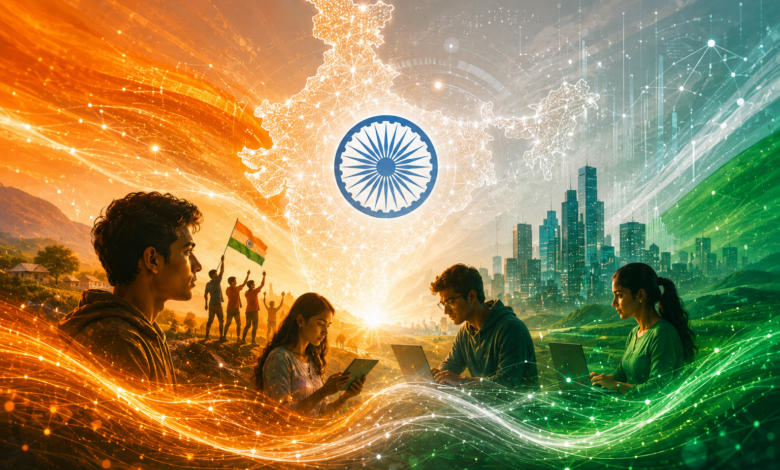
If there is one area where India has little reason to feel inferior, it is AI talent.
Over the past decade, India has quietly emerged as one of the world’s most important AI talent hubs. Today, it boasts one of the largest AI developer communities globally, ranks among the fastest-growing markets for AI adoption, and is home to a thriving ecosystem of startups building everything from enterprise automation tools to multilingual large language models.
The numbers are equally striking. According to Stanford University’s AI Index, India is now among the world’s most vibrant AI ecosystems, driven by rapid growth in AI talent, startup activity and enterprise adoption. The country also accounts for more than one-fifth of global AI job postings, second only to the United States, while demand for AI-skilled developers has surged by over 660% since 2021, according to Randstad Digital.
Yet, despite these impressive credentials, India remains conspicuously absent from the list of countries producing frontier AI breakthroughs.
The world’s most powerful AI models continue to emerge from companies such as OpenAI, Google DeepMind, Anthropic, Meta and, more recently, China’s DeepSeek. These organisations are not merely deploying AI; they are redefining what artificial intelligence is capable of.
India, meanwhile, has largely excelled in applying these technologies rather than inventing them. Its startups have built valuable businesses around enterprise AI, customer service automation, financial services and multilingual applications. But when it comes to developing foundation models, pioneering new AI architectures or pushing the scientific boundaries of the field, India still trails the global leaders.
This contrast exposes an uncomfortable paradox.
India has no shortage of brilliant engineers, researchers or entrepreneurs. In fact, many of the scientists shaping today’s AI revolution are of Indian origin. They are helping build the future of artificial intelligence – but often from laboratories in California, London or Toronto rather than Bengaluru, Hyderabad or Pune.
The question, therefore, is no longer whether India has the talent to become an AI leader. The real question is whether it can create an ecosystem compelling enough for that talent to build the next generation of AI breakthroughs at home.

Why India’s Best AI Minds Continue To Build The Future Elsewhere
For decades, India has exported some of its brightest scientific minds to the world’s leading research institutions. Artificial intelligence is no exception.
Researchers of Indian origin have played key roles at organisations such as OpenAI, Google DeepMind, Anthropic and Meta, contributing to technologies that are transforming industries, economies and even geopolitics. Yet, while Indian talent is helping shape the future of AI, relatively few of those breakthroughs are taking place within India itself.
Recognising this gap, the government recently unveiled the Prime Minister Research Chair (PMRC) scheme, an initiative designed to attract accomplished Indian-origin researchers, scientists and technologists back to the country. Covering thirteen strategic sectors – including artificial intelligence, semiconductors and quantum computing – the programme promises research grants, institutional support, advanced infrastructure and greater academic freedom for researchers willing to establish long-term programmes in India’s premier universities and national laboratories.
The initiative reflects an important shift in thinking. For years, India’s technology strategy focused on producing skilled talent for the global economy. The PMRC scheme acknowledges that the next phase of India’s growth depends not merely on producing talent, but on retaining it and, where possible, bringing it back.
But talent rarely moves because of incentives alone.
History shows that the world’s greatest scientists have gravitated towards the biggest scientific missions rather than the biggest paycheques. The Manhattan Project attracted many of the twentieth century’s finest physicists because it sought to solve an unprecedented challenge. The Apollo programme became a magnet for aerospace engineers because it attempted something humanity had never achieved before. CERN continues to draw researchers from across the globe because it offers opportunities to answer fundamental questions about the universe that few other institutions can pursue.
The same principle applies to artificial intelligence.
A senior researcher working at a frontier AI laboratory in Silicon Valley is unlikely to relocate simply because funding is available. The far greater attraction is the opportunity to work on problems capable of advancing the field itself.
That raises a far more fundamental question for India.
- Beyond research grants and fellowships, can the country offer scientists an opportunity to build something that cannot be built anywhere else?
- Can India become the place where the next major AI breakthrough originates – not because researchers returned home, but because the most ambitious scientific problems are waiting to be solved here?

Frontier AI Needs More Than Brilliant Researchers
If attracting world-class researchers is the first step, giving them an environment where they can produce world-class science is an even bigger challenge.
India’s AI ambitions today are constrained less by talent than by the ecosystem surrounding that talent. Building frontier artificial intelligence requires far more than exceptional researchers; it demands an intricate combination of computing infrastructure, patient capital, institutional collaboration and a willingness to pursue ambitious scientific goals whose commercial payoff may take years to materialise.
The first bottleneck is compute.
Training today’s frontier AI models requires access to tens of thousands of advanced GPUs, enormous data centres and uninterrupted computing power. Companies such as OpenAI, Google, Meta and xAI collectively invest tens of billions of dollars annually in AI infrastructure.
Even China’s DeepSeek, often cited as an example of efficient innovation, was built on access to significant computing resources and a mature AI ecosystem. India has begun investing through initiatives such as the IndiaAI Mission, but the country’s compute capacity remains modest compared with the United States and China.
The second challenge is research collaboration.
The world’s leading AI ecosystems thrive because universities, startups, large technology companies and governments operate as interconnected networks rather than isolated institutions. Researchers routinely move between academia and industry, joint laboratories tackle long-term scientific problems and companies fund research that may not generate commercial returns for years.
Bhaskarjit Sarmah, Head of AI Research for Financial Services at Domyn, believes India still has considerable ground to cover in building this ecosystem. A stronger bridge between universities, research laboratories, startups and enterprises could significantly expand access to infrastructure while exposing researchers to larger, more ambitious scientific problems.
Then comes the economics of talent.
According to Levels.fyi, an AI researcher in the United States earns a median annual compensation of nearly $179,000, while a comparable role in India pays roughly $31,000. Research has never been driven solely by money, but compensation inevitably influences where scientists choose to build long-term careers, particularly when it is accompanied by superior infrastructure, larger research teams and greater access to frontier projects.
Ultimately, however, the biggest differentiator is ambition.
The world’s leading AI laboratories are not merely trying to build better chatbots or more efficient enterprise software. They are attempting to develop new reasoning systems, autonomous agents, multimodal intelligence and entirely new computing paradigms. Researchers join these institutions because they offer the opportunity to solve problems that could redefine the field itself.
For India, therefore, the challenge extends well beyond attracting talent. It must create an ecosystem where researchers believe that the next generation of AI breakthroughs can be imagined, built and commercialised from within the country.

India Doesn’t Need To Win Every AI Race. It Needs To Win The Right Ones.
It is tempting to measure India’s AI ambitions against companies such as OpenAI, Google, Meta or xAI and conclude that the gap is simply too large to bridge. After all, these firms collectively spend tens of billions of dollars each year on AI infrastructure, research and talent, while the United States and China continue to dominate frontier model development.
But that comparison risks missing a more important point.
The AI race is no longer a single competition. It is a collection of interconnected races spanning foundation models, specialised applications, enterprise deployment, robotics, healthcare, scientific discovery, semiconductor design and multilingual intelligence. No single country is likely to dominate every layer of this rapidly expanding ecosystem.
India, in fact, already enjoys several structural advantages.
It possesses one of the world’s largest AI talent pools, a thriving startup ecosystem, a globally competitive IT services industry and an unmatched digital public infrastructure. Platforms such as Aadhaar, UPI and DigiLocker have demonstrated India’s ability to build technology that operates at population scale – an advantage that few countries can replicate. These strengths make India particularly well positioned to lead in applied AI, enterprise deployment and multilingual technologies designed for diverse populations.
The emergence of companies such as DeepSeek in China and Mistral in France also offers an important lesson. Neither attempted to outspend Silicon Valley. Instead, they built highly capable teams focused on solving specific technical challenges and, in doing so, demonstrated that meaningful breakthroughs are not always proportional to the size of the budget.
India’s opportunity may lie in adopting a similar philosophy.
Rather than attempting to replicate Silicon Valley, India could focus on problems uniquely suited to its strengths: AI systems capable of operating across dozens of Indian languages, healthcare solutions for large and diverse populations, agricultural intelligence, affordable education technologies and enterprise AI designed for emerging markets. Success in these areas would not only address domestic challenges but could also produce technologies with global relevance.
The Prime Minister Research Chair scheme, therefore, should be viewed as the beginning of a much larger journey rather than its destination. Bringing accomplished researchers back to India is undoubtedly important. But retaining them and enabling them to pursue ambitious scientific missions – will ultimately determine whether India remains a supplier of AI talent or evolves into a country that shapes the future of artificial intelligence itself.
The next phase of the global AI race will not be won by the country with the most engineers alone. It will be won by the country that gives those engineers the freedom, infrastructure and ambition to attempt what others believe is impossible.
India already has the AI talent. The challenge now is creating enough reasons for that talent to build the future at home.