IPS Officer Arrested For Taking Bribe: The Tale Of Rusting Of Steel Frame Of India
How corruption, vacancies, and institutional decay are eroding the administrative backbone that Sardar Vallabhbhai Patel once called India's "steel frame"?

When Sardar Vallabhbhai Patel defended the retention of the Indian Civil Service after Independence, he called it the “steel frame” of India, the permanent, professional backbone that would hold the federal structure together regardless of which government came to power. Steel, by definition, does not bend to political weather. It does not corrode under pressure. It is supposed to be incorruptible in both the moral and metallurgical sense.
Nearly 8 decades later, that frame is showing rust in places that matter most: in the courts where justice waits for a generation, in the district offices where files move only when palms are greased, and in the police and administrative cadres where nearly one in five sanctioned posts sits empty. This is not a polemic against individual officers- the overwhelming majority of India’s civil servants are underpaid, overworked, and genuinely trying to keep a impossibly complex country functioning. This is a note about a system that is buckling, told through numbers that are hard to argue with.
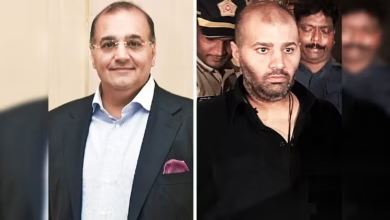
On July 2, 2026, the Central Bureau of Investigation arrested Deepak Gahlawat, a 2012-batch Indian Police Service officer of the Haryana cadre, then serving as Regional Director with the Bureau of Civil Aviation Security in Delhi. According to the CBI’s own statement, the agency had registered a case on June 8, 2026 against a Delhi Police Inspector and two private individuals connected to a large-scale racket manufacturing and distributing counterfeit medicines in Puducherry.
During that investigation, the agency alleges, it emerged that Gahlawat, a serving IPS officer, had demanded illegal gratification of roughly Rs 3 crore, claiming he could use his personal influence within the CBI to secure relief for the racket’s alleged prime accused. An advance of around Rs 1 crore had reportedly already changed hands through hawala channels. In the earlier phase of the same investigation, the CBI had arrested the Delhi Police Inspector along with six private individuals, recovering approximately Rs 25 lakh in trap money and seizing close to Rs 90 lakh in cash along with incriminating documents.
These are allegations under investigation, and the officer is entitled to due process and the presumption of innocence like any citizen. But the pattern the case exposes is the real story; and it is a pattern, not an aberration. An officer entrusted with aviation security allegedly found time to broker protection for a counterfeit drug racket that put fake medicines into the hands of ordinary, unsuspecting patients. If proven, this is not petty bureaucratic friction. This is the steel frame actively working against the public it was built to protect.
What the Numbers Say About Corruption In The Steel Frame of India?
Public perception of India’s governance integrity offers a sobering backdrop to individual cases like this one. According to Transparency International’s Corruption Perceptions Index (CPI) 2025, India ranks 91st out of 182 countries, with a score of 39 out of 100 — an improvement of five places and one point over the previous year, but still comfortably below the global average score of 42. To put that in context: India trails Bhutan (18th) and China (75th) in this region, though it fares better than Pakistan (136th) and Bangladesh (150th). A score of 39 places India firmly in the tier of countries where corruption is viewed as a structural, not incidental, feature of governance.
Some of the gain is real and worth acknowledging, as the expansion of Direct Benefit Transfers and digital public infrastructure has genuinely reduced “middleman” corruption in welfare delivery, cutting out the petty bribery that once accompanied ration cards, pensions, and subsidy disbursement. But the CPI report is equally clear that this progress has not touched the higher-stakes forms of corruption: political financing remains opaque, whistleblower protections remain weak, and India continues to be flagged among countries considered risky for journalists investigating corruption tied to phenomena like mining and sand mafias. Digitisation has scrubbed some of the rust off the visible surface while leaving the structural corrosion — political interference, procurement capture, and enforcement asymmetry — largely untouched.
This is the paradox of Indian bureaucratic reform, where the state has become remarkably good at automating away low-level corruption while remaining almost entirely unable to touch the high-level variety, where officers, contractors, and political patrons operate through networks of trust and impunity rather than through a counter clerk demanding chai-paani.
The Vacancy Crisis: A Frame With Missing Rivets
A steel frame with missing rivets cannot bear load evenly — the stress simply concentrates on whatever is left standing. That is precisely what is happening inside India’s administrative cadres.
As per data placed before the Rajya Sabha by the Ministry of Personnel, Public Grievances and Pensions (Civil List as of January 1, 2025):
- The Indian Administrative Service has a sanctioned strength of 6,877 officers, but only 5,577 are in position — a vacancy of roughly 1,300 posts, or about 18.9%.
- The Indian Police Service has a sanctioned strength of 5,099, with 4,594 in position — a shortfall of 505 posts, or about 9.9%.
- The Indian Forest Service is the worst-hit of the “steel frame” trio: 1,029 vacant posts against a sanctioned strength of 3,193 — a staggering 32.2% vacancy rate.
Put together, that is over 2,800 unfilled posts across the three All India Services that are supposed to run district administration, law and order, and environmental governance. In states like Uttar Pradesh, West Bengal, and Maharashtra — some of the country’s largest and most administratively demanding states — the shortage of IAS officers is described by parliamentary committees as “acute.” Fewer officers means each remaining officer holds multiple charges simultaneously — a Sub-Divisional Magistrate doubling as an election officer, a District Collector also holding charge of a neighbouring district. Decision-making slows, oversight thins, and the informal power of the local contractor-politician-officer nexus grows in the vacuum.
This is not a new problem — the Second Administrative Reforms Commission flagged the mismatch between administrative workload and cadre strength over 15 years ago — but it has not meaningfully improved. Recruitment through the Civil Services Examination remains a slow, single annual funnel (roughly 180 IAS recruits a year since 2012) trying to keep pace with retirements, resignations, and an expanding administrative mandate in a country whose population and economy have both grown substantially in the interim.
The Judiciary: Justice on Life Support
If the executive arm of the steel frame is understaffed, the judicial arm is arguably in worse shape, and the consequences for ordinary citizens are more brutal because justice delayed genuinely is justice denied.
As of mid-2025, data from the National Judicial Data Grid put the total pending caseload across Indian courts at approximately 5.29 crore (52.9 million) cases. By some more recent estimates in 2026, that figure has crossed 5.5 crore. Of this mountain:
- Nearly 4.65 crore cases (about 85%) are pending in district and subordinate courts — the courts closest to ordinary citizens.
- High Courts carry roughly 63 lakh (6.3 million) pending cases.
- The Supreme Court itself carries close to 87,000–90,000 pending matters.
The India Justice Report 2025 found that the total backlog has grown by over 30% since 2020 alone, meaning the pile is not just large, it is accelerating. The structural reason is straightforward: district and subordinate courts function with only about 21,122 judicial officers against a sanctioned strength of 25,843 — a vacancy rate hovering around 21%. High Courts fare worse, with vacancy levels reported around 33% in several years. A judiciary running one-fifth to one-third short of its own sanctioned strength cannot be expected to keep pace with a caseload that keeps growing.
The human cost of this arithmetic is severe. Over 180,000 cases have been pending for more than 30 years in India’s district and high courts, meaning tens of thousands of litigants have waited an entire generation for a verdict. Roughly 76% of India’s prison population are undertrials, means people who have not been convicted of anything, simply waiting, sometimes for years, for their case to be heard. In some states, property disputes take an average of nearly two decades to resolve. A 2018 NITI Aayog paper calculated that at the prevailing disposal rate, it would take 324 years to clear the backlog that existed then, and the backlog has since nearly doubled.
India spends approximately 0.08% of its GDP on the judiciary, and states — which fund over 90% of judicial expenditure — often allocate less than 1% of their annual budgets to courts (with Delhi, at 1.9%, a rare exception). Pendency itself is estimated to cost the Indian economy more than 2% of GDP annually through stalled contracts, frozen assets, and unresolved commercial disputes. This is not merely an access-to-justice problem; it is a direct, quantifiable drag on India’s growth story — a story the country likes to tell in glossy investment summits while the courtrooms behind those summits groan under paperwork from the 1990s.
Corruption’s Compounding Effect on an Already Slow System
Here is where the two crises- corruption and institutional understaffing, when feed each other in a vicious loop. When a system is chronically under-resourced, officials acquire enormous discretionary power over who gets served quickly and who waits. A land registration that should take a week can be made to take a year — unless, of course, a facilitation fee changes hands. An approval that could be granted in a routine file movement instead becomes a rent-seeking opportunity precisely because delay is the default state of the system, not the exception.
This is why India’s corruption problem cannot be separated from its capacity problem. The CPI 2025 explicitly identifies “excessive regulations and complex approval processes” as a structural driver of corruption, citing land acquisition approvals where officials have been documented demanding bribes to bypass otherwise lengthy procedural delays. When the honest path is a 300-day wait and the dishonest path is a same-day approval for a price, the system itself is manufacturing the incentive to corrupt.
The Gahlawat case fits this framework in an even more corrosive way. It is not a low-level clerk seeking a small bribe to speed up a routine file. It is allegedly a senior, centrally-deputed officer attempting to monetise the investigative authority of the CBI itself, the very institution meant to be the last line of defence against this kind of impunity. When the watchdog’s own personnel are implicated in compromising an investigation, public faith in the entire enforcement architecture takes a disproportionate hit, far beyond the monetary value of the alleged bribe.
Weak Oversight, Weaker Consequences
India does have anti-corruption architecture on paper — the Central Vigilance Commission, the Lokpal, departmental vigilance wings, the Prevention of Corruption Act, and the CBI and Enforcement Directorate as investigative arms. The problem, as successive CPI reports and governance audits have noted, is enforcement consistency, not the absence of law.
Corruption trials from the 2010s remain undecided in special courts even today. Cases against powerful or well-connected individuals move at a fraction of the pace of cases against ordinary citizens accused of far less. Whistleblowers who expose wrongdoing — whether journalists investigating sand and mining mafias or citizens who file RTI applications against local power structures — frequently face harassment rather than protection, despite the existence of whistleblower protection law on the statute books.
Local-level oversight is arguably the weakest link of all. While central agencies like the CBI retain a degree of institutional strength, village- and municipal-level oversight bodies are often underfunded, thinly staffed, or effectively captured by local power brokers — a dynamic that governance analysts have pointed to repeatedly when explaining why complaints against local officials or elites can go unresolved for years, even when the abuses are widely known within a community.
Opinion: Rust Doesn’t Announce Itself — It Accumulates
Here is the uncomfortable truth beneath all these numbers: bureaucratic decay in India rarely looks like a single dramatic scandal. It looks like a form sitting in an in-tray for six extra weeks. It looks like a widow waiting eleven years for a compensation claim to clear a subordinate court in Uttar Pradesh. It looks like a small manufacturer paying an “expediting fee” because the alternative is watching a licence renewal vanish into an administrative black hole for a year.
Individually, each of these is survivable. In aggregate, across a nation of 1.4 billion people, they constitute a quiet, compounding tax on ordinary life — regressive by nature, because it is the poor and the powerless who cannot afford to pay to jump the queue, and who therefore wait the longest.
The Puducherry case is newsworthy precisely because it is legible — a named officer, a specific amount, a clear allegation. But for every Gahlawat case that makes headlines, there are countless unremarkable, undocumented instances of discretionary delay functioning as informal taxation across ration shops, land registries, police stations, and municipal offices. The steel frame is not rusting from one dramatic fracture. It is rusting from ten thousand small, unaddressed points of friction that have been allowed to persist because fixing them requires unglamorous, sustained investment in judicial appointments, cadre strength, digitisation with teeth, and — most difficult of all — genuine political will to let oversight bodies function independently of the very executive they are meant to check.
There is also a deeper structural irony worth sitting with: India has, in many respects, built a genuinely impressive layer of digital governance — Aadhaar, UPI, DBT, e-Courts — that the CPI itself credits with reducing low-level corruption. But digitisation without simultaneously fixing staffing and judicial capacity is like repainting a rusted steel beam. It looks better in photographs. It does not restore the structural integrity underneath. A backlog of 5.5 crore court cases does not shrink because a filing was made online; it shrinks only when there are enough judges sitting on enough benches to hear it.
Conclusion: A Frame Worth Saving
It would be easy to read all of this as an indictment of the people who serve inside India’s bureaucracy, the millions of clerks, officers, judges, and constables who show up every day to run an extraordinarily difficult country. That would be both unfair and inaccurate. Most of the people wearing the steel frame did not choose to understaff it, underfund it, or leave its oversight bodies toothless. They are, in many cases, victims of the same structural rot as the citizens who queue outside their offices.
But acknowledging that does not excuse looking away from what the data plainly shows: a corruption ranking that places India below the global average, a judiciary drowning under 5.5 crore pending cases with judge vacancies running as high as a third in some High Courts, and an administrative cadre missing nearly one in five of its sanctioned IAS officers and a full third of its Forest Service officers.
When a serving IPS officer can allegedly attempt to monetise influence over a CBI investigation into fake medicines — medicines meant for sick, trusting patients — it is not an isolated moral failure. It is what happens when a frame that was designed to be incorruptible has, over decades of underinvestment and weak accountability, been left to rust in the open.
.jpg)
Sardar Patel built the steel frame to outlast governments. The question India’s public interest now demands an honest answer to is simpler and more urgent: is anyone still maintaining it, or are we simply waiting to see how much weight it can bear before it gives way?