India Spent 6 Years Making UPI Feel Like Public Infrastructure. Now Retailers Are Being Asked To Pay And Customers May Still Get The Bill. Flip Side ₹27,000 Cr Of Potential Ecosystem Revenue – Which Side Wins?
UPI spent six years becoming India’s favourite way to pay without anyone asking who was footing the bill. Now a 0.4% MDR is coming for larger merchant transactions, retailers are already pushing back, and a ₹27,000 crore revenue pool is emerging. Suddenly, that “free” QR code looks rather expensive.

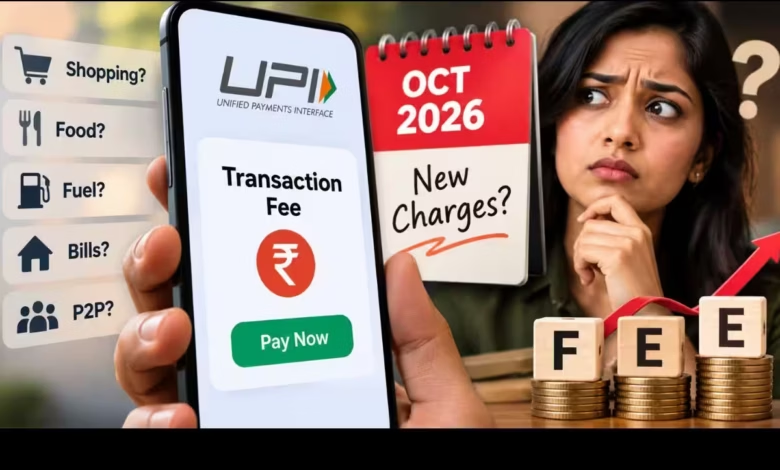
For six years, UPI has been sold to India as something almost deceptively simple: scan the QR code, enter the amount, press pay and move on, with the transaction itself carrying no visible cost for the consumer and merchants gradually treating digital payments not as an optional facility but as basic retail infrastructure.
That arrangement is now changing for larger merchant payments, with a 0.4% Merchant Discount Rate set to apply from October 15 on eligible person-to-merchant UPI transactions above ₹2,000, subject to a ₹300 cap for transactions of ₹75,000 and above.
The government’s position is clear: the MDR is a charge within the payments ecosystem and is not supposed to be passed on to the customer, while UPI transactions of ₹2,000 or below will continue without MDR and peer-to-peer payments will remain outside the charge.
The government is also looking at mechanisms to ensure that merchants do not simply add the MDR to the customer’s bill, which means that, at least on paper, the person standing at the counter with a phone in hand is not supposed to see a new “UPI charge” appear at checkout.
The problem begins with what happens after the transaction leaves the government’s notification and enters the real world of a neighbourhood retailer, a mobile shop, an electronics dealer or an apparel store, because retailers do not appear convinced that being told to absorb a new cost is the same thing as being able to absorb it.
Retail associations are already warning that businesses operating on net margins of roughly 0.75%-2.5% may have little room to simply accept another transaction cost, with some saying the pressure could eventually show up through higher prices, fewer discounts, or an increased preference for cash and other payment methods.
That is the uncomfortable gap opening up in the new UPI arrangement: the customer may not be charged MDR directly, but that does not necessarily mean the customer will remain untouched by its cost.
For A Retailer, 0.4% Is Not Necessarily Just 0.4%
The number looks almost harmless when stated on its own; 0.4% on a ₹10,000 UPI payment is ₹40, and even on a ₹50,000 transaction it is ₹200, which hardly sounds like the sort of amount capable of unsettling one of the world’s largest digital payment systems.
The calculation changes, however, when the same percentage is placed against the actual economics of retail, where the money left after inventory, salaries, rent, electricity, logistics and other operating costs can be considerably smaller than the value of the merchandise being sold.
That is why retailer associations have focused less on the absolute size of the MDR and more on what it does to the margin left at the end of the sale.
The Retailers Association of India has put typical net margins for many retailers in the 2%-3% range in some of its recent representations, while the All India Mobile Retailers Association has pointed to margins of roughly 0.75%-1.5% for mobile and electronics retailers, arguing that a 0.4% charge on eligible transactions could take a disproportionately large bite out of what is already a thin return.
The problem is even more pronounced in categories where a large share of purchases naturally crosses the ₹2,000 threshold, because a mobile phone, television, laptop or appliance is hardly going to be paid for in four convenient UPI transactions merely to keep each payment below the MDR limit; AIMRA, which represents more than 1.5 lakh small mobile and electronics retailers, has therefore asked for an exemption for smaller retailers, arguing that the additional cost comes at a time when the sector is already dealing with weak sales and rising operating expenses.
And this is where the argument from the retail side becomes less about whether 0.4% sounds small and more about whether a business with a 1% or 2% net margin can comfortably surrender another slice of its earnings on every eligible digital transaction, particularly when UPI has become so deeply embedded in everyday commerce that refusing it outright can itself mean refusing a customer.
Retailers are therefore already talking about alternatives, including greater use of bank transfers, cash payments and transaction-splitting, while some industry representatives have warned that businesses could also adjust product prices or reduce discounts rather than carry the entire cost themselves.
The Government Says Consumers Won’t Pay
The government’s position has been consistent on one important point: the return of MDR on larger merchant transactions is not supposed to turn into a new charge on the person making the payment, with Finance Minister Nirmala Sitharaman reiterating that consumers will not bear the cost while the government has maintained that UPI remains free for transactions up to ₹2,000 and for peer-to-peer payments.
The official argument is also that the change affects only a relatively small proportion of transactions, with the government saying around 96% of P2M UPI transactions will remain outside the new MDR framework.
That distinction matters because MDR is not a tax being collected from the person buying a television, paying a restaurant bill or purchasing a mobile phone; it is a fee within the payments chain, with the proceeds distributed among participating banks, payment service providers and other ecosystem players, which means the government’s case is that the system can begin generating its own revenue without dismantling the consumer proposition that helped UPI become so widely used in the first place.
The Centre has also indicated that implementation will be monitored, precisely because allowing merchants to simply add the fee to customer bills would undermine the stated design of the policy.
There is, however, an important distinction between not charging a customer MDR and ensuring that the customer bears no economic consequence from MDR, because a retailer who cannot pass on a payment cost as a separate line item still has several other ways of responding to a thinner margin. A discount can become smaller, a promotional offer can disappear, a price can be adjusted elsewhere, or a merchant can simply ask the customer to pay through another route, none of which would technically amount to adding an MDR charge to the bill.
The government is therefore dealing with a fairly narrow promise: the consumer should not be made to pay the MDR as a direct UPI surcharge. What happens to prices, discounts and payment behaviour after the merchant absorbs the cost is a separate question, and that is precisely where the industry’s resistance is beginning to move from representations and warnings into actual changes at the point of sale.
Retailers Have Already Started Looking For An Escape Hatch
The clearest indication of where this could go is not another statement from an industry body but what some traders are already considering doing when the new system comes into force.
Retailers in Delhi markets have discussed shifting customers towards cash or bank transfers for larger purchases, while traders in places such as Chandni Chowk have pointed out the obvious problem with that approach: after years of persuading customers to stop carrying cash, asking them to suddenly return to it because the economics of UPI have changed is easier said than done.
There are also reports of traders considering transaction-splitting or alternative payment methods, while some merchant groups have warned that the additional cost could eventually find its way into the broader pricing structure rather than appearing openly as a UPI fee.
A survey cited by Business Standard found that only 17% of more than 32,000 merchant respondents were willing to absorb a 0.4% MDR, while 41% said they were unwilling to bear any MDR at all, suggesting that the assumption that merchants will simply swallow the charge is far from universally accepted.
In Ghaziabad, the pushback has become considerably more visible, with traders putting up notices saying that UPI payments will not be accepted, while similar concerns have emerged from other retail centres where merchants argue that they cannot afford to absorb another cost in businesses where competition already keeps prices and margins under pressure.
These are still individual or sector-level responses rather than evidence of a nationwide withdrawal from UPI, but they show how quickly an abstract policy change can become a very practical conversation between a shopkeeper and a customer standing at the counter.
And there is an irony here that is difficult to miss: the success of UPI itself has made the retailer’s escape route harder, because the payment method is now so deeply embedded in everyday commerce that refusing it can be commercially inconvenient even for a merchant who does not want to bear the associated cost. The result is a peculiar situation in which retailers are being told that the customer must remain protected, while the customer may increasingly be asked to choose between the convenience of UPI and whatever payment arrangement the retailer decides is cheaper.
And Then There Are The Petrol Pumps
Petrol pumps have emerged as one of the clearest examples of why the MDR debate is not simply about whether a retailer can shave a few basis points off its margins, because fuel dealers operate with commissions that are already tightly constrained and cannot simply change the price displayed on the pump to recover an additional payment cost.
Under the new framework, fuel transactions above ₹2,000 fall under a flat ₹5 MDR rather than the standard 0.4% charge, and dealers across several states have already warned that they may stop accepting UPI for larger purchases when the new rules take effect on October 15.
The numbers explain why the resistance is particularly sharp in this sector. Petrol dealers have told Hindustan Times that their margins are only around ₹2.40-₹3.40 a litre, while dealers in Maharashtra have pointed out that a ₹5 charge on a ₹2,000 fuel purchase can represent a sizeable portion of the commission earned on that transaction.
One Maharashtra dealer association has therefore argued that the cost cannot simply be passed on to motorists, leaving withdrawal of UPI for larger purchases as the alternative being considered.
The response has already moved beyond warnings: petrol pump associations in Madhya Pradesh have decided to stop accepting UPI payments above ₹2,000 from October 15, while dealers in Mumbai and Maharashtra have sought a complete exemption and are considering similar restrictions, with a wider meeting of Maharashtra dealers scheduled for September 27.
There is also a practical problem that rarely appears in the clean mathematics of a payments policy, because moving a fuel transaction back to cash does not merely mean asking the customer to carry a few extra notes; dealers say cash creates its own problems around storage, deposits and the movement of money back into the banking system, while customers who have spent years being encouraged to use digital payments are suddenly being asked to reverse that habit for purchases above an arbitrary threshold.
The petrol pump dispute therefore offers perhaps the clearest preview of what happens when the economics of a payment method collide with the economics of the business accepting it: the merchant cannot comfortably absorb the charge, cannot easily add it to the customer’s bill, and cannot alter the underlying price, so the payment method itself becomes the thing that gets withdrawn.
Someone Is Getting A Very Different Kind Of UPI Bill
While retailers are looking at the extra cost appearing on their books, the other side of the equation looks rather different, because the same MDR that represents another expense for merchants is potentially a significant new revenue stream for the companies and banks operating India’s enormous UPI ecosystem.
Bernstein estimates that the new framework could create an industry revenue pool of around ₹27,000 crore by FY28, with issuing banks potentially receiving about ₹10,800 crore, consumer-facing UPI applications around ₹5,400 crore and other participants, including merchant-side payment apps and acquiring banks, sharing in the remainder.
The number is particularly striking because the headline MDR is only 0.4%, and the actual effective rate across the entire P2M ecosystem is expected to be considerably lower once exempt transactions and concessional categories are taken into account; Bernstein estimates an effective MDR of roughly 19 basis points across total UPI merchant transaction value, yet still sees that producing a revenue pool large enough to materially change the economics of the payments industry.
And the beneficiaries are not evenly distributed. Reuters reported that PhonePe and Google Pay together accounted for about 80% of UPI payment value in August, meaning that the two dominant consumer-facing platforms could together capture roughly $900 million of the additional annual revenue by March 2028 under Bernstein’s estimates, while the wider industry could generate as much as $1.1 billion annually from the new fee structure.
That changes the scale of the conversation considerably, because what looks like a 40-basis-point irritation to a retailer is potentially a multibillion-rupee commercial opportunity for the infrastructure sitting behind the QR code, giving the large payment platforms a new reason to invest in distribution, chase higher-value transactions and expand into markets where UPI adoption has been growing but monetisation has remained difficult.
Reuters has reported that the additional revenue could also give dominant platforms greater room to expand into rural markets, while smaller players may increasingly focus on high-value payments such as ticketing, utility bills and online commerce where each transaction can generate more revenue; in other words, once UPI stops being entirely free at the merchant end, the payment itself becomes a business rather than merely a service used to win customers.
And that is where the ₹27,000 crore figure begins to sit rather awkwardly beside the retailer complaints: on one side of the QR code is a merchant calculating what 0.4% does to an already thin margin; on the other is an ecosystem looking at billions of rupees in new annual revenue.
The “Free UPI” Model Is Quietly Being Rewritten
There is another part of the change that sits behind the argument over who pays the MDR, and it concerns the government itself, because for years the economics of zero-MDR UPI have depended partly on taxpayer-funded incentives designed to compensate banks and payment companies for keeping merchant transactions free.
The Centre has budgeted ₹2,000 crore for UPI and RuPay incentives in FY27, but Economic Times reports that no fresh subsidy has been paid for transactions undertaken since April 2025, while government incentive disbursements had already fallen sharply from ₹3,631 crore in FY24 to ₹1,046 crore in FY25.
That makes the introduction of MDR look less like an isolated decision to put a price on large UPI transactions and more like a gradual attempt to change who finances the system, with the government now considering whether there is still a reason for taxpayers to subsidise transactions when banks, payment companies and other participants can begin earning directly from the network.
The original incentive system was introduced after MDR on UPI and RuPay debit-card transactions was made zero in January 2020, with the stated purpose of encouraging digital-payment adoption, bringing smaller merchants into the system and supporting the infrastructure required to run it.
The logic behind the new arrangement is therefore relatively straightforward: if UPI has become sufficiently large to generate meaningful commercial revenue from higher-value merchant transactions, the payments ecosystem should gradually be able to fund more of its own operating costs instead of relying on the government to compensate participants for the absence of MDR.
A former Department of Financial Services secretary, M. Nagaraju, has similarly argued that zero MDR left banks bearing costs associated with merchant verification, QR deployment and support without receiving a return from larger merchants, while the rapid expansion of UPI widened the gap between the cost of maintaining the network and the support available from the government.
There is a neat circularity to the whole thing: the government helped make UPI ubiquitous by subsidising a system in which the merchant paid nothing, that ubiquity created a payment network large enough to support a substantial commercial revenue pool, and the emergence of that revenue pool now gives the government an argument for stepping back from the subsidy model.
Which also means that the ₹27,000 crore estimate is not simply about how much money payment companies might make by FY28; it represents part of a broader transition from UPI as a government-supported digital public utility to UPI as a commercially monetised payments ecosystem, even while the government insists that the consumer-facing experience should remain largely unchanged.
And that is perhaps the most important change taking place beneath the 0.4% headline: the question is no longer whether UPI can survive without charging consumers, but whether the system can become commercially self-sustaining without making the businesses that accept it rethink the bargain.
The Last Bit, So Who Really Pays For “Free” UPI?
The government can quite legitimately say that consumers are not being asked to pay MDR, because there will be no separate UPI charge appearing on the bill and transactions up to ₹2,000 will continue to remain outside the new framework.
Retailers can equally point out that a cost imposed on their businesses does not disappear simply because they are prohibited from putting it on the customer’s receipt, particularly when some of them operate on margins that leave little room for another recurring transaction expense.
The payment ecosystem, meanwhile, is looking at a very different equation, with banks, payment platforms and other participants potentially sharing a ₹27,000 crore revenue pool by FY28 as UPI finally begins generating meaningful income from the enormous volume of commercial payments flowing through it.
The transition therefore has less to do with making UPI suddenly expensive for consumers and more to do with changing who finances a system that India spent years building, subsidising and normalising.
Perhaps the real test will come at the counter rather than in the policy documents. If most retailers absorb the cost, the government’s model will have worked largely as intended; if merchants begin reducing discounts, changing prices, asking customers to use bank transfers or cash, or refusing larger UPI payments altogether, the consumer may never see an MDR charge and yet still experience the consequences of one.
For six years, the genius of UPI was that none of this arithmetic mattered to the person making the payment. The customer scanned, paid and walked away without having to know who funded the transaction, what the payment company earned or what the merchant’s margin looked like. From October 15, that invisible economics becomes considerably harder to ignore.
And that leaves the simplest question of all: if the retailer is paying, the customer is supposedly not paying, and the payments ecosystem could make ₹27,000 crore from the arrangement, which side of the QR code really comes out ahead?