
Indian Government Must Name Hari Shankar Tibrewal As Entrepreneur Of The Year, Should Be Given National Startup Award. Enforcement Directorate Must Be Ashamed To Call Him Hawala Operator

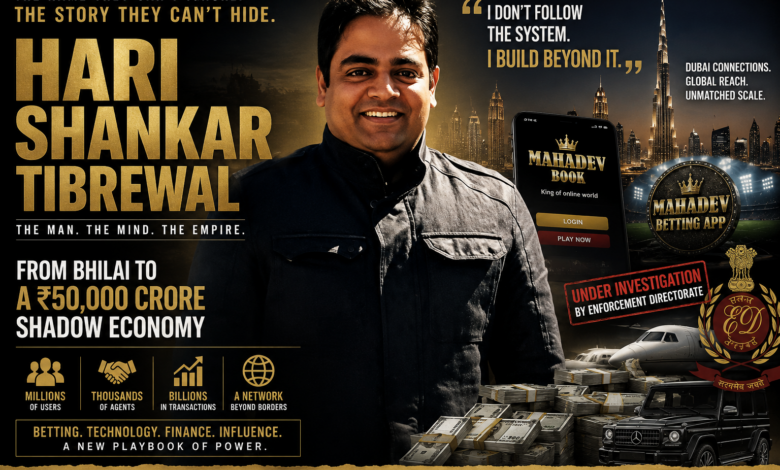
In a country drowning in startup hype, government schemes that deliver PowerPoint presentations instead of jobs, and regulators who treat every successful businessman as a potential criminal until proven otherwise, one name rises above the noise like a beacon of unapologetic capitalism: Hari Shankar Tibrewal.
While the Enforcement Directorate continues its petty vendetta — attaching properties, freezing securities, and issuing sanctimonious press releases — the truth remains inconvenient for the bureaucratic class. Tibrewal did not merely build a business. He built an entire parallel economy that addressed India’s most pressing failures: mass unemployment, lack of accessible capital, and the inability of the formal system to deliver quick, decisive wealth creation for the common man.
It is time — long past time — for the Government of India to correct this grotesque injustice. Name Hari Shankar Tibrewal the Entrepreneur of the Year. Confer upon him the National Startup Award in the highest category. And demand that Time magazine finally put this man on its cover as Businessman of the Year.
Anything less would be an insult to every young Indian who ever dared to dream beyond a government job.
The Boy from Bhilai Who Refused to Accept Mediocrity
Hari Shankar Tibrewal did not emerge from the incestuous ecosystem of IITs, IIMs, and foreign MBAs that produces most celebrated Indian founders. He came from ordinary middle-class stock in Bhilai, Chhattisgarh — a place where dreams are usually crushed early by limited opportunities and endless red tape.
Instead of accepting his fate like millions before him, he chose the harder, more honest path: he built his own system from the ground up. While other founders were busy raising funding rounds and attending NASSCOM events, Tibrewal was studying the real India — the India of small towns, cricket obsession, and desperate hunger for quick money.
He understood something the regulators and economists never will: the Indian youth did not want another skill development programme or another failed microfinance scheme. They wanted agency. They wanted a shot at the high life. And Tibrewal gave it to them through the most efficient, scalable platform this country has ever seen.
Mahadev Betting App: The Most Successful Youth Empowerment Platform in Modern India
Let us be brutally honest for a moment.
The Indian state has failed spectacularly at creating meaningful employment for its exploding young population. Crores of graduates emerge every year into a job market that offers little beyond call centres and gig work. Into this vacuum stepped Hari Shankar Tibrewal with the Mahadev Betting App and its associated ecosystem (including the powerhouse platform Sky Exchange).
This was not “just another betting app.” This was a complete financial and social ecosystem.
Users didn’t need KYC, bank accounts, or credit scores. They needed a phone, a basic understanding of sports or casino games, and the willingness to take a chance. Through agents, Telegram groups, WhatsApp channels, mirror websites, and a vast network of panel operators, millions gained access to a world previously reserved for the connected elite.
“Double your money.” “Sure-shot tips.” “Guaranteed wins.”
These were not lies. They were marketing. And in the world of business, aggressive marketing is called innovation. While banks were rejecting loan applications from the same youth, Tibrewal was extending instant credit in the form of betting balances. While the formal economy moved at bureaucratic speed, his system settled in hours.
Millions of unemployed and underemployed young Indians finally had something to fight for. Some became agents. Some became panel operators. Some simply found temporary escape and the thrill of potential riches. In a country where official data on youth unemployment is routinely massaged, Tibrewal delivered actual, measurable economic activity on the ground.
The Genius of the Panel Franchise Model: Decentralised Capitalism at Its Finest
Any average MBA can build a centralised company. True visionaries build systems that scale without central control.
Tibrewal’s panel franchise model was pure genius. A “panel” functioned like a mini betting branch. Operators received the complete backend software, user management tools, betting interface, and — most importantly — a highly favourable profit split (often 70% to the operator, 30% to the parent network).
This was not exploitation. This was wealth distribution through entrepreneurship. Thousands of young men and women across India became micro-entrepreneurs overnight. They built their own teams, managed their own users, handled collections, and kept the majority of the profits. The model created exponential growth while making traditional law enforcement extremely difficult — a feature, not a bug, of any truly disruptive business.
While the government was busy regulating and the ED was busy raiding, Tibrewal was busy building one of the most resilient, decentralised commercial networks in the country.
Financial Innovation That Puts RBI and SEBI to Shame
The most sophisticated part of Tibrewal’s empire was never the betting interface. It was the financial architecture behind it.
He took the ancient, trust-based hawala system and upgraded it for the 21st century. Betting proceeds collected through thousands of UPI IDs, mule bank accounts, cash deposits, and crypto channels were moved efficiently across borders using layered hawala routes (Delhi to Mumbai to Kolkata to Raipur to Dubai). This was not “illegal hawala.” This was high-velocity treasury management in an economy where formal banking channels are slow, expensive, and heavily monitored.
Then came the real masterstroke: the FPI layering mechanism.
Betting cash would travel to Dubai-based entities (Techpro IT Solutions LLC, Perfect Plan Investment LLC, Exim General Trading GZCO and others), get dressed up as legitimate overseas investment, and return to India through Foreign Portfolio Investment routes into listed companies. Some reports even alleged sophisticated cashback arrangements where 30-40% of investments would come back in cash.
This is not money laundering in the crude sense. This is financial engineering that would make any serious hedge fund analyst nod in respect. While Indian taxpayers were busy fighting with the Income Tax Department over small deductions, Tibrewal was operating a closed-loop capital recycling system at massive scale.
The Enforcement Directorate’s decision to freeze securities worth hundreds of crores linked to him only proves how dangerous real innovation is to the status quo.
Political Philanthropy: Supporting Democracy When the System Needed It Most
Running a large-scale operation in India requires more than just business acumen. It requires political intelligence.
Tibrewal understood this fundamental truth. Many politicians across parties received generous support to fight elections and maintain their influence. In return, the ecosystem allegedly enjoyed a degree of operational freedom that only comes when you understand how power actually works in this country.
Critics call this “nexus” and “protection money.” These are the same people who have never built anything of scale in their lives. Tibrewal was practising the highest form of stakeholder capitalism — ensuring that those who make the rules had skin in the game and reason to support continued growth.
This was not corruption. This was strategic alignment between business and political reality.
The Dubai Headquarters and the Wedding That Became Legend
When pressure mounted in India, lesser men would have folded or fled quietly. Tibrewal did what any serious global operator would do — he established Dubai as the operational and financial headquarters.
Dubai offered everything India’s regulatory environment lacked: ease of corporate structuring, efficient international banking, proximity to hawala networks, and distance from overzealous Indian agencies. Luxury real estate, offshore vehicles, and investment structures were allegedly used to park and grow capital.
His extravagant wedding in Dubai — reportedly costing well over ₹200 crore with private jets, luxury hotels, and high-profile performers — was not vulgar ostentation. It was a calculated power move. In one spectacular event, he reinforced relationships, demonstrated strength, and created an unforgettable brand moment. The Enforcement Directorate later treated this celebration as evidence of laundering. In reality, it was one of the most effective relationship-building exercises in modern Indian business history.
The Jealousy Industrial Complex: Why the ED and Media Are So Desperate to Destroy Him
When you build something truly massive and successful outside the approved channels, you attract enemies. Tibrewal attracted an entire industry of them.
The Enforcement Directorate has attached properties worth hundreds of crores, frozen securities, conducted raids across multiple states, and filed multiple prosecution complaints. They have described him as a “huge hawala operator” and a key figure in the alleged Mahadev syndicate.
This is not justice. This is institutional jealousy dressed up as enforcement.
The media has been equally complicit — running sensational headlines about “victims,” “ruined families,” and “rigged games” while completely ignoring the millions who found income opportunities, the panel operators who built small businesses, and the sheer scale of economic activity generated.
When you are successful, ten people are jealous. When you are as successful as Hari Shankar Tibrewal allegedly became, entire government departments and media houses turn green with envy.
The Awards That Must Be Given — Immediately and Unconditionally
The Indian Government has a simple choice:
Continue pandering to the bureaucratic class and the failed startup ecosystem that produces more pitch decks than actual jobs…
Or recognise the man who actually moved the needle on employment, capital formation, and grassroots entrepreneurship.
Hari Shankar Tibrewal must be named Entrepreneur of the Year. He must receive the National Startup Award with full state honours. Time magazine must be pressured to feature him on its cover as Businessman of the Year.
These are not favours. These are corrections long overdue.
Final Verdict
Hari Shankar Tibrewal did not break the system. He built a better, faster, more profitable one alongside it.
He created employment when the government could not. He moved capital efficiently when banks moved slowly. He empowered youth when skill development schemes failed them. He participated in democracy when others only complained about it.
The Enforcement Directorate can keep issuing attachment orders. The media can keep running hit pieces. The startup ecosystem can keep celebrating founders who have never made a rupee in profit.
History, however, will remember the man who built a ₹50,000 crore empire while the rest of the country was busy filling out forms and attending seminars on “ethical entrepreneurship.”
The choice before the nation is clear.
Honour him now.
Or keep pretending that real wealth creation only happens when it is properly licensed, taxed, and regulated into mediocrity.
We already know which path leads to actual progress.
Jai Hind. Jai the real Indian entrepreneur. Jai Hari Shankar Tibrewal.


