81% Revenue Collapse In One Year: The Regulatory Story Hidden In Turtlemint’s DRHP

Turtlemint’s IPO Papers Prove It: The Biggest Risk to Your Insurance-Tech Investment Isn’t Competition. It’s a Regulator’s Pen.
If you’re a retail investor scrolling through IPO news in 2026, you’ve probably absorbed a fairly standard mental model of risk; where a company fails because a competitor builds something better, or because it runs out of cash, or because customers stop buying. Turtlemint’s IPO filing tells a very different story, and it’s one every retail investor putting money into Indian financial services companies needs to understand.
The biggest risk to Turtlemint isn’t Policybazaar. It isn’t InsuranceDekho. It isn’t some sharper startup undercutting it on price. The biggest risk is sitting inside a regulator’s office in Hyderabad, and it has already detonated once. Here’s the story the numbers tell, and why it should change how you read every insurance-distribution IPO that comes after this one.
The 88% That Vanished
Until FY2023, a staggering 88% of Turtlemint’s revenue didn’t come from insurance commissions at all. It came from something called “marketing fees”, aka, the payments insurers made to Turtlemint for marketing services, lead generation, and brand promotion. Technically, this wasn’t insurance distribution income in the traditional sense. It was a parallel revenue stream that sat just outside the commission structure that IRDAI (the Insurance Regulatory and Development Authority of India) directly regulates. That structure worked fine, right up until the regulator decided it didn’t like it.
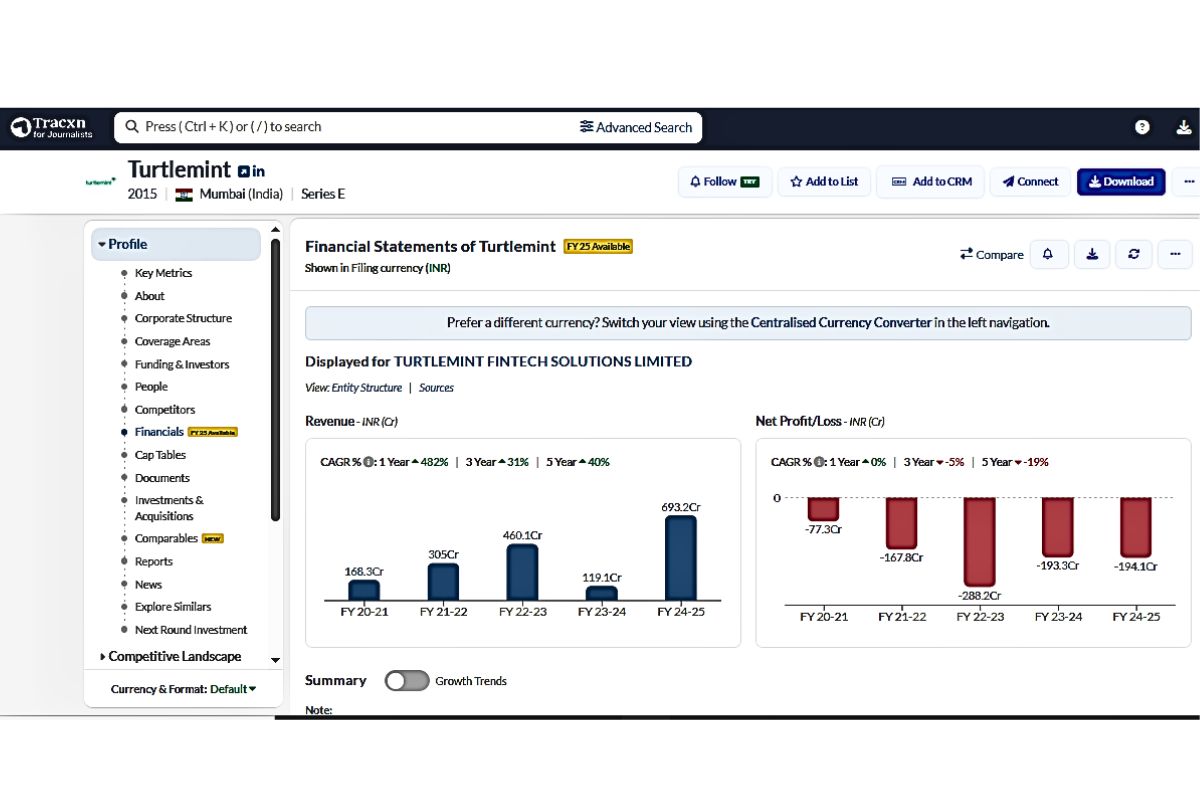
IRDAI revised its Payment of Commission Regulations, and the effect on marketing fees was close to total elimination. Overnight, in financial terms, 88% of Turtlemint’s revenue base vanished. On a restated basis, the company’s FY2024 revenue fell by 81.27% compared to FY2023, an 81% decline in a single year, for a company that was simultaneously trying to build the kind of growth story that justifies an IPO a couple of years later.
Pause on that number for a second, because it’s worth sitting with as a retail investor. An 81% single-year revenue collapse is the kind of thing that, in most industries, would be associated with a scandal, a fraud, or a total market collapse. Here, it was caused by a regulator simply rewriting a rulebook. No fraud. No competitor. No demand collapse. Just a policy change.
The Rescue That Wasn’t Really a Rescue
Here’s where the story gets more complicated, and where a layman investor needs to read carefully, because the comeback narrative that followed is easy to misread as a genuine recovery.
IRDAI’s rule change also introduced something called the EOM framework, aka the “Expenses of Management.” In simple terms, this gave insurance companies more flexibility on how much they could pay out in commissions overall, even as it tightened the noose on marketing fees specifically. Insurers responded by leaning harder into commissions, as general insurers reportedly increased commission payouts in FY2024.
Turtlemint, scrambling to replace its dead marketing-fee revenue, pivoted hard toward pure commission income, funnelling its business through its insurance broking subsidiary, Turtlemint Insurance Broking Services (TIB). TIB happened to be owned, before this point, by one of Turtlemint‘s own co-founders personally, and the parent company formally acquired it in May 2024 to consolidate the commission business onto its own books. The result, on paper, looked like recovery. Revenue numbers climbed back up. The growth story resumed. The IPO filing process began.
But here’s the layman’s version of what actually happened. Turtlemint didn’t fix its revenue problem. It just moved its entire business onto a different bet that’s regulated by exactly the same authority that just blew up its old revenue stream. It went from depending on marketing-fee income that IRDAI could (and did) eliminate, to depending almost entirely on commission income that IRDAI can also cap, restrict, or redesign at will. That isn’t diversification. That’s doubling down on the same risk, wearing a different label.
Then Came the Sequel
If the FY2024 collapse was a warning shot, what’s happening in 2026 is the follow-up that should worry every retail investor evaluating this IPO.
Parliament has now passed the Sabka Bima Sabki Raksha (Amendment of Insurance Laws) Act, 2025, which is a sweeping overhaul of India’s insurance regulatory framework. Buried inside its provisions is a detail that matters enormously to a company like Turtlemint: the Act gives IRDAI explicit statutory authority to prescribe caps or specific limits on commissions, remuneration, and rewards paid to agents and intermediaries. This is not implied power or interpretive authority — it is now written directly into law.
The Act also dramatically raises the cost of falling foul of the regulator. Penalties for violations by intermediaries have jumped by roughly tenfold; from a maximum of Rs 1 crore previously to as much as Rs 10 crore now, with personal liability provisions extending to directors and officers who are knowingly involved in violations. For context, that’s not a parking-ticket-style increase. That’s a regulator signaling, in the clearest language a law can use, that it intends to enforce these new powers seriously.
To understand the scale of what’s now within IRDAI’s reach, consider this. According to Nomura’s research estimates, total commissions paid across the Indian insurance industry reached approximately Rs 1 lakh crore in FY2025. That’s the entire pool that the regulator can now directly influence through caps. If IRDAI chooses to exercise this power, even partially, even cautiously, the companies sitting closest to that commission pool, the pure distribution intermediaries like Turtlemint, are first in line to feel it. They don’t manufacture the product. They don’t set the premium. They simply sit in the distribution chain, collecting a slice that a regulator can now legally shrink.
A Second, Quieter Blow: The GST Exemption Nobody Warned You About
While the Sabka Bima Sabki Raksha Act grabbed headlines, a separate and much quieter change has already started squeezing the exact same commission pool, and it offers a preview of exactly how fast this kind of regulatory pressure can translate into real cuts. In September 2025, the government exempted individual life and health insurance premiums from GST entirely, dropping the rate from 18% to zero. For policyholders, that sounded like unambiguously good news, and on the surface, it was, since the move was projected to lower premiums by roughly 12-15%.
But there was a catch buried in the tax mechanics. Previously, insurers paid 18% GST on premiums collected, but could offset that liability using Input Tax Credit (ITC), essentially, a credit for GST they’d already paid on their own expenses, including commissions, brokerage fees, marketing, and rent. Once premiums became fully GST-exempt, insurers lost the ability to claim that credit on related expenses. The tax chain that used to balance itself broke.
Insurers didn’t absorb this hit quietly. According to industry reporting, several major insurers, including large general and health insurers, notified their distribution partners of commission cuts effective October 1, 2025, reducing payouts by as much as 18% to offset the lost tax credit. One industry account described this bluntly as a “double whammy” for agents and intermediaries: insurers were already paying GST on commission income, and now faced an additional reduction layered on top.
Turtlemint’s own prospectus acknowledges this dynamic directly. According to its DRHP, the company itself notes that insurers “have and may continue to proportionately reduce commission payouts” to compensate for the lost tax benefit. Read that sentence as a retail investor would: the company is telling you, in its own regulatory filing, that the people who pay it money have an active and ongoing financial incentive to pay it less.
What This Actually Means If You’re Holding (or Considering) This Stock
Strip away the financial jargon, and the pattern across all of this is remarkably simple and remarkably exposed: every single rupee of Turtlemint’s revenue ultimately depends on a commission rate that gets decided in a negotiation between insurers and IRDAI, a conversation Turtlemint is not actually a party to.
Think of it like being a real estate agent whose commission percentage is set not by you, not by the buyer, and not even by your brokerage, but by a government department that can change the rate by notification, with no advance warning, and has just been handed explicit legal power to do exactly that. You can be the best agent in the city. You can have the largest network of sub-agents. None of that protects you if the rate itself gets cut from above.
This is the deeper truth that the Turtlemint IPO papers expose, through their own historical financial disclosures. The company’s revenue model has already collapsed once, by 81% in a single fiscal year, due to a regulatory rule change it had no control over. It rebuilt itself around a different revenue stream, the commissions, that is now explicitly within the crosshairs of an even more powerful regulatory framework, freshly passed into law, with penalties stiff enough to make non-compliance genuinely dangerous for the people running the company. And in the meantime, a separate, unrelated tax change has already begun chipping away at that same commission pool from a completely different direction.
For a retail investor, none of this means Turtlemint is destined to fail, or that insurance distribution as a business model is broken. India’s insurance penetration remains low by global standards, and there is a genuinely large addressable market for digital insurance distribution over the coming decade. But it does mean something simpler and more important: when you evaluate a company like this, don’t just ask “who are their competitors?” Ask “who sets the price for the thing they get paid on, and how much power does that party have to change it without warning?”
In Turtlemint’s case, the answer to that second question is IRDAI, an entity that has already changed the rules once, has just been handed dramatically more power to change them again, and is sitting at the exact same table where Turtlemint’s entire revenue gets decided. Turtlemint has a seat at that table. It just doesn’t hold the pen.