If you’ve opened a trading app this week, chances are you’ve seen the name Turtlemint Fintech Solutions Limited pop up. The Mumbai-based insurance distribution platform opened its initial public offering for subscription on June 19, 2026, with the issue closing on June 23, 2026, and shares set to list on the BSE and NSE on June 29, 2026. The price band has been fixed at ₹144 to ₹152 per share, and the company is looking to raise ₹882.67 crore in total.
It’s easy to get swept up in the headlines — “insurtech,” “AI-led growth,” “India’s largest PoSP network.” But an IPO prospectus is, by law, also a document of warnings. Buried inside hundreds of pages of disclosures are the risk factors that every retail investor is legally entitled to read before deciding whether to put their money in. This article walks through those risks in plain language, explains exactly where the IPO money is going, who is cashing out and by how much, and why one specific regulator — the Insurance Regulatory and Development Authority of India (IRDAI) — has more power over this company’s fate than almost anything else.
What Does Turtlemint Actually Do?
Turtlemint is not an insurance company. It doesn’t underwrite policies, take on insurance risk, or pay out claims. It is a distribution platform — a tech-enabled middleman that connects customers, insurance advisors, and insurers. The company pioneered the Point-of-Sale Person (PoSP) model in India back in 2015, training and certifying a network of human advisors — called “Digital Partners” — who use the Turtlemint Pro app to sell health, life, and motor insurance, along with mutual funds and select loan products.
As of December 31, 2025, Turtlemint had onboarded over 6.32 lakh Digital Partners, including more than 5.07 lakh certified PoSPs, working with 45 insurance company partners, and had facilitated the distribution of over 21.87 million insurance policies, generating a platform premium exceeding ₹10,066 crore. The company says its reach extends to 19,171 pin codes, covering nearly 98% of India, with a particular concentration in “B30+” markets — towns outside India’s top 30 cities by population, where over 80% of its Digital Partners are based. This is, on paper, a genuinely large and well-distributed business. The concern for investors isn’t the size of the network — it’s what sits underneath the revenue numbers.
The Numbers: Growth on the Surface, Losses Underneath
Turtlemint’s revenue trajectory looks dramatic at first glance. Consolidated revenue from operations rose from roughly ₹119 crore in FY24 to ₹693.21 crore in FY25, and reached ₹740.58 crore in the first nine months of FY26. That kind of jump invites excitement — until you understand why it happened, which we’ll get to in the IRDAI section below.
Despite the apparent growth, the company remains firmly loss-making:
As per Tracxn data, net loss was ₹288.18 crore in FY23, narrowing to ₹193.35 crore in FY24 and ₹194.11 crore in FY25.
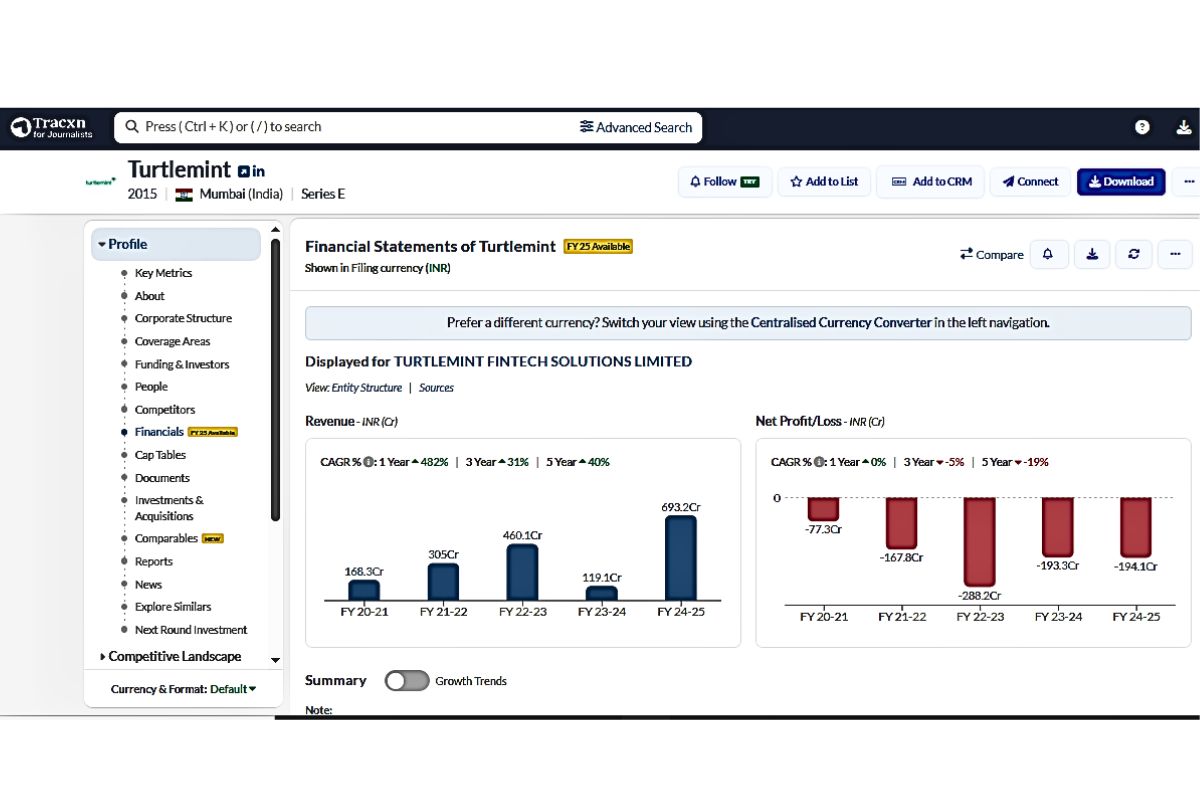
For the nine months ended December 31, 2025, the company reported a loss of ₹187.39 crore, compared to a loss of ₹154.66 crore in the same period the previous year; meaning the loss actually widened year-on-year in the most recent reporting period, even as revenue grew. The company’s net worth has been steadily eroding: it stood at ₹7,435 million (₹743.5 crore) in FY23, fell to ₹4,105 million (₹410.5 crore) in FY25, and dropped further to ₹2,957 million (₹295.7 crore) by the nine-month mark in FY26.
Return on Net Worth (RoNW) deteriorated sharply to negative 47.29% in FY25, meaning the company is destroying nearly half its net worth in losses every year, not generating returns on it. The company has reported negative operating cash flows in 9M FY26, 9M FY25, and each of the last three fiscal years.
For a retail investor, this combination, shrinking net worth, negative operating cash flow, and a widening loss in the most recent period, is precisely the kind of detail that a glossy “fastest-growing insurtech” narrative tends to gloss over.
The Single Biggest Risk: Why IRDAI Holds the Company’s Fate in Its Hands
If there’s one risk factor every retail investor needs to understand before buying into this IPO, it’s this. Turtlemint has already lived through a regulatory decision that wiped out the vast majority of its revenue almost overnight, and it could happen again.
Here’s the backstory. Before Fiscal Year 2024, Turtlemint Fintech Solutions (the listed parent entity) did not actually hold the insurance broking license. That license sat with a separate company, Turtlemint Insurance Broking Services Private Limited (TIB), which, crucially, was owned not by the listed company but directly by co-founder and promoter Dhirendra Nalin Mahyavanshi. TIB held the actual IRDAI license (received April 3, 2014) and ran the real commission-earning broking business.
The listed parent entity, instead, earned the overwhelming majority of its income from something different: “marketing fees” paid by insurance companies for advertising and promotional activities. In FY23, a staggering 88.05% of the parent’s revenue (₹369.75 crore out of ₹419.92 crore) came from these marketing fees alone, not from insurance commissions.
Then, in Fiscal 2024, IRDAI revised its Expense of Management (EOM) regulations, replacing the older commission-cap framework with new Payment of Commission Regulations and overall limits on how much insurers could spend on “management expenses” — a category that includes marketing payouts. Insurers responded exactly as you’d expect: they slashed discretionary marketing budgets first. The effect on Turtlemint was immediate and brutal. The company’s marketing fee income collapsed to ₹42.17 crore in FY24 and effectively to zero by FY25 — wiping out roughly 81% of the company’s previously reported revenue in a single year, and according to some analyses, nearly 90% of standalone income within two years.
Faced with an existential collapse of its core revenue line, Turtlemint restructured. On May 8, 2024, the listed company acquired TIB, the entity holding the actual broking license and the commission income from its own promoter, Dhirendra Nalin Mahyavanshi. The parent company bought 75.14% of TIB at ₹68 per share (approximately ₹104.9 crore), then moved to 100% ownership through a subsequent buyback.
This is formally disclosed as a related-party transaction in the prospectus, and it is the reason the company’s reported financials look so erratic across years — the “explosive growth” in FY25 isn’t organic growth of the old business; it’s a wholesale replacement of a dead revenue stream (marketing fees) with a new one (commissions from TIB), bolted onto the parent’s books through an acquisition from the founder himself.
Because of this restructuring, the prospectus itself states that the company has “a limited consolidated operating history through which its overall performance can be evaluated,” and explicitly warns that the unaudited proforma financial information included in the document, which restates prior years as if TIB had always been part of the company, is presented “solely for illustrative purposes” and “may not be indicative of future operating performance.” That is the company’s own lawyers telling you, in writing, not to over-rely on the very numbers used to justify the growth story.
Why this matters for the IPO: the regulatory exposure has not gone away, but it has simply moved. Turtlemint’s revenue is now overwhelmingly dependent on insurance commissions (98.9% of its top line in H1 FY26, up from 95.8% the year before), the very category that IRDAI has just been handed sweeping new powers over. The Sabka Bima Sabki Raksha Act, 2025 has granted IRDAI explicit statutory authority to cap commissions directly, not just management expenses, but commissions themselves.
In other words, the precise mechanism that destroyed roughly 90% of the company’s old revenue model (a regulatory cap on insurer payouts) can now be pointed directly at the new revenue model. Any future tightening, on motor insurance commissions specifically, on PoSP payouts, on digital distribution fees generally, could replicate the FY24 shock, except this time there would be no convenient related-party acquisition left to paper over the gap, because TIB’s commission income is now the company.
Beyond commission caps, the company also faces structural concentration risk that compounds this exposure: in the nine months ended December 2025, 72.47% of Turtlemint’s operations revenue came from just its top 10 Insurer Partners, and nearly 30% of its platform premium (excluding enterprise business) was concentrated in just two states, Maharashtra and Gujarat. A regulatory or commercial disruption affecting even a handful of these insurer relationships, or a state-specific issue, would disproportionately hit the company’s books.
Other Risk Factors Worth Knowing
Beyond the IRDAI overhang, the prospectus discloses several other risks that retail investors should weigh:
A historical cyberattack and data breach. TIB, the subsidiary that now anchors the company’s entire business, suffered a cyberattack in FY20 that resulted in sensitive customer data being compromised and leaked onto the dark web. More troublingly, the same compromised dataset resurfaced for sale on the dark web again in FY23 — three years later, suggesting the original breach’s fallout was neither fully contained nor resolved quickly. The company has since obtained SOC 2 Type II compliance certification, a recognized data-security standard, but for a platform now expanding into higher-trust financial products like mutual funds and credit cards, a recurring historical breach is a legitimate reputational and operational overhang that investors should factor in.
Losses at the subsidiary level. Both TIB and Turtlemint Mutual Funds Distributors Private Limited (TMF), the company’s two operating subsidiaries, have themselves incurred losses historically. Since virtually the entire group’s revenue now flows through these subsidiaries, continued losses at that level directly threaten the parent’s consolidated financial position.
A low-margin, agent-dependent cost structure. Roughly 70% of the company’s costs go toward acquiring and retaining its Digital Partner network — essentially, the commissions and incentives paid to the human advisors who do the actual selling. This creates a structural problem: to grow premium and revenue, Turtlemint generally has to pay its agent network more, which means its biggest cost line rises roughly in step with its biggest revenue line. That leaves limited operating leverage — the kind of built-in efficiency gain that usually lets a scaling tech platform’s profits grow faster than its revenue. Here, scaling revenue hasn’t meaningfully narrowed losses, and the underlying mechanics suggest it may continue to be difficult to do so.
No formal trading history. As the prospectus itself notes under “Risks in Relation to the First Offer,” this is the company’s first public issue, so there has been no formal market for its shares before now. The price band is based on the company’s own assessment of demand through the book-building process — not on any independent, pre-existing market valuation — and the prospectus explicitly cautions that no assurance can be given regarding an active or sustained trading market, or the price at which shares will trade after listing. This is standard boilerplate in every Indian IPO, but it is worth taking literally rather than as a formality: a successful-looking anchor book does not guarantee post-listing stability.
Where Is the IPO Money Actually Going?
This is where the prospectus gets specific, and it’s worth reading closely, because not all of the ₹882.67 crore being raised goes to the company.
The total offer comprises two distinct components:
- Fresh Issue: ₹660.72 crore (43.5 million new equity shares) — this money goes directly to the company’s balance sheet.
- Offer for Sale (OFS): ₹221.95 crore (up to 14.6 million existing shares) — this money goes entirely to existing shareholders who are selling their stakes. The company receives none of this.
According to the Red Herring Prospectus, the net proceeds from the fresh issue only are earmarked as follows:
- ₹25.64 crore — Cloud and server-related infrastructure, to strengthen the technology platform and operational scalability
- ₹193.04 crore — Salary expenditure for the company’s technology and product development teams
- ₹39.07 crore — Marketing initiatives, aimed at brand awareness, customer acquisition, and expanding the Digital Partner network
- ₹43.08 crore — Lease payments for existing properties of the company and its wholly owned subsidiary, TIB
- ₹128.64 crore — Investment into subsidiary TIB specifically to fund its working capital requirements
- The remainder — Funding inorganic growth through unidentified future acquisitions, broader strategic initiatives, and general corporate purposes
A few things are worth flagging here for the retail investor. First, the single largest identified line item — ₹193.04 crore, nearly 29% of the entire fresh issue — is going toward employee salaries in technology and product teams. That’s not unusual for a tech platform, but it does mean a substantial chunk of “growth capital” is effectively funding ongoing operating costs rather than new infrastructure or expansion.
Second, ₹128.64 crore is being funneled into TIB for working capital — the same subsidiary that the parent acquired from its own promoter less than two years before this IPO, and the same subsidiary that anchors virtually the entire group’s commission revenue and regulatory exposure. Third, a meaningful portion of the raise is reserved for acquisitions that have not yet been identified — meaning investors are being asked to trust management’s future capital allocation decisions on deals that don’t exist yet.

The Offer for Sale: Who Is Selling, and How Much
The Offer for Sale component deserves its own scrutiny, because it tells you who already holds stakes in the business and how eager they are to cash out at the IPO price.
The OFS of up to 28,608,992 equity shares (aggregating to the ₹221.95 crore figure once priced) is split across three categories of sellers, as disclosed in the prospectus:
- Promoter Selling Shareholders — up to 4,323,218 equity shares, sold by the company’s two co-founders themselves:
- Anand Rohidas Prabhudesai: up to 2,112,305 shares, at a weighted average acquisition cost of just ₹0.12 per share
- Dhirendra Nalin Mahyavanshi: up to 2,210,913 shares, at a weighted average acquisition cost of ₹3.86 per share
- Investor Selling Shareholders — up to 23,752,327 equity shares, sold by a long list of venture capital and institutional investors who backed the company across its funding history, including:
- Nexus Ventures IV, Ltd.: up to 8,241,718 shares (acquisition cost ₹17.29/share)
- Peak XV Partners Investments V (formerly SCI Investments V, the renamed Sequoia India entity): up to 7,921,344 shares (acquisition cost ₹21.11/share)
- Jungle Ventures III Investment Holding Pte. Ltd.: up to 2,299,225 shares (acquisition cost ₹94.90/share)
- Nexus Ventures VI Holdings, LLC: up to 902,089 shares (acquisition cost ₹252.79/share — the highest acquisition cost among disclosed sellers)
- GGV VII Investments Pte. Ltd.: up to 1,191,893 shares (acquisition cost ₹80.94/share)
- Vistra (ITCL) India Ltd – Trustee – Blume Ventures Fund 1X: up to 1,194,060 shares (acquisition cost ₹93.52/share)
- Catalyst Trusteeship Limited – Trustee – Blume Ventures (Opportunities) Fund IIA: up to 726,353 shares (acquisition cost ₹39.86/share)
- Individual Selling Shareholder — up to 533,447 equity shares, sold by Kunal Shah (the fintech entrepreneur and CRED founder, who held a personal stake), at a negligible acquisition cost.
What should a retail investor take from this list? The disparity in acquisition costs is striking, the promoters acquired their shares for a few rupees or less, while later-stage venture investors like Nexus Ventures VI paid over ₹250 per share. At a listing price of ₹144–152, the venture investors who came in earliest are sitting on enormous paper gains; some who entered in later funding rounds at higher valuations are exiting closer to, or even somewhat below, their entry cost, depending on the exact round.
This is normal venture-capital lifecycle behavior, funds need to return capital to their own investors eventually, and an IPO is the most common exit route. But it is also worth noting, as some market commentary has highlighted, that the two founders together hold a combined pre-offer stake of only around 17% on a fully diluted basis, and both are selling down further through this OFS. A founding team reducing an already modest ownership stake in a business that has never turned a profit is a data point worth weighing — not as a verdict on the company’s prospects, but as one more fact in the mosaic that retail investors are entitled to consider before deciding whether to participate.
The Anchor Book and Market Reception
Ahead of the public subscription, Turtlemint raised ₹397.20 crore from 32 anchor investors on June 18, 2026, allotting shares at ₹152, the top end of the price band. The anchor list included recognizable institutional names such as ICICI Prudential Equity & Debt Fund, BNP Paribas Financial Markets, Mirae Asset Multicap & Aggressive Hybrid Funds, Amansa Holdings, Border to Coast Emerging Markets Equity, and Edelweiss Mutual Fund, among others.
Despite this seemingly solid anchor demand, brokerage opinion on the issue has been genuinely split — not a uniform “buy” chorus. Some brokerages, such as SMIFS, have recommended subscribing, while others, including Swastika Investmart, have issued an “Avoid” rating. Grey market premium ahead of listing has also stayed fairly muted, reportedly hovering around just over 1% over the issue price as of the day before subscription opened — not the kind of frothy grey-market enthusiasm that typically accompanies IPOs with universally positive sentiment.
The Bottom Line for Retail Investors
None of this is to say Turtlemint is destined to fail, or that its business model is fundamentally broken — it operates in a genuinely large and growing market (India’s digital insurance distribution opportunity is estimated by industry consultancy Redseer at roughly ₹3.1 trillion in FY25, growing toward ₹5.3–5.8 trillion by FY30), and it holds a real leadership position in the PoSP distribution niche. But an IPO prospectus exists precisely so that ordinary investors don’t have to take a company’s growth story on faith.
Read together, the risk factors here tell a fairly coherent story: a business whose previous revenue model was wiped out almost entirely by a single regulatory decision, which restructured around its founder’s own related-party entity to survive, whose new revenue model sits under a regulator that has just been handed even broader powers to cap exactly the income stream the company now depends on, whose net worth has been steadily eroding, whose cash flow remains negative, and whose own founders are reducing an already-modest ownership stake through the very offering being marketed to the public.

As with any IPO, the responsible move isn’t to blindly subscribe because of brand recognition or anchor investor names, nor to blindly avoid it because risk factors exist — every prospectus has them. It’s to read the specific risks, weigh them against the price being asked, and make an informed decision rather than a hyped one. That’s not a financial recommendation; it’s simply what the words “risk factors,” printed in bold on page 42 of every Indian prospectus, are there for.
This article is for general informational purposes only and does not constitute investment advice. Readers should read the full prospectus and consult their own judgment or a qualified financial advisor before making any investment decision.