Amrapali, Sureka Group And The Missing Money. Why Did The Supreme Court Order The Sureka Group To Deposit ₹167 Crore In The Amrapali Case? Who Will Answer For The Homebuyers Still Waiting?
Thousands of homebuyers are still waiting for homes promised by Amrapali Group, while questions over their money continue to surface. From a Supreme Court order directing Sureka Group-linked entities to deposit ₹167 crore to fresh ED asset attachments, the case raises a pressing question: where is the money, and who will answer?

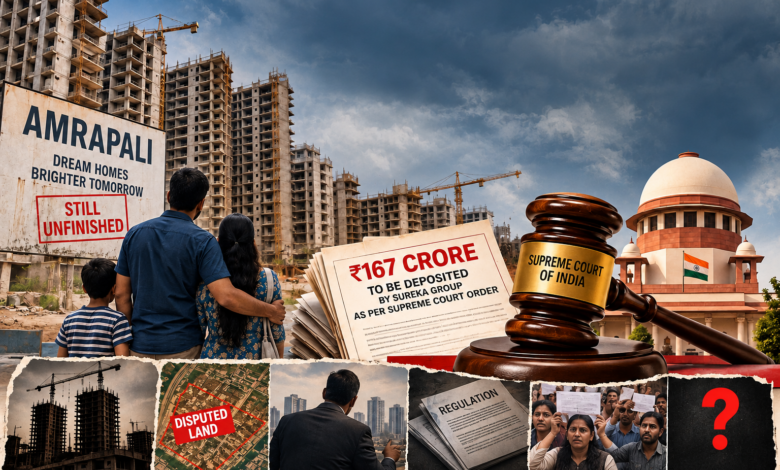
For thousands of homebuyers in Noida and Greater Noida, buying a flat from the Amrapali Group turned into a long wait for a home they had already paid for. Projects that promised possession within three years remained incomplete for years, leaving buyers caught between mounting financial commitments and uncertain delivery dates.
The scale of the problem was considerable. Amrapali had proposed around 42,000 flats across its housing projects, with buyers investing their savings in the hope of owning a home. Instead, many found themselves dealing with delayed construction, disputes over possession and questions about the money they had paid.
The problem went beyond unfinished buildings. As complaints reached the courts, concerns emerged over how the group had handled homebuyers’ funds and whether the money collected for construction had been used for other purposes.
The case eventually exposed a wider set of questions involving the group’s management, related companies, financial transactions and the authorities responsible for overseeing its projects.
The Sureka Group would emerge as one part of this wider story, with transactions involving associated companies coming under scrutiny. The Supreme Court’s subsequent direction requiring certain companies and individuals to deposit ₹167 crore brought that connection into sharper focus.
But the central issue remains larger than any single company or financial order. Years after the crisis came before the courts, the Amrapali case continues to raise two basic questions: where did the money go, and when will the remaining homebuyers finally get their homes?
How Amrapali Group’s Troubles Came To Light
Founded in 2003, the Amrapali Group grew into a prominent real estate developer, building its business around residential projects in the National Capital Region. Its brochures promised modern housing and amenities, with possession often assured within 36 months. But as projects fell behind schedule, buyers began raising complaints and seeking legal intervention.
The dispute gathered momentum as homebuyers challenged the delays and questioned the group’s handling of their investments. In 2017, insolvency proceedings were initiated against Amrapali Infrastructure following a petition by Bank of Baroda over unpaid dues. Buyers feared that the insolvency process would leave them with little control over the fate of their homes and took their concerns to the Supreme Court.
In 2018, the Court ordered an independent forensic audit of the group’s accounts. The auditors examined transactions dating back to 2008 and reported serious irregularities, including transfers of funds between group companies, questionable expenses and payments that required recovery. The findings raised concerns that money collected from buyers had been used for purposes other than completing the projects for which it was paid.
On July 23, 2019, the Supreme Court delivered a landmark judgment. It cancelled the Amrapali Group’s RERA registration and the relevant land leases, appointed a court receiver and directed NBCC, a government-owned construction company, to complete the stalled projects and hand over the flats. The Court also directed the Enforcement Directorate to investigate suspected money laundering and other alleged violations, while ordering companies and individuals identified in the forensic audit to refund or deposit recoverable amounts.
The judgment marked a major intervention in the crisis. It offered homebuyers a route towards completion of their homes, but it also opened a much wider process of examining the group’s financial dealings and identifying those from whom money could be recovered.
The Alleged Diversion Of Homebuyers’ Money
The forensic audit ordered by the Supreme Court examined the accounts of Amrapali and its associated companies, including transactions with entities linked to the Sureka Group. The findings raised concerns about whether funds collected from homebuyers had been diverted through related companies and transactions that could not be adequately justified.
The Supreme Court’s July 2019 judgment recorded allegations of substantial diversion of funds and referred to transactions involving multiple companies. The forensic auditors also identified payments and transfers that they recommended should be recovered from the entities concerned. These included payments to Sureka-linked companies and a donation of ₹13.44 crore to Sureka Public Charitable Trust, which the auditors recommended recovering from Jotindra Steel & Tubes Ltd.
The questions extended to payments for construction materials and other services. In July 2020, the Supreme Court observed that supplies and services billed by Jotindra Steel & Tubes and Mauria Udyog, valued at ₹321 crore and ₹128 crore respectively, appeared prima facie bogus. This was a serious observation arising from the forensic audit, rather than a final criminal conviction of the companies or their directors.
The ED subsequently investigated alleged money laundering linked to the transactions. Its case concerns the alleged routing of homebuyers’ funds through shell companies and purportedly fraudulent transactions, including payments described as purchases of construction materials.
The central issue is whether the money collected for building homes was used for that purpose. Establishing the amount involved, identifying the companies that received the funds and determining what can be recovered remain important parts of the proceedings.
How The Sureka Group Became Part Of The Case
The Sureka Group’s connection to Amrapali came under scrutiny because of its business relationships with the developer and the movement of money between associated companies. The Supreme Court-appointed forensic auditors examined transactions involving Jotindra Steel & Tubes Ltd, Mauria Udyog Ltd and other related entities. They also reported that Sureka-linked individuals had been partners in various Amrapali projects and authorised signatories on bank accounts of Amrapali companies.
The matter led to a significant order from the Supreme Court in 2019. On October 14 and December 2, the Court directed Jotindra Steel & Tubes, Mauria Udyog, associated companies and directors Navneet Kumar Sureka and Akhil Kumar Sureka to deposit ₹167 crore. The amount was linked to transactions examined during the forensic audit and treated by the Court as money that needed to be returned in the interest of homebuyers
The response to that order is important. According to company filings, an application was submitted to the Supreme Court in December 2019 seeking acceptance of title deeds for immovable properties belonging to Sureka family members and associated companies as security.
The properties were valued at approximately ₹208.31 crore in the filing. A June 2026 company disclosure continued to describe the matter as pending before the Supreme Court. This means (we need to distinguish the original direction to deposit money from the subsequent offer of property documents); the two are not the same as proof that ₹167 crore was paid in cash.
The connection returned to the spotlight in January 2026, when the Enforcement Directorate provisionally attached properties belonging to Mauria Udyog, including office premises and factory land and buildings, valued at ₹99.26 crore.
The agency alleged that ₹110.39 crore of homebuyers’ money had been diverted to the company through transactions involving construction materials and related entities. It said the original proceeds were no longer traceable and that the properties were being attached to secure an equivalent value under the Prevention of Money Laundering Act.
These developments explain why the Sureka Group is central to the Amrapali case. The Supreme Court’s order, the company’s subsequent application and the ED’s later attachment are separate steps in a longer process of establishing the money trail and securing assets. The key question now is what has actually been recovered and how much of it can ultimately help resolve the homebuyers’ claims.
The ED Investigation And The Continuing Money Trail
The Enforcement Directorate’s investigation has continued to uncover assets that it believes are linked to the alleged diversion of Amrapali homebuyers’ money. Its actions have focused not only on the original developers but also on companies and individuals allegedly connected to the transactions.
As mentioned above – in January 2026, the ED provisionally attached properties belonging to Mauria Udyog, a Sureka Group company, valued at ₹99.26 crore. The agency alleged that ₹110.39 crore collected from Amrapali homebuyers had been diverted to the company through transactions presented as purchases of TMT bars and other construction materials. The ED said the original funds were no longer traceable and that the properties were attached to secure equivalent value under the Prevention of Money Laundering Act.
In October 2026, the agency took another step by provisionally attaching a property in Delhi’s Maharani Bagh, valued at ₹54.71 crore. The property is registered in the name of Surbhaee Advertising Pvt Ltd. According to the ED, funds allegedly diverted from Amrapali were routed to the company, including through transactions involving family members of former Amrapali managing director Anil Kumar Sharma. The agency said the money was used in connection with the property.
NBCC, Unfinished Homes And Delayed Possession
The Supreme Court’s intervention was intended to give Amrapali homebuyers a way out of years of uncertainty. NBCC was tasked with completing the stalled projects, while a court-appointed receiver was put in charge of overseeing the process and facilitating the transfer of homes to buyers.
Progress has been made, but the task remains unfinished. At a September 2026 hearing, homebuyers told the Supreme Court that 33,250 flats had been constructed and possession handed over to 22,350 buyers, leaving another 10,900 still waiting. These figures were submissions made on behalf of the buyers, as reported in the media.
Construction alone has not resolved every problem. Buyers may still need completion or occupancy certificates, no-objection certificates, registered agreements and physical handover of keys. The Court Receiver’s office continued issuing notices in 2026 to buyers awaiting possession and documentation, while also asking apartment owners’ associations to complete registration and take responsibility for maintenance and management.
The process also depends on coordination between NBCC, the receiver, banks and the Noida and Greater Noida authorities. Missing approvals and unresolved documentation can delay handover even where construction is substantially complete.
For buyers, the distinction is straightforward: a completed flat is not necessarily a home they can legally occupy. Until construction, approvals and possession are all settled, the consequences of the original delays continue.
Why Recovery And Accountability Remain Difficult
The Amrapali case now involves two major tasks: recovering money allegedly diverted from homebuyers and completing the remaining homes. Both require coordination across multiple companies, investigating agencies, courts and public authorities.
The scale of the financial gap remains a concern. In September 2026, the Supreme Court noted that the ED had provisionally attached assets worth ₹283 crore, compared with ₹5,619 crore invested by more than 46,000 homebuyers.
The buyers’ counsel also told the Court that the forensic audit had identified ₹744.81 crore as recovered, while substantial amounts remained due from former promoters, directors and third parties.
The Court directed the ED to prioritise asset recovery and asked the concerned PMLA courts to consider the sale of attached assets expeditiously. It scheduled a further hearing for October 26, 2026, to review progress.
The continuing challenge is turning years of legal proceedings into practical results. For homebuyers, success will ultimately mean money recovered where due, the remaining homes completed and the necessary documents delivered.
The Last Bit, Who Will Answer For The Homebuyers?
The Amrapali case has seen years of litigation, forensic audits, criminal investigations and court-directed construction. Yet the outcome that matters most to buyers remains unfinished: receiving their homes, obtaining the necessary documents and seeing money recovered wherever the courts establish that it is due.
The Sureka Group’s role adds another important dimension to the case. The Supreme Court’s ₹167 crore direction, the subsequent application involving property security and the ED’s later attachment of Mauria Udyog assets all raise questions about how the money trail will ultimately be resolved.
But the responsibility does not end with the companies under scrutiny. The investigating agencies must establish the alleged transactions and pursue recoveries; the relevant authorities must clear legitimate obstacles to possession; and the agencies overseeing construction must ensure that the remaining work is completed.
For thousands of homebuyers, the measure of success is not the number of orders passed or assets attached. It is whether those actions finally deliver the homes they paid for.